

Arado Ar E.381 Mini fighter
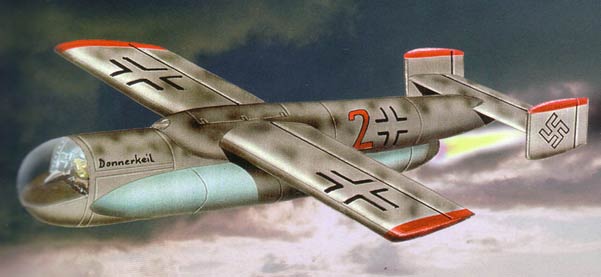 |
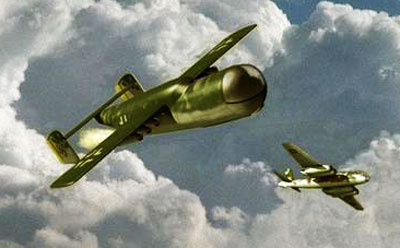
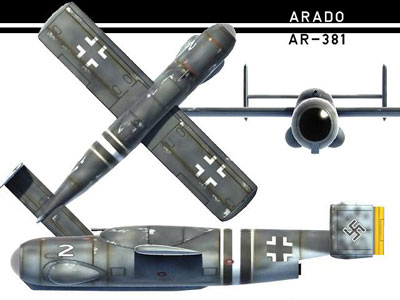
Artwork by Ingolf Meyer |
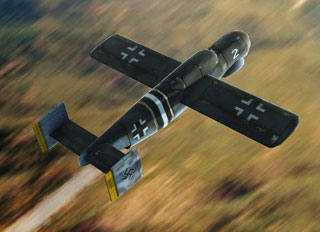
In the summer of 1944, the Ar E.381 was designed to be carried
under the fuselage of an Ar 234 C-3 jet bomber. Due to insufficient
ground clearance, Arado was forced to adopt a prone position for
the pilot. Because of the cramped arrangement, the pilot was unable
to leave the cockpit once the Ar E.381 was attached to the Ar
234's fuselage. The wing of this midget fighter possessed constant
chord and thickness and rounded wing tips .There was no space in
the narrow fuselage for the standard armament of two MK 108s,
six RZ 73 Rauchzylinder (smoke cylinder), but rather an improved
air-to-air rocket developed from the earlier RZ 65 was to be carried,
and two MG iSis installed in the fuselage were thought to be feasible.
In 1945, this armament proposal was canceled in favor of a single
MK 108 mounted behind the pilot's cockpit and containing forty-five
rounds of ammunition.
Arado Ar E.381
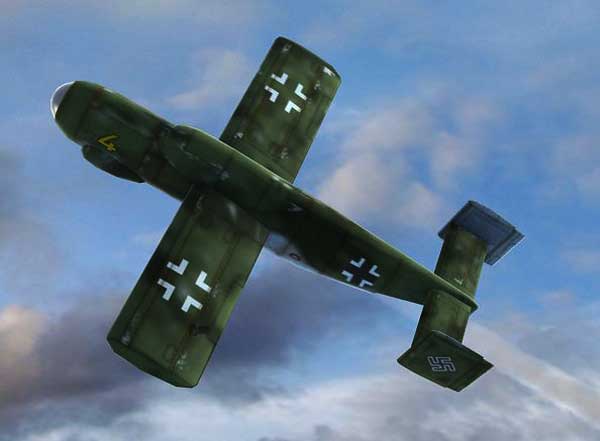
After climbing to 19,685 ft , within eight minutes or less, the carrier Ar 234 would release the midget fighter. The Ar E 381's pilot then dove toward his target igniting the HWK 509 B-1 rocket motor, and accelerated to a speed of about 560 mph. After a high-speed approach to its target, the attack would be made at close range, ensuring a higher degree of success.
Having completed his mission, the pilot had to either land the aircraft on its fuselage-mounted skid, or bail out if the aircraft had been damaged by enemy fire; although the heavily armored and small size of the Ar E 381 would have made it a difficult target. The first Ar E 381 design proposals had shortcomings, that required complete re-design of the fuselage. In particular, the cockpit entry hatch was moved from the fuselage top to the side. The HWK 509B-1 rocket motor that was mounted on the wooden tail was replaced by the HWK 509C-1 with two separate combustion chambers. the total take-off weight was only 2,545 lb !!
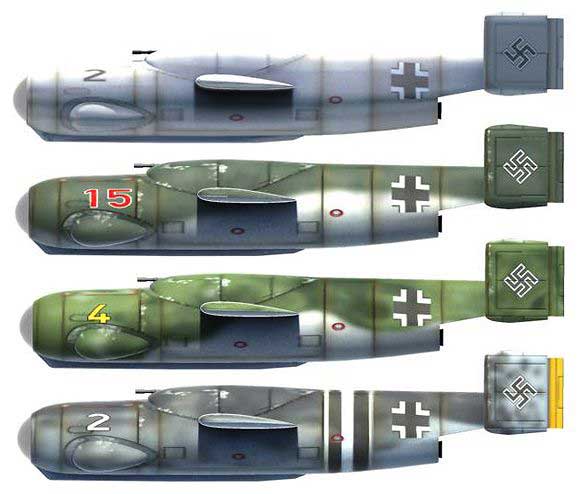
The E 381.02 proposal lay in the Bordjager category, whereby a self take-off was not intended from the outset. Such types, also known as parasite aircraft, were to have been attached to and air-launched from another aircraft in flight prior to reaching the target. The Ar F 381.02 was to have been attached to the ventral fuselage of an Ar234 C or D in place of the bomb load. Due to the low ground clearance, it had twin end-plate fins and rudders and housed the pilot in the prone position. Variants were drawn up, all featuring the same basic configuration. Armament consisted of a single MK 108 cannon housed in the raised dorsal fuselage aft of the cockpit and provision was made for a number of rocket projectiles fired from within the wing. Power plant was a 350kp thrust FMK 109-509 B liquid-propellant rocket motor. Landing was to have been on an extensible skid and a brake parachute was provided, the full-span ailerons assisting as landing flaps. The cockpit had 6mm thick armor plating, with auxiliary protection provided by a 20mm swiveling armor shield which had a clear vision panel for target aiming. Calculated performance data are not available, save that a speed of around 900km/h was expected to be attained in a dive.
 The first version had a circular cross-section fuselage, with a
small round window in the nose for the pilot's vision. Overall,
the entire fuselage was protected by a 5mm armored shell. The pilot
lay in a prone position, and the cockpit was very cramped. A removable
140mm (5.5 inch) armored glass screen was mounted in front of the
pilot. Two small bulges were located on the fuselage sides for the
pilot's elbows. Alongside the pilot's legs were two C-Stoff (one
component of the rocket fuel) fuel tanks and by his feet a single
T-Stoff fuel tank. The wings were straight and mounted mid fuselage,
with a stepped bulge above the wings which held the single MK 108
30mm cannon with 60 rounds. The rocket engine exhausted beneath
the tail unit which featured a twin fin and rudder setup. A retractable
skid could be lowered for landing and a drag parachute (ejected
from a hatch on the top rear fuselage) was also to be used upon
landing. The aircraft could
only be entered from a hatch above the cockpit, so the pilot had
to enter the E.381 before the aircraft could be attached to the
carrier Ar 234C-2 and had no way to escape in case of emergency.
The first version had a circular cross-section fuselage, with a
small round window in the nose for the pilot's vision. Overall,
the entire fuselage was protected by a 5mm armored shell. The pilot
lay in a prone position, and the cockpit was very cramped. A removable
140mm (5.5 inch) armored glass screen was mounted in front of the
pilot. Two small bulges were located on the fuselage sides for the
pilot's elbows. Alongside the pilot's legs were two C-Stoff (one
component of the rocket fuel) fuel tanks and by his feet a single
T-Stoff fuel tank. The wings were straight and mounted mid fuselage,
with a stepped bulge above the wings which held the single MK 108
30mm cannon with 60 rounds. The rocket engine exhausted beneath
the tail unit which featured a twin fin and rudder setup. A retractable
skid could be lowered for landing and a drag parachute (ejected
from a hatch on the top rear fuselage) was also to be used upon
landing. The aircraft could
only be entered from a hatch above the cockpit, so the pilot had
to enter the E.381 before the aircraft could be attached to the
carrier Ar 234C-2 and had no way to escape in case of emergency.
The second version was very similar to the first version of the Ar E.381. The overall dimensions were enlarged slightly, but the basic layout remained the same. The front canopy was enlarged, giving the prone lying pilot better vision out of the still cramped cockpit. A slight step still remained aft of the entry hatch atop of the forward fuselage, and a single MK 108 30mm cannon (45 rounds) was still mounted here, firing over the cockpit. The tail unit was similar, with the fins being slightly smaller and rounder. Landing was accomplished by means of a built-in landing skid and the same drag parachute, and the same means of entering and exiting the second version of the E.381 (via a hatch on top of the fuselage) remained from the first version.
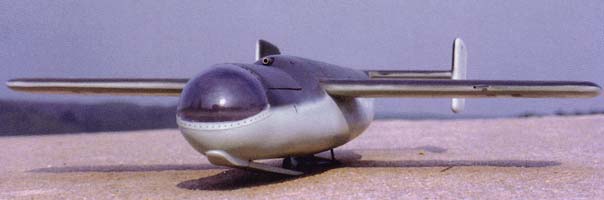
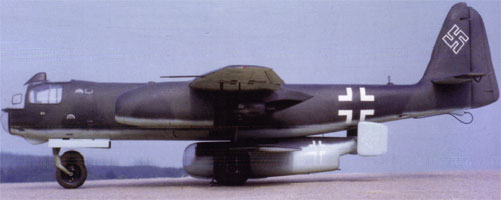 |
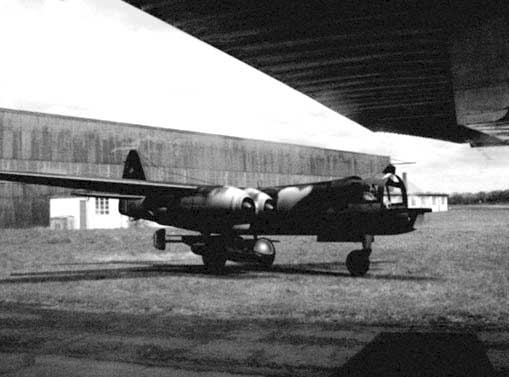
Above: Günter Sengfelder's
large scale model of the Ar E 381 midget rocket interceptor
attached to the underbelly of the Ar 234 C-3 jet bomber,
illustrates the central landing skid as well as the location
of the single MK 108 cannon above and to the rear of the
prone pilot. |
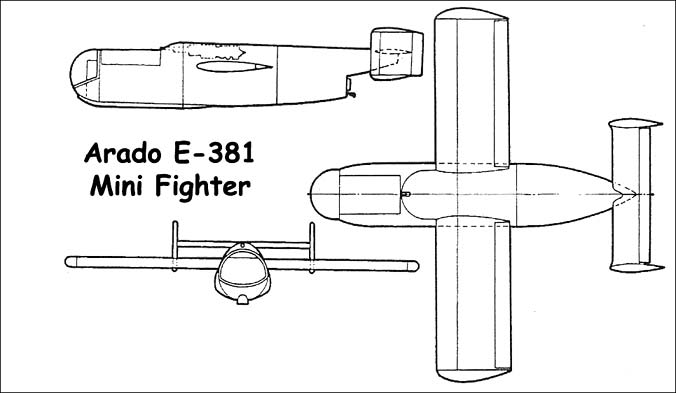
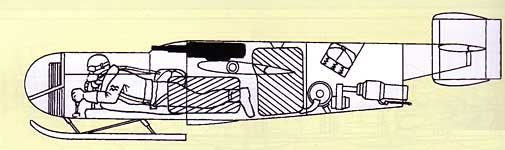 Ar-E381 Mini fighter cross section |
Specifications
 |
Length: 18.70ft Performance |
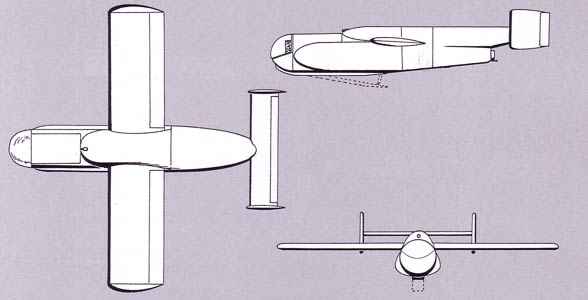
Arado Ar E381.02 version