

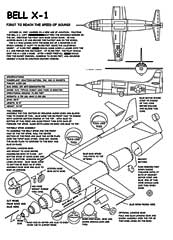
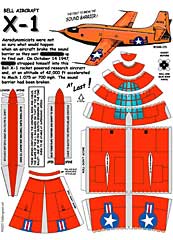
Bell-X1 - $$8.50
The Bell X-1, originally designated XS-1, was a joint NACA-U.S. Army Air Forces/US Air Force supersonic research project and the first aircraft to exceed the speed of sound in controlled, level flight. On October 14, 1947, Test Pilot 'X" did exactly that. (We've had to delete HIS NAME because HIS NAME has been copyrighted and can't be printed without buying a license or sumptin' per order of Mrs Yeager and lawyer!!

Bell X-1 Manned Rocket
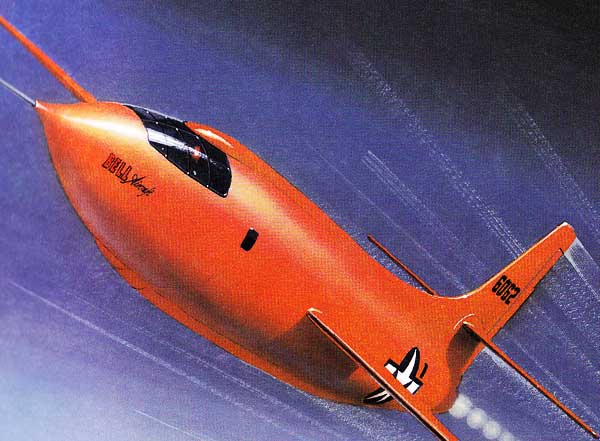
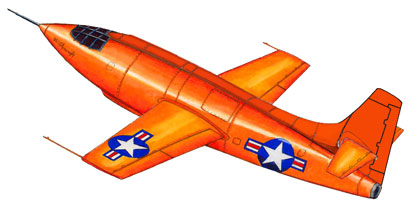 The name of the brave and highly decorated test pilot who flew this airplane has been deleted all through this web page because of COPYRIGHT REASONS.
Printing this model can be some special fun.. You can print it on
sheets of bright orange craft paper and get a really nice model.
BW version is available (only) on the (small size shown - 8 x 11
format) The large size is approximately 135% larger and on TWO sheets.
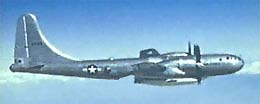
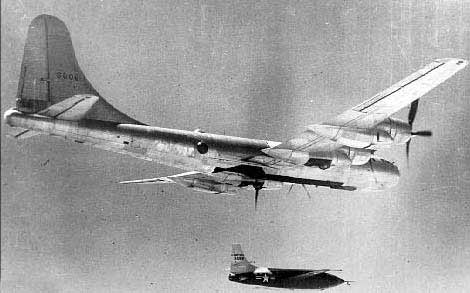
The Bell X-1 series aircraft were air-launched from a modified Boeing B-29 or a B-50 Super fortress bombers used its rocket engine to climb to its test altitude. It flew a total of 78 times. This particular craft is now on permanent display in the Smithsonian's
National Air and Space Museum in Washington, D.C. On October 14, 1947, the Bell X-1 became the first airplane to fly faster than the speed of sound. The X-1 reached a speed of 700 miles per hour, Mach 1.06, at an altitude of 43,000 feet. This was the highest velocity and altitude reached by a manned airplane up to that time.
This is the Bell X1 model that won the FG Modeling Madness (FGMM) 2010 best in class prize. Thanks to Håkan Hammarling for his entry !! |
|
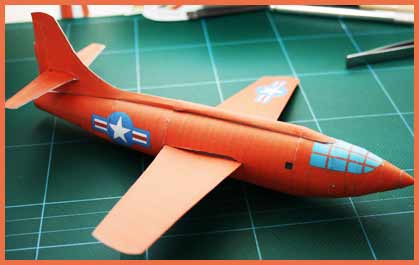 |
I chose the X1, because of it's history as being the first aircraft to break the sound barrier. I recommend it to intermediate beginners as it is a very simple construction, easy to build in flight mode, as I did. Something to really wet the beginner's appetite for more! -Håkan |
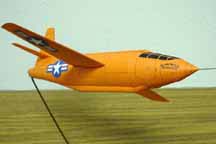
The models certainly have been getting better and better. I printed the Bell X-1 at the office with the Canon laser printer on photo glossy paper and it looks fabulous! I've got it about halfway assembled and it makes an amazing model. I may just have to find an IPMS meeting somewhere (maybe Albuquerque) to show it off. C. Severs
 You forget to model the broom handle in the X1 that the pilot
needed to close the hatch after busting some ribs the night
before while horse riding. Keith Fainges
You forget to model the broom handle in the X1 that the pilot
needed to close the hatch after busting some ribs the night
before while horse riding. Keith Fainges
Hats off to FG for adding the white NACA Bell X-1 to your growing collection of historic aircraft. When most people remember the Bell X-1, they think of the X-1 breaking Mach One for the first time on Oct 14, 1947, That is to say - one plane, one milestone, one flight, one pilot... and
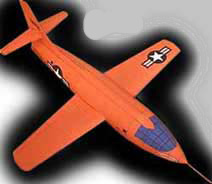 this much is is true.
 But a more complete way to think of the X-1 program is captured by the word "Dozens".
The half-dozen X-1s flew for a dozen years, with over two dozen different pilots, and hundreds of test missions. This year marks the 60th anniversary ( 5 dozen years) of that first Mach One flight. And by my quick count, there are at least a dozen different markings variations for those first X-1s - #'s 6062, 6063 and 6064 - including the white finned movie star from the Howard Hughes / John Wayne movie "Jet Pilot". So the re painters can have a good time- especially if they still have the old FG b&w pdf files.
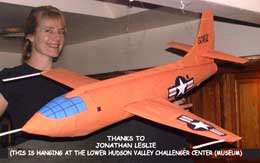
At this year's Forum Presentations at Oshkosh air show I shared a collection of video clips from the vault titled "The Bell X-1 and the NACA". During the show, we distributed over a thousand b&w photocopies of Tony Landis' gray scale repaint of the NACA's white X-1 6063. The NASA exhibit staff liked the overall effect of the finished model." Cam Martin
 |
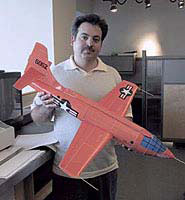 |
The Bell X-1 models above were probably from enlarged FG originals |
|
Bell X-1 Rocket
Purpose:
The Bell X-1 rocket aircraft was designed specifically
for research in the transonic speed range. Aircraft of the period,
including F-80 and F-84 Jets, were limited to Mach numbers near
0.8 and 0.85 and could reach these speeds only in hazardous dives. In reaching subsonic speeds, these aircraft were virtually uncontrollable
making it desirable to build a research aircraft which would be
slowed merely by cutting the engine. Advanced X-1 series emphasized
research in such areas as aerodynamic heating, pilot reaction
control systems, and problems of supersonic flight.
Description:
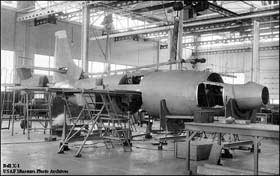 The bullet-shaped X-1 was propelled by a four-chambered, liquid-fueled
rocket engine: An improved version, the X-1A, featured turbo-driven
fuel pumps, nitrogen-pressure fuel feed, increased fuel capacity,
longer fuselage, and a nitrogen-pressurized cockpit modified for
improved visibility.
The bullet-shaped X-1 was propelled by a four-chambered, liquid-fueled
rocket engine: An improved version, the X-1A, featured turbo-driven
fuel pumps, nitrogen-pressure fuel feed, increased fuel capacity,
longer fuselage, and a nitrogen-pressurized cockpit modified for
improved visibility.
Significant occurrences:
The Air Force took over the flight test program from the
contractor on 27 July 1947 and although data accumulated during the first few flights indicated that the X-1 would not
break the sound barrier, The pilot on 14 October 1947
exceeded the speed of sound in level flight.
Later flights established the top speed of the X-1 at 967 mph and the maximum altitude attained was 73,000 feet. The second X-1 went to the NACA and after testing and modernizing in 1951 and 1954 was re designated the X-1E.
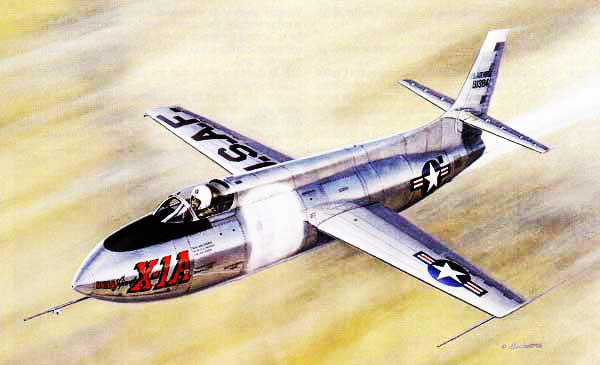
The third X-1 was destroyed by an explosion during contractor testing on a captive flight on 9 Nov. 1951. The X-1A made its first powered flight on 21 Feb. 1953; XXXX reached a speed of 1,650 mph in the aircraft on 12 Dec. 1953 and Major Arthur Murray attained an altitude of 90,000 feet in the craft on 4 June 1954. The plane was transferred to the NACA on 1 March 1955 but was destroyed in an explosion on 8 August 1955.
Contributions:
The X-1 became the first aircraft to exceed the
speed of sound in level flight and provided data on control, stability,
buffeting, and other aerodynamic phenomena associated with transonic
and supersonic flight. 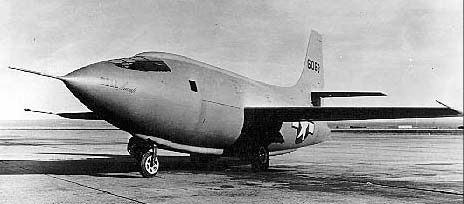
The X-1B was modified for investigation of aerodynamic heating and characteristics of reaction controls and during a three-year test program provided NACA with data on heat flow, effects of internal heat sources and sinks, and the effects of boundary-layer transition and aerodynamic interference. Research into reaction controls during the X-1B test series involved test flights at altitudes above 90,000 feet and paved the way for the hydrogen peroxide reaction system used in the X-15.
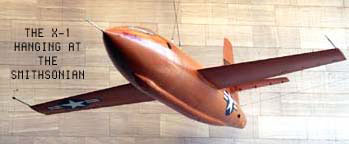 The XS-1 was developed as part of a cooperative program initiated
in 1944 by the National Advisory Committee for Aeronautics (NACA) and the U.S. Army Air Forces (later the U.S.
Air Force) to develop special manned transonic and supersonic research aircraft. On March 16, 1945, the Army Air
Technical Service Command awarded the Bell Aircraft Corporation of Buffalo, New York, a contract to develop three
transonic and supersonic research aircraft under project designation MX-653.
The XS-1 was developed as part of a cooperative program initiated
in 1944 by the National Advisory Committee for Aeronautics (NACA) and the U.S. Army Air Forces (later the U.S.
Air Force) to develop special manned transonic and supersonic research aircraft. On March 16, 1945, the Army Air
Technical Service Command awarded the Bell Aircraft Corporation of Buffalo, New York, a contract to develop three
transonic and supersonic research aircraft under project designation MX-653.
The Army assigned the designation XS-1 for
Experimental Sonic-i. Bell Aircraft built three rocket-powered XS-1 aircraft. The National Air
and Space Museum now owns the XS-1 #1, The XS-1 #2
was flight-tested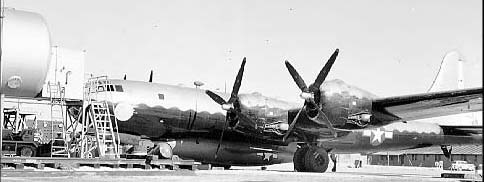 by NACA and later was modified as the X-1 Mach
24" research airplane. (The X-1 E is currently on exhibit
outside the NASA Flight Research Center, Edwards, California.)
by NACA and later was modified as the X-1 Mach
24" research airplane. (The X-1 E is currently on exhibit
outside the NASA Flight Research Center, Edwards, California.)
The X-1 #3 had a turbo pump-driven, low-pressure fuel feed system. This aircraft, known popularly as the X-1-3 Queenie, was lost in a 1951 explosion on the ground that injured its pilot. Three additional X-1 aircraft, the X-1A, X-1B, and X-1D, were constructed and test-flown. Two of these. the X-1A and X-1D, were also lost, as a result of propulsion system explosions. The two XS-1 aircraft were constructed from high-strength aluminum, with propellant tanks fabricated from steel. The first two XS-1 aircraft did not utilize turbo pumps for fuel feed to the rocket engine, relying instead on direct nitrogen pressurization of the fuel-feed system.
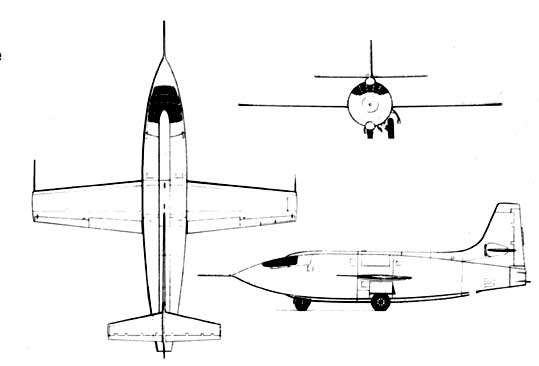
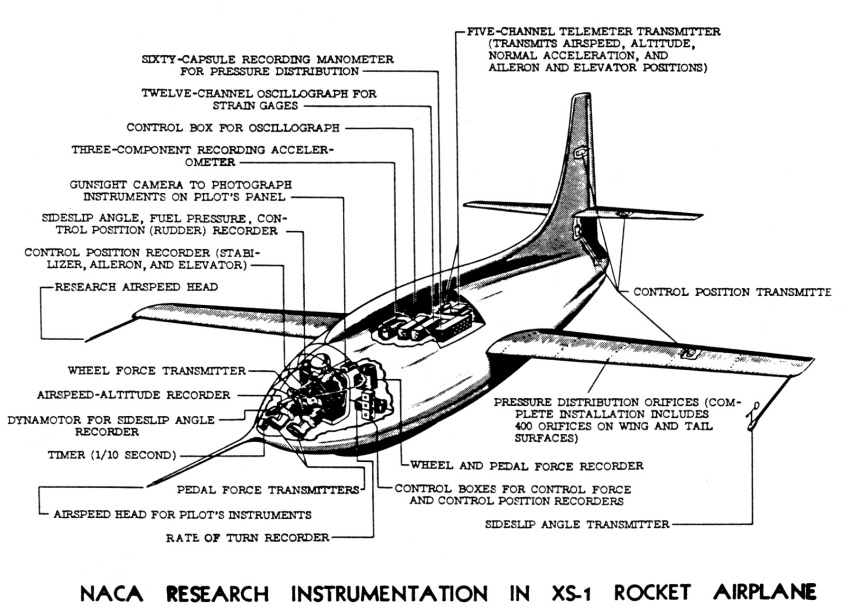
The smooth contours of the XS-1, patterned on the lines of a .50-caliber machine gun bullet, masked an extremely crowded fuselage containing two propellant tanks, twelve nitrogen spheres for fuel and cabin pressurization, the pilot's pressurized cockpit, three pressure regulators, a retractable landing gear, the wing carry-through structure, a Reaction Motors, Inc., 6.000-pound-thrust rocket engine, and more than five hundred pounds of special flight-test instrumentation.
Design Features:
\Many important structural and aerodynamic advances were first
employed in the Bell X-1, including extremely thin yet exceptionally
strong wing sections and a horizontal stabilizer that could be
adjusted up and down to improve control, especially at transonic
(near the speed of sound) speeds. Because of the stabilizer's
success, later transonic military aircraft were designed with
all moving The X-1's fuselage was shaped like a .50 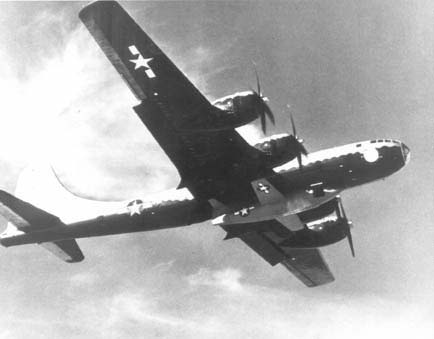 caliber bullet.
Even the windscreen was specially flared to retain the bullet
shape. The X-1 carried more than 500 pounds of
flight test instruments.
caliber bullet.
Even the windscreen was specially flared to retain the bullet
shape. The X-1 carried more than 500 pounds of
flight test instruments.
The X-1 (originally designated the XS-1 for Experimental Supersonic), a rocket-powered research aircraft, was a bullet-shaped airplane that was built by the Bell Aircraft Corporation, Buffalo, N.Y., for the U.S. Army Air Forces and the National Advisory Committee for Aeronautics (NACA).The mission of the X-1s was to investigate the transonic speed range (speeds from just below to just above the speed of sound) and, if possible, to break the "sound barrier." There were three X-1s built with the designations as follows: X-1-1 , X-1-2 , X-1-3, that were flown by eighteen pilots from 1946 to 1951.
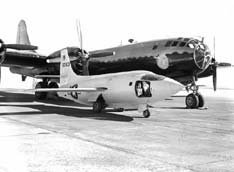
Though originally designed for conventional ground takeoffs, all X-1 aircraft were air-launched from Boeing B-29 or B-50 Super fortress aircraft. The performance penalties and safety hazards associated with operating rocket-propelled aircraft from the ground caused mission planners to resort to air-launching instead. Nevertheless, on January 5,1949, the X-1 #1 completed a ground takeoff from Muroc Dry Lake,
The maximum speed
attained by the X-1 #1 was Mach 1.45 at 40,130 feet, approximately
957 mph, during a flight by XXXX on March 26, 1948. On August 8,1949, Maj. Frank K. Everest, Jr.,
USAF, reached an altitude of 71,902 feet, the highest flight made
by the little rocket airplane. It continued flight test operations
until mid-1950, by which time it had completed a total of nineteen
contractor demonstration flights and fifty-nine Air Force test
flights.
The Bell Aircraft Corporation X-1 Sitting on the ramp at NACA High-Speed Flight Research Station with the Boeing B-29 launch ship behind . The B-29 was fondly referred to as "Fertile Myrtle". The painting near the nose depicts a stork carrying a bundle which is symbolic of the Mother ship launching her babe (X-1-2). The pilot access door is open to the cockpit of the X-1-2 aircraft. |
|
On August 26, 1950, Air Force Chief of Staff Gen. Hoyt Vandenberg
presented the X-1 #1 to Alexander Wetmore, then Secretary of the
Smithsonian Institution. The X-1, General Vandenberg stated, "marked
the end of the first great period of the air age, and the beginning
of the second. In a few moments the subsonic period became history
and the supersonic period was born." Earlier, Bell Aircraft
President Lawrence D. Bell, NACA scientist John Stack, and Air
Force test pilot XXXX had received the 1947 Robert J.
Collier Trophy for their roles in first exceeding the speed of
sound and opening the pathway to practical supersonic flight.
 FASTER THAN SOUND
Higher speeds brought their problems. Even the faster piston-engine fighters sometimes ran into trouble during high-speed dives, losing their wings or tails for no apparent reason. Designers knew that their enemy was the invisible, seemingly harmless air, which became so compressed by the speeding aircraft that it formed almost solid shock-waves that hammered the structure until it broke up.
The shock-waves form when airflow over any part of the aircraft's structure reaches the speed of sound, which is 760 mph at sea level, dropping to 660 mph above 36,000 ft. By sweeping back the wings of their aircraft and making them thinner, designers managed to delay the shock-wave effects and gain a few extra precious miles per hour; but many experts doubted that airplanes would ever be able to fly above the speed of sound and newspapers began to write about the "sound barrier". To discover if a specially-designed aircraft with a very powerful engine would be able to penetrate the barrier, the British government ordered a bullet shaped research monoplane from the Miles company. It then got cold feet and cancelled the project.
In the USA, work continued on a small rocket powered research
aircraft known as the Bell XS-1 (later X-1), intended for a 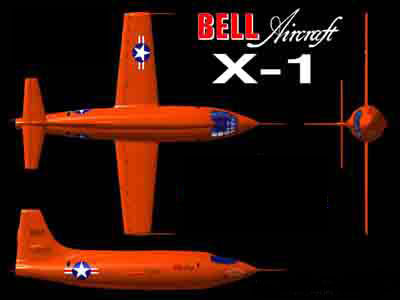 similar
purpose. The pilot chosen for the attempt to smash through the
sound barrier to supersonic speed was (( DELETED FOR COPYRIGHT REASONS)) who had no illusions about the hazards confronting him. Everything
about the program was strange and rather like science fiction.
To conserve fuel, it was even necessary to drop the X-I from a
converted bomber at a height of around 30,000 ft, instead of taking
off normally.
similar
purpose. The pilot chosen for the attempt to smash through the
sound barrier to supersonic speed was (( DELETED FOR COPYRIGHT REASONS)) who had no illusions about the hazards confronting him. Everything
about the program was strange and rather like science fiction.
To conserve fuel, it was even necessary to drop the X-I from a
converted bomber at a height of around 30,000 ft, instead of taking
off normally.
Each time he flew, XXXX approached a little nearer to the speed of sound. Eventually he reached a speed of Mach 0.94 (94 per cent of the speed of sound), and felt the aircraft bucking under the hammer blows of shock waves that would have smashed anything else in the air at that time. But he had complete confidence in the X-I's structure and finally, on October 14, 1947, he opened up the four-chamber rocket engine to full power for an all-out attempt to reach supersonic speed. Fighting to keep control, he watched the needle on the Mach meter swing past Mach .94, on to .96, .98 . . . suddenly, instead of getting worse, the hammering stopped. XXXX had become the first man to fly into the calmer conditions that lie beyond the "sound barrier". In doing so, he had proved that the barrier does not really exist.
By 1956, Britain's delta-wing Fairey Delta 2 research aircraft, powered by an ordinary jet-engine, was able to demonstrate that a properly-designed airplane can approach and pass the speed of sound with no more noticeable effect than a flicker of needles on the cockpit instruments as it does so. From that moment, it became only a matter of time..
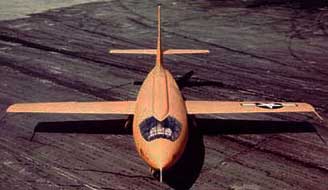 Front view of the X-1 |
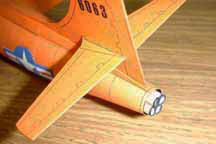 View of the rocket tail pipe on the Bell X-1 model |
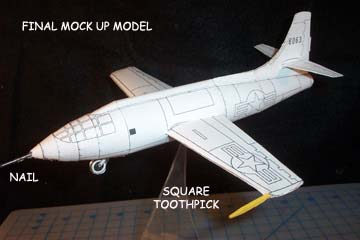 Final mock up of the Bell X-1 cardmodel |
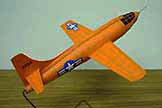 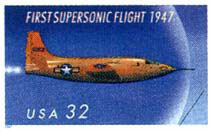 Bell X-1 cardmodel |
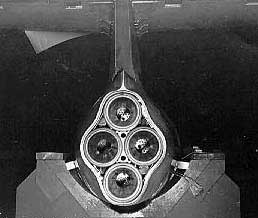 Bell X-1 aft end |
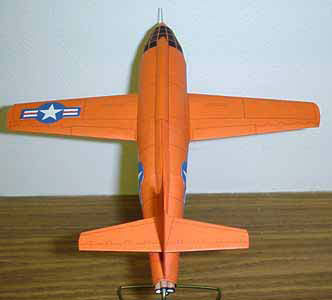 Bell X-1 cardmodel on stand |
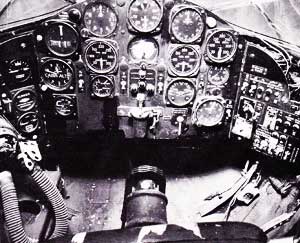 |
Cockpit of the Bell X-1. |
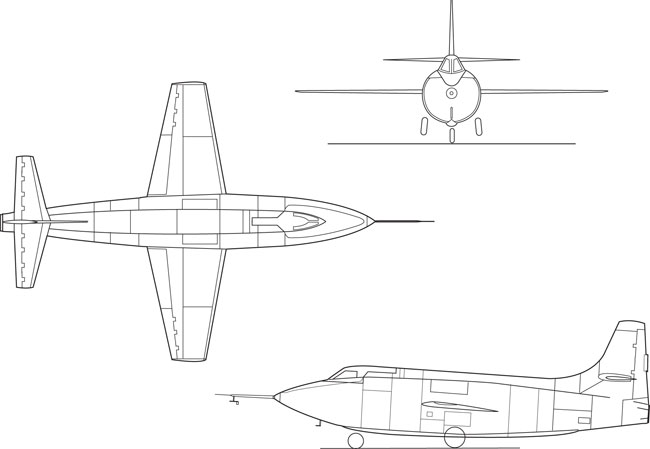
Specifications
| Length: 31 ft |
 |
||
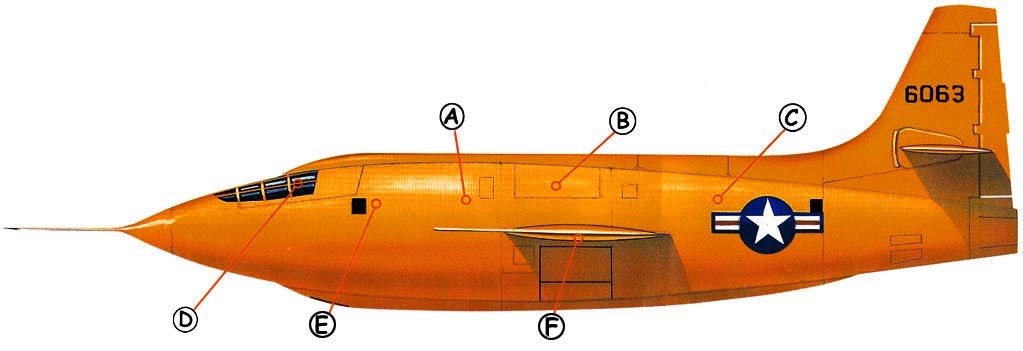
| A: The shape of the X 1 was based on that of the .50 caliber machine gun bullet, one of the few objects designers of the time knew to be stable at supersonic speeds. | B: Test and recording equipment was fitted in the central section | C: Another large tank contained the second component in the X-1's fuel mixture: 300 gallons of ethyl alcohol. |
| D: The original X-1 cockpit had a fixed canopy, the only access being through a small hatch in the starboard side. | E: The tank immediately behind the pilot contained 310 gallons of super-cooled liquid oxygen. | F: The X-1's thin, razor-edged wings were designed to dissipate shock at transonic speeds. |