

Brewster Buccaneer - $$5.50
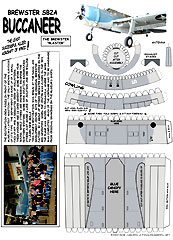
The Buccaneer was apparently a good design but in the hands of bumbling management and inexperienced in aircraft workers in bad production facilities is the sorry story of Brewster and it's dive bombers. This model, by Rob Carleen, is of the only remaining Brewster Buccaneer proudly displayed at the Naval Air Museum, Pensacola, Florida

Brewster SB2A Buccaneer & Bermuda (dive bomber)
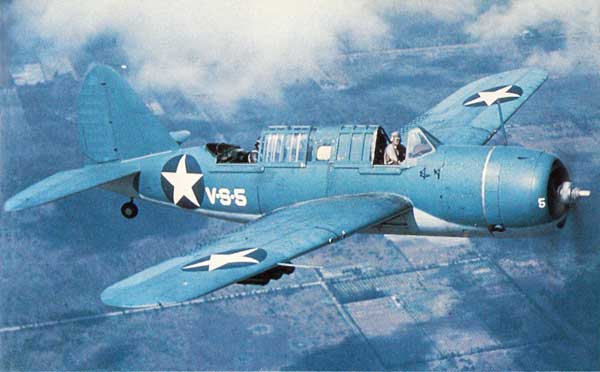
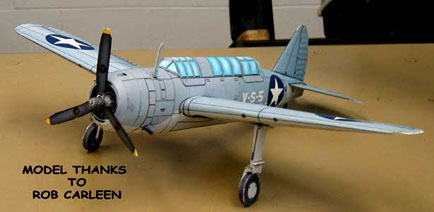
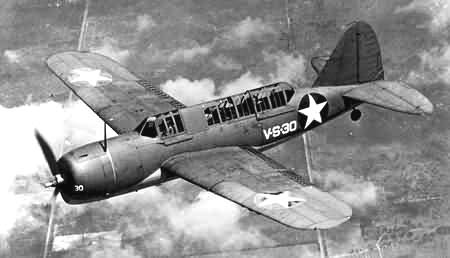
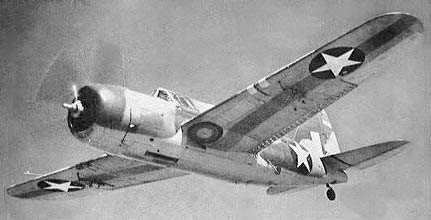
The Buccaneer dive bomber, was developed by Brewster in parallel with the Curtiss SB2C. The two aircraft looked very similar. Handling and production problems caused two years delay, and the USN had no need for a new dive bomber when the SB2A was finally available. Many were used as target tugs, others were scrapped straight from the production line.
Development of the SB2A Buccaneer dive-bomber was protracted, and by the time it was ready the US Navy had no need for more aircraft of this type. Used mainly for training, none saw combat and many were scrapped straight from the production line after orders were cancelled in 1943. Company publicity even before the first flight convinced several customers, including the British and Dutch, that the SB2A was a potent dive-bomber, but when evaluated by Boscombe Down, the Bermuda Mk I (as it was known in the UK) proved 'entirely unsuitable for combat operations'. The naval section of the UK main aircraft test center found it too heavy, underpowered and lacking maneuverability. Most of the 740 British examples became target tugs or were used only to train mechanics.
The SB2A was developed in parallel with the Curtiss SB2C Helldiver, a much better aircraft that went on to serve in the Pacific Theatre until the end of World War II. The Royal Navy tested five examples of the Bermuda at Boscombe Down (four dive-bombers and one in target-towing configuration) and quickly established that the aircraft was not carrier-capable. Of these, 450 were allocated to the RAF.
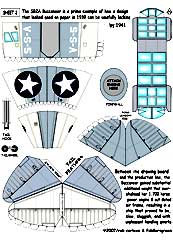
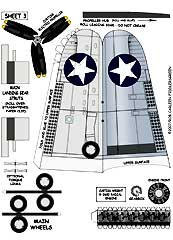
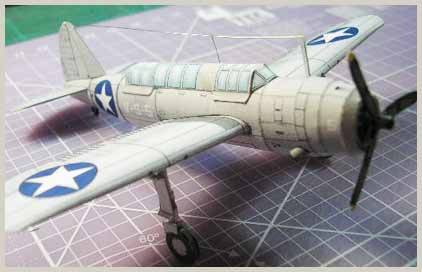
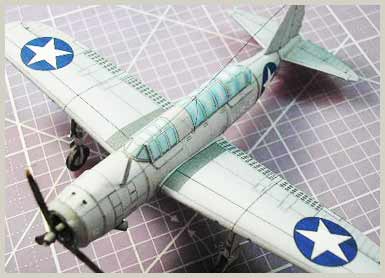
This is the Brewster SB2A Buccaneer model that won the FG Modeling Madness (FGMM) 2010 best in class prize. Thanks to Péricles Lopes Gomide Filho for his entry !! |
|
 |
 |
There's quite a bit of info on it....including a video of the pilot's familiarization film on the web. It did a lot of home front support
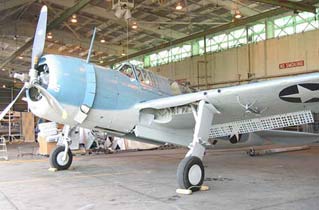 duty, in a lot of roles from target tug to night fighter trainer. It's a big brute of a plane---actually not bad looking once you get used to it. Just a sky clunk, though. ROB
I was stationed at Warminster for three years, and remember the thing (see photo) as a pile of scrap--very little progress was made during the time I was there. Most of the difficult work was performed here in Pensacola. The crew assigned had to hand craft many of the airframe parts from the original drawings. I would hate to see the guys down here fail to get credit for their tireless efforts to get it right. Rob
Wow. That's the first new addition to the WWII folder in a while isn't it? Very nice work. Very interesting plane. Great stuff Rob Dan RM
Ditto! Nice lookin' birdie, even if it wasn't worth a hoot...Z
The Buccaneer must be one of the ugliest planes ever built. I don't know how you did it, but your Buccaneer actually looks attractive!!! Great job! BTW a little typo on the sheets (you probably got a million e-mails about that already) the proper spelling would be handling "quirks", not "qwerks". Thanks for churning out such great models!!! YMP Norman Gorn
For what it's worth:
A buccan is a native South American and Caribbean name for a wooden framework or hurdle on which meat was roasted or smoked over a fire, similar to the original meaning of a barbecue.
The term "Buccaneer" for pirates or privateers, is said to be derived from buccan. In the Caribbean, these seafarers would smoke fish, wild pigs and turtles to provision their ships.
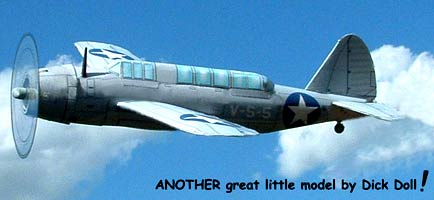
Brewster SB2A
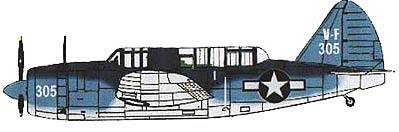
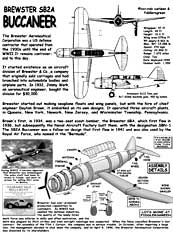
The SB2A Buccaneer is a prime example of how a design that looked good on paper in 1939 can be woefully lacking by 1941. Between the drawing board and the production line, the SB2A put on substantial additional weight that overwhelmed her 1,700 horse power engine and out dated air frame, resulting in a ship that proved to be, slow, sluggish, and with unpleasant handling qwerks. Though many other stats appear comparable to the Grumman TBF on paper, her inferior wing area, bomb load, and real world performance put her way behind the Avenger.
As WWII loomed, the entire initial delivery of Buccaneers were quickly relegated to training duties. 162 non folding wing Buccaneers ordered by the Dutch were taken over by the Navy, christened the "SB2A-4," and used by the Marines as trainers for the first two years of the War. Perhaps the high point of the Buccaneers service for the Navy was their use in the Marines first Night Fighter squadron.
The British ordered the SB2A under Lend Lease as the "Bermuda," and quickly came to the same conclusion as the Americans, Most were quickly relegated to duties such as target tug towing- although there is a report that they were used with some success as a level bomber in the plane starved India-Burma campaign.
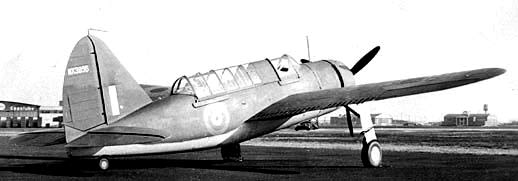 |
The Brewster Bermuda is the name given by the RAF to the Brewster SB2A. In the US Navy service, the aircraft was the SB2A "Buccaneer." The Bermuda was not carrier-capable, although it was designed as a dive bomber. |
HISTORY:
 The Brewster Aeronautical Corporation was a North American defense contractor that operated from the 1930s until the end of World War II. It remains controversial to this day.
It started existence as an aircraft division of Brewster & Co., a company that originally sold carriages and had branched into automobile bodies and airplane parts. In 1932, Jimmy Work, an aeronautical engineer, bought the division for $30,000 and created the Brewster Aeronautical Corporation. Brewster started out making seaplane floats and wing panels, but with the hire of chief engineer Dayton Brown, it embarked on its own designs. It operated three aircraft plants, in Queens, New York, Newark, New Jersey, and Warminster Township, Pennsylvania.
Brown's first, in 1934, was a two-seat scout-bomber, the Brewster SBA, which first flew in 1936, but subsequently the Naval Aircraft Factory built them, with the designation SBN-1. The SB2A Buccaneer was a follow-on design that first flew in 1941 and was also used by the Royal Air Force, who named it the "Bermuda".
A design in 1936 for a carrier-capable monoplane resulted in the Brewster F2A (nicknamed "Buffalo" by the British), which was chosen over a biplane version of the F4F Wildcat. The Buffalo prototype handled well in 1938 tests, and the Navy ordered 54. However, production was slow, at least partly due to an inefficient factory in Queens, New York. The Navy ended up ordering Wildcats, which by 1938 had been greatly improved.
The Buffalo was exported to Finland starting in 1939, and more were intended for Belgium, but the country was overrun in the early stages of World War II, before deliveries could begin. The United Kingdom also received Buffalos, which eventually ended up in the East Indies. They engaged in combat with Japanese Zeros and suffered badly. The Buffalos were most popular with the Finns, who modified them and used them successfully against the Russian air force.
During WWII it became apparent that Brewster was mismanaged. The company had grown from a relatively minor aircraft parts supplier to a fully-fledged defense giant in only a few years. Jimmy Work had hired Alfred and Ignacio Miranda as the company salesmen. They had been involved on frauds, spending two years in prison for selling illicit arms to Bolivia, and had over-promised Brewster production capabilities to customers.As WWII had swelled the defense industries, the quality of the newly hired work force was inferior in skills and often motivation, and the work was plagued by illicit strikes and even outright sabotage was suspected. The Navy installed a George Chapline as president of the company, easing out Jimmy Work, in the hopes of speeding up production, but then in early 1942 Jimmy Work regained control of the company, just in time to be sued for $10 million for financial misdeeds. In May 1942 the Navy simply seized Brewster and put the head of the Naval Aircraft Factory in charge.
When the Navy cancelled Brewster's last contract, for assembly of the F3A-1 Corsair, the company was in serious trouble. In October, after reporting a large loss, the management decided to shut down the company, and on April 5, 1946, the Brewster Aeronautical Corporation was dissolved by its shareholders.
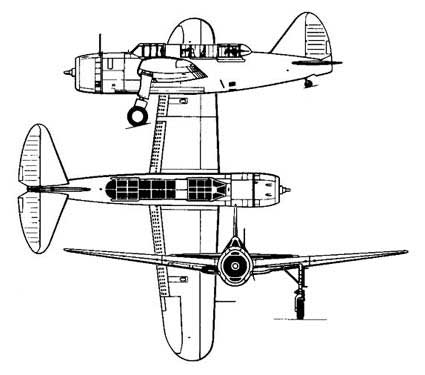 |
Crew: 2: pilot and gunner |
 |
||
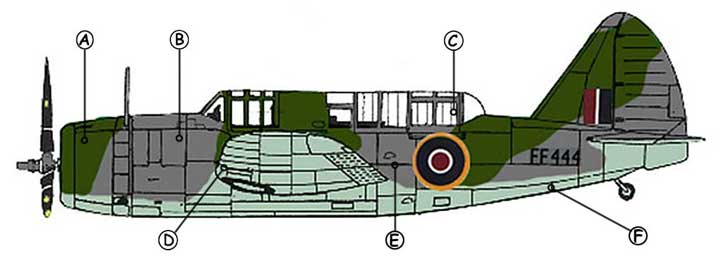
| A: The 1700 hp Wright Cyclone Engine was just not powerful enough for the SB2A's max weight of 14,289 lbs. | B: Over 1000 examples of the SB2A were built, but it was still regarded as a failure. | C: The prototype was tested with a mockup powered dorsal turret, but this caused such buffeting that it was abandoned. |
| D: The firepower of thc Bermuda was the same as the Spitfire Mk 1 - eight machine guns, albeit distributed between the cowling, wings and rear cockpit. | E: The Brewster Company never quite got the hang of aircraft manufacturing. All their production aircraft are regarded as failures, especially the SB2A, as it saw no operational service. | F: The RAF's Bermudas lacked the arrester hook and folding wings of the US Navy's SB2As. |
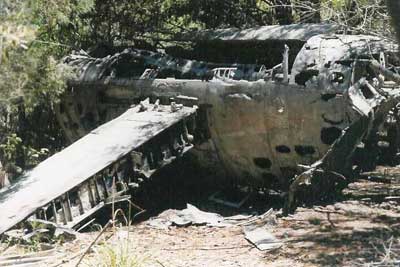 |
The remains of a Brewster Buccaneer crash. |