

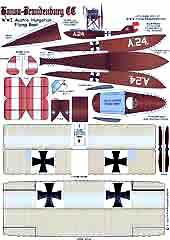
Hansa-Brandenburg CC - $$4.50
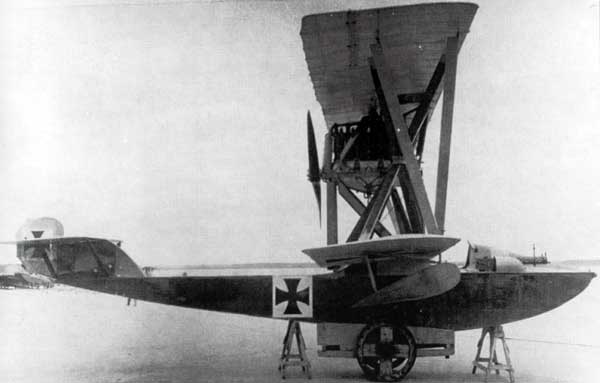
Operational in 1917, the Hansa-Brandenburg CC was a single-seat German fighter flying boat of World War I. It was used by both the Imperial German Navy and the Austro-Hungarian Navy The CC was characterized by 'starstrut' interplane bracing.

The Hansa Brandenburg CC Flying-Boat

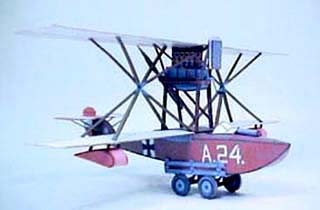
The first Brandenburg flying-boat was the 3-seat FB developed by Ernst Heinkel from a Lohner design and built in small numbers for the German and Austro-Hungarian Navies in 1915. The CC was characterized by 'starstrut' interplane bracing like that used for the D.II and plane fighter.
In 1916 Heinkel produced an original design for a single-seat wooden-hulled fighter flying-boat which he named CC after Camillo Castiglioni, financial controller of the Brandenburg company. The CC was characterized by 'starstrut' interplane bracing...
Really cool airplane! WWI stuff is so cool because it is so different and out of the ordinary. This looks like a gem of the outstanding quality that we have all become accustom to but do not take for granted. Keep up the good work! Dave Still 3/19/02
Hansa Brandenburg CC
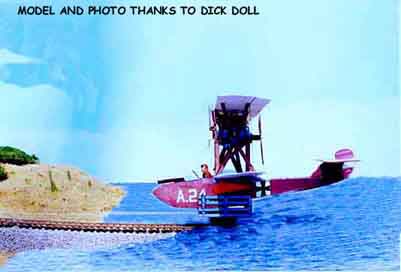
Designated in the A class in Austrian service, the flying-boats
were used up and down the Adnatic in defense of ports and naval
bases. Like their German counterparts, they were at first fitted
with one. and later with two, machine-guns; it may be supposed
that these were the domestic 8mm Schwarzlose weapon.
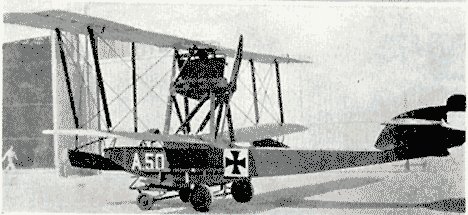
The CC's chief opponent in the Adnatic was the Italian Air Force's Nieuport 11, against which the flying-boats acquitted themselves fairly well, having a slight edge in speed to offset their lesser maneuverability. Overall Phoenix production of the CC amounted to thirty-five aircraft (A.13-42 and A.45-49). Machine A45 appeared in 1918 as a triplane, but this line of development was not pursued. The 'Phoenix A' designation was also applied to sixty-one examples of the Hansa Brandenburg W.18 seaplane built for the Austro-Hungarian Navy. Examples of the CC in German service included at least one aircraft with a spinner and the engine in a streamlined. egg-shaped nacelle, and another with extra V-struts outboard of the 'star' struts.
 |
 |
A small single-seater fighter flying boat was developed by Ernst Heinkel, the Hansa-Brandenburg designer, early in 1916; out of gratitude to the proprietor of the firm, Camillo Castiglione, he christened it the CC.
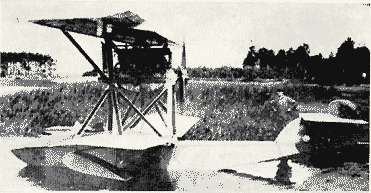
The first CC boat to be supplied to the German Navy, No. 946, was ordered in May 1916, but was not delivered until the following February. Like all German-built CCs, it was powered by the 150 h.p. Benz engine mounted close under the top wing on steel-tube struts streamlined with laminated wooden coverings, and driving a two-bladed pusher propeller. The radiator was directly in front of the engine.
Its wing structure much resembled that of the D-I land plane; square-cut planes with ailerons incorporating wash-out, and the same 'star-strut' interplane bracing. Below and in front of the engine was the pilot's cockpit. The wooden hull, of well-streamlined shape, was provided with a step underneath. Wing-tip floats of streamlined section with flat sides were attached to the planes by means of one forward strut and two rear struts, with cross-wire bracing in between. A low aspect-ratio fin of thin laminated wood carried the rather square tail-plane, which was braced from below by two struts on each side; the rudder was horn-balanced.
The armament consisted of a single Spandau gun which protruded through a windshield of large proportions.
Although the German Navy had no love for flying boats, the CC was evidently considered satisfactory; for two further series, 1137-1146 and 1327-1351, were built during 1917. The later machines were somewhat modified, having longer hulls, radiators in the top wings, and twin guns. On some, the engine was enclosed in an egg-shaped cowling and a pointed spinner was fitted to the propeller; others had extra interplane bracing struts. The operational history of these flying boats is obscure.
The Austro-Hungarian Navy, however, were well aware of the
value of flying boats, and found the CC to be a useful weapon.
Known as the KDW (Kampf Doppeldecker Wasser-Fighter Biplane, Water)
it was employed in defense of the Adriatic ports. The KDW had
either the 185 h.p. Austro-Daimler or the 200 h.p. Hiero, in place
of the Benz engine. In performance it compared favorably with
the opposing Italian Nieuport 11; although less maneuverable the
flying boat was faster.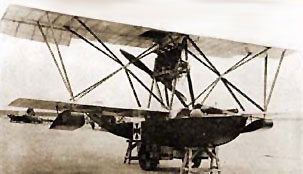
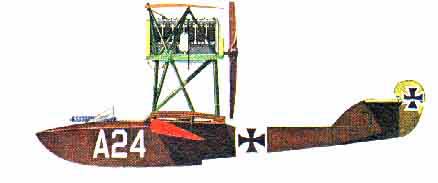
Austro-Hungarian fighter flying boats were designated the 'A' class, A.24 was flown by the well-known Austrian naval pilot, Gottfried Banfield.
In 1918 an experimental triplane version of the KDW appeared, numbered A.45; it was not put into production.
The Phoenix company developed an improved fighter flying boat based on the Hansa-Brandenburg CC design in the last year of the war, it was powered by the 185 h.p. Austro-Daimler engine, had a hull of simpler cross-section, orthodox interplane struts and twin Schwarzlose guns mounted on a transverse steel tube inside the front portion of the cockpit.
However, in the last few months of the war the single seat flying boats were unable to deal with the ever-increasing Italian air raids. Production figures for the 'A' class were: 1916 6; 1917 64; 1918 65; a total of 135 boats.
 |
 |
|
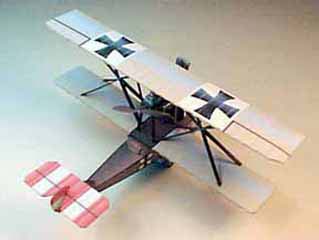
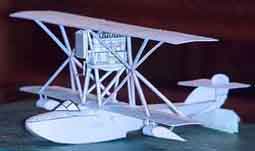 Ok I gave it a shot, mind you I tried this without looking at any of your pictures. so I screwed it up a couple places.The back turtle deck, from the tail to the back of the cockpit Is it supposed to be flat or rounded. and I had no clue what to do with the flap on the back of the cockpit section. One thing I do know is the turtleback rear to cockpit needs to be a separate section. on one side are great tabs for attachment, on the other side are two tiny little triangles that didn't hold at all. Other than that it seemed to go together nicely, a little tight on the top, but it's great you can stick your finger in the cockpit to help align things. Matt (Feb 25) |
|
|
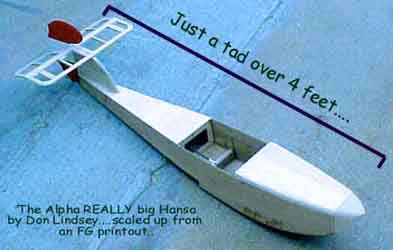 |
||
I'm always shy of putting things like "make this
part out of pop sickle sticks" and such. I'd much rather
give a guy a complete model,even if the card parts aren't the
best suited and let *him* make the choice of whether to substitute
or not. He can either set down and make a plane in a couple of
hours with everything provided, or choose to take his time and
build a show piece, substituting carefully crafted parts of his
own making. Sound familiar?
I can see your point about them using up a lot of space...
perhaps if you made one of the sides a "swollen X" shape
instead of a full rectangle it would allow for nestling them in
better amongst each other. Would save the guys a few pennies worth
of ink too. ;-) That is looking like such a great model too guy,
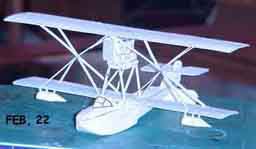
keep up the good work. CG (Chauncy Green- Feb 23, 01 ) FEB,
22......
Couple of issues that I need to resolve.
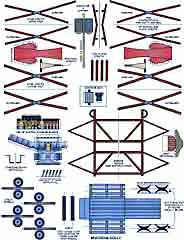
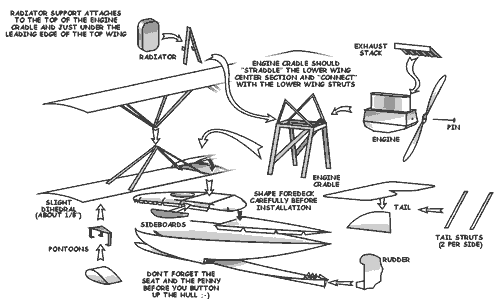
1. There's some way too fiddly parts in here. Namely the radiator
and its mounting. And also the pontoon mountings. Most of this
stuff is mounted right now with little, teeny, tiny bits of paper
"sticks". Kinda true to scale but I don't think its
gonna work.
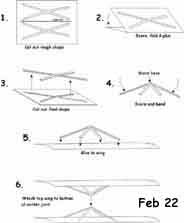
2. The star-struts while straight-forward, take up lots of
room on the page. I've basically have it where the struts are
in "top" and "bottom" halves. Each being in
the form of and X that is folded in the middle, glued to the wings
and then the top wing is joined to the bottom at the strut joints.
That in itself isn't too bad, but I've also got it where they
are first folded over to make double thickness before they are
cut out.
Other than that I'm pleased with the progress so far.
Comments, criticisms welcome.
T.
Specifications for the Hansa-Brandenburg CC
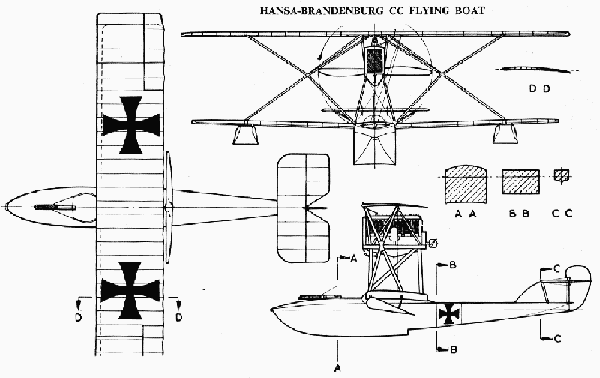 |
Length: 25 ft 2.75 in Wingspan: 30 ft 6.125 in Height: 11 ft 8.5 in Wing area: 285 ft² Empty weight: 1,764 lb Loaded weight: 2,381 lb Powerplant: 1× Benz Bz.III water cooler six-cylinder inline engine, 150 hp Performance Maximum speed: 109 mph Range: 310 mi Wing loading: 8.35 lb/ft² Power/mass: 0.063 hp/lb Climb to 3,280 ft:4.8 min Armament 1 × 8 mm (.315 in) Schwarzlose (Austro-Hungary) or 1 or 2 × 7.92 mm (.312 in) LMG 08/15 machine guns |