

HillerCopter-XH44 - $$4.95
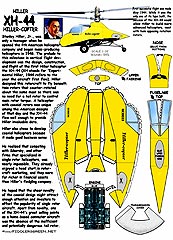
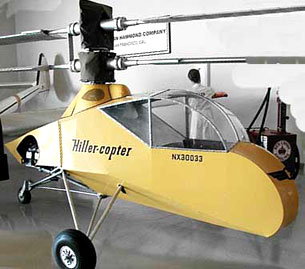
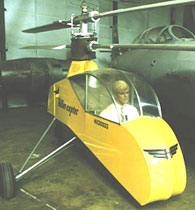
The XH-44 was the first Hiller Helicopter, like MOST Hillers, had a coaxial rotor blade system. It is the smallest model in the Fiddlers Green Helicopter Collection. Looks kinda like a giant bug..Probably sounded like one too. The 44 was the year it flew.

XH-44 Hiller-copter and Stanley Hiller
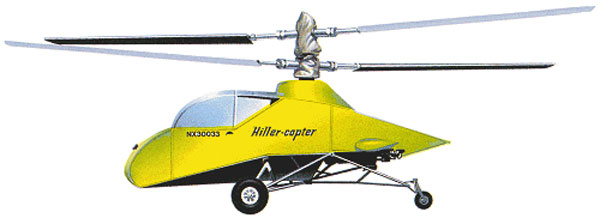
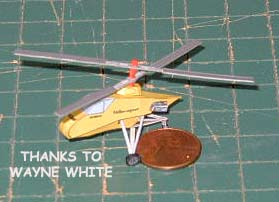
Stanley Hiller, Jr., was only a teenager when he opened the fourth American helicopter company and began mass-producing helicopters in 1948. The prelude to this milestone in vertical flight development was the design, construction, and flight of the first Hiller helicopter, the XH-44 (XH stands for 'Experimental Hiller', 1944 refers to the year the aircraft first flew). Hiller designed this rotorcraft to fly beneath twin rotors that counter-rotated about the same mast so there was no need for a tail rotor to control main rotor torque. A helicopter with coaxial rotors was unique among the American designs of that day and the XH-44 flew well enough to provide Hiller invaluable data.
For more about Stanley Hiller and his Helicopters see also the Hiller Hornet.
This is a lovely one! This will make for a great little thing beside my other helicopter(which) is 1:100. Please keep on going with some more helicopters... With best regards, Matthias
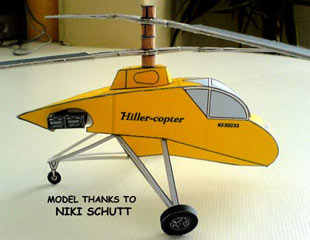 |
 Niki's Hiller XH-44 |
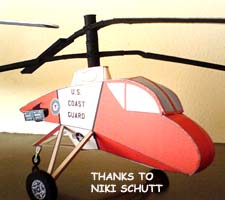 |
Nice job once again on the XH-44. Very nice little helicopter, built it last night, nice and quick. Looking forward to the next one.Niki BTW I've attached a picture of my XH-44 build. |
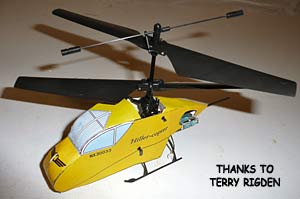
| Hi, I thought you might be interested to know that I have made one of your Hiller copter models fly. I printed the model out at 120% and widened it to 30mm so I could wrap it round an E-Flite mCX chassis and it flies superbly. Here's a picture of the result...Regards Terry Rigden (see right) |
 |
Stanley Hiller's XH-44
 Hiller's interest in helicopters began in 1941 at age sixteen.
At that time, this young man was already running a successful
enterprise manufacturing model cars powered by small gasoline
engines. After the United States declared war on Germany and Japan,
Hiller converted his production line to build window frames for
Douglas C-47 Dakota transports but he continued to refine his
ideas about helicopters.
Hiller's interest in helicopters began in 1941 at age sixteen.
At that time, this young man was already running a successful
enterprise manufacturing model cars powered by small gasoline
engines. After the United States declared war on Germany and Japan,
Hiller converted his production line to build window frames for
Douglas C-47 Dakota transports but he continued to refine his
ideas about helicopters.
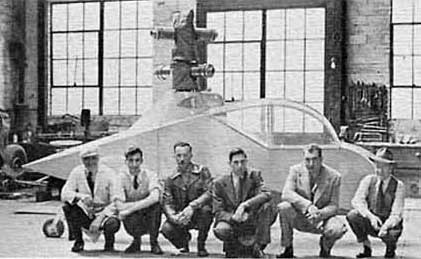
By 1942, his thinking had advanced enough to warrant creating an organization to build the aircraft and he formed the Hiller Aircraft Company. Working with a small group of experienced engineers and craftsmen, he started fabricating a compact helicopter with a steel-tube fuselage covered with fabric in December 1942.
The nation's all-out efforts to support the war effort caused
shortages of materials and equipment that delayed development
of Hiller's helicopter, just as it affected Frank Piasecki's efforts
to build his first helicopter, the PV-2. Hiller's staff had to
scrounge or manufacture almost all their own components. The power
plant was a critical item that no small firm could fabricate and
Hiller selected a Franklin 90 horsepower engine, de-rated to 65
horsepower. Hiller could not buy the engine commercially so he
appealed to several government agencies before he obtained one.
The enthusiastic eighteen year-old convinced Grover Loening, then
chief aircraft consultant to the War Production Board, that his
helicopter was worth supporting with a small, reciprocating engine.
Workers installed the unit in late 1943 and testing began 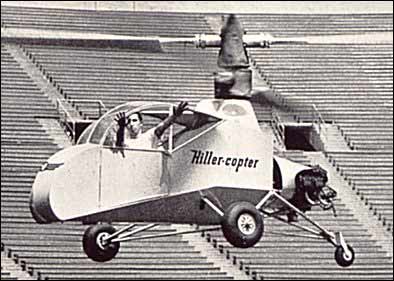 immediately.
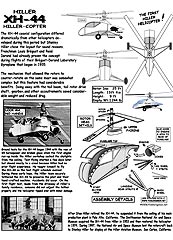
The XH-44 coaxial configuration differed dramatically from other helicopters developed during this period but Hiller chose the layout for sound reasons. The mechanism that allowed the rotors to counter-rotate on the same mast was somewhat complex but this feature had considerable benefits. Because a coax' did not generate torque, no engine power was wasted driving a tail rotor that produced no lift or forward thrust. Doing away with the tail boom, tail rotor drive shaft, gearbox, and other accoutrements also saved considerable weight and reduced drag. The coaxial configuration did have several drawbacks. The coaxial helicopters exhibited weak directional control in forward flight and yaw control forces reversed during autorotation's.
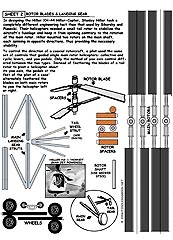
To control the direction of a coaxial rotorcraft, a pilot used the same set of controls that guided single main rotor helicopters: collective and cyclic levers, and yaw pedals. Only the method of yaw axis control differed between the two types. Instead of feathering the blades of a tail rotor to pivot a helicopter about its yaw axis, the pedals at the feet of the pilot of a coax' alternately feathered the blades on both main rotors to yaw the helicopter left or right.
A single rotor helicopter requires hinges on each main rotor blade. As the helicopter transitions to forward flight, the hinges allow the blades to move independently of each other, as one blade rotates forward and generates more lift than blade retreating backward toward the tail. The two rotors of a coaxial helicopter cancel out the asymmetrical lift effects in each rotor. It is here that coaxial helicopters pay their greatest penalty in the requirement for very strong 'rigid' (hinge-less) main rotor blades. The blades must be rigid to prevent them from flapping into contact.
 It was not possible to manufacture wooden blades rigid enough
to prevent excessive flapping so Hiller produced the first practical,
all-metal, main rotor blades. These blades held up far better
than the wooden, fabric-covered blades built by Sikorsky, Bell,
and Piasecki, and others. The wooden blades also required more
time to build, were harder to balance, and suffered form severe
quality control problems.
It was not possible to manufacture wooden blades rigid enough
to prevent excessive flapping so Hiller produced the first practical,
all-metal, main rotor blades. These blades held up far better
than the wooden, fabric-covered blades built by Sikorsky, Bell,
and Piasecki, and others. The wooden blades also required more
time to build, were harder to balance, and suffered form severe
quality control problems.
Hiller also chose to develop coaxial helicopters because it made good business sense. He realized that competing with Sikorsky, and other firms that specialized in single rotor helicopters, was nearly impossible. They already enjoyed a head start in rotorcraft marketing, and they were far richer in material and financial assets than Hiller's fledgling company. He hoped that the sheer novelty of the coaxial design might attract enough attention and investors to offset the popularity of single rotor aircraft. Apart from novelty, one of the XH-44's great selling points as a home-based commuter aircraft was the absence of the inefficient and potentially dangerous tail rotor.
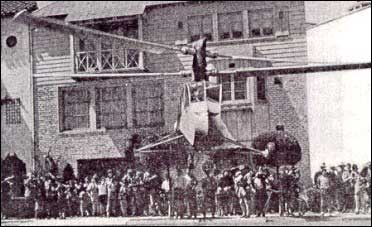 Ground
tests began 1944 with the roar of 65 horsepower and broken glass
when the first engine run-up inside the Hiller workshop sucked
the skylights from the ceiling. Test flying started a few days
later but slowed nearly to a crawl because Hiller had no prior
flight experience. He taught himself to fly the XH-44 as the test
flight schedule evolved. During these early hops, the Hiller team
securely tethered the XH-44 to preserve the pilot and their hand-crafted
machine. Accidents did occur. On the first flight test, made from
the driveway of Hiller's family residence, someone did not adjust
the tether properly and the helicopter tipped over with minor
damage. Subsequent tests took place in the football stadium at
the University of California at Berkeley.
Ground
tests began 1944 with the roar of 65 horsepower and broken glass
when the first engine run-up inside the Hiller workshop sucked
the skylights from the ceiling. Test flying started a few days
later but slowed nearly to a crawl because Hiller had no prior
flight experience. He taught himself to fly the XH-44 as the test
flight schedule evolved. During these early hops, the Hiller team
securely tethered the XH-44 to preserve the pilot and their hand-crafted
machine. Accidents did occur. On the first flight test, made from
the driveway of Hiller's family residence, someone did not adjust
the tether properly and the helicopter tipped over with minor
damage. Subsequent tests took place in the football stadium at
the University of California at Berkeley.
On July 4 1944, Hiller flew the bright yellow aircraft free from its tether for the first time in the stadium. A public demonstration followed less than two months later on August 30, 1944, in San Francisco. These events attracted outside investment, primarily from Henry Kaiser, a wealthy Seattle ship builder. Kaiser infused the project with enough capital to allow Hiller to further refine the XH-44.
 His most important improvement was a redesign of the rotor blades
and mast to allow each two-blade set to teeter freely. The new
arrangement resembled
the teetering rotor developed by Arthur Young and flown on all
Bell helicopters for decades. The XH-44 now handled much more
smoothly in calm air or turbulence. Hiller also installed a more
powerful Lycoming O-290 CP engine on December 1, 1945. By late
1945, Hiller judged the XH-44 test bed refined enough that he
could proceed with construction of a new model, the X-2-235.
His most important improvement was a redesign of the rotor blades
and mast to allow each two-blade set to teeter freely. The new
arrangement resembled
the teetering rotor developed by Arthur Young and flown on all
Bell helicopters for decades. The XH-44 now handled much more
smoothly in calm air or turbulence. Hiller also installed a more
powerful Lycoming O-290 CP engine on December 1, 1945. By late
1945, Hiller judged the XH-44 test bed refined enough that he
could proceed with construction of a new model, the X-2-235.
 The
designer hoped that this helicopter would lead to a production
order. When it did not, Hiller prepared another version, the UH-4,
for production as a personal commuter aircraft and it too failed
to win outside interest.
The
designer hoped that this helicopter would lead to a production
order. When it did not, Hiller prepared another version, the UH-4,
for production as a personal commuter aircraft and it too failed
to win outside interest.
The problem was not of Hiller making but rather the result of faulty social forecasting. During World War II, many captains of the aviation industry forecast a massive shift of thousands of pilots from the cockpits of military aircraft to the cabins of personal, commuter aircraft as soon as the war ended.
This boom failed to occur, dooming hundreds of promising light fixed- and rotor-wing aircraft including the Hiller designs. Stanley Hiller shifted his sights to the market for commercial and business helicopters.
After Stan Hiller retired the XH-44, he suspended it from the ceiling of his main production plant in Palo Alto, California. The Smithsonian National Air and Space Museum acquired the XH-44 from Hiller in 1953 and then restored the helicopter in 1974. During 1997, the National Air and Space Museum lent the rotorcraft back to Stanley Hiller for display at the Hiller Aviation Museum in San Carlos, California.
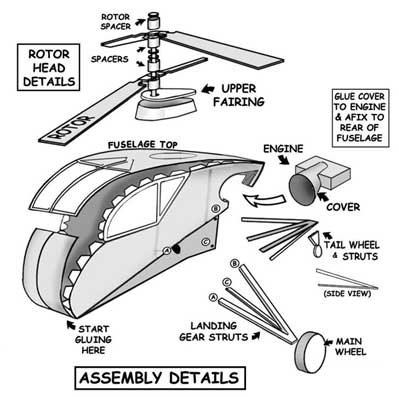
Specifications for the Hiller XH-44 Hiller-Copter
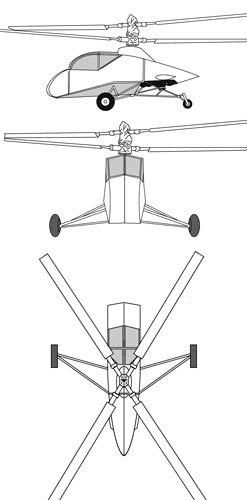 |
Rotor Diameter: 25 ft Length :13 ft 4 in Height: 9 ft Weight Empty: 1,244 lb |