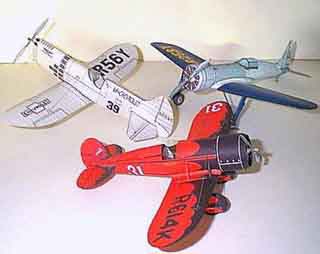

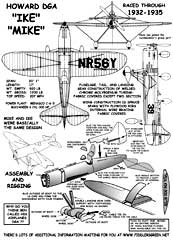
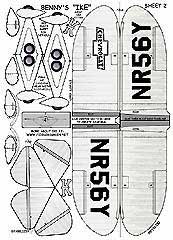
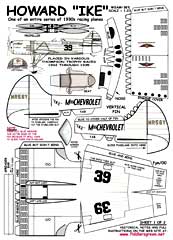
Howard Mike and Ike - $3.95
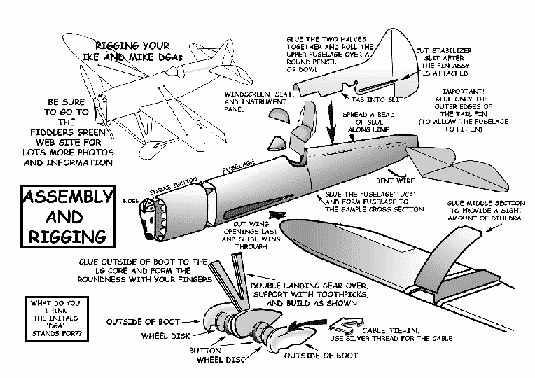
Both Howard MIKE and IKE are included in this folder.
Benny Howard's MIKE and IKE
IKE, MIKE, and other race planes of the thirties are a breed apart from military airplanes. The men who built and flew them are also in a class by themselves, and although that brilliant era in aviation history is gone, we still can enjoy some of its glow through modeling the famous airplanes of the air races. Instructions available as free download (see below)For years we've been getting mail and (recently) lots of Email asking if we'll ever have a 1930s Racing Plane series.
We never really took them seriously until we got into this series. Historically, we see the racers as the spring-board to a great leap aviation made during WWII. Look closely at these designs and you'll see the seeds of the Zero, FW-190, and the P-47 Thunderbolt, just to name a few.
IKE, MIKE, and other race planes of the Thirties are a breed apart from military airplanes. The men who built and flew them are also in a class by themselves, and although that brilliant era in aviation history is gone, we still can enjoy some of its glow through modeling the famous airplanes of the air races
Benny Howard's Darn Good Airplanes (DGA)
by Major Truman C. Weaver,
USAF (ret)
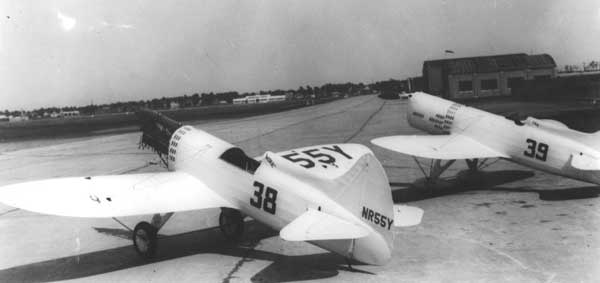
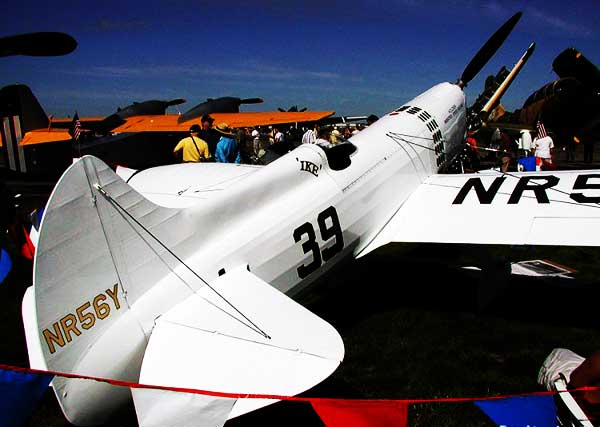
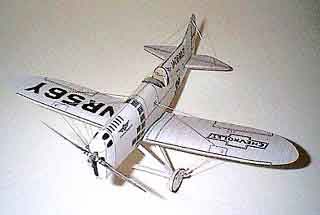
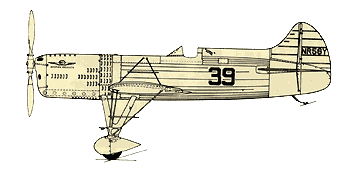
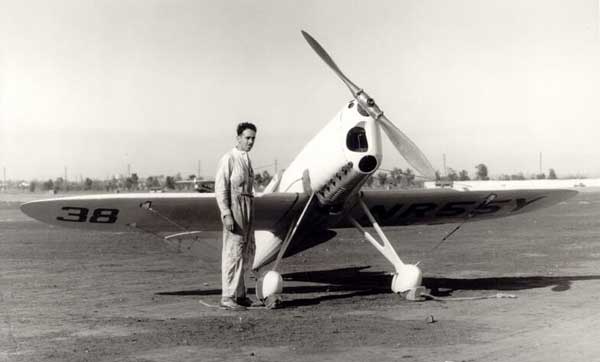
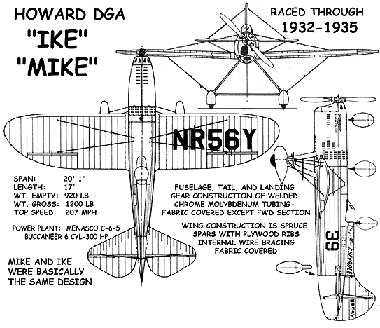
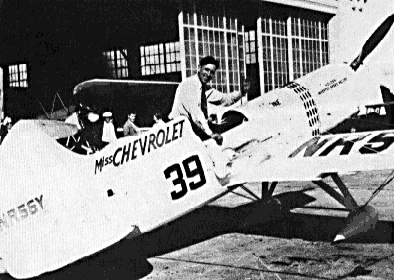
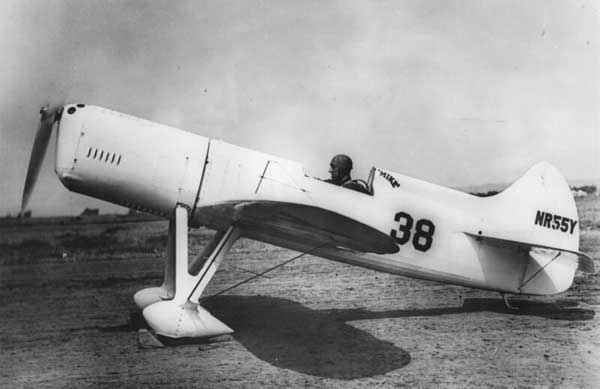
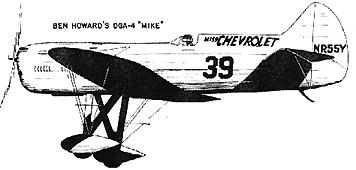
AFTER COUNTING THE trophies and money won by "Pete" in the 1930 and 1931 races, Benny Howard decided that there was money in the race game. He was also aware that "Pete" was on the way to being outclassed and if he was to remain in the winner's circle, he would have to do something about it. So early in 1932 work began on two larger racers. The end result was "Mike" and "Ike," (they look alike). The two racers were almost identical, the only difference being in the landing gears. They were both painted snowy white with shiny black lettering. "Mike" (DGA-4) drew license number NR-55Y and race number 38, (race number 7 was used, at Omaha)' while "Ike" (DGA-5), carried NR-56Y and race number 39.
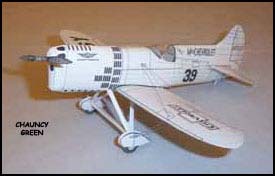
Both racers were
low-wing, wire braced monoplanes, and like "Pete" were
very small and had a minimum of frontal area. There was a slight
difference in weight, "Ike" being a bit lighter of the
two. Both were powered by Menasco Buccaneer engines of 485 cu.
in. displacement, differing in octane ratings only. The engine
in "Ike" was set for a higher octane, thus giving a
little boost in horsepower. The extra horsepower and being a little
lighter may have accounted for "Ike" being the faster
of the two in 1932. Oddly enough, it was always a toss-up as to
which of the ships would be the fastest from year to year.
Wing span of both ships was 20 ft. 1 in. and the fuselage was
17 ft. Iong. The cockpit in each case was hinged on the side and
closed after the pilot was inside. A large hole for the pilot's
head was left open. Ventilation was assured by 30 small holes
drilled in the windshield. The cockpits were small and the pilot's
seat was level with the rudders. A slight difference appeared
in the engine cowling, with "Mike" having less cooling
louvers than "Ike" but a larger rectangular opening
on the left side of the cowl for cooling. "Mike" had
a cowl designed for a spinner, which was never used.
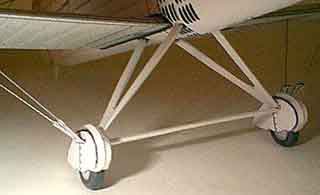
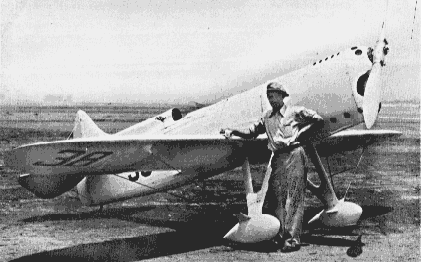
The landing gears on the two ships were very different. The gear on "Mike" was similar to that used on Pete. with the rather large wheels housing an internal shock; absorbing system needed to meet CAA (then ATC' requirements (both aircraft were built to these specification-but never certified because of cancellation of ATC races . "Ike" had a novel tandem gear arrangement consisting of two small wheels spaced about 20 in. apart and coveled by a single wheel fairing, one on each leg. Howard stated that this was done for a gag, but the gear did prove rather successful. However, ground handling and spotting the aircraft in the hangar presented problems since the wheels did not caster. Single wheels with spats replaced the original gears on both ships.
Ben Howard entered "Ike" in six events at the 1932 National Air Races. He flew three of them himself -taking two firsts and one second. During one of the races he was pressed closely by Roy Liggett in the Cessna CR-2 with Johnny Livingston and his short-winged Monocoupe a length behind. Bill Ong ran fourth in this event but later got "Mike" wound up and took second under same conditions.
Two major air races occurred at the same time in 1933, so Howard sent Harold Neumann to the American Air Races with "Ike". The tandem wheels had been removed and replaced with normal small panted wheels. This resulted in a weight saving and improved streamlining so a performance improvement resulted. Harold participated in only one event, placing third. He was dogged by engine trouble during the balance of the meet, so he stepped into the Folkerts SK-1 to finish the races.
Roy Minor and "Mike" were sent out to take over the Nationals. "Mike" had been modified considerably. The spinner design for the cowl had been abandoned and the large rectangular opening on the side was closed. Many of the cowl louvers were also faired in. A set of small wheels and wheel pants replaced the large unspatted wheels of 1932.

Minor and "Mike" really took over the National Air Races of 1933, copping four firsts, two seconds, two two fifths, two thirds and one fourth. Both ships were present at the 1934 Nationals, with no apparent changes other than a recovering job on Mike," whose lettering was now in gold edged with black. Roy Hunt was in the cockpit of "Mike" and Harold Neumann in "Ike". Hunt picked up two fifths and .Neumann finished with two fourths. Best closed course speed for "Ike" this year was 211.55 mph, 30 mph faster than "Mike".

Jokingly called the 1935 "Benny Howard National Air Races",
this was a banner year for Ben. His racers won the Bendix, Thompson
and Greve Trophy races that year.
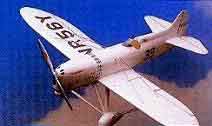
Ike" was sponsored by the Chevrolet Division of General Motors and was known as "Miss Chevrolet". It was equipped with a special carburetor and now held the worlds inverted speed record. However, the ship did not participate in the races as Neumann wiped the gear off during qualifying runs. Harold came back strong winning the Thompson in "Mr. Mulligan" and three firsts in the 550 cu. in. class with "Mike". Marion McKeen had worked the bugs out of his new Brown B-2 and gave Neumann some uninvited competiton by finishing less than one mile per hour behind "Mike".
The 1936 Nationals certainly were not a repeat for Howard.
"Mike" was the only one to finish a race that year.
Harold Neumann ran a speed dash in it, clocking 223.714 tnph,
which placed him fourth in the Shell event. Joe Jacobson placed
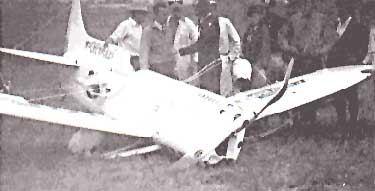
fifth in the Greve and nosed over on landing. The 1936 r aces
were not profitable to Ben Howard.
Only "Ike" appeared at the 1937 Nationals, now traveling with the Fordon-Brown Air Shows. It did not race as the Menasco was not functioning properly. Both "Ike" and 'Mike" were brought by R. Rovner of Cleveland and were to participate in the 1939 races, but due to technical difficulties did not appear. The only visible change was a yellow paint job on each.
'Ike" and "Mike" are still in existence, located in Ohio where it is rumored that they are undergoing retoration. During the racing career of these two ships the honors for top speed changed hands snany times. "Mike" turned a speed dash of 241.61 mph compared to 239.63 mph for "Ike," but closed course speed honors went to "Ike" with 215.2 tnph, with 214.4 tuph for "Mike". Not much difference in speed performance, yet they differed as much as 30 mph in single events in which both performed. Could it have been piloting?
![]() |
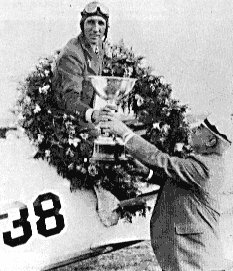
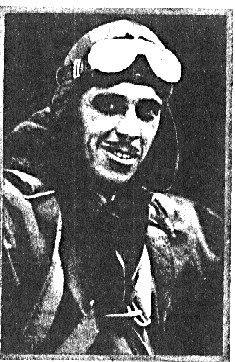
Elation! Neumann accepts
the Greve trophy from Louis W. Greve for his sweep of the race
with times of 212.716 mph, 194.930 mph, and 207.292 mph.
|
![]() |
His ship won $6,925 prize money, next to the highest amount, won by the Wedell-Williams Air Service, $13,400. That must have cheered Ben a great deal and sweetened his outlook on racing, which rather soured on him last year. You see, Ben entered a period of prosperity with "Pete," which paid for itself four times over; and then, greatly elated, he built "Mike" and "Ike," only to learn that he had overjudged his cash prize market. He was so annoyed about it that he went around at Cleveland in 1932 and bitpieces out of the grandstand and Cliff HendersoThere's one thing you can count on at Nationa; air races: there's always a good snappy fight abou something or other. It's only put on to add interest to the sport of racing and to keep us limber. U hen all else fails, Ray Brown shadow-boxes with Jack Berr`-. Or Roscoe Turner misses a pylon and hits the contest committee. But it's all in a spirit of good clean fun.

Ben Howard was born in Palestine, Texas, Feb. 4, 1904, and despite his best efforts to avoid any education whatever, was held in school long enough to finish half a term in high school, when he leaped clear of all guidance and attached himself to a soda fountain. They paid him too much money, for one week he had $10 saved and bought a Standard for the ten, promising to pay another ten every week for fifteen weeks. Well, next day he sent word from the hospital that the former owner could have the wreckage of the craft. Ben had taken it up with enthusiasm, and nothing else. He spent a hot summer in a plaster cast, which is an uncomfortable way to spend a hot summer in Texas.
When the 17 year old flying enthusiast was able to hobble around
again, it was that fine gentleman, the late R. W. Mackie, who
gave him some needed flying lessons in return for mechanical work.
This was in Houston in the winter of 1922, after which Ben flew
a year for C. C. Cannon, an oil operator with drilling operations
scattered all over south Texas. He paid for the Standard he had
used up, went to Nicholas-Beazley in the summer of 1924 and then
back to Houston to build his first ship, DGA-1. "Mike"
and "Ike" are DGA-4 and DGA-5. I wonder if the Department
of Commerce guesses what DGA stands for. The answer is Damned
Good Airplane!
In the spring of 1926 Ben joined J. Don Alexander at Denver, where he stayed two years, was fired twice, and went to Dearborn to insert rivets in Fords for a month, then joined Robertson Air Lines in St. Louis to fly J-5 Fords on the Chicago run. Next spring he was fired by his dear friend, Bud Gurney, and went to work for T. A. T., which was just starting. By Christmas he was fired for reasons that seemed adequate to Dog Collins, even if they didn't to Ben, so he went to work for Universal, flying mail back and forth between St. Louis and Omaha in Pitcairns and Stearmans, and mail and passengers from Chicago to Tulsa in F-10's, until he told his boss, Bob Dentz, a few truths, and got fired in September, 1930 In November he was working for N. A. T., in time to be canned in December because they shut down the Stout Airlines. For a couple of months he rebuilt "Pete" and then went to work for Bill Bliss, in person, for Century Airlines, but was offered his job back with N. A. T., so returned to that company, where he has been ever since, flying between Kansas City and Chicago. He is careful not to get fired from N. A. T. because he is running out of airlines. Besides, he's married now and settled down. Probably the sensible thing to do will be to stay on the airline, and shuttle back and forth between Kansas City and Chicago until he finally wears out. We all wear out at something or other - usually something we don't care especially about. In Ben Howard's case he has an undoubted genius for designing racing planes - and I hope he designs a dozen more of that interesting series known as DGA.
a LOT more about Benny...
Ben Howard was a pilot who made up for lack of brute power in his air racers with the ultimate in flying finesse. He negotiated the pylon enclosed courses with such precision that he soon earned the sobriquet "pylon polisher" from his contemporaries. This technique permitted him to earn enough in prize monies with first through fourth place finishes to build a large race plane with enough horses up front to compete with the "big irons" of the likes of Roscoe Turner and Earl Ortman. That plane was the classical high wing, cabin plane, Mister Mulligan, a machine, which even to this day, has never been surpassed in performance, range and speed relative to cost.
The life of Ben Howard couldn't possibly be accurately or completely chronicled without hearing the viewpoint of his most trusted ally and associate during those racing days, Gordon Israel. In a recent exclusive interview granted to Wings Israel fondly recalled his days with Benny and clarified some of the contradictions that have been written about Howard.
Ben Howard was a pilot who made up for lack of brute power in his air racers with the ultimate in flying finesse. He negotiated the pylon enclosed courses with such precision that he soon earned the sobriquet "pylon polisher" from his contemporaries. This technique permitted him to earn enough in prize monies with first through fourth place finishes to build a large race plane with enough horses up front to compete with the "big irons" of the likes of Roscoe Turner and Earl Ortman. That plane was the classical high wing, cabin plane, Mister Mulligan, a machine, which even to this day, has never been surpassed in performance, range and speed relative to cost.
The life of Ben Howard couldn't possibly be accurately or completely chronicled without hearing the viewpoint of his most trusted ally and associate during those racing days, Gordon Israel. In a recent exclusive interview granted to Wings Israel fondly recalled his days with Benny and clarified some of the contradictions that have been written about Howard.
Ben Howard claimed in a self authored article in the October, 1935 issue of Aviation that ... . . . my good friend and associate, Gordon Israel, comes nearer being a genius than anyone I know. Neither of us have had any engineering training. I was forced to stop school shortly after entering the 10th grade. Gordon finished high school. This explains perhaps why we have so much fun in figuring things out for ourselves."
During our interview, Gordon began his narration with reminiscences on how it was designing race planes in the 1930s and then proceeds to unfold the saga of Mulligan.
GORDON ISRAEL ON AIRPLANE DESIGN
"I was involved in PETE to quite an extent. I worked in Benny's apartment in University City, Missouri and helped on the design, stress analysis and drawing it up. Then we moved out to the field and I was in charge of construction, with Benny's heckling of course. I had nothing to do with MIKE and IKE; I was building my own Menasco powered REDHEAD at the same time."
"Neither Benny nor myself had any formal college training, I graduated fromhigh school but Benny did not. I took some advanced math courses at Washington University night school. A lot of times I've regretted not taking more, because every once in a while you run into a problem where if you had some smarts you could work it out. It comes harder without having a formal education but if I can't finally grind it out I have some friends that can."
"There was a theoretical background for airplane design in those days and we ran a pretty thorough stress analysis on PETE, the first little airplane we built. Itwas a 9g limit airplane. You just didn't worry about the structure when you were flying it, and the same thing was true of the REDHEAD with the 6 cylinder Menasco. I've still got the original hand written stress calculations I made on it, and although we didn't have full facilities, those, airplanes weren't built by guess and by God. The structures at that time were simple to analyze, welded steel truss fuselages, and using a graphic method you could run a complete stress analysis in very little time.
"The biggest problem I had, in stress analysis on the REDHEAD was the fancy butterfly shaped wing with varying spar depths, where figuring the bending moments was a chore. There was an English gal named Barbara Goff, who was a highly theoretical type on stress analysis, and she had developed this graphical method for resolution of shears and moments in tapered spars. I don't know how many sheets of paper I wound up wasting before I finally got the scale on it down to keep me from going, not only off the board, but complete out of the room."'
"There were a lot of airplanes in that era that came unglued structurally but the last thing we had to worry about in our planes was the structure."
"You've seen so many people hurt beyond a doctor's repair due to structural failures and there were a lot of them in the thirties. People would find an angel, go out and buy a lot of stuff and start building an airplane, with very little consideration for the structure. It backfired on a lot of guys. Poor old Lee Miles, was one. An excellent pilot, he had his plane just come apart on him."
I'll tell you when you had a six cylinder su percharged Menasco in your plane you had enough problems keeping it going without having to worry about the structure."
"There is no doubt that air racing con-tributed to the advancement of the state-of-the-art in engines and airplanes. The Travelair Mystery Ship, which was built in 1928 and first flown by Doug Davis at Cleveland in 1929, where he won the predecessor of the Thompson Race, is a good example. The Boeing P-26 was pretty much a copy of the Mystery S, which was a sensational airplane at that time,, The guys there at Wichita did a bang up job on building a real fine airplane and they had structure in that airplane too; it was strong. I remember Shell bought one and Jimmy Haizlip used to put on exhibitions at Lambert Field on Sunday afternoons. He dived that thing down from way up yonder, came across the field and did a triple snap roll that was so fast it made your head vibrate to watch it. With the speed he had when entering that first snap he must have been building up at least 6g's. He'd dive it down and the minute he got it level he would just haul back with all he had and kick rudder; the left wing would go so fast you could hardly count it. It was a good airplane and a
strong airplane
GORDON ISRAEL ON MISTER MULLIGAN
"I was with MULLIGAN all the time until it was cracked up in the 1936
Bendix. We built it in the old American Eagle factory in Kansas City, Kansas,
over at the Fairfax Airport. It was completed in time for the 1934 Nationals
and Benny and I knew we had a high performance airplane."
"In the fall of 1934, one Saturday afternoon, Benny and Mike, another
guy and myself decided to go down to Wright Field and heckle them a little
bit. So we flew down there and Benny put on quite an exhibition with MULLIGAN,
rolls, loops, Immelmanns and everything else, and we were all dressed in our
Sundaygo-to-meetin' best. We landed and taxied up to the control tower there.
The whole gang came out to see what the hell was48cooking and they saw us
gettin' out with no parachutes and they about died. At that time MULLIGAN
could whip the pants off any fighter the Air Force had, literally fly circles
around them."
"After the crack up of MULLIGAN in 1934 (with Harold Neumann) kept Benny
from winning any prize money that year, he appealed to United Air Lines to
let him fly in the 1935 Bendix so that he might recoup some of his losses.
They gave their approval but not for the closed course races. They took a
dim view of one of their pilots flying around pylons and the .effect it might
have on passengers and potential passengers."Smiling confidently Ben
Howard and youthful appearing Gordon Israel stand before their 1935 Bendix
Trophy Race winning vehicle, Mister Mulligan, at Burbank prior to commencing
race. Street clothes such as these were standard attire in the relative comfort
of the cabin of their big white monoplane; oxygen masks were used for high
altitude flying. Note the streamlined rocker box clearance bumps on the tight
cowling surrounding the Wasp engine and the short exhaust stacks whose din
must have punished their eardrums in flight.
With MISTER MULLIGAN all primed and ready for the cross-country Bendix Trophy
Race in 1934 Benny had to find an experienced pilot since his employer, United
Air Lines' President, W. A. Patterson, forbade him from doing any air race
flying. He succeeded in engaging the services of Harold Neumann, a very capable
man who later became a Boeing 707 Captain for TWA. Neumann and his co-pilot,
George Cassidy, ferried MULLIGAN from Chicago westward for the starting point
of the Bendix, Burbank, California. Flying at altitudes of 20,000 feet and
higher to avoid the weather both men suffered from lack of oxygen and eventually
lost consciousness. The plane flew along until it ran out of fuel over the
Nevacla-California border. As the plane glided down, the denser air revived
Neumann sufficiently to permit him to make a crash landing in Hawthorne, Nevada.
Fortunately neither man was hurt seriously but MULLIGAN suffered landing gear
and propeller damage which could not be repaired in time for the Bendix. MULLIGAN'S
chance for glory would have to be postponed for another year, and once again
Howard called upon his majordomo, Gordon Israel, to proceed to the scene of
the wreck and do whatever was necessary to make the plane flyable again.
Israel headed west in his '32 Ford to meet Cassidy at Hawthorne, Nevada. There
he assessed the damage to MULLIGAN, procured a trailer and dismantled the
plane sufficiently to be carried on the trailer. The two men then proceeded
to make the precarious 350 mile trip to Los Angeles over the winding roads
of the Sierra Nevada Mountains. Arriving safely but with the '32 Ford the
worse for wear, they repaired MULLIGAN in a hangar at Mines Field, now L.A.
International, with the help of some aircraft woodworkers just recently laid
off by Lockheed. As soon as it was airworthy, Howard and Neumann flew out
from Chicago to ferry the ship back east. Howard was delighted with the job
done by Gordon and all three flew back to Chicago in the rejuvenated MULLIGAN.
By then Benny had succeeded in obtaining permission from United to pilot the
plane himself, with Israel as co-pilot. Their chances for a victory looked
excellent with Roscoe Turner the main competition. Other contestants included
Russell Thaw in a Wright Cyclone powered Northrop Gamma ' Roy Hunt in a Wasp
engined Lockheed Orion, Cecil Allen in a revamped Gee Bee and Amelia Earhart
in her relatively slow Lockheed Vega.
.
GORDON ISRAEL ON THE 1935 BENDIX TROPHY RACE WITH MULLIGAN
"We had enough fuel when we took off out of Burbank to go non-stop to
New York and also had a 50 gallon oil drum in back of the cabin to provide
enough oil because those ""Wa-saps" as we called them then,
the Pratt and Whitney R-1340, every once in a while started swallowing oil
and we didn't want to have to make a landing to replenish the oil supply."
441 just spelled Benny during the flight. Actually if he hadn't been such
a master pilot I probably wouldn't be here today, because the night before
the start of the race, predictions were for lousy weather in Cleveland and
the fog was starting to roll across the mountains into Burbank. So a pilots'
meeting was held along about 8 or 9 o'clock in the evening and it was agreed
that nobody would take off until the weather was more certain. But Amelia
Earhart wanted to fly in the Bendix and realizing she had no chance of really
winning in her Vega, she still wanted to fly in it for sportsmanship"s
sake and so in order to get to Cleveland before the 6 o'clock deadline of
the following evening, she had to take off shortly after midnight. Everybody
in the race agreed, and she signed a statement to the effect that if she took
off shortly after midnight and nobody else could get off the ground that day,
she would automatically cancel herself out of the race and not win without
the other competitors. So everybody agreed to go ahead and let Amelia take
off. Along about 2 otclock in the morning while Benny and I were sleeping
on cots in Charley Potter's hangar, we heard an engine roar. We jumped out
of the cots, went dashing downstairs and asked, "What was that just taking
off?"
Well, one of the guys, Roy Hunt, had decided to pull a fast one. He had a
Locheed Orion and took off just as the weather was really getting socked in
out there. So we enlisted some help and pushed MULLIGAN out to the northwest
end of the field and got her fired up. By the time we were ready to go, you
couldn't distinguish any light at the other end of the field.
"We had an old beat-up, directional gyro on the airplane that had a bad
habit of wandering and it wouldn't dare stand a take off, so Benny and I agreed
that I would hold the gyro caged during take off and as soon as I felt the
airplane was really airborne, and not going to settle back in again, I would
uncage it. Well, I never pulled a knob out straighter in my life. Benny and
I got on the gyro but within 30 seconds it started to drift. At that time
instrument flying had not progressed to the state-of-the-art it is today and
the average guy would have believed that directional gyro and wound up on
the deck."
"Not Benny. He monitored the gyro with the turn and bank indicator instead,
and realized that the gyro had gone ape. So he climbed up and circled the
four legs of the radio range station at*Burbank, cutting the legs as close
as he could. He climbed to 7 or 8,000 feet before he broke out on top; the
sweat was just pouring off of him.
"MULLIGAN was an easy airplane to fly in normal loading configuration
but freighted down as we were for the Bendix with 50 gallons of oil, additional
fuel and oxygen tanks in the back, the center of gravity was too far aft and
the plane was very unstable longitudinally; you had to stay with it constantly.
For a pilot to take over instantly and appreciate that one instrument had
gone bad, while believing5. Benny and Mrs. Maxine (Mike) Howard pose in front
of Mister Mulligan in New York prior to start of ill-fated 1936 Bendix Trophy
Race. With no real speed competition in the race they were certain to win
until Mulligan's propeller threw a blade over New Mexico and forced them down.
Both were seriously injured and spent many months recuperating. Mulligan was
a complete washouf and unrepairable. (Bendix Corp.)Wthe other one, and climb
up on instruments with so unstable an airplane, took great piloting ability.
When he broke out on top he said to me, "How about taking over? I need
a little rest."
"'Even with the visual horizon of stars it was still a handful of airplane
to fly and I also got tired before long. We had two RCA AVR 7A receivers in
the airplane, no transmitter, but Benny had previously arranged with United
Air Lines to give us weather reports at 15 minute intervals all the way across
the country. When we were a little east of Pike's Peak it became obvious that
the weather over the entire eastern seaboard was questionable. In fact, it
was bad from Chicago on east. All of the airlines were grounded, so we elected
to land at Kansas City, where, on the way west, we had arranged for a fuel
stop in case of such an emergency, That way we would have enough fuel to go
to Cleveland and if we couldn't land, we could at least get back out to weather
that was above minimum.""At Kansas City we were told about Cecil
Allen being killed shortly after take off in his Gee Bee out in California
and even though everybody was half expecting it, it still came as a shock.
We all knew he was afraid of the airplane. Some religious society had bought
the crack-up that Russ Boardman had been killed in at Indianapolis the year
before. They had it rebuilt and Allen having committed himself to fly it for
them, didn't want to back out. He nearly cracked it up landing at Burbank
when he brought it over from LAX, which was then called Mines Field, to be
there for the start of the race. It nearly got away from him then; he overshot
and poured the coal into it and pulled up abruptly. It started to snap roll
and he caught it just in time."
"That was a miserable airplane, a miserable airplane, to fly. The airplane
was fast; it won the Thompson Trophy Race in 1932 which was proof of that,
but you didn't dare yaw the airplane at low speed or you were in real serious
trouble; or you didn't dare make any abrupt changes in angle of attack or
you were also inAn apparently ordinary cabin monoplane, albeit trim, Mister
Mulligan, was probably the finest all around racer of its decade, and undoubtedly
one of aviation history's most remarkabie classics.trouble. It just wanted
to snap roll."
"We dropped the flaps when landing in Kansas City and with the disturbances
of Allen being killed and getting the fuel into our plane in a hurry, we took
off out of there with the flaps still down. During the flight we communicated
by hand written notes passed back and forth to each other. It was so noisy
in the cabin due to the short stacks pounding against the aluminum side panels
that it was impossible to hear each other. Mike (Mrs. Howard) still has all
of those original notes incidently. Anyway we were flying at such a high altitude,
we flew the race at 26,000 feet from California, that we wanted to save our
breath. On the climb out from Kansas City we commented to each other on how
fast the plane got off the ground and upstairs. Being a relatively short trip
from Kansas City to Cleveland we planned to fly at only 20,000 feet."
"I was tuned in on a Chicago range station, and as we crossed the Mississippi
River Benny wanted to change range stations. The radio controls for the receivers
were over behind the flap handle; there was a Johnson bar on the left side
of the cockpit that operated the flaps. Benny went to change frequencies and
having a hard time getting at the knobs on the radio, he thought to himself,
"I never had this problem before." He looked around and found that
the flaps were down about 15 or 20 degrees. Actually this helped the climb
out of Kansas City and we may have even gained in getting a faster take off
and climb to cruise altitude. So we actually flew with the flaps down between
Kansas City and the Mississippi River."
"We were the first airplane to land at Cleveland for about eight hours
and the weather was down. If Benny's regular route on United Air Lines at
that time had not been flying from Chicago to New York I don't think that
even he would have elected to go on into Cleveland. But because he was so
completely familiar.
Additional vertical fins were added for directional stability. This particular
model has huge volume floats which must have yielded minimum draft. Below
right: Beautifully kept OGA-15 still in flying condition today sits proudly
on display at a midwestern fly-in. The Howard design, although nearly 40 years
old, retains a modern appearance by today's standards. (Leo J. Kohn)with the
surrounding terrain we went on in. At the south end of the Detroit beam he
told me, and remember this is all by notes, to keep a sharp lookout for any
landmark and the first thing I saw was a big aerial sign indicating Port Clinton,
Ohio. I punched Benny and wrote a note saying, "Port Clinton," but
he had decided already through United Air Lines radio that the way was clear
on in to Cleveland. One of the notes that he wrote on the way in was "Do
you think we ought to drop the flaps and sneak in across the finish line,
down close to the stall speed, and make the people wonder how we ever got
from California so fast while flying at that speed?"'
"At 26, 000 feet the top speed of MULLIGAN was about 290 to 300 mph.
We got a bum break in that a big low pressure area that was down over the
Gulf and a big high pressure area that was up over Canada caused us to not
get the tailwinds that we normally expected at that altitude. We couldn't
afford to waste much time because we knew Roscoe (Roscoe Turner in his Wedell-Williams
Special) would have had us. We really sweated it out; we knew the time was
approaching for his arrival and we kept looking towards the southwest to see
if there was anything on the horizon. As it turned out we beat his time by
something like 23 seconds. Some people facetiously implied that if Roscoe
had not posed for pictures at his refueling stops he would have won the race.
I don't believe that about him, especially when there was prize money involved.
Roscoe was a publicity hound, there is no question about that. I donft say
that in a52derogatory way, but during the depression years ole Roscoe was
eating steak while the rest of us were lucky to find a hamburger someplace.
He was some aviator though, that's for sure
"THE THOMPSON TROPHY
"Benny used to call his wife, Mike, Mulligan once in awhile; I think
that's where the name MISTER MULLIGAN came from. After our success in the
1935 Bendix he entered MULLIGAN in the Thompson a few days later and asked
Harold Neumann to fly it, since United Air Lines wouldn't allow him to. Neumann
was very experienced at that time and a good choice."
"Benny always stood out on the field like a pit man in an automobile
race giving cues to Harold: Harold was cruising at pretty high speed, he didn't
have it at full bore, but just enough to keep ahead of the rest of the competition.
Realizing then that he had Harold in a comfortable position, Benny waited
to make his move on Roscoe Turner who was leading in his Wedell-Williams Special,
when, suddenly, Roscoe blew his engine. That thing he was flying was a vicious
son-of-gun. When he landed he just didn't have any visibility. The oil smoke
was coming out of that thing so bad that he just couldn't see anything and
I'll never forget that landing; at the last minute he frantically flared the
thing and boy the airplane came down like a bouncing ball."
"So with Roscoe out of the race Harold and MULLIGAN went on to win the
Thompson Trophy for 1935. Harold Neuman also won the Greve Trophy Race in
the Menasco powered MIKE to give Benny a clean sweep of all three of the major
races that year. With the prize money, Benny decided to proceed with his plans
to build a commercial adaptation of MULLIGAN."
"Before the start of the 1935 Bendix Race I worked for about two months
on the applied loads analysis of what was going to be the commercial version
of MULLIGAN. This airplane was one of the first to be licensed under some
new regulations that came out, in which you had to have a rational approach
to airloads distribution. I worked up the applied loads report, and at that
time the Washington office headquarters was the only one that could approve
the analysis and so we mailed it in to Washington. We then went on to Cleveland
and won the Bendix and Thompson."
"The Howard Aircraft Company was started in 1935 and several airplanes
were delivered before Benny cracked-up in the 1936 Bendix Race. The plant
was located near Chicago Municipal Airport in an industrial district on 65th
Street about 2 blocks from the airport boundary. Airplanes were built-up there
and we hauled the fuselages and wings to a hangar at the airport where they
were assembled. This plant was maintained through a good part of World War
11 but there was a larger production facility at St. Charles, Illinois where
most of the airplanes were put together."
GLIDERS / HELICOPTERS / JETS / LIGHT AIRCRAFT / RACERS
TRAINERS / WEIRD AIRCRAFT / WWI / WWII
CD ordering information


Elation! Neumann accepts
the Greve trophy from Louis W. Greve for his sweep of the race
with times of 212.716 mph, 194.930 mph, and 207.292 mph.