

F-85 Goblin - $$4.95
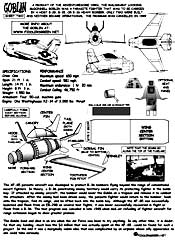
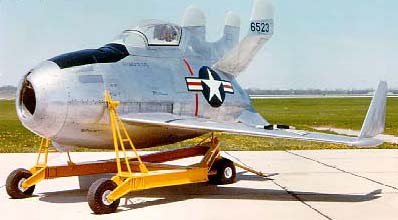
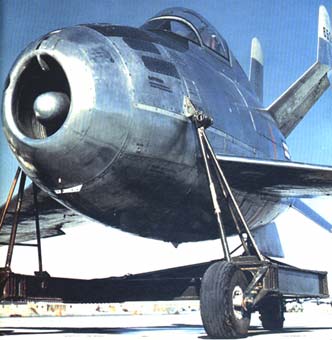
McDonnell XF-85 Goblin was a tiny, short fuselage fitted with low/mid-set foldable swept wings, of 21 ft 1.5 in (6.44 m) span. It was powered by a Westinghouse J34-WE-7 turbojet, of 3,000 lb. (1,361 kg) thrust. The fighter was intended to return to the parent aircraft and dock with a trapeze, by means of a retracting hook.

F-85 XF-85 McDonnell Goblin Parasite Jet Fighter
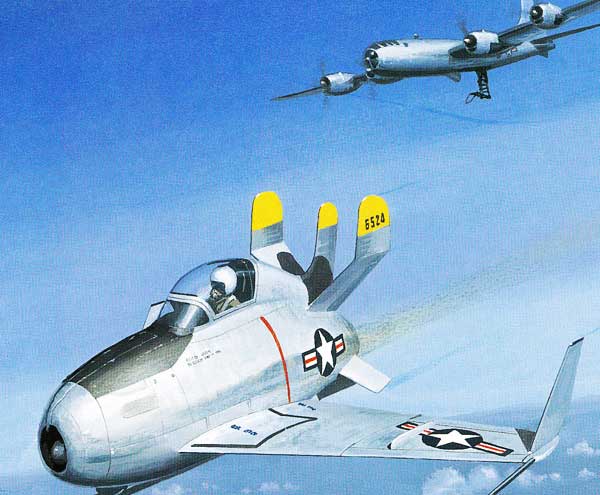

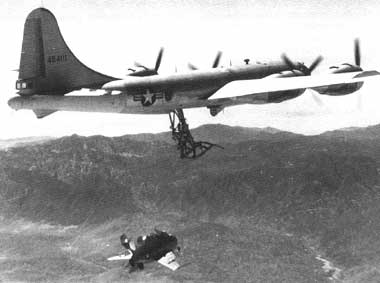
The XF-85 Goblin was intended to let heavy bombers bring along their own fighter escort along the lines of various 'parasite fighter' experiments, conducted with US airships and Soviet bombers in the 1930s. The XF-85 itself was designed entirely around the constraints of the bomb bay of the B-36 and thus lacked the performance of a conventional fighter. After fighting off the enemy (with its four machine guns) the XF-85 Goblin was to return to the bomber and hook on to its trapeze. In its test programme, using a B-29, turbulence under the bomber made this very difficult and it was only achieved three times. On another flight the hook broke the canopy and knocked off the pilot's helmet. Experiments were abandoned, but later on modified F-84s were flown under B-36s.
Another idea was that the B-36 could be used to carry an RF-84F reconnaissance fighter; the latter would be launched at some point outside hostile territory, up to 2800 miles from the B-36's base, at an altitude of 25,000 ft and would then make a dash over the target
at high speed, after which it would be retrieved by the parent aircraft. It
was a desperate idea born of desperate times. Its performance and armament would have been inadequate to deal with the MiG fighters it would have encountered
in action.
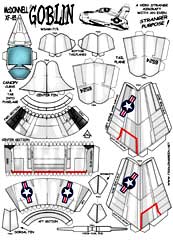
Shown is the larger size of this mini monster- 6'5" wing span.
There's another in the folder that is about 1:60
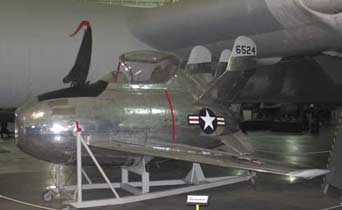
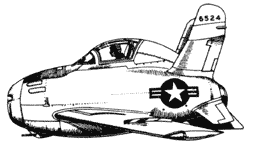
I was looking at the XF-85 today and remembered that the local museum I work at has one of the originals. Your model with tail # S/N 46-524 is the plane that is here. I knew this for sometime now but it didn't really hit me
until today. Here is the link to the museums website for the XF-85. http://strategicairandspace.com/collections/F-85.html I've attached a couple of pictures of the real one as well. In the museum, the Goblin is right next the the B-36F. It's a pretty neat display. Hope this is helpful. (see right) Brett Redemske
Quick historical note on the Goblin:
Another reason for the USAF dropping it was that, in addition to
being unstable as all get-out (which is normally a good thing in
a fighter), the control surfaces were so dinky that pilots invariably
over controlled the li' l beast trying to hook the trapeze for recovery--after
a couple of midair's (with the Goblin coming off second-best), common
sense eventually prevailed and the Boys in Blue opted to go back
to sticking drop tanks on escorting fighters. Bill Tuttle
McDonnell XF-85 Goblin Parasite Jet Fighter
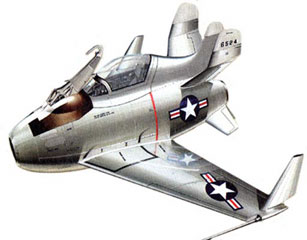
 The F-85 (XF-85) McDonnell "Goblin" Parasite Jet Fighter.
The XF-85 was developed to protect B-36 bombers flying beyond the
range of conventional escort fighters. In theory, a B-36 penetrating
enemy territory would carry its protecting fighter in the bomb bay, ready to fly in front.
The F-85 (XF-85) McDonnell "Goblin" Parasite Jet Fighter.
The XF-85 was developed to protect B-36 bombers flying beyond the
range of conventional escort fighters. In theory, a B-36 penetrating
enemy territory would carry its protecting fighter in the bomb bay, ready to fly in front.
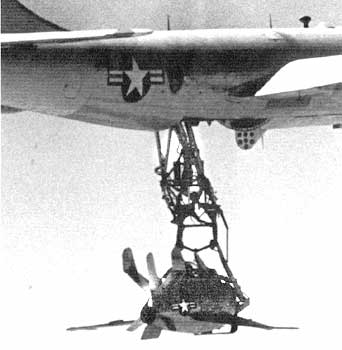
If attacked by enemy aircraft, the bomber would lower the Goblin on a trapeze and release it to combat the attackers.
After the enemy had been driven away, the parasite fighter would return to the bomber, hook onto the trapeze, fold its wings, and be lifted back into the bomb bay. Although the XF-85 was successfully launched and flown from an EB-29B on several test flights, it was never successfully recovered in flight or flown from a B-36.
The test program was canceled in late 1949 when mid-air refueling of fighter aircraft for range extension began to show greater promise.
FICON (Fighter-Conveyor) was a project intended to provide the B-36 with its own fighter type aircraft to be carried into the combat zone. The first such project involved the McDonnell XF-85, ordered October 9, 1945, a midget fighter designed to be carried within the B-36 bomb bay. Although two XF-85 prototypes were built and flight tested from a B-29B in August 1948, the concept did not prove practical.
In spite of that failure, Convair received a contract for a prototype FICON system to carry and retrieve a Republic F-84E single-seat fighter from a B-36. On January 19, 1951 RB-36F-1, 49-2707, was assigned for modification as the GRB-36F prototype and was able to make its first contact flight on January 9, 1952.
 |
 |
 |
 |
XF-85 Goblin
During the strategic air offensive against Germany during World War 11, the US Army Air Forces had faced serious and deadly opposition from Luftwaffe interceptors. To counter this threat, the development of long-range fighters to escort the bombers had become one of the USAAF's highest priority projects.
 The wartime problem was solved by the development of long range
escort fighters, but as the war was ending, the USAAF was beginning
to develop bombers such as the Boeing B-50 and Convair B-36, whose
range was three to five times greater than that of the bombers
that had been used against Germany. This necessitated the development
of escort fighters capable of matching the longer range, a problematic
situation which led to the consideration of other, more radical,
solutions.
The wartime problem was solved by the development of long range
escort fighters, but as the war was ending, the USAAF was beginning
to develop bombers such as the Boeing B-50 and Convair B-36, whose
range was three to five times greater than that of the bombers
that had been used against Germany. This necessitated the development
of escort fighters capable of matching the longer range, a problematic
situation which led to the consideration of other, more radical,
solutions.
As early as the summer of 1944, when the USAAF was pondering its dilemma, the idea of developing an escort fighter that could be carried by a bomber was proposed. Even then, it really wasn't a new idea'. In the early 1930s Curtiss F9C-2 Sparrowhawk fighters had successfully conducted similar operations on a routine basis, flying from a 'trapeze' apparatus slung beneath the US Navy dirigibles Akron and Macon. The idea of conducting such operations from bombers flying at much higher speeds presented a great many additional problems. Not the least of these was the fact that the weight of the fighter would cut the bomb load proportionally. Future bombers, however, would be bigger, so if a fighter could be made smaller, a workable equation was theoretically possible.
Early in 1945, the USAAF's Air Technical Services Command (ATSC) began sounding out various airplane builders on the idea of building an ultra lightweight 'parasite' fighter that could be carried by the new, larger bombers that would be coming on-line in the late 1940s. McDonnell Aircraft of St Louis, a new, and certainly eager, company was willing to give it a try. McDonnell's original proposal was submitted in March 1945, and in October the USAAF ordered two prototypes under the designation XP-85, and with the stipulation that the resulting fighters had to fit entirely within a B-36 bomb bay.
In September 1947, the USAAF became the US Air Force, and in July 1948, the latter took delivery of the first XP-85 at Muroc (now Edwards) AFB, which was redesignated XF-85 under the Air Force policy of designating fighters as fighters rather than as pursuit planes.
The XF-85, which was named Goblin because of James Smith McDonnell's belief in the spirit world, was the smallest jet fighter that would ever be built. It was a tiny, rotund creature that looked more like an amusement park airplane than a serious Air Force program. The Goblin was only 15 feet long, with a wingspan of 21 feet. Its gross weight was 5600 pounds. It was powered by a Westinghouse J34 turbojet, and could be launched at altitudes up to 48,200 feet. Its performance could thus be maximized, because - unlike most fighters - it wouldn't have to expend time and fuel getting to altitude.
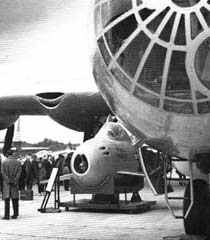
In the proposed scenario, B-36s deep inside enemy territory would, upon encountering enemy interceptors, release a swarm of Goblins to chase them away. The F-85s would have a duration of an hour or more, which was considered adequate for the job. The Goblin would fit into a B-36, and it looked good on paper, but somehow the idea of F-85s chasing MiG-17s is somewhat surreal.
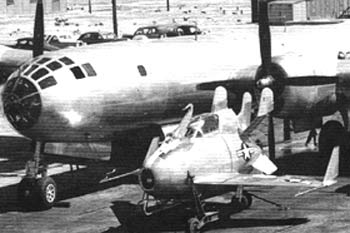
The first 'parasite -ready' B-36 wasn't yet available, so the XF-85 test flights, that began on 28 August 1948, were conducted from a B-29 fitted with the 'trapeze' that was designed for the B-36. There were only seven flights conducted, but the XF-85 pilot was able to reattach the Goblin to the trapeze in only three of these. In the cases of these aborts, he had to bring the tiny airplane in for belly landings because it was designed without landing gear.
By 1949, it had -become clear to the Air Force that parasite fighters would not be a practical solution to the escort fighter program, and on 24 October, the XF-85 program was terminated. Both prototypes were, however, preserv6d rather than being scrapped.
The Goblin lived and died in an era when the Air Force was keen to try anything. In any other time, it is doubtful that any funding -much less the $3 million that was actually spent on the XF-85 -could be found for such a project. In the end it was a marginally viable idea that was complicated by an airplane whose silly appearance no one could take seriously.
The XF-85 was first tested in August 1948 over the Mojave Desert. A B-29 carried it aloft and then extended the parasite on an elaborate 'trapeze.' The Goblin was then released to scamper home on its own. The XF-85 was designed to equip the giant B-36 bombers but was never carried by any aircraft other than a single B-29 which was the only aircraft ever equipped with an operational XF-85 trapeze.
The XF-85 Goblin resurrected the concept of a parasite fighter - an aircraft carried by and launched from a bomber for which it was intended to provide defense. Designed as the Model 27 under the leadership of Herman D Barkley, the XF-85 was intended to be carried by the Convair B-36 bomber and was the subject of a Letter of Intent for two prototypes on 9 October 1945. A small, egg-shaped aircraft with vertically-folding wings and triple vertical tail surfaces, the fighter was intended to be launched from and recovered by a retractable trapeze. This was to be extended beneath the parent bomber, no undercarriage being fitted to the fighter.
Thanks to Peter Eveleigh for these Goblin Pictures! (5/03) |
|
Goblin on a Clothespin! 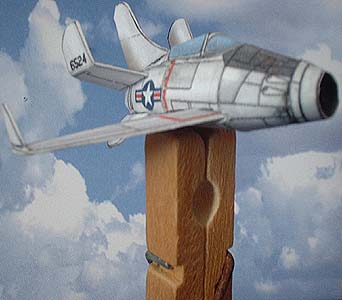 |
Goblin in the Palm! 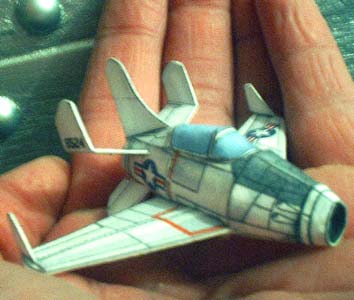 |
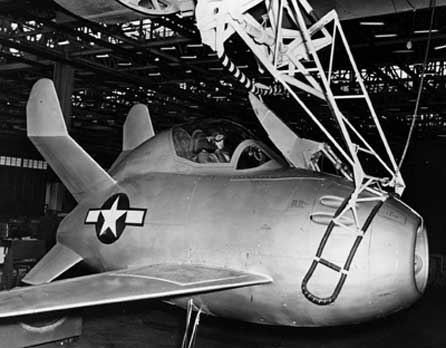 |
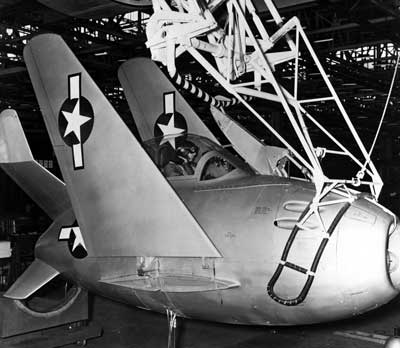 |
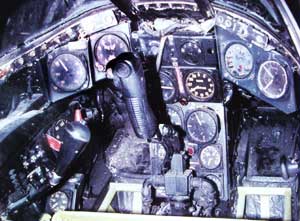 |
McDonnell XF-85 Goblin Cockpit. |
Specifications of the McDonnell XF-85 Goblin
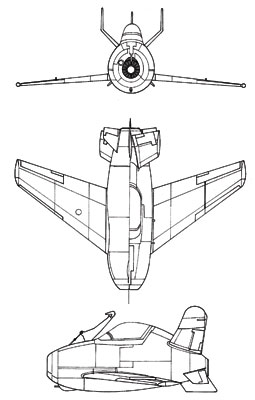 |
Length: 14 ft 10 in Wingspan: 21 ft 1 in Height: 8 ft 3 in Wing area: 90 ft² Empty weight: 3,740 lb Loaded weight: 4,550 lb Powerplant: 1× Westinghouse XJ34-WE-22 turbojet, 3,000 lbf Performance Maximum speed: 664 mph Service ceiling: 48,000 ft Rate of climb: 12,500 ft/min Wing loading: 51 lb/ft² Thrust/weight: 0.66 Armament 4 × 0.50 in (12.7 mm) M2 Browning machine guns |
 |
||
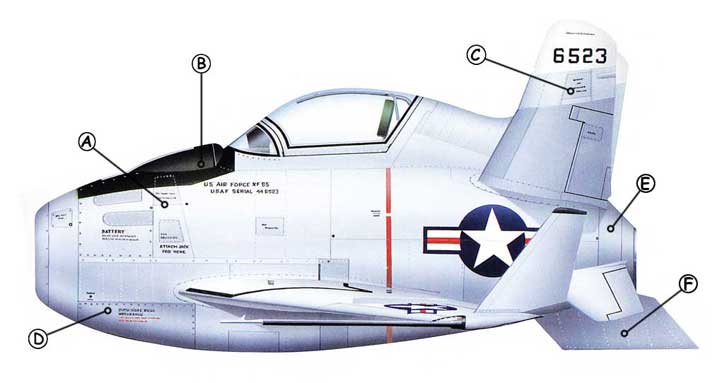
| A: The two prototype XF-85s did not have any armament fitted, but installations were provided for the carriage of four 12.7-mm (.50 cal.) Browning machine-guns in the upper sides of the fuselage. | B: Just forward of the cockpit was a large, retractable hook which attached the Goblin to the mothership. This was retracted for operations, and then extended again for recovery. | C: Flight control was undertaken using standard ailerons on the wings, and rudder/elevator surfaces on four of the tails. The ventral fin and wingtip fins were added after the disastrous first flight in an unsatisfactory attempt to improve stability during the hook-up procedure. |
| D: Fuel was crammed into any available space within the tiny fuselage. Total capacity was 200 gal., used up by the thirsty J34 engine in about 30 minutes. | E: Power was supplied by a single Westinghouse J34-WE-7 turbojet, mounted in the lower part of the fuselage. This engine was low on power but reliable by early jet standards. It was one of the few areas of the Goblin which did not give the engineering team problems. | F: The lower tail and low-set dihedral wings allowed the XF-85 to make a reasonably safe belly landing in the event that it could not hook back up. This was just as well: in the course of the XF-85's flights, pilot Ed Schoch had to make four belly landings. |
Just for fun...
Pete sent this for us.It's good for a chuckle, right?