

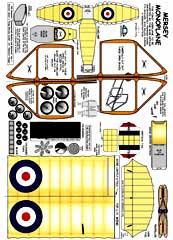
Mersey-Monoplane - $$4.95
Robert Fenwick designed the Mersey monoplane, which was the first plane to be accepted by the War Office. Unfortunately, during a demonstration, it plunged to the ground and he was killed. A tablet was placed at the entrance to the main hall of the South Shields Grammar Technical school to commemorate his name and achievements.

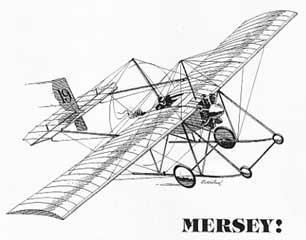
1912 British Mersey Monoplane
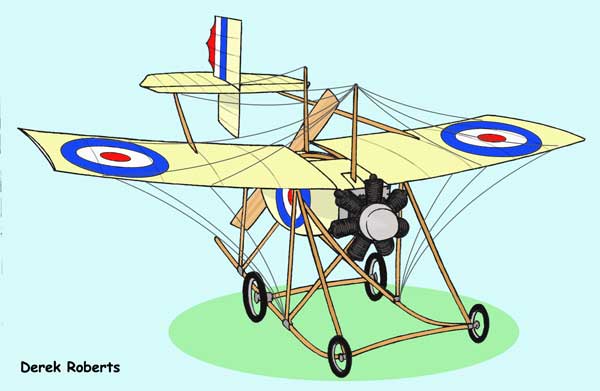
This original artwork by Derek Roberts is available in much higher quality (suitable for framing), on the Full Collection DVD.
The Mersey was a side by side 2 seater monoplane. The 1/2 reduction drive shaft passed between the seats. The span was 35 feet, chord 7 feet, area 220 sq ft, length 24 feet, weight 750 lbs empty and 1,150 fueled and occupied and top speed was 55 mph.
The power was from a 7 cylinder radial of somewhere between 45 and 60 HP. with the prop running at 1/2 engine rpm. The fuselage was 7 foot long (same as the cord). It held enough fuel to fly 6 hours. The number it had on it's tail during the trials was 19.
The Mersey was a British aircraft built in 1911. The plane was built by R.C. Fenwick and S.T. Swaby, who met at Planes Ltd. Fenwick designed and piloted the plane in 1911. "Janes" lists the plane as a 1912 model with a 60 HP Isaacson Radial motor but Goodall and Tagg say it had a 45 HP Isaacson 7 cylinder radial.
After test flights Fenwick enlarged the vertical and horizontal tail surfaces to present configuration.The plane competed in the British Military Trials of August 1912 and was said to have done quite well ( top 3) in spite of the fact that it crashed in the wind near Stonehenge and killed Fenwick.
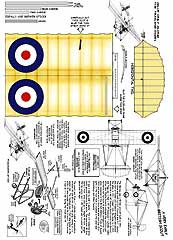
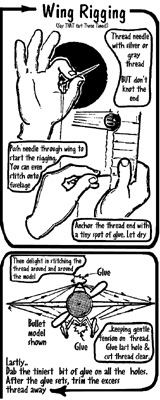
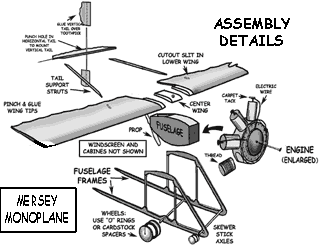
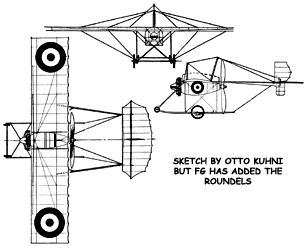
Download complete and successful. The locator holes on the undercarriage is going to be a real help. The drawing of the aircraft at the bottom of the instructions and the larger three-view clearly show all of the rigging locations. A big help when the time comes. The real fun is going to be keeping the rigging thread from getting tangled! Our cats will go nuts with all that thread being moved about ("Bad Kitty! Bad Kitty! No tuna fish!").FG models keep getting better with every new release. ...ymp,John
I keep thinking about the history of the Mersey and how insignificant you probably think it was. The reason that I was drawn to this plane is that it epitomized the plane of this era. If we remember that most of the airplane designers were artist and almost none were engineers. Most of the test pilots were the designer because there weren't any experienced test pilots ( also known as dare devils). And many planes made their maiden voyage with a pilot who was flying for the first time..
The Mersey was the perfect example of many of these tenants and the designer, test pilot died in his plane. The success of this plane in the trials must have inspired the Voisines and De Havilland and others to develop pusher planes. The first successful English fighter was the DH2 because as a pusher, It could fire it's machine gun forward! It must have been a bit scary with it's 7 cylinders spinning at 1200 RPM right behind the pilot. Ric
1912 British Mersey Monoplane
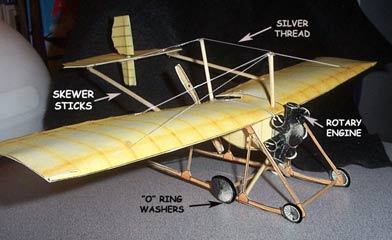
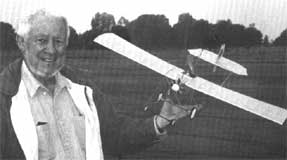
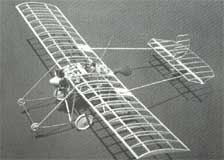
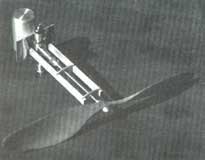
Otto Kuhni's and his Flying Mersey Monoplane Model
Specifications for the Mersey Monoplane
 |
Length: 24ft |