

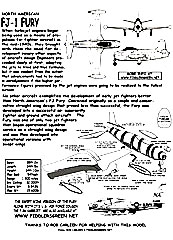
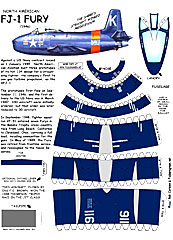
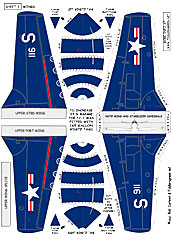
North American Fury - $$5.95
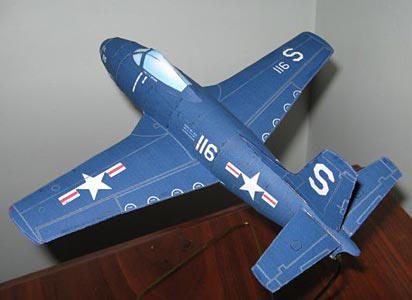
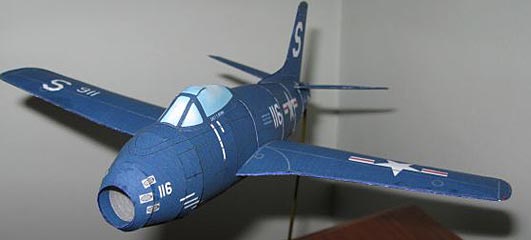
Another Navy model by Rob Carleen, who is retired from the Navy. Don't miss the 5 page tutorial Rob put together about how he designed this model. You can thank him- he will enjoy hearing from you.. rcarleen@cox.net ALSO, the FG model 'Fury-FJ1' has been deleted and added to this folder as an additional version

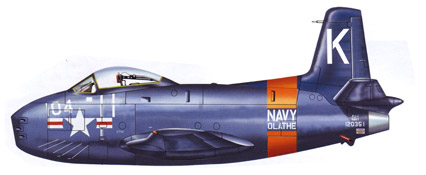
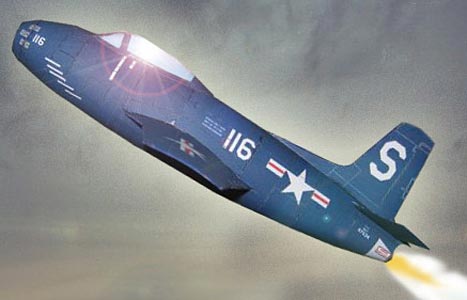
North American FJ-1 Fury
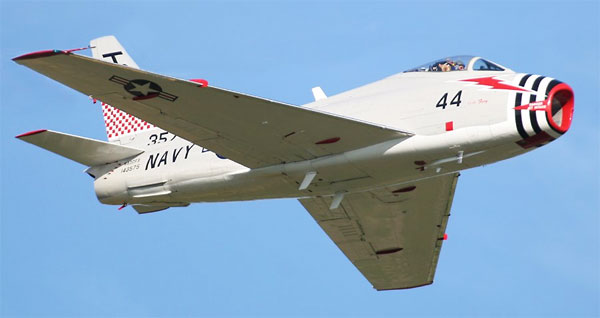
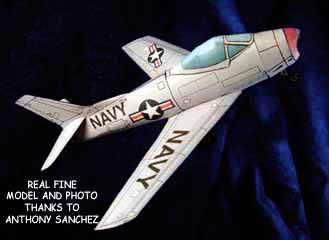
Beginning life as the straight-winged FJ-1, the North American Fury became the first jet fighter to go to sea under operational conditions. After the US Navy belatedly followed the USAF in using German research data to produce swept-wing fighters, the FJ Fury was reborn as a carrier-based equivalent of the F-86 Sabre. The swept-wing Fury was one of the Navy's first fighters to carry missiles and served widely in the 1950s.
From the fat, straightwinged, dark blue FJ-1 to the sleek, swept-winged, gray and white FJ-4, the North American FJ Fury fighters of the US Navy and Marine Corps marked a decade of progress that began at the start of the jet age and continued to the brink of the supersonic era. Although the Fury never went to war, from the late 1940s to the Beirut crisis of 1958, the aircraft was armed and ready to fight if the need arose.
Thirty straight-winged FJ-1 Fury fighters were briefly the newest and fastest machines in the sky when they went aboard the carrier USS Boxer in 1948. Quickly overtaken by other jets (the Navy focusing on the straight-wing F9F Panther which became its standard fighter in the Korean War), the FJ-1 Fury was relegated to Reserve duty and then retired, in less than two years.
North American, meanwhile, had developed a faster, sweptwing aircraft, based on the FJ-1 and called the F-86 Sabre, for the USAF. The swept-wing FJ-2, FJ-3 and FJ-4 Fury fighters resulted from an effort to produce a navalized F-86. While the first FJ-2 was little more than a Sabre in blue paint, the FJ-3 and much improved FJ-4 missile-armed attack fighter introduced new engines and major airframe and equipment changes.
Not being one to let a nit go by unpicked, I have to point out the the first Jet to operate from an Aircraft Carrier was not the North American Fury, but the De Havilland Vampire which flew off of HMS Ocean in Dec 1945. The RN also tried out a version without undercarriage which was to land on a rubberized deck, it worked but was not put into production (which I suspect resulted in a loud sigh of relief by the aircrew...<g>).Rick (8/06)
Chip,Sorry.. you reversed the history of the North American FJ-1 and F-86 and there is a bit more to the wing sweep story.
The Navy FJ-1 came first. Known within the Company as the NA-134, the XFJ-1 first flew in November 1946. As the Navy was placing the first orders, the Air Force followed up with an order for the derivative NA-140 with a thinner wing. This was then developed further into the swept wing F-86. Which was navalized to become the FJ-2 & FJ-3. The FJ-4 was still called a Fury, but as a new design, it didn't share much of anything with the F-86s. So the Navy flew swept wing North American Aviation jets from its carriers in the 1950s.
Wing sweep was first alluded to in a paper at the 1935 Volta Conference by Adolph Buseman. The NACA's R.T. Jones independently arrived at the concept of wing sweep for transonic aircraft, published in a February 1945 paper in the U.S. But the idea was met with resistance, until similar work was discovered in German research facilities several months later. Only then did the work of R.T. Jones find its way onto the B-47 and F-86. Cam Martin (8/06)
Actually, the 1946 FJ-1 design preceded the F-86. The original straight-winged F-86 was developed parallel to the FJ-1 but lagged behind. After the FJ-1 was in production, the captured WW2 German data came to light, was evaluated & applied to the redesigned F-86. There was some initial reluctance about flying swept-wing jets off the carriers, but the Korean War demonstrated that straight-wing jets were overmatched. Hence the swept-wing Cougar developed from the straight-winged Panther. The later swept-wing Fury jets were the F-86 derivatives and had nothing in common with the straight-winged FJ-1's. Rick Boyette (8/06)
.".. to break the sound barrier you needed swept wings"
Chip, I can think of a few supersonic aircraft with "straight"
wings. X-1, F-104, etc
Wing sweep is very useful for accelerating through the trans sonic
region, but not essential, especially if you have enough excess
thrust. Not sure what fighters you have in mind when you say
the FJ-1 was one of ONLY two fighters to enter service with
straight wings and then later to be be evolved with swept
wings. There are at least 3...the F-84, the F9F, and the Fury. There
may be more... Cam (8/06)
 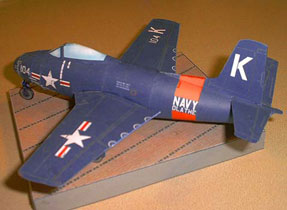 These are photos of Rob's beta build |
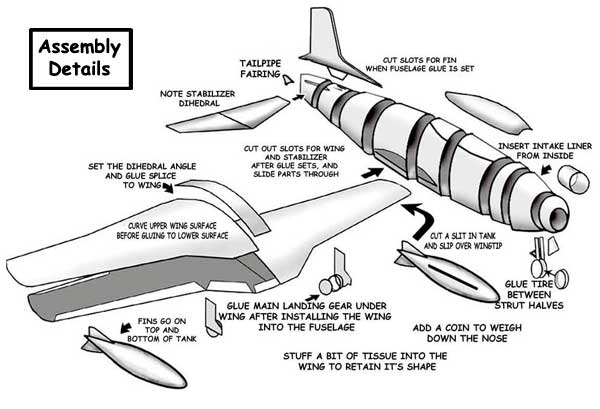
Included in the FJ-1 folder, is this tutorial with some good design tips regarding Rob's FJ-1 Fury. |
North American FJ-1 Fury
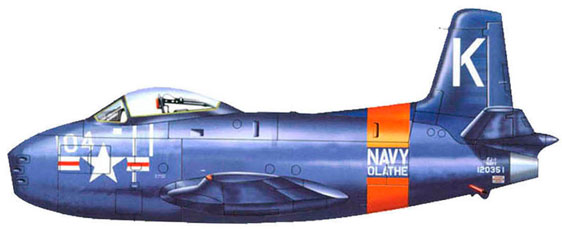
The U. S. Navy's first experiments with jet power for carrier-based aircraft began with several composite designs which combined both a piston engine and a turbojet in the same aircraft. But the Navy realized that a true jet fighter had to be developed for carrier use if naval aviation was to remain an important part of America's military in the post World War II era.
The unknowns associated with jet engines and the development of jet aircraft in general caused the Navy to issue contracts for two jet fighter designs. One of these was to the Vought Corporation on December 12, 1944, for the XF6U Pirate. The second was made to North American Aviation for the XFJ-1, known as model NA-134 at North American. This contract was issued on January 1, 1945, just twenty-six days before McDonnell's XFD-1 prototype made its initial flight.
On May 28, 1945, the Navy placed an order for one hundred production FJ-1s and bestowed the name Fury on the aircraft. As work continued on the development of the XFJ- Is, the U. S. Army Air Forces contracted with North American for a refinement of the design which featured a more slender fuselage and swept back flying surfaces. This was known as NA-140 at North American, and it was reviewed by the Navy.
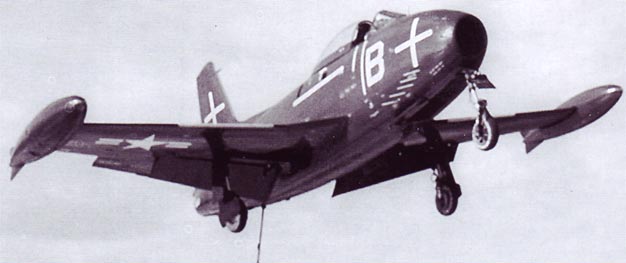
The Navy took the conservative approach and opted to stay with the original design of NA-134. While it was obvious that NA-140 with its swept wings would offer better performance, the Navy was concerned that it could not fly slowly enough to land aboard an aircraft carrier. The straight wing of the NA-134 permitted better handling at slower speeds necessary for carrier operations, but the Navy had no flight data to indicate that this could be done with a swept wing fighter.
 There appears to be some debate on when the maiden flight of the
first of the three XFJ-1 prototypes took place. Some references
indicate that it was made on November 27, 1946, but official Navy
records state that it was made on September 11, 1946.
There appears to be some debate on when the maiden flight of the
first of the three XFJ-1 prototypes took place. Some references
indicate that it was made on November 27, 1946, but official Navy
records state that it was made on September 11, 1946.
The first production FJ-1,was delivered to the Navy in March 1947, however the initial contract of one hundred FJ-1's was reduced to only thirty. Several of these went to the Naval Air Test Center at Patuxent River. In March 1948, two FJ-1s were used for carrier evaluations aboard USS BOXER, CV-21. VF-5A's evaluations aboard BOXER marked the first time jet aircraft assigned to a regular line squadron had operated from a carrier.
After the squadron's designation had been changed to VF-51 in mid-1948, seven of their aircraft took part in the Bendix Trophy race between Long Beach, California, and Cleveland, Ohio. But a disastrous carrier evaluation by eight of the squadron's FJ-1s aboard USS PRINCETON, CV-37, along with more confidence in the swept wing design, led to a quick retirement of the FJ-1 from active Navy service.
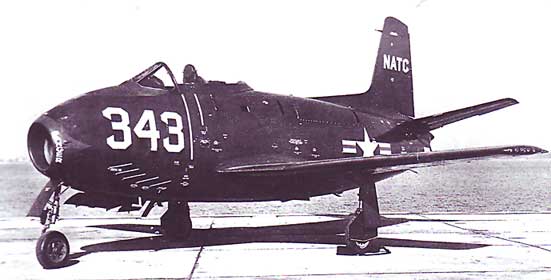
When turbojet engines began being used as a means of propulsion for fighter aircraft in the mid-1940s, they brought with them the need for development in many other aspects of aircraft design.
Sometimes innovation requires a new approach. Engineers proceeded slowly at first, adapting the
jets to tried and true formulas, but it was evident from the outset
that advancements had to be made in aerodynamics if the higher
performance figures promised by the jet engines were going to
be realized to the fullest extent. Swept wings and tail surfaces,
more aerodynamic fuselages, and new control surfaces, like the
all-flying tail, became necessary as development of jet fighters
progressed.
Pilots of propeller-driven fighters simply jumped out of their
stricken aircraft when a bailout became necessary in an emergency.
But jets flew too fast, so ejection seats became necessary. The
higher speeds also meant that standard machine gun armament became
less effective. They had to be replaced with rapid-fire aerial
cannons firing explosive shells which could destroy a target with
fewer hits. Almost every aspect and component of the fighter,
from the fire control system to the brakes, had to be improved
or completely redesigned.
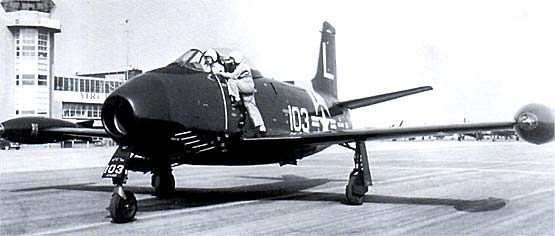 No other aircraft exemplifies the development of early jet fighters
better than North American's FJ Fury. Conceived originally as
a simple and conservative straight wing design that proved less
than successful, the Fury was developed into a successful air
superiority fighter and ground attack aircraft. The incorporation
of a more powerful engine, swept wings and tail surfaces, an all-flying
tail, and 20-mm cannons instead of .50-caliber machine guns, all
contributed to the success of the later versions of the Fury.
No other aircraft exemplifies the development of early jet fighters
better than North American's FJ Fury. Conceived originally as
a simple and conservative straight wing design that proved less
than successful, the Fury was developed into a successful air
superiority fighter and ground attack aircraft. The incorporation
of a more powerful engine, swept wings and tail surfaces, an all-flying
tail, and 20-mm cannons instead of .50-caliber machine guns, all
contributed to the success of the later versions of the Fury.
The Fury was one of only two jet fighters that began operational squadron service as a straight wing design and was then developed into operational versions with swept wings. The other was Grumman's F9F Panther and Cougar, and like the F9F, the swept wing versions of the Fury included two quite different refinements in the design of both the wing and fuselage. The Fury was also involved in the rapid advancements relating to more powerful and sophisticated armament.
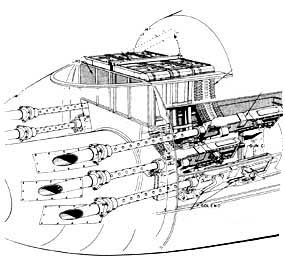
The FJ-1 was armed with six .50-caliber machine guns and had no
capabilities to carry external ordnance. Four 20-mm cannons replaced
the machine guns in the FJ-2, and provisions to carry basic underwing
stores, in the form of rockets and bombs, were also added. The capability
to employ the infrared-guided Sidewinder air-to-air missile appeared
on the FJ-3M and was retained on the FJ-4 and FJ-4B. The FJ-4B could
carry the command-guided Bullpup air-to-ground 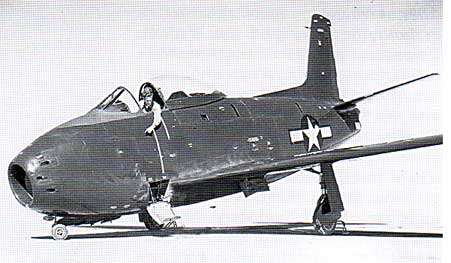 missile, rockets,
and both conventional and tactical nuclear bombs.
missile, rockets,
and both conventional and tactical nuclear bombs.
The FJ-3, FJ-3M, FJ-4, and FJ-4B versions of the Fury were still in service when the Department of Defense directed that aircraft designations within all services of the military should be standardized. The FJ-3 became the F-1 C, the FJ-3M was redesignated MF-1 C. The FJ-4 became the F-1 E, and the FJ-4B was redesignated AF- 1F to indicate its attack mission.
Unlike most other carrier aircraft, the FJ-1 did not have folding wings. To conserve valuable and limited space aboard ship, a small dual-wheel truck could be attached to the forward nose gear door. After the small wheels were attached, the nose gear was retracted, causing the aircraft to "kneel". The lowered nose of one FJ-1 could then be tucked under the high tall of another, thus saving space.
 |
 |
 |
On February 29,1948, three FJ-1s from VF-5A took off from Seattle and set speed records to San Francisco, Los Angeles, and San Diego. CDR Evan "Pete" Aurand flew the 1,205 miles between Seattle and Los Angles in one hour, fifty-eight minutes, and seven seconds. LCDR John J. Magda averaged 511.8 miles-per-hour flying from Seattle to San Diego in two hours, twelve minutes, and fifty-four seconds. The third Fury, flown by LCDR Robert Elder, averaged 492.6 miles-per-hour flying the 690 miles from Seattle to San Francisco. Shortly after entering service, the FJ-1 Fury had made its presence known by grabbing the headlines.
 |
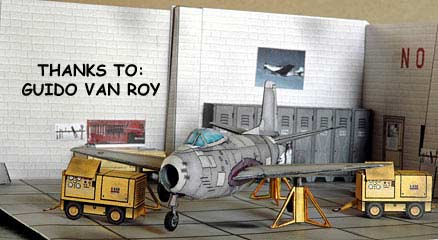 |
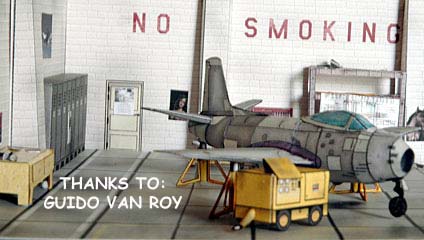
| Another neat diorama from Guido Van Roy! | |
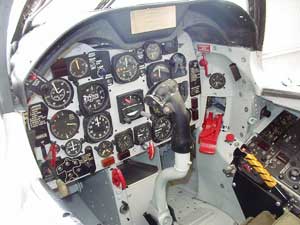 |
| Cockpit of the North American FJ-4B Fury. |
Specifications for the North American FJ-1 Fury
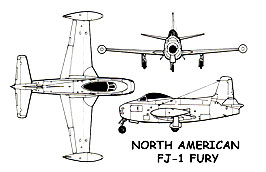 |
Span: 38ft 2in Length: 34ft 5in Height: l4ft l0in Empty Wt: 8,348 lbs Max Wt: 15,600 lbs Performance Max Speed: 547mph Range: 1,500 miles Service Ceiling: 32,000ft |
 |
|||
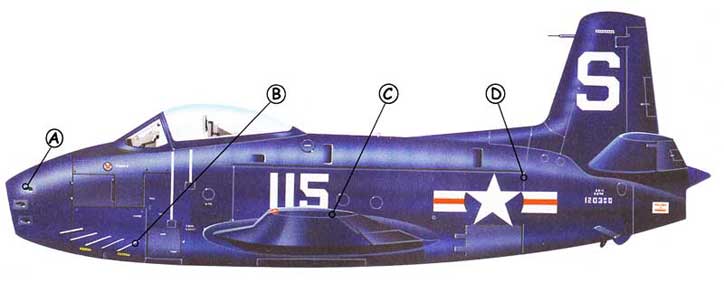
| A: Fitted with six 12.7-mm (.50-cal.) machine guns in the nose, the FJ-1 was the last US Navy aircraft to have 'half-inch' guns. | B: Like the McDonnell FH-1 Phantom which followed it, the FJ-1 was able to 'kneel' on the carrier deck by retracting its nose gear and resting on a tiny wheel. This facilitated stowage without wing folding. | C: To increase its somewhat limited range, the FJ-1 was soon fitted with 165-gallon wingtip fuel tanks. Airbrakes were a feature of all FJ variants, especially the FJ-4B attack version. | D: Designed around the General Electric J35 axial-flow turbojet, the production Fury used an Allison-built variant of this engine, producing 4000 lb thrust. |
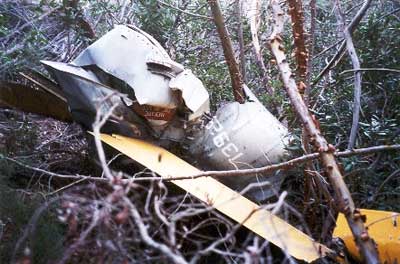 |
| 3/27/61 North American FJ-4 #139291 crashed in cloudy weather killing the pilot Lt. JG Henry M. "Hank" Harding, USN. Site is on West Otay Mountain at the 2,500 foot level near the Mexican Border about a half mile north of road in heavy brush. |