

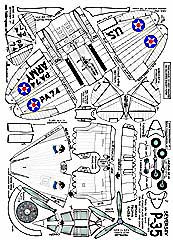
P-35 - $$4.50
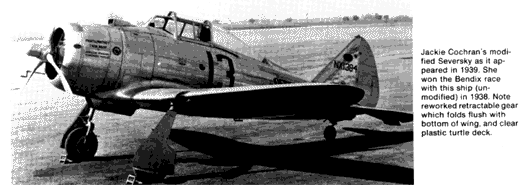
The Seversky P-35 was a fighter aircraft built in the United States in the late 1930s. The P-35 was the first single-seat fighter in U.S. Army Air Corps to feature all-metal construction, a retractable landing gear and an enclosed cockpit.

The Seversky P-35-Predecessor of the P-47 Thunderbolt

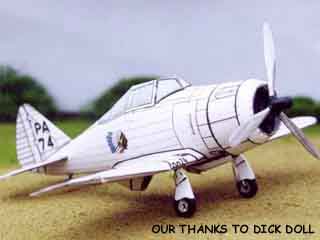
The Seversky P-35 was powered by a 900-h.p. P. & W. radial; top speed: 285 m.p.h. This was the last model produced by Seversky before renaming as Republic Aviation. Predecessor of famed World War II "Thunderbolt" and sister of the SEV-S2 racing plane which is also in this collection.
Seversky P-35
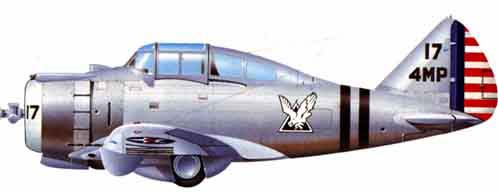
With the purchase of 77 Seversky P-35's on June 16, 1936, the Army Air Corps began the next generation of fighters. Retractable landing gear, all-metal construction, enclosed cockpit canopy-all were standard on fighters now, and the new designs displayed an aesthetic elegance as they flashed through the sky.
The Seversky Sev-1 was declared the winner of a hotly contested competition with the Curtiss Model 75 in April 1936. Engine troubles plagued both competitors during the evaluation. The Seversky plane could not reach the guaranteed 300 mph speed with its 850 hp Wright XR-1820-39 Cyclone engine so an 850 hp Pratt & Whitney R-1830 Twin Wasp was mounted in its place. The top speed dropped even more as the new engine actually developed only 740 hp. Despite the engine problems, the Army accepted the Seversky contender and began receiving the first of 76 Twin Wasp powered P-35's in July 1937.
The landing gear of the P-35 retracted straight back and remained partially exposed. A streamlined fairing smoothed the airflow around the tire to reduce drag. Armament was two nose-mounted machine guns, one .30 cal. and one .50 cal., totally inadequate by now but stubbornly adhered to by the Air Corps. Ten 30 pound bombs could be carried externally. Fuel capacity was 200 gallons providing a range of 1,000 miles at 200 mph.
Seversky began taking orders for an export version of the P-35 as the EP-1, and a contract for 120 planes was received from Sweden. Half of the order had been delivered to Sweden when war broke out and the deliveries ceased. The U. S. Army purchased the remaining 60 EP-1's as P- 35A's. By this time, Seversky had become the Republic Company and subsequent fighters of this type bore the Republic name.
The P-35A was a greatly improved plane with a 1,050 hp Twin Wasp finally delivering the elusive 300 mph speed-it could reach 305 mph at 12,000 feet.
Seversky to Republic Aircraft
During its lifetime, Republic Aircraft Corporation constructed tens of thousands of combat aircraft yet, today, any form of Republic fighter is a very rare commodity. During the 1930s, a one-legged former Czarist Russian aristocrat had a very profound effect on American military aircraft design. Alexander P. de Seversky had been born in Tiflis, Russia, to a wealthy family. During the Great War, he entered the Imperial Russian Naval Air Service but on his first combat mission Seversky had the misfortune of having his aircraft hit by antiaircraft fire during an attack on German naval units in the Gulf of Rige. Seversky managed to bring his burning aircraft down for a rough crash-landing in the open sea but a bomb had hung up on its rack and detonated upon impact with the water.
The explosion instantly killed Seversky's observer and blew his own right leg off. Rescued by friendly forces, Seversky was rushed to a hospital and his life was saved. During his recuperation, the pilot demanded an artificial limb so he could get back into combat! His superiors thought him mad but eventually gave in and Seversky entered combat with an enthusiasm that bordered on mania. Seversky attacked every German aircraft that he spotted with a wild abandon. His score of enemy aircraft confirmed destroyed mounted, and he soon had 13 to his credit and was ranked as Russia's third highest ace.
 During 1917, Seversky was ordered to travel to the United States on a fact-finding mission to check on that country's supply of raw and finished war materials. Seversky crossed the country, visiting war plants and talking to high-placed officials. While Seversky was in the United States, the depressing news of the Russian revolution reached him. Deciding not to return to a country dominated by the hated Communists, a type that he detested even more than the Germans, Seversky made the choice to stay in the United States and work to become a citizen of the country that he had quickly learned to admire.
Seversky built up a large friendship of important military and political officials and during the 1920s patented a number of devices that helped develop aviation. In 1926, he was commissioned as a major in the Army Air Corps Reserve, a rank that he would proudly use for the rest of his life.
In 1931, with the help of investors, he set up his own aircraft company and began developing numerous modern aircraft which eventually resulted in the Seversky P-35 pursuit, the US Army Air Corps' first modern production fighter with all-metal construction, enclosed cockpit, and retractable landing gear. Seversky and chief designer Alexander Kartveli, also a Russian refugee, were always modifying their designs to attract more customers- especially lucrative export orders. The company made a controversial sale to the Japanese government in 1939 of 20 SEV2PA-B3 two-seat fighters which were based on the basic P-35 design.
The contract with the Japanese had a disastrous effect on future business for Seversky. The secret nature of the Seversky negotiations with the Japanese government angered American politicians who, in turn, apparently exerted considerable pressure on the Air Corps not to order any more P-35s and, instead, to concentrate on the rival Curtiss Model 75-the pursuit that would become known as the P-36.
While no actual evidence was uncovered that Seversky acted illegally, his sale of aircraft to Japan was extremely unpopular with the public and the company began to experience severe financial difficulties. While Seversky was in England trying to convince the British that the P-35 was just what they wanted (fortunately, they knew better), the Board of Directors ousted Seversky and reorganized the company in order to avoid bankruptcy. The new organization became known as the Republic Aircraft Corporation.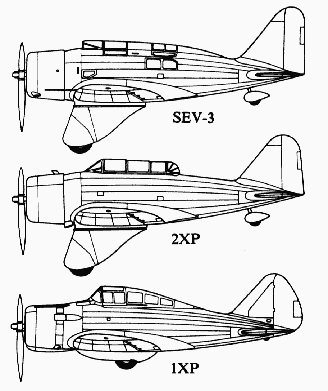
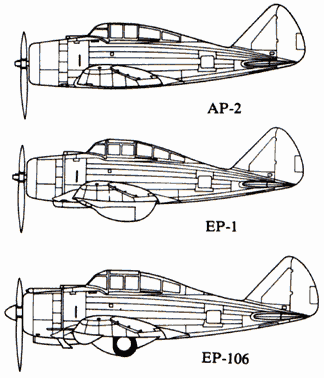
During this time of transition, a deal was being struck with Sweden for the sale of modified P-35s. During February 1939, Sweden placed an order with Republic for 100 EP- I 06s (the designation of EP- 1 was also utilized for this aircraft) and 50 SEV2PA-204A two-place fighters that were to be outfitted as dive bombers. The first batch of EP- I s arrived in Sweden and a second order for 60EP- 1 s was signed.
However, events soon turned sour for Sweden when the United States placed an embargo on all military goods to that nation and, on 24 October 1940, claimed all the completed and uncompleted Swedish aircraft in the United States. The remaining EP- I s were given the designation P-35A and shipped to the Philippines to bolster American defenses. Only two of the dive bombers had been delivered and the remaining aircraft were taken over by the Army Air Force (redesignated the previous June) and assigned to training units as AT- 12 Guardsman advanced trainers.
The 48 AT- I 2s led a quiet life, serving mainly as base hacks and at the conclusion of the war, the majority of survivors were simply scrapped. However, a couple were sold surplus. One surplus AT- 12 was even entered (as a "Super P-35") into the 1949 Bendix Trophy cross-country speed dash! Flown by Vincent Perron and sponsored by actor Buddy Rogers, the completely outclassed Guardsman was registered NX55811 and carried the race number 61. The AT12 was to start off with the rest of the competition from a race horse start on Rosemond Dry Lake but Perron had a hard time starting the engine and the AT- 12 was the last craft to take off. Perron and the AT- 12 dropped out at Grand Junction, Colorado, with a malfunctioning engine, thus ending the "Super P-35's" brief moment of fame.
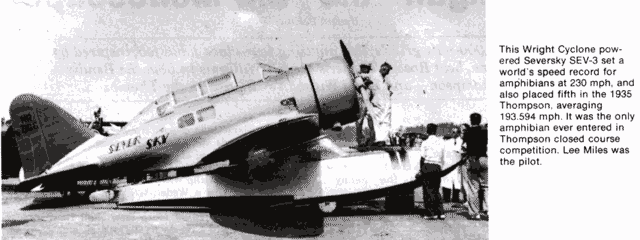
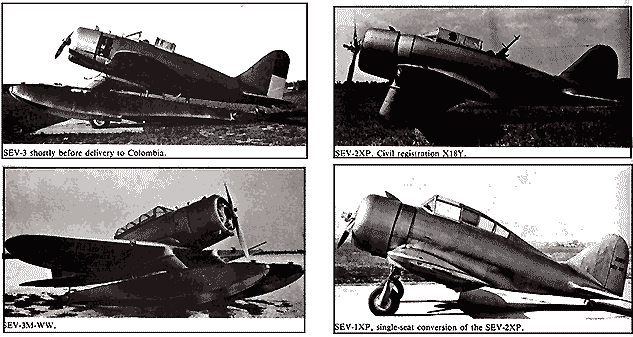
 As a private venture, Seversky built the prototype of a two-seat fighter which it designated Seversky SEV-2XP, but while being evaluated by the US Army Air Corps in June 1935 this prototype was damaged sufficiently to need factory repair. The company's designer Alexander Kartveli, took the opportunity to introduce retractable main landing gear and revised the cockpit as a single seater, the aircraft then being redesignated SEV-1XP. When tested by the USAAC it was found to be underpowered, its 634-kW (850-hp) Wright R-1820-G5 Cyclone radial then being replaced by a Pratt & Whitney R-1830-9 Twin Wasp of similar output, resulting in the new designation SEV-7.
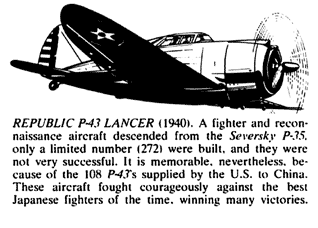
Performance had deteriorated still further, the R-1830-9 delivering little more than 85 per cent of its rated power resulting in the installation of an R-1830-9 engine with a guaranteed output of 708 kW (950 hp) in the aircraft that was then redesignated AP-1. In this form the type was ordered by the USAAC under the designation P-35, the first of 77 aircraft being delivered in July 1937. The last of the batch was completed as an improved aircraft designated XP-41 which flew shortly before the company changed its name to Republic Aircraft Corporation, and this was fundamentally the prototype of the Republic P-43 Lancer.
Under the designation EP-1 the type was offered for export, the Swedish government ordering the first 15 of a batch of 120 designated EP-106, which differed primarily by having a more powerful R-183045 engine and heavier armament Half of these had been delivered by 18 June 1940, being designated J 9 in Swedish service, but the balance of 60 was requisitioned for the USAAC and delivered under the designation P-35A. They were severely mauled by the Japanese when deployed in the Philippines, only eight of 48 remaining airworthy after the first two days of enemy attacks, and this represented the first and last operational use of the type. The remaining 12 P-35As were later supplied to Ecuador.
|
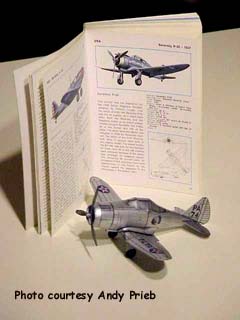
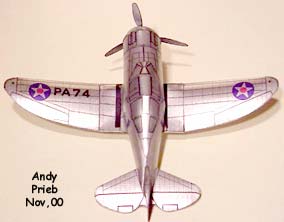
Here, at last, is my all-silver P-35 done on the paper stock I sent you. Finished it last night at midnight. The silver paper takes longer to work with but it is definitely worth it for this model. Andy Prieb, Nov,00 |
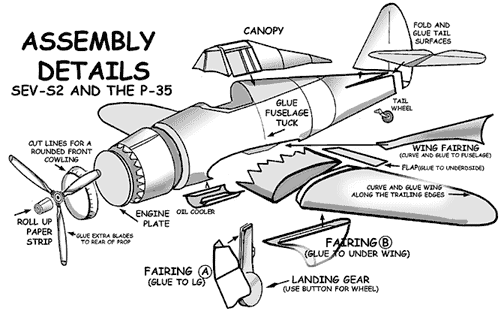
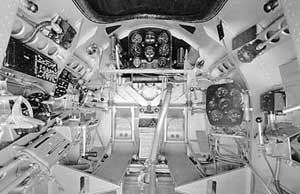 |
Cockpit of the Seversky P-35a. |
Specifications for the Seversky P-35a
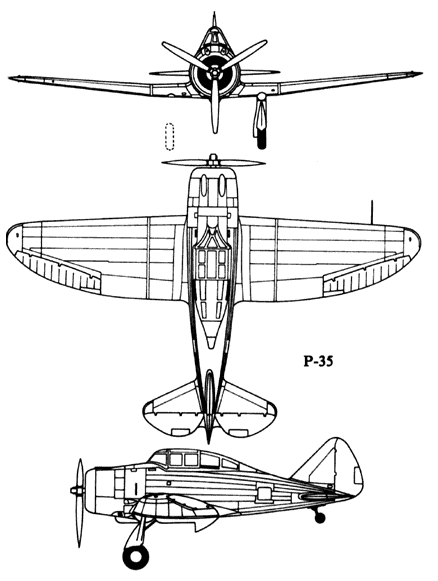 |
Length: 26 ft 11 in Wingspan: 36 ft Height: 9 ft 10 in Wing area: 219.5 ft² Empty weight: 4,565 lb Loaded weight: 6,105 lb Max takeoff weight: 8,688 lb Powerplant: 1× Pratt & Whitney R-1830-45 Twin Wasp radial engine, 1,050 hp Performance Maximum speed: 310 mph Cruise speed: 260 mph Range: 950 mi Service ceiling: 31,400 ft Rate of climb: 1,918 ft/min Wing loading: 27.8 lb/ft² Power/mass: 0.17 hp/lb Armament 2x 0.30 in machine guns; 2x 0.50 in machine guns; up to 350 lb of bombs |
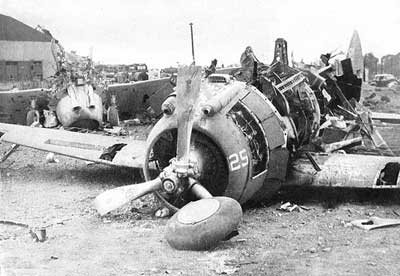 |
| Seversky P-35 fighters destroyed during an air attack on Nichols Field,Luzon on December 10,1941. (U.S. Air Force photo) |