

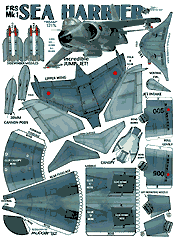
BAe Harrier - $$4.50
The Harrier Jump Jet, often referred to as just "Harrier" or "the Jump Jet", is a British designed military jet aircraft capable of Vertical/Short Takeoff and Landing (V/STOL) via thrust vectoring. The Harrier has become an aircraft icon and is seen as major milestone in aviation.

British Aerospace Harrier FRS.Mk1
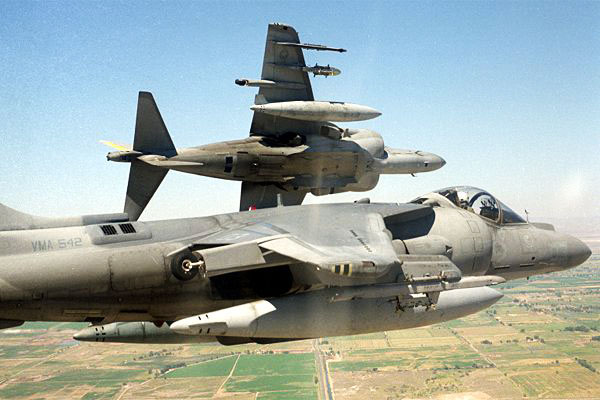

First ordered by the Royal Navy as a multi-role, carrier-borne fighter in 1975, the Sea Harrier went on to prove itself in various missions in the Falklands conflict. It was not taken seriously at first, but the Sea Harrier has proved capable of undertaking reconnaissance, anti-ship missile attacks and air defense missions with efficiency. It has been exported to India, and recently upgraded by Britain with more advanced radar and missiles.
One of most fascinating planes ever built. Vertical take-off, hover, and high sub-sonic speeds make this engineering masterpiece truly an airplane of the future. It's best displayed hanging horizontally from the ceiling by a thread.
....By the way, the Harrier is an incredible model! I can't believe how good it looks! Its a real tribute to the quality of your models when I can make one that looks good. Thanks Chris F (11/1/01)
This one was a bit of a challenge for me (seeing how I'm still a beginner) but I had great fun building it. - John H. Seatle WA
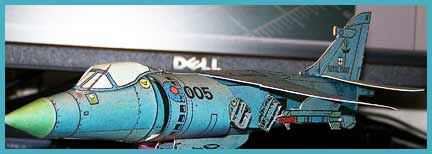
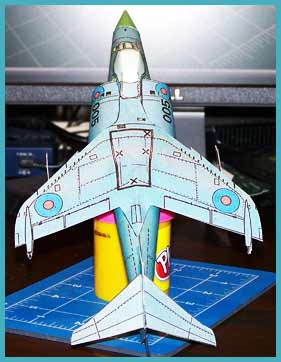
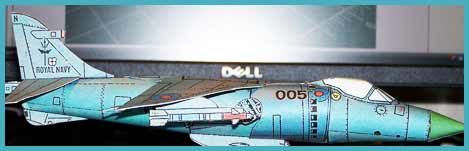
This is the BAe Sea Harrier model that won the FG Modeling Madness (FGMM) 2010 best in class prize. Thanks to Stephen Gifford who donated his $20 prize money toward modeling materials for hospitalized vets!! |
|
 |
 |
 |
|
This was a fun build, bit of a challenge because it is one of Chip's old hand drawn models but it all went together with some trial and error and some dry fitting. Definitely need a couple builds under your belt to understand how everything fits together. She is worth an enjoyable lazy afternoon or evening to build. No modifications were made to this build. -Stephen |
|
British Aerospace Jump Jet Harrier
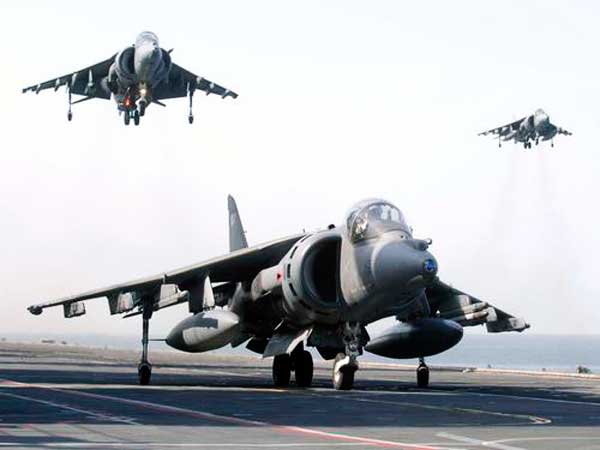
Not long after the jet engine had been invented, aircraft designers began to look for new ways to harness its thrust. The unprecedented combination of high power and light weight opened the way to VTOL (vertical take-off and landing) aircraft.
The concept of vectoring the thrust downwards dates from the late 1940s. By the late 1950s a spate of V/STOL (vertical or short take-off and landing) aircraft, many of them prop-driven were being test flown on both sides of the Atlantic.
Most of the early V/STOL schemes were ungainly and complex, some having batteries of special vertical turbojets used only at take-off and landing. A French engineer, Michel Wibault, proposed a VTOL scheme in which an engine drove giant air compressors delivering through pipes which could be vectored downwards, to lift the machine off the ground, or to the rear, for forward flight.
At Bristol Dr Stanley Hooker and his engine designers simplified this into a much neater and more compact solution which eventually became the Bristol (now Rolls-Royce) Pegasus engine. A turbofan, it delivers fan air to left and right front nozzles and hot jet gas to left and right rear nozzles, all four nozzles rotating in unison. At Hawker Aircraft Sir Sydney Camm's designers created the P.1127 around this unique engine.
The prototype Hawker P. 1127 hovered for the first time on 21 October 1960. Five months later, it made its first proper flight. From this stemmed first a squadron of aircraft called Kestrels and then, from early 1969, regular PAF service by the production Harrier, a fully developed combat aircraft. Although these aroused considerable interest, much of this seemed to be idle curiosity rather than serious interest in the aircraft's potential for military use. This amused tolerance by the worlds air forces and aircraft makers continued for over 20 years.
 Then, unexpectedly, the Harrier startled the world. In May,
1982 pilots of the British Royal Navy and RAF showed the world,
and in particular the Argentinian air force and navy, just what
a deadly weapon the Harrier can be. Helicopters apart, the Harrier
was the only aircraft that Britain could deploy in its bid to
liberate the Falkland Islands and their inhabitants.
Then, unexpectedly, the Harrier startled the world. In May,
1982 pilots of the British Royal Navy and RAF showed the world,
and in particular the Argentinian air force and navy, just what
a deadly weapon the Harrier can be. Helicopters apart, the Harrier
was the only aircraft that Britain could deploy in its bid to
liberate the Falkland Islands and their inhabitants.
Its ability to take off from the tiny decks of Britain's two small carriers, HMS Hermes and Invincible, with no catapult or arrester gear, was of course fundamental. But what shocked the pilots of the Skyhawks, Mirages and Super Etendards was the little aeroplanes' staggering maneuverability.
To return to the pioneer P. 1127, it was obvious that considerably more power was needed if the aircraft was to have a useful combat potential. Initially rated at 11,000 lb thrust, the Pegasus was next up rated to 15,000 lb and supplied for the Kestrel, an intermediate development aircraft formed into a single British/American/German squadron for NATO evaluation purposes. Britain's own government and RAF had been prohibited from showing any interest, because it was official policy to believe that there was no longer any need for manned combat aircraft.
A truly revolutionary new idea was just what was needed to overcome this nonsensical belief, and in 1962 plans for a much bigger, highly supersonic development, the P.1154, went ahead. In 1965 this was suddenly scrapped by the British government. However, permission was given for the development of the smaller subsonic Harrier, which was first supplied to the RAF with a 19,000lb thrust Pegasus engine in January 1969.
Today there are several versions of the Harrier in service. The GR.3 close-support attack and reconnaissance model has the Pegasus 103, of 21 ,500 1b thrust. Four squadrons of these are serving with the Royal Air Force. They carry two 30mm Aden cannon in detachable pods and five pylons can carry up to 5000 1b of bombs, rocket pods and Sidewinder self-defense missiles. The GR.3's avionics include a laser nose, inertial navigation and a HUD (head-up display).
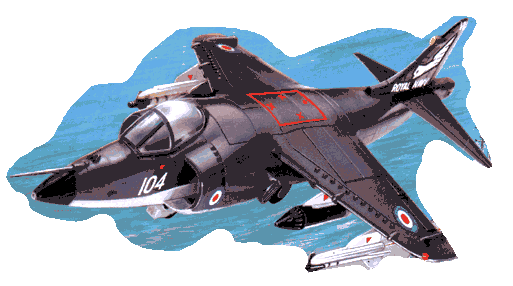
Another main variant is the Sea Harrier. Basically the same as a GR.3, the Sea Harrier has a redesigned front end with the pilot placed at a higher level to allow room for further avionics and additional cockpit interfaces and controls. This also improves all-round visibility. In the nose is a Blue Fox radar, arranged to fold through 1800 to reduce length to fit small ship lifts and hangars.
It was this aircraft, still hardly settled down in service, that was so spectacularly successful in the South Atlantic: it scored 23 air-combat victories, plus three probable's, over assorted Argentinian aircraft without suffering a single loss. Six Sea Harriers were lost, but these were either destroyed by ground fire (2) or lost in accidents (4), the latter all being caused by appalling weather conditions.
Although the Sea Harrier is perfectly capable of vertical take-off, it normally uses a ski-jump' take-off ramp to increase mission capability. On take-off the engine nozzles are all vectored rearwards at the beginning of the short but exciting run. As the Harrier reaches the end of the ramp, sloping at 70 to 150 (depending on the installation), the nozzles are suddenly vectored 500 downwards, hurling the aircraft into the sky while still accelerating it horizontally. Weapon or fuel loads can be greatly increased, and safety on engine failure is also far better.
In 1982, a fascinating new ship borne launching method was announced, the Skyhook. Developed by BAe as a private venture, it would enable even small frigates and destroyers to carry a complement of Harriers without a traditional flight deck. Cranes on each side of the ship lift two aircraft into the air, then swing them outboard. At this point the engine is started; as soon as it is supporting the aircraft, the special 'grabs' release it. At the end of its mission, the Sea Harrier hovers alongside the ship. The Skyhook, which has an inbuilt sensor, is automatically positioned so that the 'grab' can clasp the aircraft. Then the crane swings it inboard and on to the deck or straight into the hold. As with the ski ramp, it takes a long time for navies to understand and accept new ideas.
Harriers are in service with Britain, the US Marines and the navies of India and Spain. Although not yet produced in anything like the numbers that its designers had every right to hope for, the Harrier has proved beyond doubt and in the most conclusive way possible that it is no gimmick. With incredible slowness the penny is gradually dropping: future combat aircraft dare not require airfields. The Harrier was simply the first of the warplanes of the future.
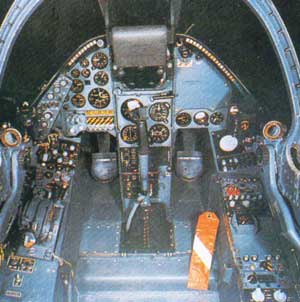 |
Cockpit of the BAe Harrier. |
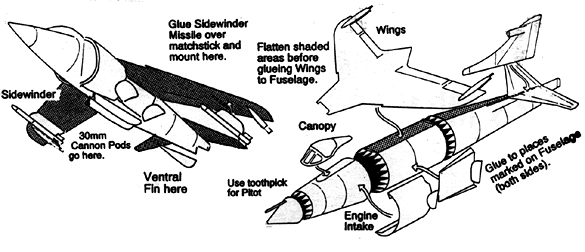
Specifications for the BAe Sea Harrier FRS. Mk 1
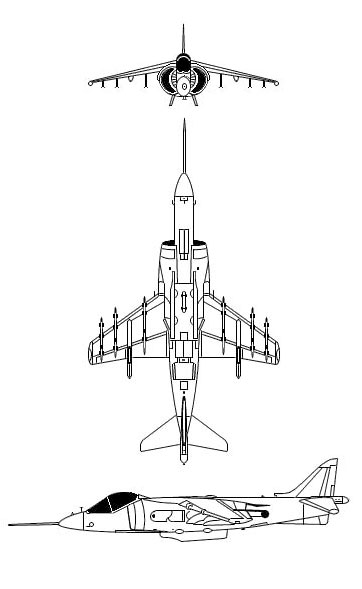 |
Length: 46ft 10 in Performance |
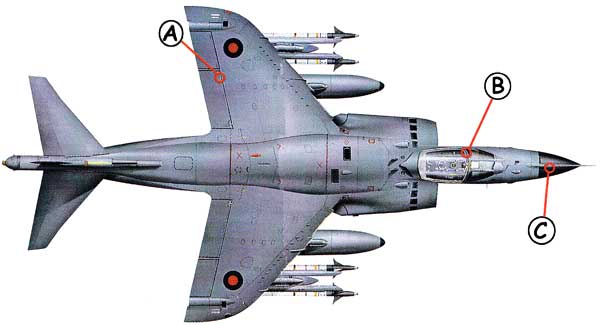 |
||
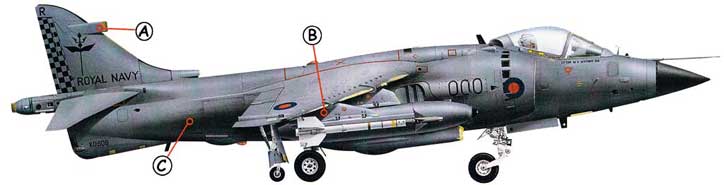
| A: For naval operations the Sea Harrier has all its easily corroded magnesium components replaced. | B: Compared to the land-based Harrier, the Sea Harrier's cockpit is raised to provide room for extra marine avionics. The FRS.Mk 1 also features weather-proof protective coatings on important components. | C: The naval Harrier carries an advanced Blue Fox all-weather radar in the nose. This radar can detect fighters out to about 25 miles and ships out to about 90 miles, but cannot look-down to search for aircraft flying low over water. |
 |
||
| A: The Sea Harrier's distinctive tail houses a Marconi radar warning receiver in the leading edge of the vertical surface, as well as various receiver antennas in the tailcone. | B:Under the fuselage are two Aden 30-mm cannon pods. Under the wings each outer pylon mounts twin AIM-9L Sidewinder heat-seeking air-to-air missiles. | C: A single Rolls-Royce Pegasus Mk 104 turbofan with two swiveling exhausts on either side of the fuselage create 21,950 lb. thrust. |