

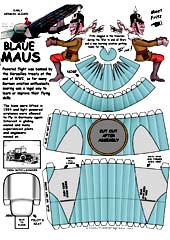
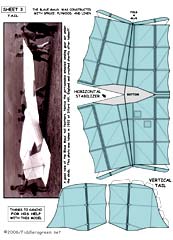
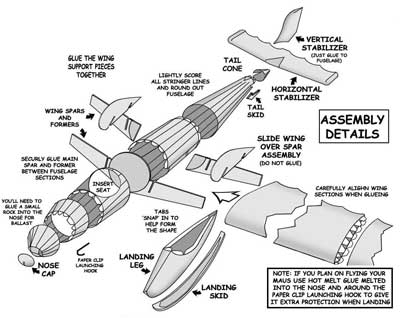
Blaue Maus Glider - $$6.95
In Germany there's a hill named Wasserkuppe that most glider enthusiasts have heard about and it was there, just after WWI ended, the first glider meet was held. Most of the competitors brought hang gliders they were developing - most of those being somewhat less than workable.

Schwatze-Duvel/Blaue Maus early Glider
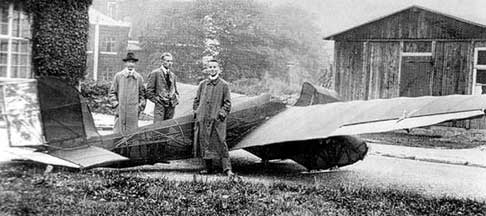
In Germany there's a hill named Wasserkuppe that most glider enthusiasts have heard about and it was there, just after WWI ended, the first glider meet was held. Most of the competitors brought hang gliders they were developing - most of those being somewhat less than workable.
Bad weather ruined the last few days of August so the meeting
was extended for another week. Belatedly, from the Technical University
of Aachen, came the FVA - 1 Schwarzer Teufel or in the dialect
form Schwatze Duvel, the Black Devil. The name Schwatze Duvel
was a natural choice, for in ancient myth, Aachem was plagued
by a monster of this name.
It had been built by members of the Flugwissenschaftlichen Vereinigung Aachen, FVA) a student club, one of the academic flying groups or 'Akafliegs' which were to play, and still play, a crucial role in the development of soaring. Wolfgang Klemperer, who at the beginning with Meyer had formulated the idea of the gliding contest, was now a lecturer at Aachen Tech under the outstanding Professor Von Karman.
Chip, I am Walter, son of Wolfgang B. Klemperer,
the designer of the above gliders. A very dear friend found
your site a couple of years ago and downloaded the Blue
Mouse instructions which at that time were free.
I just went back to your site today and discovered all the
wonderful and amazingly accurate information on those gliders.
Please share with me your sources. I am attempting to write
my Father's biography and there may be sources of which
I am not aware. I wonder if you took much of your information
and the pictures from Peter Riedel's first book of his trilogy
of the history of the Wasserkuppe?
Sincerely,
Walter Klemperer
Certified Flight Instructor-Glider and tow pilot
Over 50 years of flying!
++++++
Chip, I am Walter, son of Wolfgang Klemperer to whom you were very kind in the stuff you put together along with plans to build the Blue Mouse model. A very close friend actually downloaded it and did a beautiful job assembling it. It holds a place of prominence in my living room.
The reason for this note is to ask you where you obtained the specific flight path you portrayed along with the model plans. I ask because I would really like to authenticate the actual flight path Dad flew when he broke the 1911 Wilbur Wright records. One of our esteemed historians of the US Vintage Sailplane Assn. believes that Dad just used orographic rather than convective lift in his flight which would not have been any different than what Orville used. This is a small technical difference accept that on Dad's flight he was given credit for being the world's first to experience convective lift in a non powered aircraft.
Any information you are willing to share will be most appreciated.
Walter Klemeprer
Thank you. Gliders have come a long way
since then. Interesting Old Time photographs.
Great subject .Bob Penikas
The Blaue Maus looks like a fun project! As all your models, the possibility exists to convert to a larger unit and, using additional materials, a durable flying model. Von Ric (LB)
This is so neat!! Your graphics for the models are superb. Marion
Hi, This (Blaue Maus) is just great! I really like the upcoming baby albatross as we are experimenting with indoor glider towing. The glider(s) we are experimenting with are 50cm wingspan and the towing plane are 30cm wingspan (Minow - 1950 free flight model from frog). I'm in the process of deciding what will be my next indoor glider model.... the baby albatros seems perfect. When I use a fiddlers green model, I do not use paper, but use foam. 2 mm wall foam is great - i made the GeeBee from it, for the glider I'm aiming at a combination of 2mm wall foam, durobatics (thin hot wire-cut depron) and carbon ;-) Keep up the great work! Johan (From Belgium)
Thanks alot, really looking forward to all the great gliders. Running out room on the ceiling in my shop. Can't get my wife to let me hang some the living room! Armand
Great stuff Chipper! And the Baby Bowlus coming up--I have been waiting for that ever since seeing it at Udvar Hazy. Now I just need to figure out how to cover the wings with clear stuff, like the one the Smithsonian has! Keep 'em coming! John Freeman
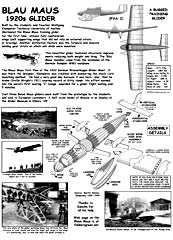
Blaue Maus Glider
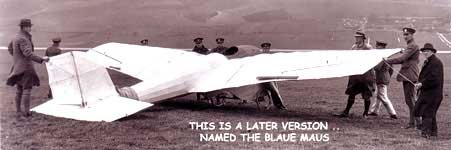
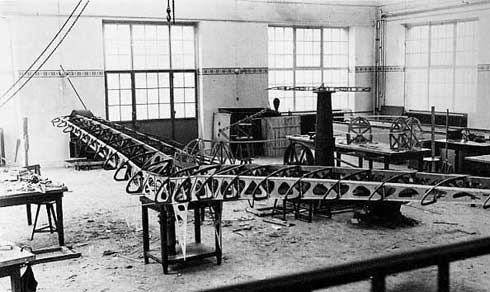
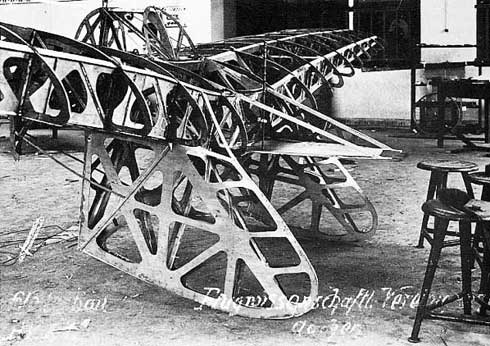
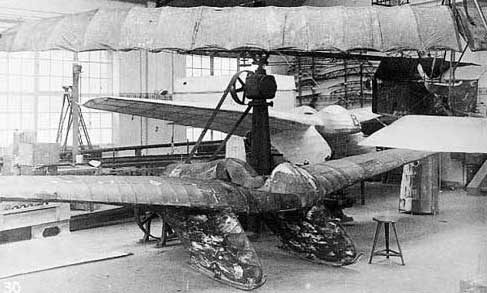
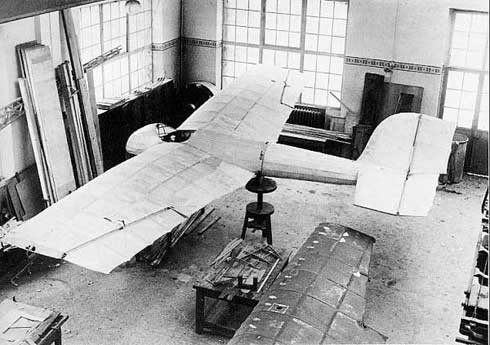
Klemperer designed the FVA 1, a simple monoplane with cantilever wings and orthodox controls, elevator, rudder and ailerons, lightly built but stressed properly and braced internally to withstand high air and landing loads.
It was covered in a light, black muslin fabric donated by the girl friend of a student, whose father owned a textile shop. Some cardboard was used to stiffen the covering along the wing leading edges and fuselage nose, the group having insufficient money for aircraft quality plywood.
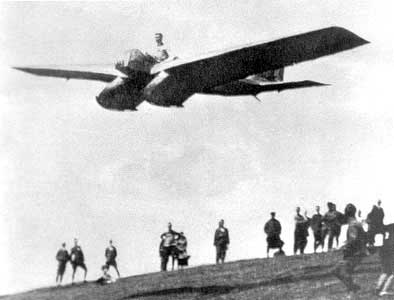
When the weather cleared on 3rd September 1920, Klemperer made three successful glides. For the first time a rubber bungee was used for the launches. The third flight duration was 2 minutes, 22 seconds, ending near a village in the valley, 1830 meters from the start. Pelzner's best effort was far exceeded.
Bad weather returned but on September 7th Klemperer succeeded in gaining about 30 meters height after launching into a wind of 30 knots, hovering for a minute or so before gliding down to land. Two more flights were made by other FVA pilots, ending in a spectacular stall and crash. This effectively ended the first Rhon competition.
There was no question that the FVA - 1 had won but Pelzner's hang gliding gained him second prize. Despite the poor results, the second Rhon meeting began on August 10th 1921, Willy Pelzner and a new hang glider making the first flight.
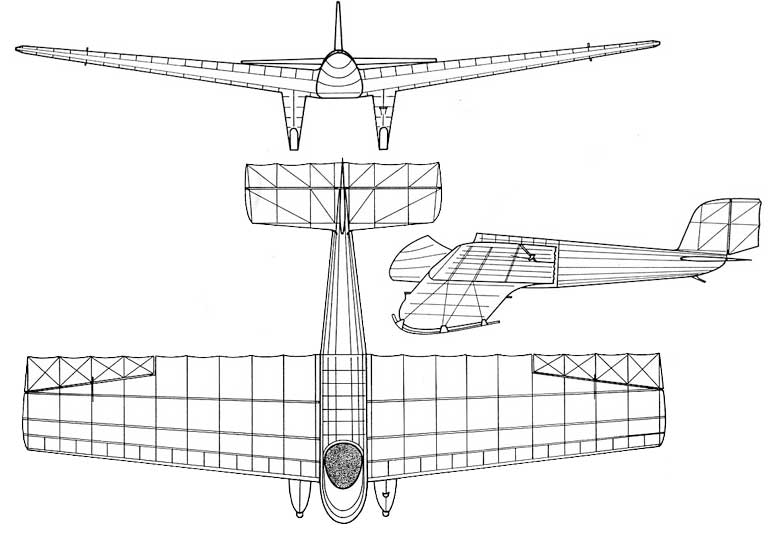
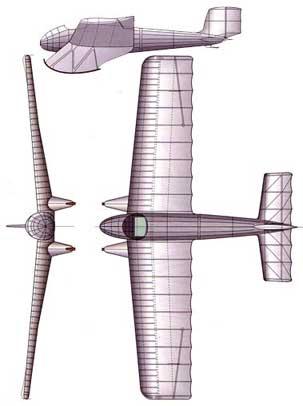
Some forty-five entries had been received but only a couple of dozen gliders arrived. Several of these were quite un airworthy but there were six hang gliders and five apparently more promising aircraft. Klemperer and the Aachen group came with the Schwatze Duvel repaired and a new glider, the Blaue Maus (Blue Mouse).
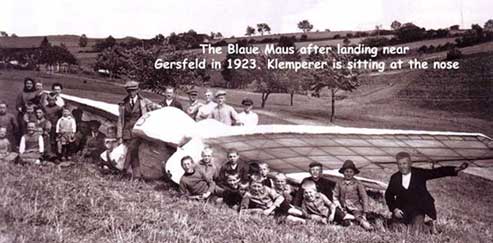
For many of the German enthusiasts, soaring was no more than a legal way into the air that would enable them to improve their skills, ready for powered flight when the Versailles bans were lifted.
This happened in 1924. Light powered airplanes were allowed in Germany again and, for many, the need for gliding disappeared. The movement went through a bad period as many of the experienced pilots and engineers moved on.
For others, especially the young, soaring was a new sport, offering
adventures and experiences of an entirely new and different kind
from powered flying, and less expensive. For students and staff
in technical colleges and universities this was also a way of
learning, experimenting and, in a practical way, improving the
efficiency of aircraft at minimal expense. An airplane might be
made to fly faster or climb better by using a more powerful engine.
For a sailplane, the only way to improve performance was to refine
the aerodynamics and structure. This was the way forward.
 |
 |
 |
 |
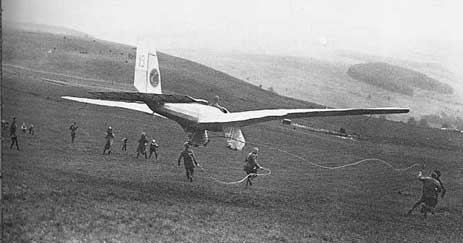 |
The Blaue Maus launching. |
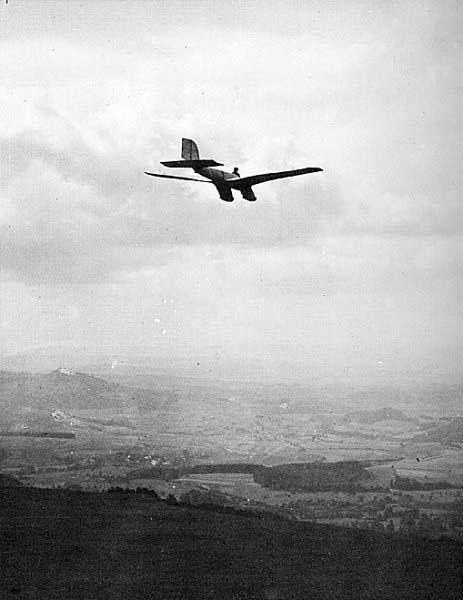 |
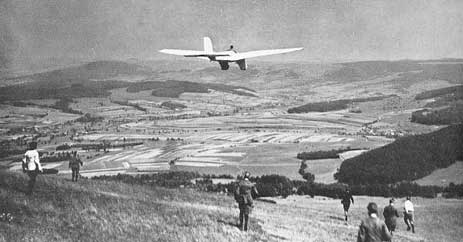
Blaue Maus in flight. |
 |
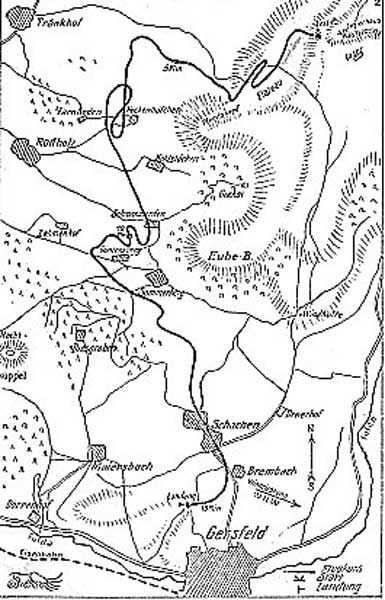 |
The flight path of the Blaue Maus. |
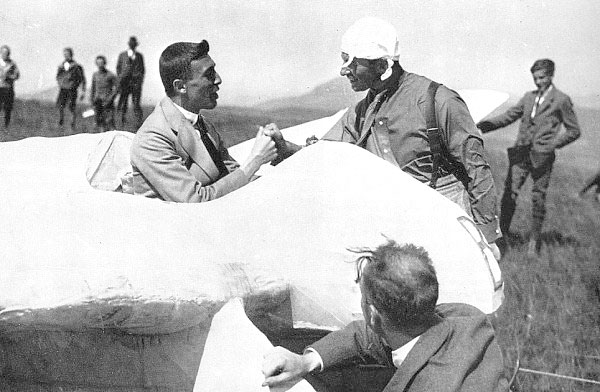 |
Klemperer being congratulated by Anthony
Fokker |
|
 |