

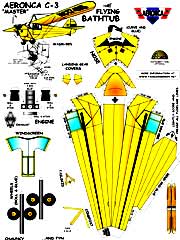
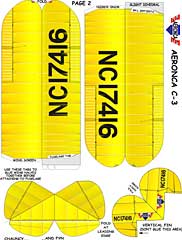
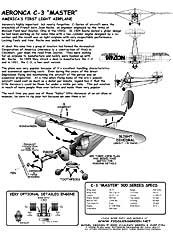
Aeronca-C3 - $$5.50
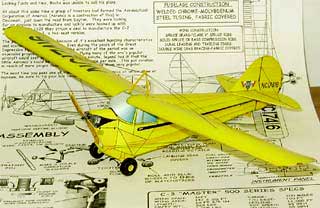
The Aeronca C-3s, nicknamed the "Flying bathtub", were manufactured from 1931 to 1937. With room for two adults the C-3 proved itself as being a low cost reliable airplane. This Aeronca C-3 was originally owned and flown by the Hughes Flying Service.

Aeronca C-2, C-3 Flying Bath Tub
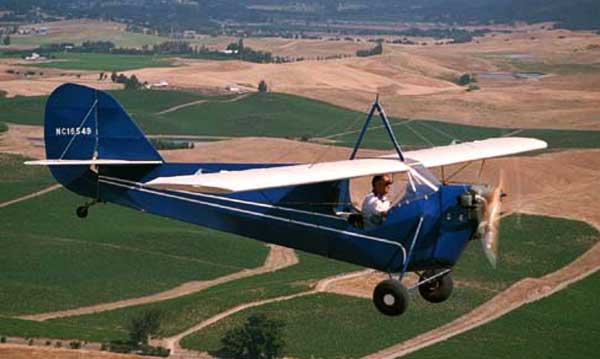
With
the pilot sitting so low in the cockpit, landing was easy with
the Flying Bath Tub-giving rise to the expression "Flying by the
seat of your pants" The Aeronca C-3 is dubbed the father of affordable
private aviation being the first really successful light plane
on the scene. It got 20 an amazing miles to the gallon!!
It's success was mainly due to the way it was hyped and
marketed in a well organized and professional way, not to mention
that it flew pretty darn well!
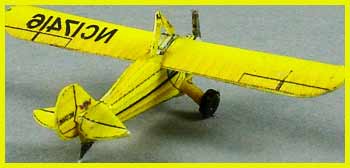
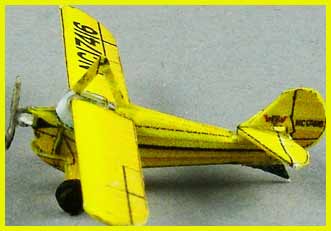
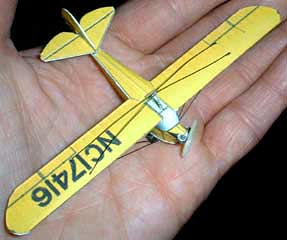
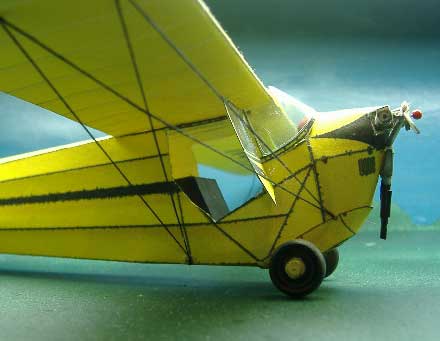
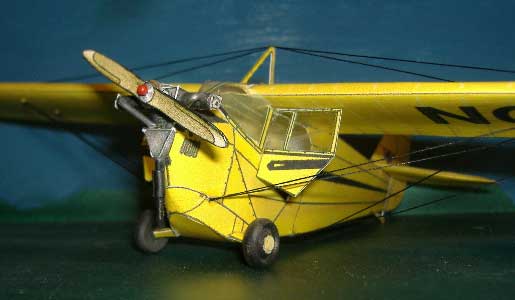
This is the Aeronca-C3 model that won the FG Modeling Madness (FGMM) 2010 best in class prize. Thanks to Tapani Huovinen who donated his $20 prize money toward modeling materials for hospitalized vets!! |
|
 |
 |
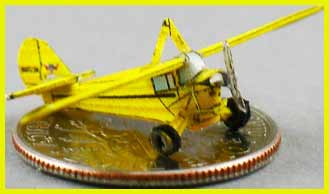 |
Another funny experimental aircraft from the history of laymen aviation. Certainly a model I wouldn’t dare to fly though many have. I reduced the original parts to 12.5% of the original – believe me it’s small. Funny little plane from the early 1930’s. -Tappi |
Aeronca C-2, C-3
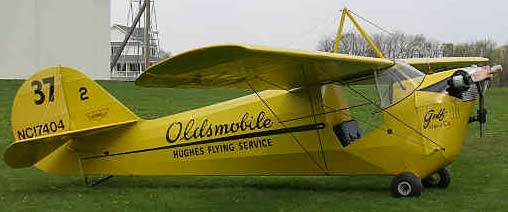
By 1931, most light aircraft had two seats rather than one. Airplane owners naturally wanted to share the pleasures of flight, and even more important was the fact that a second seat was necessary if the plane was to be used for flight instruction. In order not to lose its lead in the field, the Aeronautical Corporation of America set about developing the C-3, a larger version of the C-2 with seating for two side by side. Power was to be provided by the new Aeronca E-113 engine of 36 hp. Two prototype C-3s were put through extensive tests in 1930 and production started in March of the following year.
One C-3 was dispatched on a 13,000-mile demonstration tour through seventeen states, and gave many people their first look at the "Duplex" or "Collegian" as the regular and trainer versions were called. Despite the added fuselage size and weight, performance was crisp with the new engine. Orders poured in and production literally had to double at Lunken Airport to meet the demand.
The 70-foot takeoff roll, 12,000-foot ceiling, and landing speed of only 35 miles per hour were good selling points, but the strongest was its economy combined with a utility the C-2 had not had. A good demonstration of its ruggedness was provided when a C-3 was entered in the 1931 National Air Tour, a difficult 4,858-mile event in which the new Aeronca, the first light airplane ever to participate averaged a respectable 64 mph.
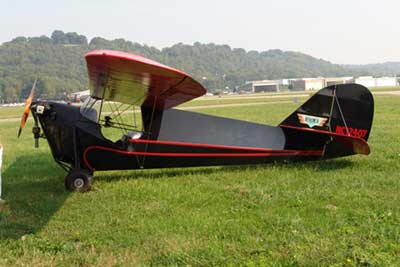 |
Photo thanks to Charlie Pyles Curator-Cincinnati Aviation Heritage Society Museum |
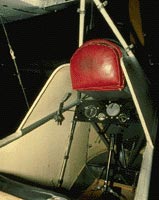
Aeronca owners all over the country flew for the pure pleasure of it, most after less than five hours of instruction due to the straightforward characteristics of the aircraft. The C-2 and C-3 were basically powered gliders with excellent gliding ability and gentle landing speeds. In addition, the pilot sat so low in the cockpit that the term "seat of the pants" applied perhaps better to landing an Aeronca than flying it. The result was that it was extremely difficult to make a bad landing as the pilot had an excellent view of the proximity of the wheels to the runway. But the nimble Aeronca's could also perform brilliantly in the hands of a truly fine pilot .Aeronca kept its finger on the pulse of the aviation public throughout the production of the C-2 and C-3. Improvements and desired features were quick to appear, the most noticeable being the new tail group and the extended, split-axle landing gear with Goodyear 16x 7.3 "airwheels." Brakes were also quickly introduced as an option to facilitate ground handling.
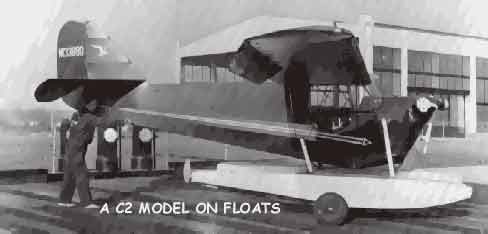
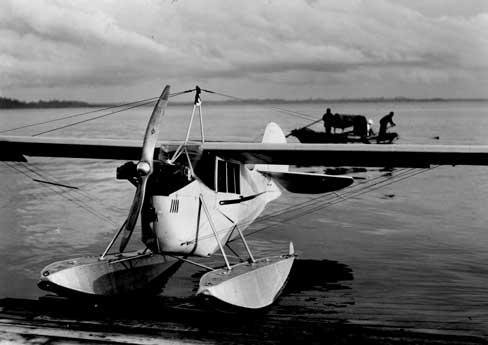
Aeroncas were also offered as seaplanes after the first fifty C-2s had rolled out the factory door. The single and two-seat versions were designated PC-2 and PC-3, respectively, the "P" standing for pontoon. Floats were manufactured by Warner; Aircraft Products Corporation; and the Edo Corporation of Long Island, New York. Edo was the largest supplier and also offer their Model D-990 and D-1070 floats as a conversion kit for wheeled Aeronca at a price of $750 The year 1932 saw the introduction of detachable cockpit doors with inset windows.
These panels could be put on for winter- or bad-weather flying, or left off to enjoy warm summer weather to the fullest. The following year, the seat back was raised, the cockpit was widened slightly, and leg room was increased. The improved Aeronca E-113A engine was put on a new mount to reduce the level of noise and vibration experienced in the cockpit. In 1934, a new cantilever landing gear without drag-inducing struts became part of the C-3 design, and the interior was made more elegant with new leather seat cushions. With wheel pants, available as an option since1931, the two seat light plane attained a top speed of a little over 80 mph despite its low horsepower.
The looks of the C-3 changed dramatically in 1935 with the introduction of the "roundback" C-3 "Master." The triangular fuselage frame was retained, but its distinctive razorback appearance was eliminated with the use of a nonstructural wooden frame. This change filled out the shape of the fuselage and improved the airflow over the tail surfaces. As a result, a new smaller vertical stabilizer and rudder were adopted that made the C-3 look distinctly round tailed. This was one of the very few cases of a control surface and stabilizer being reduced in area during the course of the development of an aircraft.
|
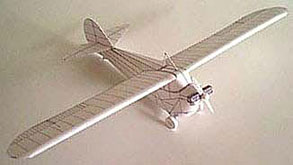
In addition to these changes, the 1935 Aeronca came with a completely enclosed cockpit, offered wheel brakes and wing lights as optional equipment, and sold for just $1,890. When compared with the $1,880 price originally announced for the C-2 before the Great Depression, the Master was a bargain. Production was doubled again, and the five hundredth Aeronca was turned out in 1935 with 128 C-3 Masters being built that year alone.
The Aeronca C-3 was also built in England as the Aeronca 100 by Light Aircraft, Ltd. This firm, under the new name Aeronautical Corporation of Great Britain, Ltd., built twenty-four Aeroncas before halting production due to a lack of sales.
(The Palm Pilot in the below photo is Peter Eveleigh)
 The British-built Aeronca was virtually identical to its American
cousin with the exception of having more conventional fabric-covered
ailerons instead of metal ones. As with the Ohio-built aircraft,
the ailerons were interchangeable right to left.
The British-built Aeronca was virtually identical to its American
cousin with the exception of having more conventional fabric-covered
ailerons instead of metal ones. As with the Ohio-built aircraft,
the ailerons were interchangeable right to left.
The Aeronca 100 originally was supposed to make use of the latest version of the C-3 engine, the 40-hp Aeronca E-113C being introduced on American aircraft in 1936. However, this engine had single rather than dual ignition and therefore did not meet British airworthiness standards. A license-built version of the E-113C with dual ignition was therefore built by J. A. Prestwick, Ltd., and was designated the J.A.P. Model J99.
That Aeronca in the United States did not incorporate dual ignition
in their engines until 1937 was a matter of economics. Two spark
plugs in each cylinder running off independent magneto generators
meant greater cost for a marginal increase in safety. A more important
area for improvement was thought to be the crankshaft, and this
component was made considerably stronger in the E-113B of 1934.
Another change in the appearance of the C-3 was accomplished when
yet another type of landing gear was fitted. The tripodal gear
had at first relied solely on the fat Goodyear "airwheels"
for shock absorption until complaints of porpoising during rough
landings led to the incorporation of an oleo strut. However, this
system was bulky and produced excessive aerodynamic drag. The
final landing gear consisted of a single cantilever strut with
shock dampening housed internally in 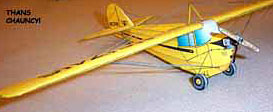 the fuselage.
Production of the successful C-3 was terminated late in 1937, not because it showed any drop in popularity but because it no longer met airworthiness requirements for production in this country. The C-3 was loaded with now illegal features such as 3/32-inch control wires, external wire bracing instead of strut bracing, fabric right up to the firewall, a single-ignition engine, and no requirement for an airspeed indicator.
In 1935, Aeronca introduced a low-wing aircraft with the designation C-70 or C-85, depending on whether it was fitted with the 70-hp or 85-hp LeBlond radial engine. With side-by-side seating for two in a completely enclosed cabin with excellent visibility, the C-85 offered a top speed of 120 mph. Overall dimensions were similar to the C-3 and the wingspan was the same at 36 feet, but the gross weight was half again higher at 1,500 pounds.
The true successor to the C-2 and C-3 series light planes, however, was the Model K. Introduced in 1937, it was a considerably more modern and pleasing design by all accounts. Powered by a dual-ignition Aeronca E-113C engine, the Aeronca K sat higher off the ground and had a strut-braced wing over an enclosed cockpit with side-by-side seating for two.
 While the Model K did away with the conical lines usually associated
with the Aeronca name, there were still plenty of "flying bathtubs"
around. A grandfather clause in the new rulings allowed all aircraft
built before the date of new regulations to continue flying.
While the Model K did away with the conical lines usually associated
with the Aeronca name, there were still plenty of "flying bathtubs"
around. A grandfather clause in the new rulings allowed all aircraft
built before the date of new regulations to continue flying.
Meanwhile, many privately owned Aeronca C-2 and C-3 aircraft were
setting an impressive number of records in the  Class
"C"-4th Category, a division established by the National
Aeronautic Association (N.A.A.) especially for light airplanes.
Aeroncas seemed to bring out the sporting side of their owners,
and the possibilities suggested themselves for altitude, distance,
and speed records.
Class
"C"-4th Category, a division established by the National
Aeronautic Association (N.A.A.) especially for light airplanes.
Aeroncas seemed to bring out the sporting side of their owners,
and the possibilities suggested themselves for altitude, distance,
and speed records.
Twelve out of thirty-three Official World's Records recognized by the N.A.A. in 1936 were won by Aeronca C-2s and C-3s, and by the time production of the C-3 ended the following year the figure was up to nineteen. Forest M. Johnston and his C-2 NC-568V held a number of them, predictably enough, including altitude records for both light land and sea planes.
Stanley C. "Jiggs" Huffman flew a C-2 with extra fuel from Lunken Airport to Roosevelt Field on Long Island, New York, with one quick stop for refueling in New Jersey due to unexpected headwinds. Total time for the flight was 10 hours 10 minutes, 9 hours 40 minutes of it in the air, and 30 gallons of gasoline were used to cover the 570-mile distance. Upon landing, Huffman stated that the total cost of the flight had been $9.70, and proclaimed the C-2 the "smallest practical plane in the world."
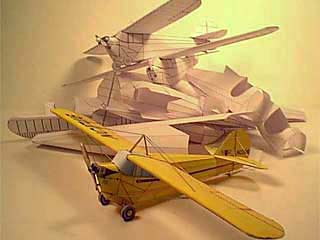 |
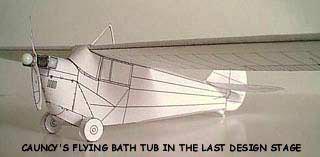
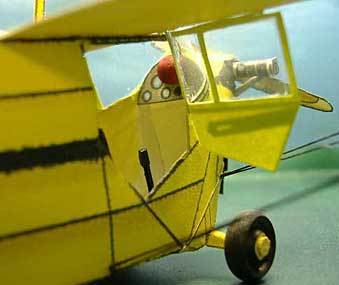
 Even a world class designer like Chauncy Green will make as many as 15 or 20 'beta tries' before his Aeronca Flying Bathtub model finally takes shape. |
 |
 |
 |
Modeln Pal, Bob Martin, has figured out how to make fabulous clear windscreens and even complex canopies using common clear packing tape. Its easy !! Step by Step instructional |
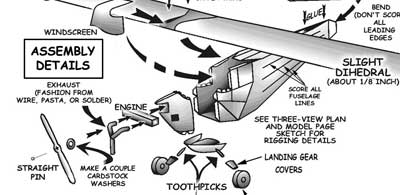
Specifications for the Aeronca C-3
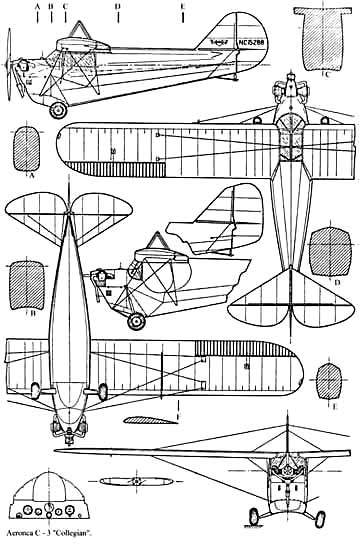 |
Length: 20 ft Wingspan: 36 ft Height: 7 ft 10 in Wing area: 142.2 ft² Empty weight: 569 lb Gross weight: 1005 lb Powerplant: 1 × Aeronca E-113C horizontally opposed 2 cylinder piston engine, 36 hp Performance Maximum speed: 95 mph Range: 200 miles Service ceiling: 12,000 ft |