

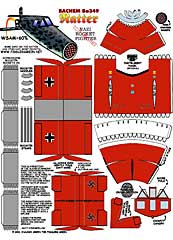
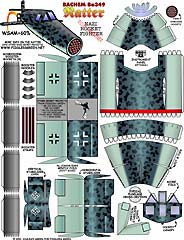
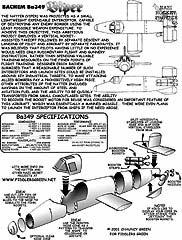
Bachem-Natter - $$8.50
The Bachem Ba 349 Natter (Adder) was a World War II era German experimental point-defense rocket-powered interceptor aircraft which was to be used in a very similar way as unmanned surface-to-air missiles. After vertical takeoff which eliminated the need for airfields, the majority of the flight to the bombers was radio controlled from the ground. Including the Fantasy Dragon Slayer, NINE versions as of 8/09 !!

The Bachem Natter Ba349 Manned Rocket
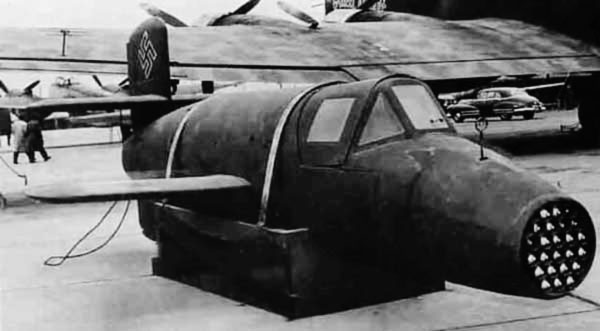
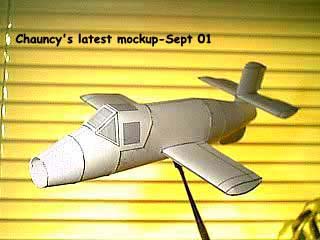
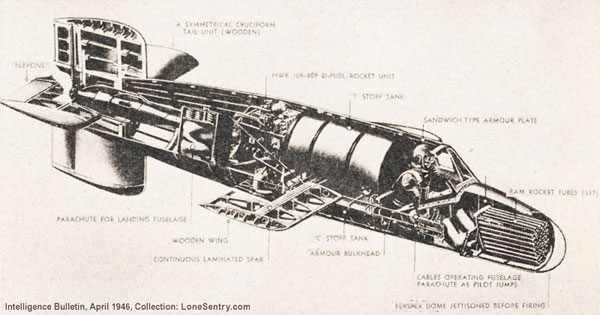
The Bachem Natter was projected as a small lightweight expendable interceptor, capable of destroying any enemy bomber using the least possible weapon expenditure. To achieve this objective, this ambitious project employed a vertical rocket-assisted takeoff followed by separate descent and landing of pilot and aircraft by separate parachutes.
It was believed that pilots having little or no experience would need only rudimentary flight and gunnery instruction, rather than spending valuable training resources on the finer points of flight training. Erich Bachem reasoned that, a reasonable number of such interceptors and launch sites could be installed around key industrial targets, to make attacking Allied bombers pay a prohibitively high price.
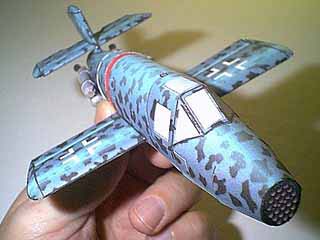
I notice in the power plant section ..you don't mention the Schmedding rockets. I was curious so I did the math, the Schmedding rockets would be 'L' motors in the model rocket world, 4 of them would kick butt. They also had a version that used two schmedding's but they were twice as big or 'M's..
I read up on the one manned natter launch. there are conflicting reports of what happened. the flight only lasted 32 seconds and the schmedding's burn for 80 seconds so it hit the ground right at peak thrust. probably wasn't a whole lot left to analyze. One is that the cockpit separated prematurely, with all that thrust that's a possibility. You mention the thrust broke the pilots neck, the second scenario which seems the more likely. ..was when it launched under full thrust the canopy tore loose and took off the pilots seat headrest, along with any of the pilot that was next to the headrest and on the way back that took out the vertical stabilizer. In model rocket language we call that CATO (catastrophe at Take off) Sparky (9/28)
Natter it's self nearly finished although I will have to find a trick to do the boosters , another wrinkle I use is where the fuselage has tabs with another section attaching and there is no room to get my fingers into the joint. I bend the tabs gently inwards about 45degrees and put glue on the tabs. The section without tabs can then be slid onto the tabs and the panel lines-camo lined up it is then a simple matter to put your finger inside and press the tabs into contact with the tab-less section. ( I need to do things this way as I us a contact adhesive where ever possible , speedy this way) Paul Needham
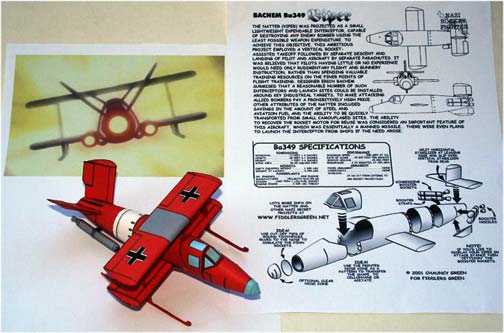
The Bachem Ba-349 Natter is my favorite aircraft and Nazi X-weapon. It is also what got me started in paper modeling, along with your website. First model I ever bought, and I was highly pleased with the service and the model. Now it is time for me to return the favor. I have done a lot of research into the Natter, and using the BW version of the model and Photoshop, have come up with some authentic variants for you to offer our modeling pals. I don't care if you give them away for free, use them in upcoming magic keys, or just update the Natter.
The variants are: Prototype 767071, Prototype BP 20-23, Prototype BP 20-M33, Prototype Camouflage, and the Prototype Dressel Pre-production Model. Matt (zardoz582000) (added, with graditude to folder-See below..chip)
 |
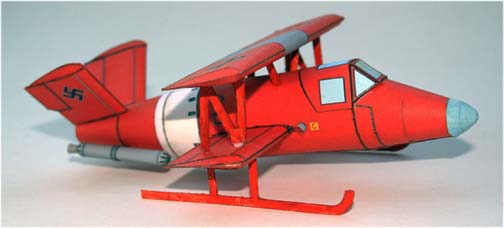 Hi Folks, Matt Stringfellow's Slayer of Dragons post on Fiddlersgreen 8/20/09 turns the Bachem Ba349 Natter into a skid equipped bi-wing from The “FULL METAL ALCHEMIST.” |
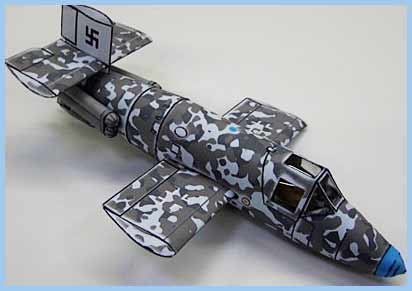
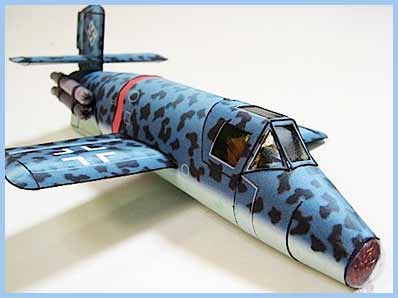
This Bachem Natter is the model that won the FG Modeling Madness (FGMM) 2010 best in class prize. Thanks to Chris Walas who donated his $20 prize money toward modeling materials for hospitalized vets!! |
|
 |
 |
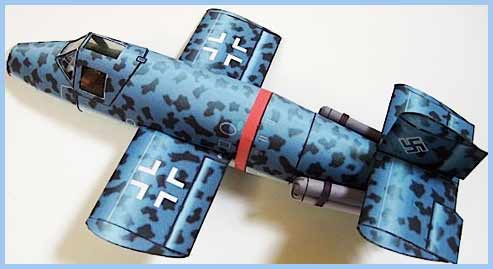 |
I chose the Bachem Natter because it was such a unique (and desperate) design. And the kit is a joy to build. It’s simple, goes together well and looks really good. I added a simple interior to these that gives it more dimension. Great kit! -Chris |
The Bachem Viper-Natter WWII Manned Rocket
The Bachem Werke GmbH was founded on February 10, 1942, by Dipl.-Ing.
Erich Bachem, formerly the Technischer Direktor of the Fieseler
firm. The company manufactured spare parts for piston-engine fighters
and other aircraft equipment before the Natter project was created.
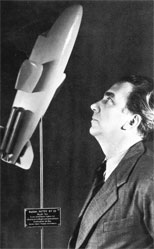 |
The Vipers creator Erich Bachem, poses next to the model of the Ba 349 after the war. |
The BP 20 was projected as a small lightweight expendable interceptor,
capable of destroying any enemy bomber using the least possible
weapon expenditure. To achieve this objective, this ambitious project
employed a vertical rocket-assisted takeoff followed by separate
descent and landing of pilot and aircraft by separate parachutes.
It was believed that pilots having little or no experience would
need only rudimentary flight and gunnery instruction, rather than
spending valuable training resources on the finer points of flight
training.
Erich Bachem reasoned that, a reasonable number of such interceptors and launch sites could be installed around key industrial targets, to make attacking Allied bombers pay a prohibitively high price. Other attributes of Natter included savings in the amount of steel and aviation fuel and the ability to be quickly transported from small, camouflaged sites. The ability to recover the rocket motor for reuse was considered an important feature of this aircraft, which was essentially a manned missile.. There were even plans to launch the interceptor from ships if the need arose.
 The BP 20 was of wood construction and was to be built without
the use of gluing presses. Most of the parts could be made in
small woodworking shops through Germany, without interfering with
the existing needs of the aircraft industry. According to Erich
Bachem, ) only 600 man-hours were required for the production
of one airframe, excluding the HWK 509 A-2 rocket motor, which
was a relatively simple to manufacture when compared to sophisticated
turbojet.
The BP 20 was of wood construction and was to be built without
the use of gluing presses. Most of the parts could be made in
small woodworking shops through Germany, without interfering with
the existing needs of the aircraft industry. According to Erich
Bachem, ) only 600 man-hours were required for the production
of one airframe, excluding the HWK 509 A-2 rocket motor, which
was a relatively simple to manufacture when compared to sophisticated
turbojet.
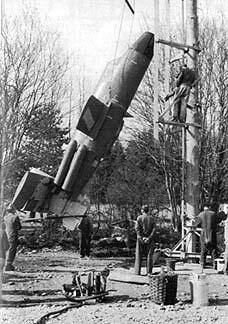
The fuel capacity was to consist of 119 US gallons (450 liters) T-Stoff and 66 US gallons (250 liters) C-Stoff, carried in separate tanks. The available fuel was sufficient for 80 seconds at full power, developing a thrust of about 3,750 lb (1,700 kg). Takeoff assistance was provided by four solid-fuel rockets SR 34 which produced an additional thrust of 2,200 lb (1,000 kg) for twelve seconds.
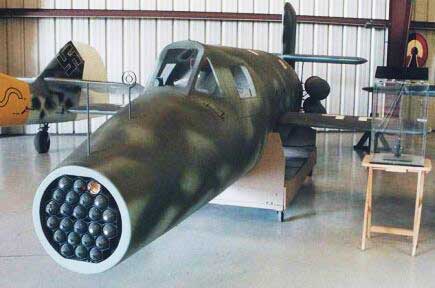
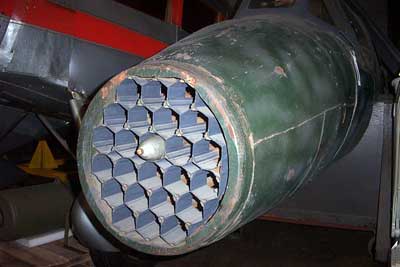
Natter's weapon systems were simple and potentially devastating. They comprised either a honeycomb 24 electrically fired 73 mm F6hn air-to-air rockets, or 32 R40 air-to-air missiles located behind a jettisonable cover in nose section. The alternative, the Rheinmetall SG 119 consisted of six clusters, each cluster containing seven MK108 barrels grouped together in a cylinder with the clusters arranged about the Viper's nose as in a revolver.
Bachem
submitted his Natter project to the OKL and simultaneously to
the SS-F6hrungshaptamt (SS Planning Office), in August 1944. One
month later, a contract for fifteen experimental BP 20 aircraft
was awarded, and a few weeks later, Natter was included in the
J5gerNotprogramm (Emergency Fighter Program).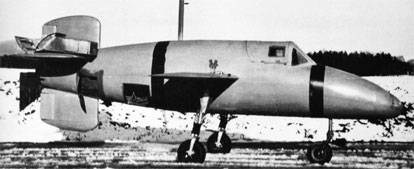
The first experimental aircraft, the Ba 349 M1 and M2, were under construction in October 1944, at a time when the RLM believed the Natter could be successfully employed against Allied heavy bombers, including the anticipated American Boeing B-29.30 The first batch of fifty Ba 349s was ordered for delivery between October 1944, and January 1945. A measure of the importance attached to the program is in the substantial order of 200 Vipers at the start of mass production.
The installation of parachutes delayed flight testing of the first
target defense prototype, the Ba 349 M1, until November 1944.
The Ba 349 M2 was completed soon thereafter and the first takeoff
under air-tow of the third prototype, Ba 349 M3, was made at Neuburg
on the Danube on December 14, 1944. A second flight behind a He
111 by the DFS, followed eight days later. After successful completion
of ground tests near Bad Waldsee on December 18, 1944, the first
vertical launch from a ramp was scheduled.
This event was marred
when the Viper caught fire as a result of a technical fault. The
next attempt was made four days later at Heuberg Hill near Stetten
am kalten Markt. The aircraft was towed to an altitude of 2,460
ft (750 m) and parachutes were deployed to carry the Viper and
its simulated pilot safely to ground. The second takeoff occurred
on December 29, 1944, without serious incident while simultaneously,
other Vipers were towed into the air for further testing.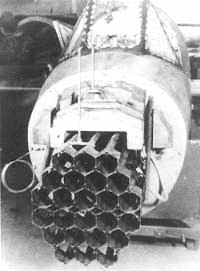
French armor advanced into Waldsee on April 1945 and a great number of spare parts was captured- Only a few days before the French arrived, fifteen rocket engines destined for Vipers had been thrown into Lake Waldsee to prevent their capture. The secret was not well kept however and all were later recovered.
Plans for mass production of the Ba 349 A-1 were authorized on
March 1, 1945, but only a few Natters were actually completed.
These were followed by the improved Ba 349 B-1 (Entwurf 2) interceptors
whkb were to be produced at Waldsee, but few were actually completed.
On of the models were powered by a solid-fuel rocket to evaluate
takeoff characteristics. Practical tests carried out at Peenemunde,
where a first test conducted during February 1945, proved unsuccessful.
Willy A. Fiedler, a testing engineer working for the RLM, was
sent to the Heuberg Hills to oversee the program Erich Bachem
is quoted after the war as having said that about twenty Vipers
had been used for practical tests. Fifteen were of the A-series,
and four B-series aircraft. All were constructed at Waldsee. Still
others were assembled by the Wolf Hirth glider factory. Four additional
Ba 349s, possibly of the B-series, were captured at the end of
the war by Allied forces near St. Leonhard, Austria.
 |
 |
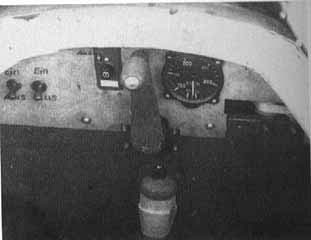 |
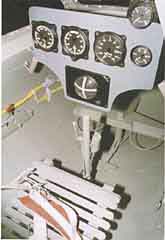
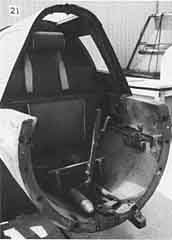
Some views of the Bachem 349 Natter (Viper) cockpit |
||
 |
 |
 |
Prototype BP 20-23:
First manned test flight
Construction of the production Ba 349A models had already started in October, and fifteen were launched over the next few months. Each launch resulted in some small modification to the design, and eventually these were collected into the definitive production version, the Ba 349B which started testing in January.
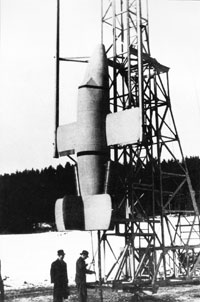
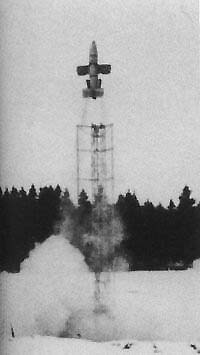
In February 1945 the SS funders decided that the program was not going fast enough, and demanded a manned launch later that month. The only time that the aircraft was tested in this way was on 1 March, when Lothar Sieber flew Ba 349A M23, which was launched from the Lager Heuberg military training area near Stetten am kalten Markt. Things went well at first, but one of the jettisonable Schmidding boosters failed to release and the Natter got out of control. At 500 m (1,600 ft) the cockpit canopy pulled off as Sieber intended to bail out. He was instructed by radio to keep trying to shake off the booster, but inside the clouds he lost orientation. Also, the parachute did not open due to the stuck booster. Eventually, the aircraft turned over and slammed into the ground, killing Sieber. It is suspected that Sieber may have broken the sound barrier on the way down.
The cause was explained as a failure of the canopy which may simply not have been properly latched before launch. Photos were altered to hide the fact that a FuG16 radio was in the cockpit, used to order Sieber not to bail out. Excavations in 1998 found remains of the booster. Matt
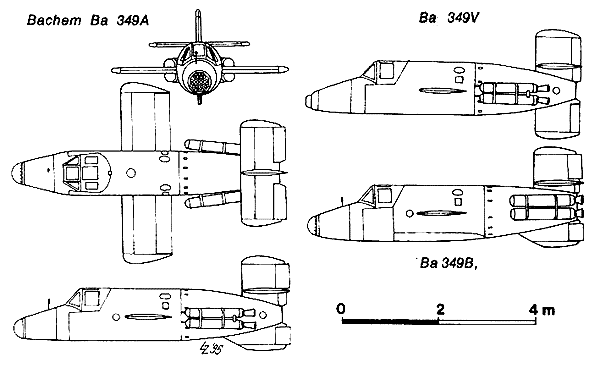 |
Length: 19 ft 9 in Wingspan: 11 ft 10 in Wing area: 51.7 ft² Empty weight: 1,940 lb Loaded weight: 4,920 lb Powerplant: 1× Walter HWK 509A liquid-fuel rocket, 10,600 lbf 4× Schmidding 109-533 (1.200 kp, 11,768 kN, 10 seconds) solid fuel rocket boosters Performance Maximum speed: 625 mph Service ceiling: 46,000 ft Endurance: 6 minutes of flight Armament 24 × 73 mm Henschel Hs 217 Föhn rockets or 33 × 55 mm R4M rockets |
 |
 |
 |
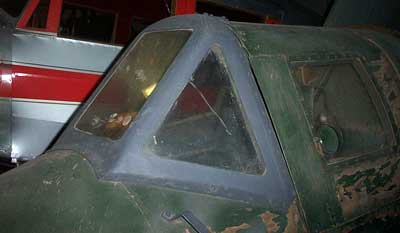 |
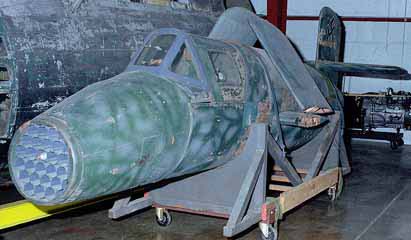
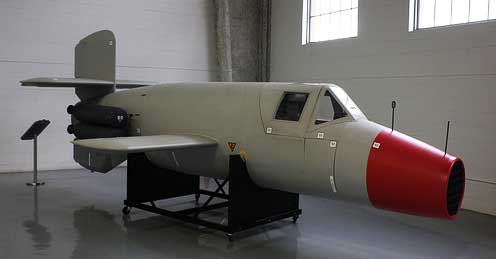
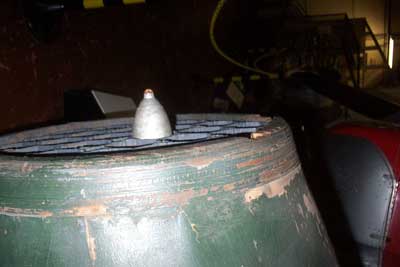
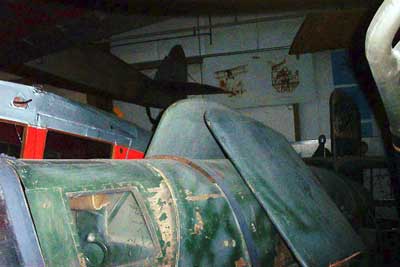
These are images Chip took of the Bachem Natter at the Garber Air and Space Museam. |
|
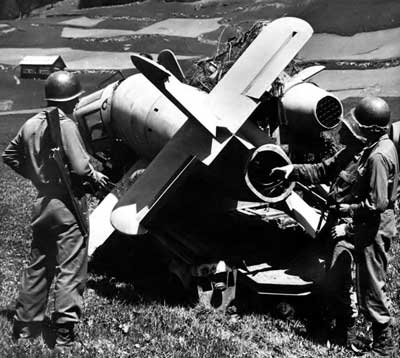 |
A captured Bachem Ba 349 Natter. |