

Beech-Staggerwing - $$6.95
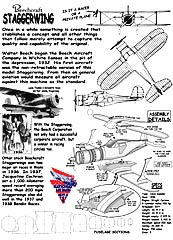
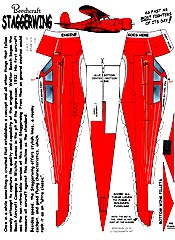
Very few pre-war biplanes had enclosed cabins and fewer still had a retractable undercarriage; the four-seater Beech-17 'Staggerwing' had both. It was something of a misnomer as many biplanes had upper and lower wings staggered but the Beech reversed the usual layout by staggering the upper pair behind the lower.

The Beech D-17 Staggerwing downloadable from Fiddlers Green
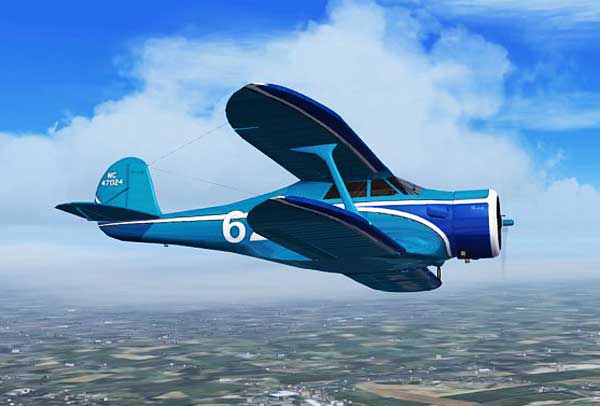
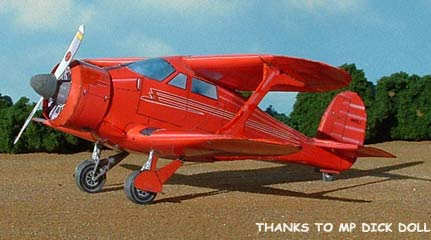
When the Beech Staggerwing biplane appeared in 1932, its distinctive
feature was the negative stagger arrangement of its wings.
Most contemporary biplanes had positive stagger, which meant that
the upper wing was located some distance ahead of the lower.
Walter Beech turned things around for a good reason. By having the lower wing forward, he was able to attach the landing gear directly to the lower wing in the manner of some low-wing monoplanes instead of to the fuselage, as was standard biplane practice. That made it possible to retract the landing gear into the wing, which gave the Beech 17 a big boost in performance.
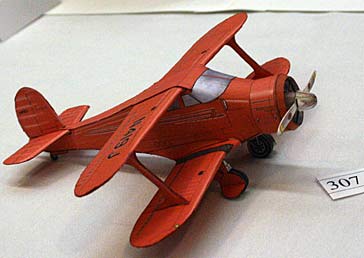 OOOPPPSS...did
I build it too soon? Your Staggerwing set off a bunch of positive
comments at last night's IPMS meeting. Sent you a picture.
The model went together quickly. The simplistic yet realistic
spring gear design is impressive. Bob Penikas
OOOPPPSS...did
I build it too soon? Your Staggerwing set off a bunch of positive
comments at last night's IPMS meeting. Sent you a picture.
The model went together quickly. The simplistic yet realistic
spring gear design is impressive. Bob Penikas
Attached Photo: The only paper model airplane on tonight's IPMS Orange County Chapter competition paper model table. I had brought your regular size Staggerwing along to show the paper guys. Nothing extra added, none of my "extra steps" I just wanted to see how it assembled before attempting a larger B&W version on heavy, colored, cover stock for next month's meeting. Thank you, Bob Penikas
Very nice! Thank you. Those big Staggerwings are classics. RJC
Thanks for the staggerwing, it's uncanny the way you seem to be releasing all MY favorite planes, you couldn't have done better if I'd sent you a list. Wishing you all the best. Dave
I built this one in less than a day and it came out just the way I wanted. Thanks FG
| This is a Staggerwing built by Bob Penikas out of Coke cans |
|  |
|---|

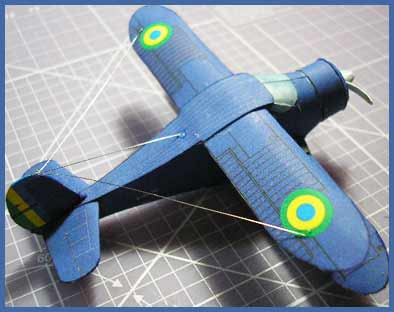
This is the Beech Staggerwing model that won the FG Modeling Madness (FGMM) 2010 best in class prize. Thanks to Péricles Lopes Gomide Filho for his entry !! |
|
 |
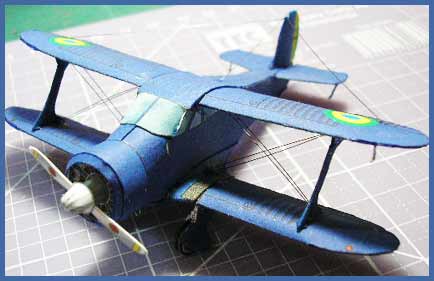 |
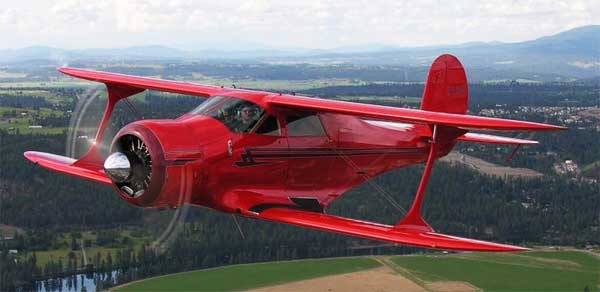
Beechcraft D-17 Staggerwing
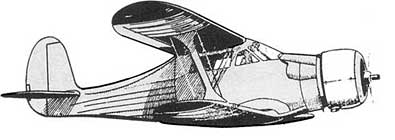 Positive stagger was such a common feature of biplanes that no
special mention was made of it. The use of negative stagger on
the Beech was a rarity worthy of note. The airplane was initially
described as the "negative-stagger Beech," but over
the years the word "negative" was dropped and the term
"Staggerwing" emerged to label the Beech 17.
Positive stagger was such a common feature of biplanes that no
special mention was made of it. The use of negative stagger on
the Beech was a rarity worthy of note. The airplane was initially
described as the "negative-stagger Beech," but over
the years the word "negative" was dropped and the term
"Staggerwing" emerged to label the Beech 17.
All of which leads to the inevitable questions. Why have stagger in the first place? What does it accomplish?
According to the old aerodynamics textbooks, stagger contributes
somewhat to longitudinal stability and also to maneuverability,
which would seem to make it an asset on fighters and special aerobatic
ships. The fact that some famous fighters like the World War I
Spad did not use it, plus the fact that the stagger was in use
long before maneuverability become a competitive factor, would
indicate that there are other reasons for its existence.
One reason is the simple matter of access, particularly in small airplanes. Take something like today's Smith Miniplane home built as an extreme example. With the pilot seated almost on the center of gravity, he'd be under the upper wing if the plane had no stagger. With such a narrow wing gap, he wouldn't be able to get in or out without a big cutout in the side of the fuselage. Staggering the upper wing positively - that is, moving it ahead - plus a cutout in the rear of the center section allows the pilot to sit further aft.
 It should be noted that few big biplanes, from single-engine mail
planes and bombers, had staggered wings. There was plenty of room
between the top wing and the fuselage on these bigger ships for
the crew to be able to climb into the cockpits. The passenger
transports had doors in the side of the fuselage, so gap was no
problem.
It should be noted that few big biplanes, from single-engine mail
planes and bombers, had staggered wings. There was plenty of room
between the top wing and the fuselage on these bigger ships for
the crew to be able to climb into the cockpits. The passenger
transports had doors in the side of the fuselage, so gap was no
problem.
The
military had considerations other than maneuverability. Early
observation planes had the observer in the front seat, and his
downward view was enhanced by the positive stagger that put the
lower wing further back.
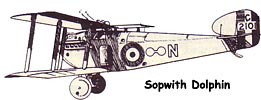
Some fighters, such as the de Havilland 5 and the Sopwith Dolphin
of World War I, had negatively staggered wings to improve the
pilot's visibility in the critical upward-forward area, normally
a blind spot on conventional single-seaters where the pilot sat
behind the upper wing. However, despite that particular advantage,
negative stagger remained rare on fighters.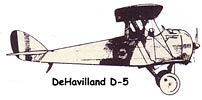
What about biplanes with no stagger? There were plenty, particularly in the larger sizes as mentioned. The term "orthogonal biplane" was used to describe them. The word eventually took on a more specific meaning and was used to identify an unstaggered biplane with equal chord (and span) on both wings.
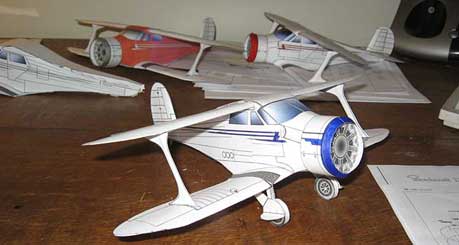 Before it's ready for release, every model is printed and built 12 or 15 times to check for fit and workability. These are a few of Glen's Betas- the additional betas built at FG studios aren't even show here. |
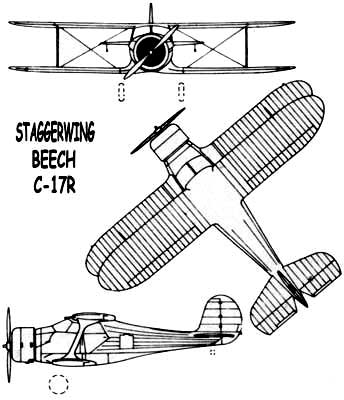 Very few pre-war biplanes had enclosed
cabins and fewer still had a retractable undercarriage; the four-seater
Beech-17 'Staggerwing’ had both. It was something of a misnomer
as many biplanes had upper and lower wings staggered but the Beech
reversed the usual layout by staggering the upper pair behind the
lower. With this configuration, the pilot enjoyed an excellent field
of view without the restrictions of the upper wing. Most 'Staggerwings'
flying today are ex-USAAF C-43 Travelers powered by a 450 hp Pratt
& Whitney Wasp junior offering a cruising speed of 200 mph.
Very few pre-war biplanes had enclosed
cabins and fewer still had a retractable undercarriage; the four-seater
Beech-17 'Staggerwing’ had both. It was something of a misnomer
as many biplanes had upper and lower wings staggered but the Beech
reversed the usual layout by staggering the upper pair behind the
lower. With this configuration, the pilot enjoyed an excellent field
of view without the restrictions of the upper wing. Most 'Staggerwings'
flying today are ex-USAAF C-43 Travelers powered by a 450 hp Pratt
& Whitney Wasp junior offering a cruising speed of 200 mph.
Stagger...Why
have it, and what does it accomplish?
0ne of the nearly forgotten words in this age of monoplanes is "stagger."
It has nothing to do with the erratic progress of a drunk down the
street; it's a term that describes the longitudinal relationship
of one wing of a biplane with the other. The word appears most frequently
today in reference to this classic Beechcraft Model 17 biplane.
A Waco cabin biplane, typical of all the 1931-41 Custom and Special lines. Like all Waco's and most other biplanes, this one has a positive stagger, with the upper wing located ahead of the lower. Note the pilot's position- his downward view is fine, but his upward view is less than great without a skylight in the roof. |
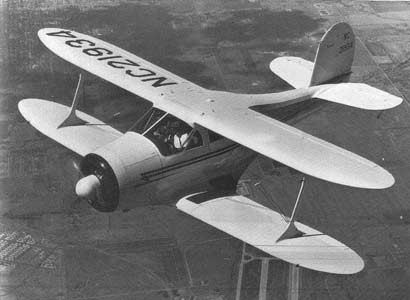
The famous Staggerwing, the Beech D-17s biplane on which the lower wing is located forward of the upper wing. This arrangement is known as negative stagger. Downward view for the pilot is somewhat reduced compared to the Waco, but his upward vision is greatly improved. |
Many biplanes were built with no stagger. When the wingspan and the chord were equal, and the gap between the wings equaled the chord, as on this Douglas M-1, the configuration was called an 'orthogonal' biplane. |
Most triplane's had their wings in alignment, but there were a few oddities, such on this experimental World War I Nieuport. At the height of the 1917 triplane craze, Nieuport tried three wings on the fuselage of its standard Model 17 biplane fighter and come up with this "double stagger" gem. |
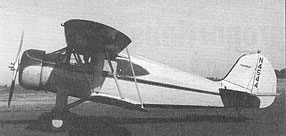
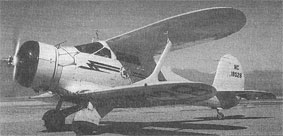
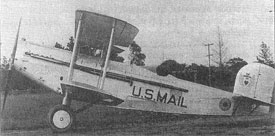
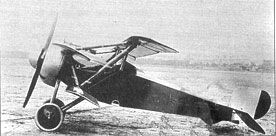
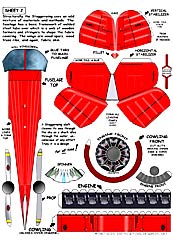
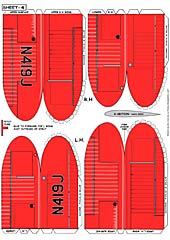
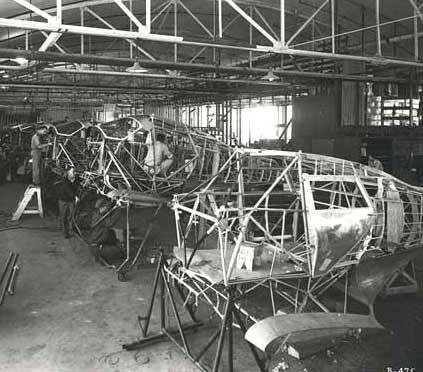 Looking at this photo of the Staggerwing Assembly Line, you can see how the cardmodel has reflected the actual Staggerwing structure.. Especially the wing root area. |
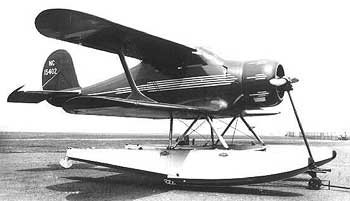 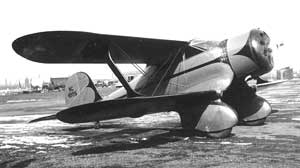 Here are a couple photos of early Staggerwing models-Floats and Pants |
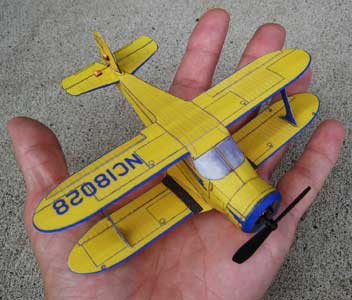
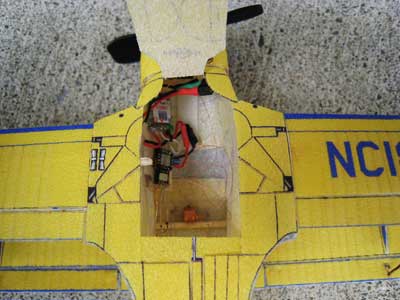
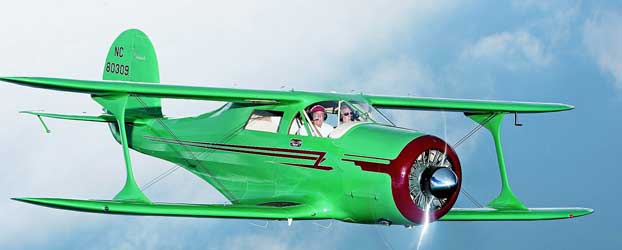 Beechcraft Staggerwings were decorated in many different schemes |
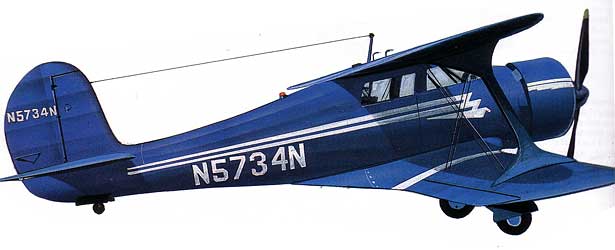 The Stagger wing usually had the typical lightning markings along the fuselage |
|
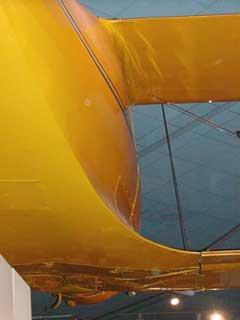 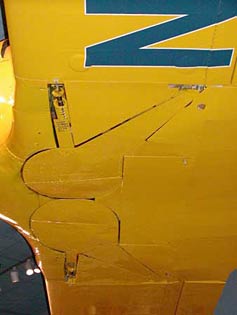 |
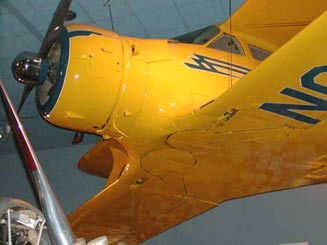 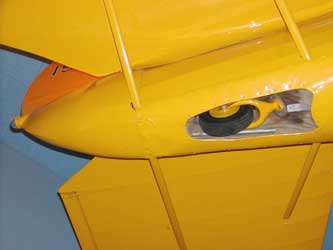 These are photos of the Beech C17 on display at the NASM |
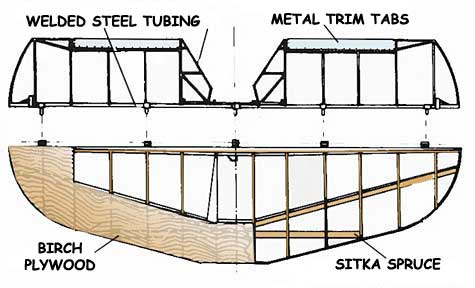 |
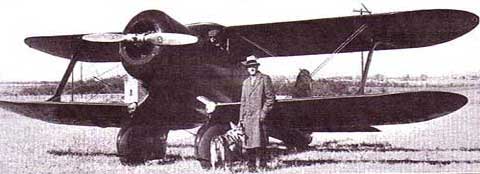
The following text is about the Beechcraft Staggerwing from the Aero Digest, December 1932 when the Staggerwing was brand new. Images are from the article as well. Mega thanks to Rob Tauxe for the photocopy..
A gross weight of 4500 pounds permits the carrying of a pilot, three passengers and 175 pounds of baggage with full fuel load of 145 gallons of gas and 10 gallons of oil. Four passengers in addition to the pilot may be accommodated by reducing the quantity of gasoline to 115 gallons. The power plant is a 420-horsepower "F' type Wright with rear exhaust stacks. The fuel capacity of 145 gallons provides for a cruising range of 1000 miles at 165 to 175 miles per hour. The rate of climb is 1600 feet per minute at sea level with full load. This ship has been stress analyzed for, and will be powered with, a 650-horsepower Wright twin-row radial engine as soon as it is commercially available. One of the most distinctive features is the negative staggering of the wings, an arrangement which makes for good visibility, as the pilot's head is forward of the upper wing leading edge. Aerodynamically, the negative stagger produces some good characteristics-the lift curve is flat at high angles of attack, showing no signs of falling off sharply, even at an angle of 30 degrees. In the past, the general belief has been that at high angles of attack the lower wing would "blanket" the upper wing. Wind tunnel and flight tests indicate that when located a considerable distance ahead, the lower wing actually straightens out the air stream for the upper wing, making it more efficient at high angles than the conventional positive staggered arrangement. The lower wing is far enough forward to permit a smooth fairing for the landing gear to grow out of. Structurally the negative stagger also has advantages-the highest loads are carried by the upper front spar which is deeper; flying wires pass through the lower wing and are fastened at the bottom of the landing gear; this results in a rigid structure as the wires make a large angle with the spars. Flying wires are fastened only to front spars and the rigging can be changed without loosening any wires. All tie rod terminals are inside and accessible through inspection covers. Wing root and other fairing's are constructed as part of the cover. The fuselage is metal covered and the portion to the rear of the cabin in insulated. Haskelite plywood is used extensively throughout. The length of roll on the ground is reduced
by the use of the decelerator and is further shortened by
an efficient brake system. The large ground angle of 18 degrees
is approximately three degrees greater than the angle of maximum
lift, and therefore once the tail is on the ground, there
is little chance of the ship's rebounding into the air. Wings have steel spars, ribs spaced six inches apart, fabric-covered, and are externally braced with true streamline wires. Long, tapered elliptical tips are removable. The resistance of the heat treated I struts is much less than that of the customary N struts. The tail, an integral unit, is fastened to the fuselage with ball bearings. There are no swivels in the wires or masts in the fin. The electrically operated stabilizer control moves the whole tail about ball-hearing hinges. Cable controls are used throughout, and all movable parts are mounted on double-seal ball bearings. Each aileron, on the lower wing only, is controlled by an independent system requiring no balance cables. Double elevator cables are used, each cable capable of carrying full design load. The control column hinges on heavy roller bearings. Two heat-treated trusses below the fuselage lower longerons eliminate the necessity for cross tubes in the passenger and luggage compartments. Trusses carry all large loads, from the landing gear, fuel tanks, pilot and passengers, control column and control column stops. The interior of the cabin is furnished with all the necessities for luxurious air travel-adjustable front seats, deep, wide rear seats and cushions; full-vision windows, ventilators,- heaters and radio equipment. Unusually large doors on each side of the cabin allow easy entrance to front and rear seats and provide good emergency exits. The bent laminated glass windshield, made in two halves, conforms to the shape of the fuselage and provides the pilot with full-range vision. Fuel is fed the carburetor by an engine driven fuel pump. An emergency hand fuel pump below the floor, operated by remote control, insures its being primed at all times. All wheels have roller bearings. The tail wheel has no shock absorbers or swivel joints and should require little attention. Landing-gear joints have large, easily removable steel alloy bushings lubricated from oil reservoirs holding enough oil to last a year. All wheels may be removed without touching the fairing around them. For engine servicing, the rear section of the N.A.C.A. cowl can he opened easily; the nose section does not have to be removed. Standard equipment includes a Smith controllable-pitch propeller, radio receiving set, five parachute flares, landing lights, starter, generator, battery, electric fuel gauges, cylinder-head temperature gauge, oil-pressure, oil-temperature and fuel-pressure gauges, tachometer, airspeed, rate-of-climb, compass, bank-and turn, altimeter, primer pump, booster coil, ammeter, clock, fire extinguisher and first aid kit. For the owner who desires full parachute equipment, seats as comfortable as the standard seats can be furnished with the chutes built in as part of the upholstery. The development of these seats was made possible through the cooperation of the Switlik Parachute & Equipment Co. |
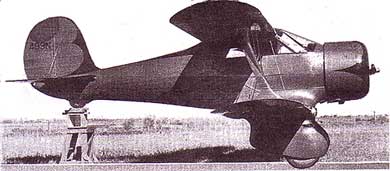 The two-unit type landing gear, with oleo type shock absorbers
having an eight-inch travel and 9.50 by 12 low pressure tires,
is covered with fairing that extends up to the lower wing.
Landing lights are faired into the intersection of the fairing
with the wing. Wheels may he pulled up into the pants after
take-off by means of an electrically operated mechanism. Safe
landings can be made with wheels retracted because approximately
six inches of the wheel projects below the pants and the lull
shock-absorber spring travel is always available. The rigid,
non-swiveling 16 by 7 tail wheel makes it practically impossible
to ground loop.
The two-unit type landing gear, with oleo type shock absorbers
having an eight-inch travel and 9.50 by 12 low pressure tires,
is covered with fairing that extends up to the lower wing.
Landing lights are faired into the intersection of the fairing
with the wing. Wheels may he pulled up into the pants after
take-off by means of an electrically operated mechanism. Safe
landings can be made with wheels retracted because approximately
six inches of the wheel projects below the pants and the lull
shock-absorber spring travel is always available. The rigid,
non-swiveling 16 by 7 tail wheel makes it practically impossible
to ground loop.
As stated in the
1932 release..
Specifications for the Beechcraft D-17 Staggerwing with Full Load (sea level)
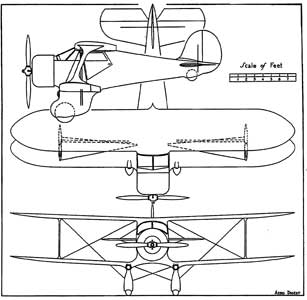 |
Wing span:34 feet 4 inches Length overall: 24 feet Height overall: 8 feet 7.5 inches Wing area (inc. 34 area of body) .. 300 sq. ft. Fuel capacity: 145 gallons Weight empty: 2700 pounds Weight of baggage: 175 pounds Useful load: 1800 pounds Gross weight: 4300 pounds Wing loading 13 pounds per square foot Power loading 10.7 pounds per horsepower High speed 201.2 miles per hour Cruising speed (1873 r.p.m.).. 170 ml. per hr. Landing speed: 60-65 miles per hr. Cruising range: 1000 miles Rate of climb: 1600 feet per minute Service ceiling: 21,300 feet Fuel consumption: (full throt.) .41 gal. per hr. Fuel consump: (cruising) 23 gal. per hr. |
Lastly, and to sum it all up,,
The Staggerwing was designed for high-class, high-speed executive travel. It was well suited for this purpose, as it swiftly flew five people in sheer comfort. This retractable gear reverse-stagger biplane was faster than most military aircraft in use when the design was introduced. Besides speed, the Staggerwing offers stylish lines, a roomy cockpit, and good flying characteristics, which rank it (together with the Ryan STA, the Bucker Jungmeister, and the Waco Taperwing) as an "ultra classic". Today, this model Beech is one of the most expensive of all antique airplanes to purchase!
| SPECIFICATIONS for the Beech-17 Staggerwing |
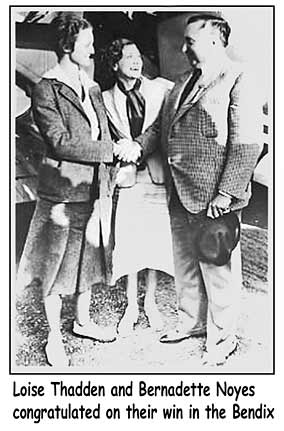
The Beech Staggerwing won a major race as a production plane, with women pilots!, amazingly, it was as fast as most fighters of it's day !! |
| A17F: Useful Load 1915 lb Span 34 ft 4 in Length (overall) 24 ft 2 in High Speed 240 mph Cruise Speed 212 mph Landing Speed 65 mph Range 780 sm Power plant Wright R-1820-F11 (650 hp) |
 |
C17L: Useful Load 1340 lb Span 34 ft 4 in Length (overall) 24 ft 2 in High Speed 175 mph Cruise Speed 166 mph Landing Speed 45 mph Range 560 sm Power plant Jacobs (225 hp) |
|
| 17R: Useful Load 1800 lb Span 34 ft 4 in Length (overall) 24 ft 2 in High Speed 201 mph Cruise Speed 180 mph Landing Speed 60 mph Range 960 sm Power plant Wright R-760 (420 hp) |
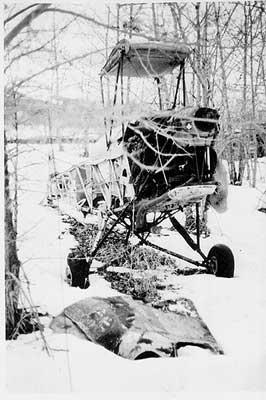 The cold sad remains of a Tigermoth |
Important Links:
There is an excellent museum dedicated exclusively to the Staggerwing in Tullahoma, Tennessee.