

Bell-H13-Sioux - $$6.49
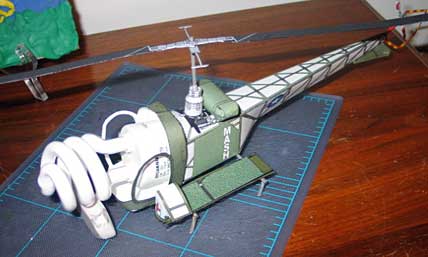
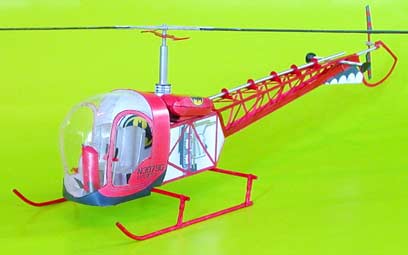
This was the most popular Bell helicopter of all due to its important role on the TV program MASH. You are going to enjoy fitting in a burned out light bulb for the canopy. Scrub the printing off the top of the bulb. Military designation was H-13, Bell 47 was their own. Now (3/10) a set of M*A*S*H* mobile field hospital tents are included in this folder

The Bell H-13 (model 47) Sioux 'MASH' Helicopter
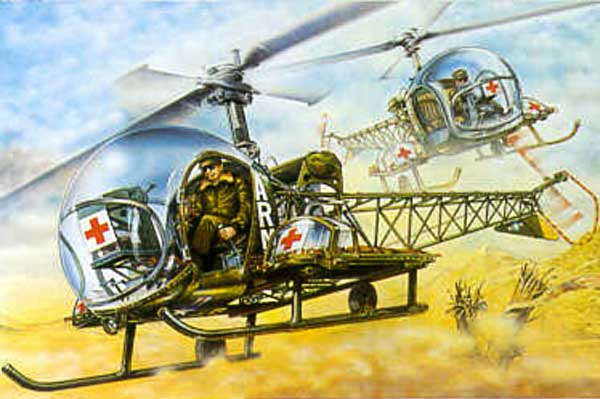
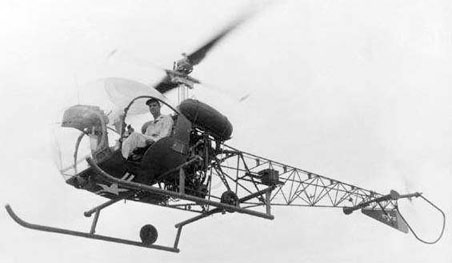
The Bell H-13 (model 47) 'Sioux' light observation helicopter was first flown in 1946 and owed it's credentials to it's predecessor, the Bell Model 30. The Bell Sioux, with a crew of three, was one of the most popular light utility helicopters ever built. The Bell model 47 was produced continuously from 1946 to 1973, and by Agusta, in Italy, through 1976. Produced in 20 different configurations, with model numbers ranging from A to T, the Bell model 47 was used in 40 countries.
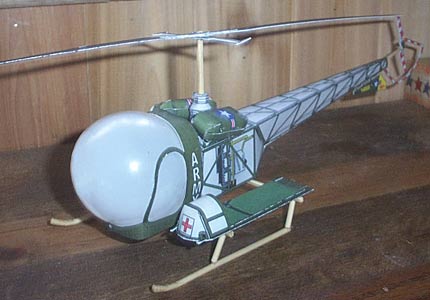 How do you like that seamless, slick looking canopy? Guess what it actually is. Answer under "What People Say..." |
 An H-13 Sioux? Wow, what an awesome choice chopper choice
for a model. Looks like Aaron figured out how to design the
fishbowl cockpit, well done to him. First the huey then a
hunter, soon enough an H-13, awesome.
An H-13 Sioux? Wow, what an awesome choice chopper choice
for a model. Looks like Aaron figured out how to design the
fishbowl cockpit, well done to him. First the huey then a
hunter, soon enough an H-13, awesome. Did you figure out WHAT the canopy 'Aaron figured out' really is? ;-) chip
Looks like a light bulb, so did Aaron figure out a paper version yet? If so, awesome stuff. Niki
ans: There will no paper version, Niki.. Just a light bulb. What do ya think? chip
Guys; The light bulb is such a good idea for the H-13, I thought it must be 150 watt, 3-way at least; ba-da-boom. Just a little light humor. scissors rock paper ...Dennis Tracy
OH BOY! Great job in making this model, for years I had been trying to figure out how to make the “fish bowel” canopy. I have been making many models out of beer and soda pop cans and never could figure out the canopy (promote that person to a Army General). “I NOW SEE THE LIGHT” Ron
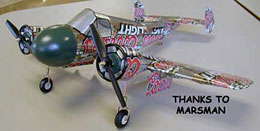
The nose cone on the C-45 is a "leggs Eggs panty hose container" there is no way I could have made one out of the Beer can to look as nice. I look at it like this it's flea's on a dog I see the dog not the flea's. Again I think great way of completing this model and plan on trying one this winter made out of beer cans to match my C-45... Marsman
Just finished the H-13 Sioux, an awesome model. Nice and
simple to build yet still looks awesome. Sorry I doubted
you guys on the light bulb canopy, it does the job amazingly
well, a paper version would've been hideous to build.
Thanks again for the models, I like the idea of helicopter
models for the next few weeks. It's a nice change from airplane
after airplane after airplane. Looking forward to the Hiller
XH-44, looks like a fun build and a funky looking model.
Niki BTW I've attached a couple of pics of my H-13 model.
Well I went out to buy a small light bulb to make the small H-13. Didn't pay much attention till I got home and removed the bulb from it's package. Low and behold the bulb was packed on a sheet with vacu-formed bubble . Wow! a clear bubble!!!! Well here is the results. Of course had to make the interior seats, control panel etc., Forgot to put the instruments on the control panel before I put the back on. Oh well, next time. Thanks for the models!!!!!Bob Martin (sorry for the image quality) Nice, Bobby.. Then can WE have the bulb? c
I'm getting ready to do the Bell H-13 sioux and in the
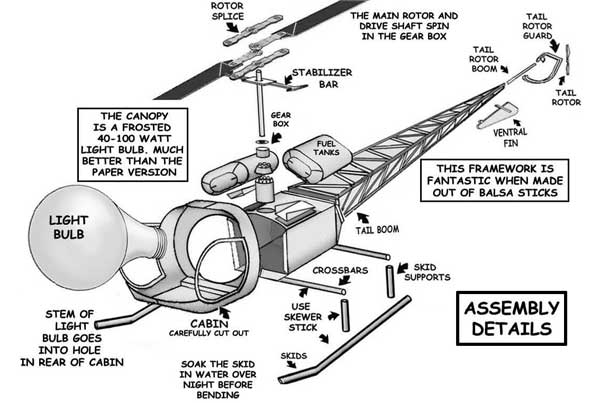
instructions it shows to use skewer sticks for the skids
and skid supports ,, what are skewer sticks ??? and could
i use toothpicks???? Thank you very much Brian
Brian ..Skewer sticks are at your super market or Wal-mart.Ask
for them ..I think toothpicks would be too short.You COULD
use a thin plastic straw, I guess. Hope this helps
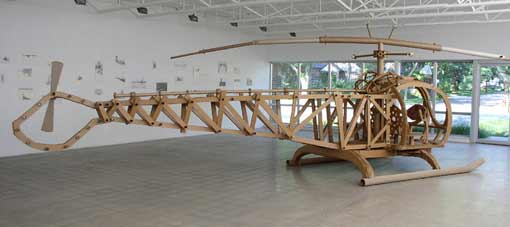
This version of the Bell H-13 is on exhibit at the Susanne
Hilberry Art Gallery
Bell H-13 Sioux
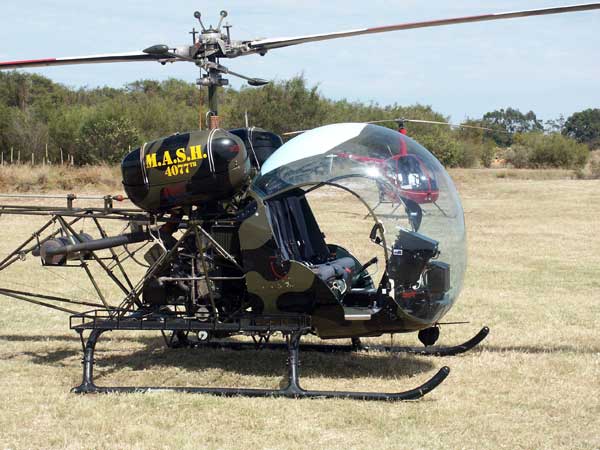
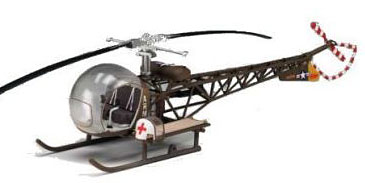
An important Bell innovation during the early development of the helicopter was the use of short weighted gyro-stabilizer bar at 90° to, and beneath, the main rotor. The gyro-stabilizer bar, with streamlined counterweights at both tips, was linked to the rotor in such a way that it determined the plane of the rotor, and maintained it generally in the horizontal, regardless of the angle of the mast.
The stabilizer bar, connected to the cyclic pitch control, acted as a hinged flywheel utilizing gyroscopic inertia to keep the teetering rotor blades in-plane and independent of fuselage movement due to gusts of wind, providing stability during flight. Arthur Young, Bell's designer, ensured the system had high enough inertia so sufficient energy would be stored in the rotor to permit safe autorotation in event of engine failure, an important safety consideration.
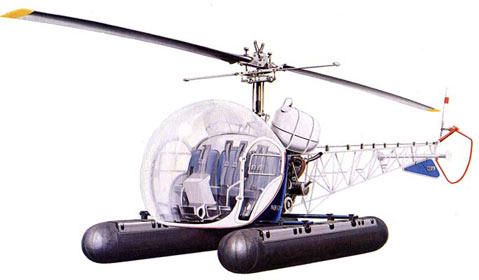
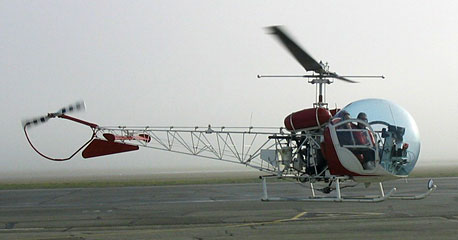
The H-13 was used for observation, reconnaissance and in the Medivac role as a litter carrier in Korea, following initial fielding in 1951. In the Medivac role a cacoon-like stretcher pod could be mounted on each skid. A distinctive feature of the Bell H-13G was the now familiar "Goldfish bowl" plexiglas canopy, featured in the TV-series MASH (Mobile Army Surgical Hospital).
The H-13 earned the nickname "Angel of Mercy" for evacuating some 18,000 United Nation's casualties during the war. The Sioux also saw service during the early days of the Vietnam war before the fielding of the OH-6A Cayuse in early 1968.
The Sioux could be armed with twin M37C .30 Cal. machine guns on the XM1 armament subsystem or twin M60C 7.62mm machine guns on the M2 armament subsystem.
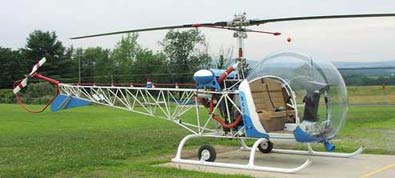 The Bell 47 was the first helicopter to be certified
for civil use, in May 1946. It was largely designed by Arthur
M. Young who assigned
his helicopter patents to, and joined Bell Helicopter in 1941.
Over 5,600 were produced through 1974, including 1200 under license
in Italy, 239 in Japan, and 239 in the UK. The British version
of the 47G, called by the British Army the Sioux, was built by
Westland Helicopters for use by the Army Air Corps, who used it
until the early 1980s.
The Bell 47 was the first helicopter to be certified
for civil use, in May 1946. It was largely designed by Arthur
M. Young who assigned
his helicopter patents to, and joined Bell Helicopter in 1941.
Over 5,600 were produced through 1974, including 1200 under license
in Italy, 239 in Japan, and 239 in the UK. The British version
of the 47G, called by the British Army the Sioux, was built by
Westland Helicopters for use by the Army Air Corps, who used it
until the early 1980s.
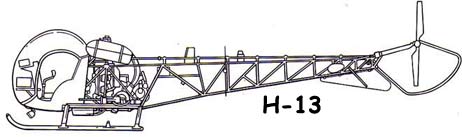
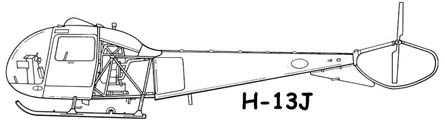
Early models had open cockpits or sheet metal cabins, but the most common model, the 47G, introduced in 1953, can be recognized by the full bubble canopy, exposed welded-tube tail boom, and saddle fuel tanks. Later H and J models had a regular cabin with full cowling and monocoque tail boom. Engines were Franklin or Lycoming horizontally-opposed piston engines of 200 to 305 HP. Seating varied from two to four.
This was the helicopter popularized in the 1957–1959 television series The Whirlybirds, and later the movie and television series MASH. A design, as well as a utilitarian, success, it was added to the permanent collection of the Museum of Modern Art of New York in 1984. Many are still in use as trainers and in agriculture.
NASA had a number of Bell 47s during the Apollo program which astronauts used as a primitive trainer for the Lunar Lander. Eugene Cernan had a near disastrous accident shortly before his flight to the moon on Apollo 17 by crashing one into the Indian River at high speed.
The combined total of commercial and military versions of this series was 5,000. The U.S. Army Air Force The H-13 had a cruising speed of 85 mph with a range of 255 miles.
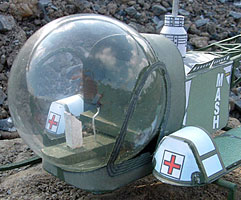 Clever Dick Doll removed the screw end, scored, and then carefully removed the excess glass of the light bulb before creating the cockpit details of his Bell Sioux. Notice he sprayed the interior of the model black. |
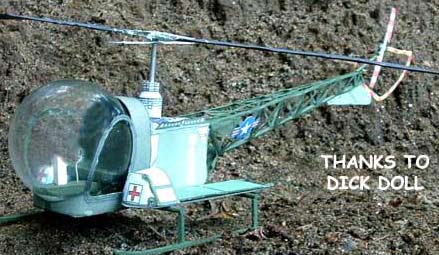 |
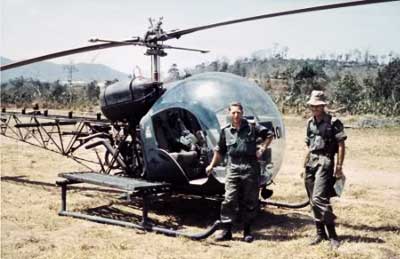 The H-13 was used for observation, reconnaissance
and in the Medivac role as a litter carrier in Korea, following
initial fielding in 1951. In the Medivac role a 4cocoon-like
stretcher pod could be mounted on each skid. A distinctive feature
of the Bell (model 47D) H-13D/H13E was the now familiar
"Goldfish bowl" Plexiglas canopy, featured in the TV-series
MASH (Mobile Army Surgical Hospital).
The H-13 was used for observation, reconnaissance
and in the Medivac role as a litter carrier in Korea, following
initial fielding in 1951. In the Medivac role a 4cocoon-like
stretcher pod could be mounted on each skid. A distinctive feature
of the Bell (model 47D) H-13D/H13E was the now familiar
"Goldfish bowl" Plexiglas canopy, featured in the TV-series
MASH (Mobile Army Surgical Hospital).
The H-13 earned the nickname "Angel of Mercy" for evacuating some 18,000 United Nation's casualties during the war. The OH-13 Sioux also saw service during the early days of the Vietnam war before the fielding of the OH-6A Cayuse in early 1968.
The Bell (model 201) XH-13F, powered by a Continental-Turbomeca XT51-T-3 Artouste 1220 hp turbo shaft engine, was Bell Helicopter's first turbine powered aircraft.
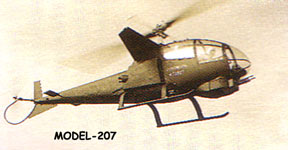
An experimental armed Bell (model 207) Sioux Scout (1963), based on the a Bell (model 47G-3B1) body and engine, with a newly developed gun ship front end, aided in the development of the AH-1G Huey Cobra attack helicopter. The Sioux Scout featured revised seating for two in tandem, small stub wings containing additional fuel, and a remotely-controlled chin barbette with two M60C 7.62mm machine guns. The Bell 207 was powered by a Lycoming 260hp TVO-435-A1A turbo charged piston engine.
 |
 |
 |
 |
 |
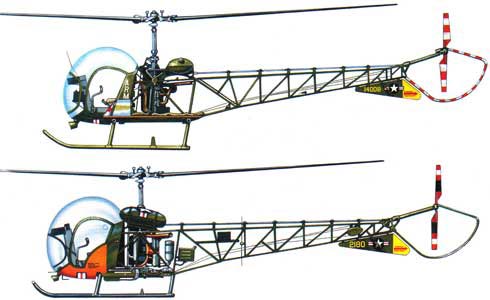
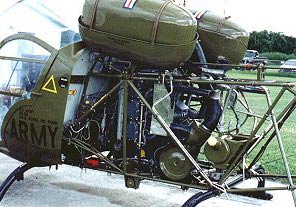 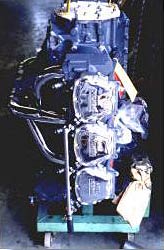 The H-13 is a study of simplicity. The dependable Lycoming engine is mounted vertically and, as you can see, there is plenty of space to work. Below are a couple more versions |
 |
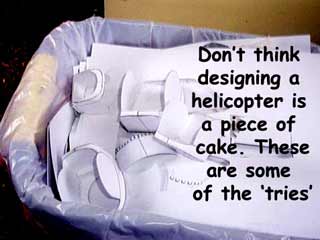 |
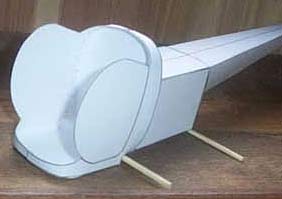 This looks like a big dragonfly, doesn't it? Don't think it was easy to design around a light bulb! |
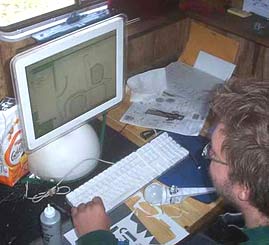
Fiddlersgreen instructions are not just about assembling your model, but filled with lots of interesting stuff. When your model's finished, save them in a binder for quick reference or hang your favorite ones up on the wall. |
 |
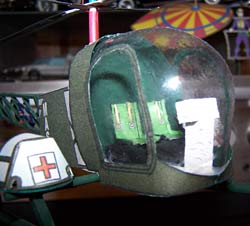 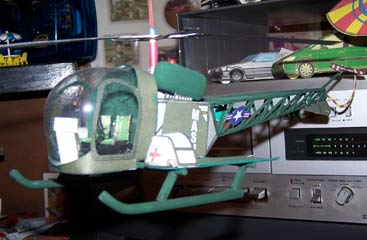 |
I was in the Dollar Store
sometime back and found a single 15 watt light bulb packaged
in bubble wrap. Well anyway here is the results. I used
the seats from the Flettner 282, made the instrument panel
from balsa wood and the cyclic and pitch controls from a
small plastic motor cycles handle bars. YMP Bob Martin |
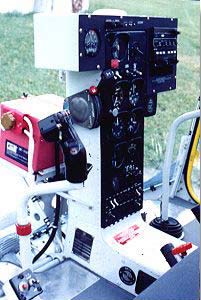 |
| Control Panel of the Bell H-13 Sioux. |
Specifications for the Bell H-13 Sioux 'MASH' Helicopter
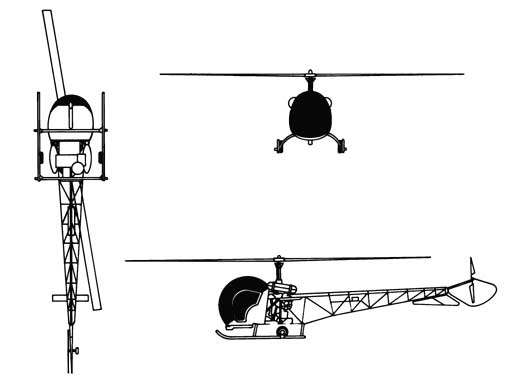 |
Crew: 1 Capacity: 3 Length: 31.6 ft Height: 9.28 ft Rotor diameter: 37.2 ft Main rotor disk area: 1085 ft2 Empty: 1893 lb Maximum takeoff: 2950 lb Power plant: Lycoming TVO-435-F1A flat six piston engine, 280 hp Performance Maximum speed: 105 mph Cruise speed: 84 mph @ 5,000 ft Range: 245 mi @ 6,000 ft Hover ceiling: 12,700 ft Rate of climb: 860 ft/min |
 |
||
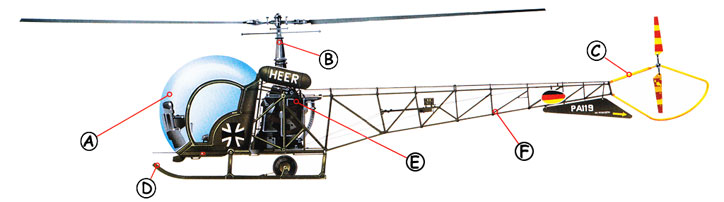
| A: Early Bell 47s had a fully enclosed cockpit like a car, but the Bell 47D introduced the classic Plexiglas bubble shape that gave such excellent visibility. | B: The main rotor head was a simple articulating type with a universal joint and a stabilizing bar mounted at right angles to the blade. | C: A simple guard rail was fitted to prevent the tail rotor striking the ground. The blades were constructed of laminated wood. |
| D: Bell 47s could have either wheels or a skid-type undercarriage and the Bundeswehr, like most military customers opted for skids. | E: Power was provided by a Franklin 6V4 six-cylinder horizontally opposed fan-cooled engine. It was rubber mounted to reduce vibration. | F: The tailboom was a simple steel tube structure with the tail rotor drive shaft running along the top of it. |
 |
 |
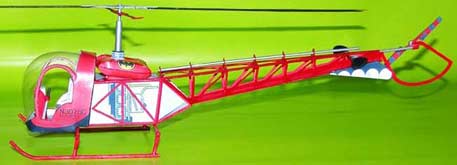
| This is one of the variations I received in the DVD from you. It is the repaint done by Niki Schutt. I stayed to the original parts list and built it entirely from paper. The things that are not paper are as follows: I used the package from a light bulb (instead of the light bulb itself as suggested in the instructions) for the canopy. That way I could cut out the doors, and then I scratch build an interior for it. I even mounted the Batman emblem from the instructions sheet behind the seats. The landing skids are sticks from long Q-tips, as well as the drive shaft on the top of the boom. I used a stick for the rotor shaft and found a plastic tube that it will fit into so the rotor turns freely as well. The tail boom rotor also turns. (used a toothpick Sanded round with paper windings) Of course I colored things that I thought would make it look a bit better. Hope you enjoy the pictures. And thanks for a great Model. Gary |
|
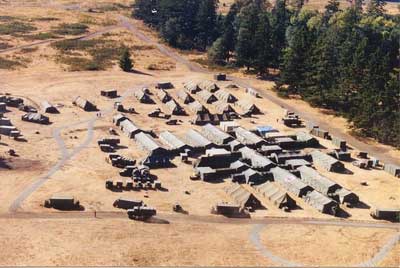
A Combat Support Hospital in Fort Lewis, Washington.
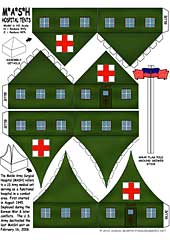
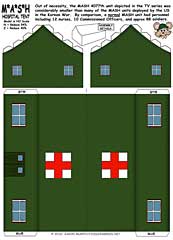
As a bonus we have added the MASH tents.
Mobile Army Surgical Hospital (M*A*S*H) was popularized by the movie from 1970 and the hit TV series that ran from 1972-1983.
The actual MASH units served a vital role in saving lives of wounded soldiers, as they were located near the front lines, and could move at a moments notice. Later they were re designated Combat Support Hospital (CSH). They were first established in the Korean War, and were used in later wars and conflicts, and were finally deactivated on February 16, 2006.
Out of necessity, the MASH 4077th unit depicted in the TV series was considerably smaller than many of the MASH units deployed by the United States in the Korean War. In the series, about 4 surgeons are depicted as being assigned to the unit, the administrative staff consists of the C.O. and his assistant, and few soldiers were shown to be present. By comparison, the 8076th Army Unit Mobile Army Surgical Hospital had personnel including 12 nurses, 89 enlisted soldiers of assorted medical and non-medical specialties, one Warrant Officer and ten Commissioned Officers of assorted specialties. On one occasion, the unit handled over 600 casualties in a 24 hour period.
 |
 |
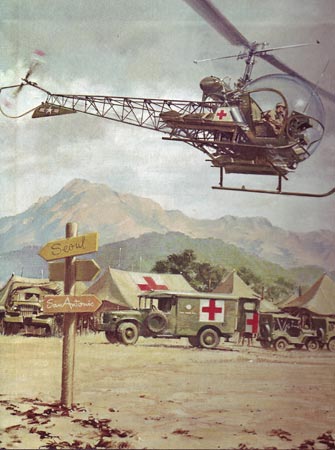
Bell H-13 Sioux Helicopter
The Bell H-13 Sioux, a single-engine light helicopter introduced in 1946, became an iconic workhorse for the U.S. military, serving as the first helicopter in large-scale combat during the Korean War for observation and medical evacuations.
Famous from its portrayal in the TV series M*A*S*H, it continued in roles like scouting early in the Vietnam War before being phased out in the 1960s.
With its distinctive bubble canopy and skid landing gear, the Sioux revolutionized battlefield mobility. This paper model faithfully recreates its compact design, perfect for helicopter fans seeking a build that combines historical accuracy with display-worthy detail.