
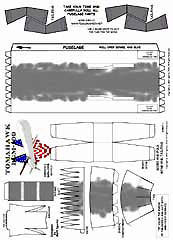
Boeing B52 - $$24.95
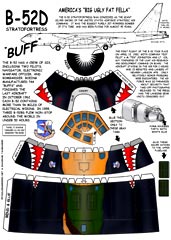
Built to carry nuclear weapons for Cold War-era deterrence missions, the B-52 Stratofortress replaced the Convair B-36. The B-52 was fitted to launch the X-15 Rocket (included with kit!). Black and Camo versions included, of course

i just got the downloadable version of the B52 , must say that you out did your self with this model!!! the B52 has always been my favorite bomber (next to the B17, and B24 which my uncle was a tail gunner in :-( (RIP ) i fell in love with the Buff ever since i saw Dr. Strangelove. the different versions of it make it an even more awesome model, seeing that in can be built through the various stages of its service life! i plan to build a few of them, and plan on buying more bombers( have hard copy of B24) as my salute to the MIGHTY 8TH AF!!! keep up the great work!!!! hey a suggestion,, what about some Russian bombers?? and some heavy airlift aicraft like C-5's and maybe some russian air lifters like the AN 124? John J
Working on regular size B-52 now. Had to make formers for the fuselage to assure the right cross section. I made them by cutting and pasting hour typical cross section example into Corel Draw and making copies in various sizes. I used Zepron foam, but balsa or 110 lb card stock would work as well. Your cruise missile TEL has similar formers. ...Dave Finkleman
THE B-52s ARE COMING!!!! THE BUFFS ARE COMING YEAH!!!!!! Here come some ARC LIGHT missions! I'll add them to my ceiling! I LOVE YOU GUYS! TSgt Edward M
A big thanks for the B-52 model! I was recently involved in a car accident, and suffered a broken knee. I am doing OK and getting better every day. However, since I wear a brace I can't drive and I need a walker to get around. What I can do, though,is build cardmodels. I put a serving tray across my lab and use it as a makeshift table. Your models help me pass the time instead of just staring at the TV. On top of that, a new Magic Key model is like an extra Christmas present! So thanks again for helping in my recovery! Tom M
Chip--you are entitled to your opinion concerning the vietnam conflict, however, if you want my business please keep your opinions out of my computer lest I unleash my opinions upon yours. ...William N- Former AE-1 United States Navy
Thank you for this terrific new model. I have researched some X-15 mounting links, especially the third one gives some excellent pictures of the wing mount pylon for the X-15: regards and keep up the excellent work..Herbert
Chip, Thank you!--David
Thank you - thank you - thank you for doing the X-15 Launch Version of the B-52.
You might be interested to know that NASA's 0008 "The Mother of All Mother ships" has never dropped anything in anger throughout its very busy career. It has always been a research airborne launch platform mother ship. It is due to launch the radical new X-43 Hyper-X in February, 04.
Just taking the opportunity to thank you and the team for another great addition to the FG stable of fine models and to wish you all the very best for '04. l know where you're coming from in sentiments regarding the delivery systems of death and destruction
THANKS FOR THE B-52 IT WILL GO IN THE TROPHY CASE AT SCHOOL ON MONDAY AND STAY THERE FOR ABOUT A MONTH THANKS A MILLION....ETHAN
Thanks again for all of the new models as of late am enjoying them very much, as are my kids. This last one is just a HUGE wow! the Buff is something else indeed and a great model. Wife got me a few packs of Avery foil greeting card stock and the models of yours come out just awesome!, and going to do the NB-52 with X-15 in that paper stock. Take care, Jeff O
....you continue to astound. Talk about a marathon downloading session...all the while wondering if the power is going to hold out. Weird weather...hail, thunder, and lightning on New Year's Day, here in the center of Idaho. Da
How about - to cleanse the palate - a few of those incredible long range racers that competed in the thirties - The Fairey monoplane, the De Haviland Comet, the Antonov An-17, (or which ever it was that first flew over the pole), those long winged graceful creatures that set the records for altitude and distance... RT
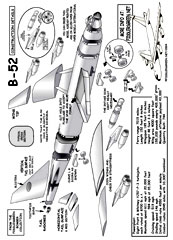
Wow! It took me a good almost 2 hours to download all(!) those B-52 variants that you sent out. Well, . . . let's see: download a model, go back and oggle at all of the sheets, repeat, repeat. I am amazed at the amount of work. The inside of the landing gear covers in zinc chromate - oh, yeah. And best of all: The alignment markers on the wings for the engine nacells. Thank you! Thank you! Thank you!
I find myself becoming more peace-nic oriented myself here of late. Currently above my desk are the F.G. Piper J-3, Piper"Pacer" (The conversion was easier than I thought.),Pietenpol "Air Camper", Aeronca "Champ", Cessna150, and North American X-15. Not one gun or missile on any of them. There are plenty of pretty, general-aviation birds, past and present, that nobody has ever done. Just a thought.... JT
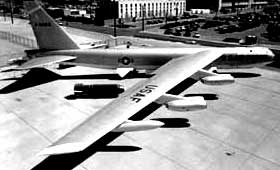
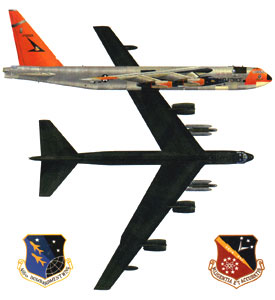 "NASA B-52, Tail Number 008, is an air launch carrier aircraft, "mother ship," as well as a research aircraft platform that has been used on a variety of research projects.The aircraft, a "B" model built in 1952 and first flown on June 11, 1955, is the oldest B-52 in flying status and has been used on some of the most significant research projects in aerospace history.
Some of the significant projects supported by B-52 008 include the X-15, the lifting bodies, HiMAT (highly maneuverable aircraft technology), Pegasus, validation of parachute systems developed for the space shuttle program (solid-rocket-booster recovery system and the orbiter drag chute system), and the X-38.
"NASA B-52, Tail Number 008, is an air launch carrier aircraft, "mother ship," as well as a research aircraft platform that has been used on a variety of research projects.The aircraft, a "B" model built in 1952 and first flown on June 11, 1955, is the oldest B-52 in flying status and has been used on some of the most significant research projects in aerospace history.
Some of the significant projects supported by B-52 008 include the X-15, the lifting bodies, HiMAT (highly maneuverable aircraft technology), Pegasus, validation of parachute systems developed for the space shuttle program (solid-rocket-booster recovery system and the orbiter drag chute system), and the X-38.
The B-52 served as the launch vehicle on 106 X-15 flights and flew a total of 159 captive-carry and launch missions in support of that program from June 1959 to October 1968. Information gained from the highly successful X-15 program contributed to the Mercury,Gemini, and Apollo human space flight programs as well as space shuttle development. Between 1966 and 1975, the B-52 served as the launch aircraft for 127 of the 144 wingless lifting body flights.In the 1970s and 1980s, the B-52 was the launch aircraft for several aircraft at what is now the Dryden Flight Research Center, Edwards,California, to study spin-stall, high-angle-of attack, and maneuvering characteristics.
These included the 3/8-scale F-15/spin research vehicle (SRV), the HiMAT (Highly Maneuverable Aircraft Technology)research vehicle, and the DAST (drones for aerodynamic and structural testing). The aircraft supported the development of parachute recovery systems used to recover the space shuttle solid rocket booster casings. It also supported eight orbiter (space shuttle)drag chute tests in 1990. In addition, the B-52 served as the air launch platform for the first six Pegasus space boosters.
 During its many years of service, the B-52 has undergone several modifications. The first major modification was made by North American Aviation (now part of Boeing) in support of the X-15program. This involved creating a launch-panel-operator station for monitoring the status of the test vehicle being carried, cutting a large notch in the right inboard wing flap to accommodate the vertical tail of the X-15 aircraft, and installing a wing pylon that enables the B-52 to carry research vehicles and test articles to be air-launched/dropped.
Located on the right wing, between the inboard engine pylon and the fuselage, this wing pylon was subjected to extensive testing prior to its use. For each test vehicle the B-52 carried, minor changes were made to the launch-panel operator's station.
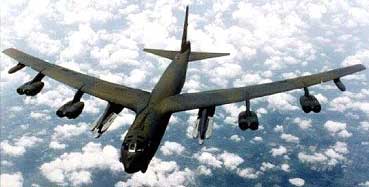
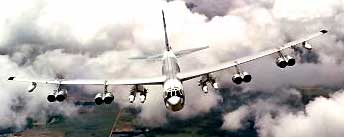
Built originally by the Boeing Company, the NASA B-52 is powered by eight Pratt & Whitney J57-19 turbojet engines, each of which produce 12,000 pounds of thrust. The aircraft's normal launch speed has been Mach 0.8 (about 530 miles per hour) and its normal drop altitude has been 40,000 to 45,000 feet. It is 156 feet long and has a wing span of 185 feet. The heaviest load it has carried was the No. 2 X-15 aircraft at 53,100 pounds. Project manager for the aircraft is Roy Bryant.For more than 40 years B-52 Stratofortresses have been the backbone of the manned strategic bomber force for the United States. Air Combat Command's B-52 is a long-range, heavy bomber that can perform a variety of missions. The bomber is capable of flying at high subsonic speeds at altitudes up to 50,000 feet (15,166.6 meters). It can carry nuclear or precision guided conventional ordnance with worldwide precision navigation capability. In a conventional conflict, the B-52 can perform strategic attack, air interdiction, offensive counter-air and maritime operations. The B-52 is capable of dropping or launching the widest array of weapons in the U.S. inventory. This includes gravity bombs, cluster bombs, precision guided missiles and joint direct attack munitions. The aircraft can carry 70,000 lb bombs both internal and external. B52 bombers also have a nuclear capability made famous in the 1960s film Dr Strangelove.
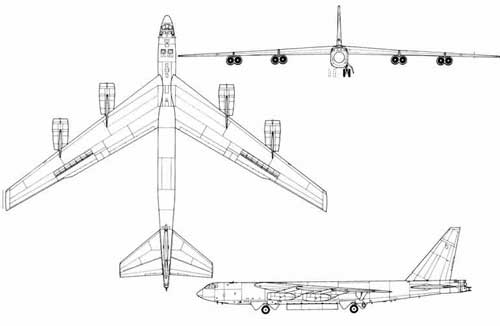
It is highly effective when used for ocean surveillance, and can assist the U.S. Navy in anti-ship and mine-laying operations. Two B-52s, in two hours, can monitor 140,000 square miles (364,000 square kilometers) of ocean surface.
All B-52s are equipped with an electro-optical viewing system that uses platinum silicide forward-looking infrared and high resolution low-light-level television sensors to augment targeting, battle assessment, and flight safety, thus further improving its combat ability and low-level flight capability.
Pilots wear night vision goggles (NVGs) to enhance their vision during night operations. Night vision goggles provide greater safety during night operations by increasing the pilot's ability to visually clear terrain, avoid enemy radar and see other aircraft in a covert/lights-out environment.
The B-52A first flew in 1954, and the B model entered service in 1955. A total of 744 B-52s were built with the last, a B-52H, delivered in October 1962. Only the H model is still in the Air Force inventory and is assigned to Air Combat Command and the Air Force Reserves. The first of 102 B-52H's was delivered to Strategic Air Command in May 1961. The H model can carry up to 20 air launched cruise missiles.
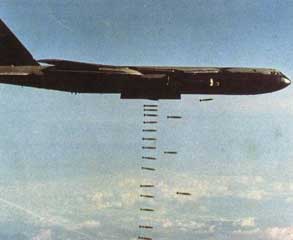
The B52 bomber saw heavy duty in Vietnam. From June 1965 to August 1973 no fewer than 126,615 B52 sorties were flown. Of these, 125,479 reached their targets, and 124,532 dropped their bombs. Six percent of these sorties were flown in North Vietnam, and 17 B52s were lost to hostile fire in North Vietnam. During the month of December 1972, 62 crew members of B52 aircraft were shot down and captured or went missing over North Vietnam.
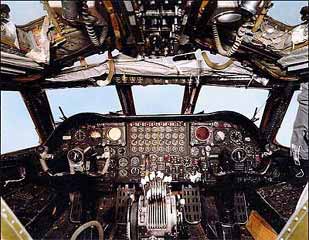
In addition, it can carry the conventional cruise missile that was launched in several contingencies during the 1990s, starting with Operation Desert Storm and culminating with Operation Allied Force.
The aircraft's flexibility was evident in Operation Desert Storm
and again during Operations Allied Force. B-52s struck wide-area
troop concentrations, fixed installations and bunkers, and decimated
the morale of Iraq's Republican Guard. The Gulf War involved the
longest strike mission in the history of aerial warfare when B-52s
took off from Barksdale Air Force Base, La., launched conventional
air launched cruise missiles and returned to Barksdale -- a 35-hour,
non-stop combat mission. During Desert Storm, B-52s delivered
40 percent of all the weapons dropped by coalition forces. During
Operation Allied Force, B-52s opened the conflict with conventional
cruise missile attacks and then transitioned to delivering general
purpose bombs and cluster bomb units on Serbian army positions
and staging areas.
Current USAF inventory of B52 Stratofortress bombers are the latter B52H variant and these have undergone extensive modifications of systems since they were built.
The B-52 will be capable of delivering the full complement of joint developed weapons and will continue into the 21st century as an important element of our nation's defenses. Current engineering analyses show the B-52's life span to extend beyond the year 2045.
Unlike it's ancestors the B29 Superfortess and B17 Flying Fortress
the five man crew of a B52 enjoy ejector seats just like fighter
jocks.
A truly classic aircraft which harks back to a bygone era and
can still 'cut the mustard'.
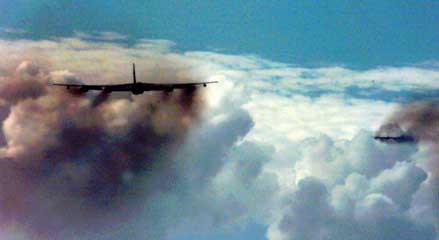 The B-52 would have a water injection system to get a big boost from the engines..AND belch out massive black smoke.. We lived in Pollock Pines east about 60 miles from the base at Sacramento and you could hear them take off on a damp night. |
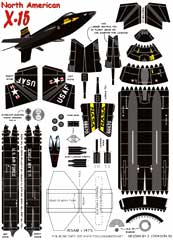
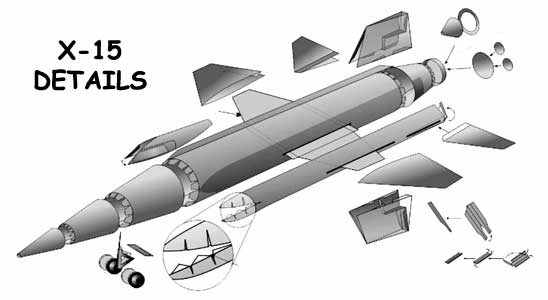 The X-15 rocket is scaled to match the B-52 and is included ((along with a cruise missile and F-84!) in the BUFF folder |
|
General Characteristics Primary Function: Heavy bomber |
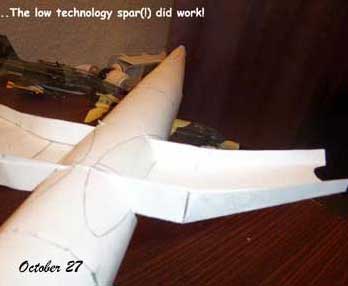 |
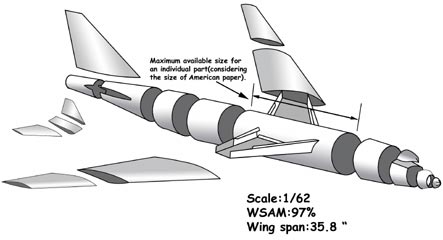
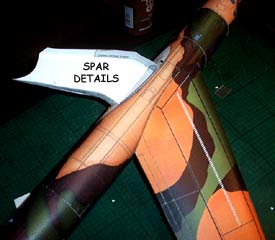
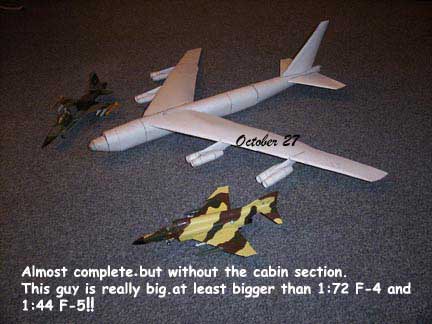
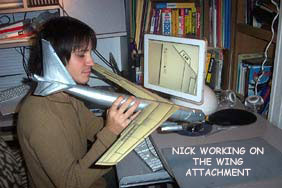
Shahram started this model back in July, 2003 and by October sent these photos |
 |
 |
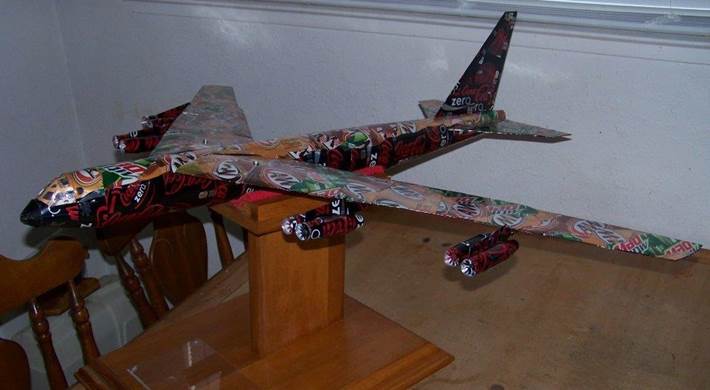
This sodacan paper model of the B-52 was submitted by Roy Greenwood. He says that FG models are very good for building aircraft (and other things) out of soda cans.