

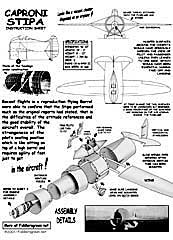
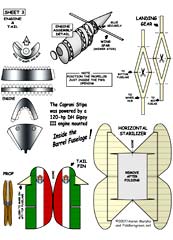
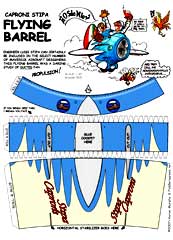
Flying-Barrel - $$6.95
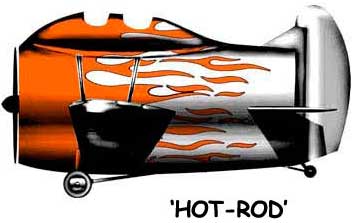
A lasting tribute to Luigi Stipa and his quest for aeronautical knowledge. Designed by Aaron Murphy, cartooned by Derek Carter, and bashed into the dreaded FG format by Dave and Chip, this simple little model came in as one of the more expensive models to design and publish on the internet.

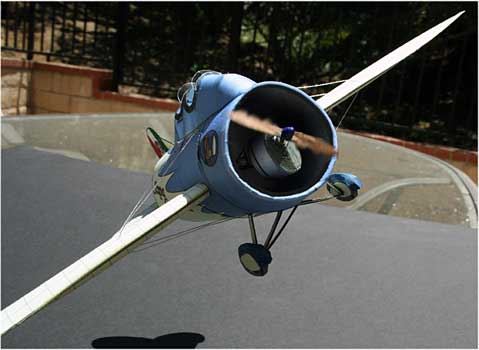
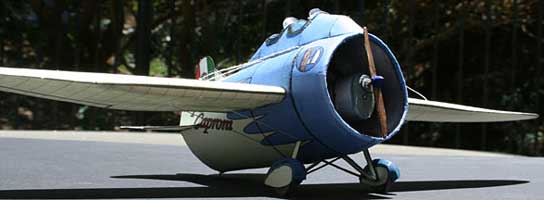
The Caproni Stipa-1930s Flying Barrel Airplane

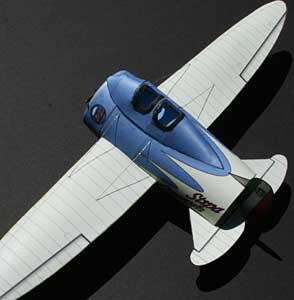
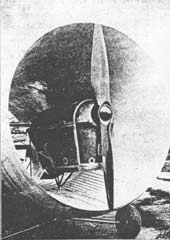
The principle of ducted fans is well understood now. They require a duct with correct tapering at each end and a low drag but powerful engine at its core. Multiple-bladed propellers, or a fan as on a modern high-bypass turbofan are needed for efficiency. Placing a Tiger Moth engine inside a fat tube doesn't cut it. An Italian government engineer, Luigi Stipa, convinced the Caproni Company to build an aircraft to test his theory that a tubular fuselage gave significant extra thrust to a conventional engine and propeller. The resulting Caproni-Stipa aircraft had a corpulent annular fuselage, which concealed a Gipsy engine and two-bladed propeller. All this achieved was high drag and low noise, although the landing speed was reduced to 42mph. Performance was otherwise lower than a conventional airframe with the same powerplant.
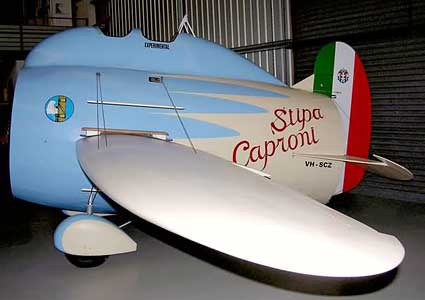
In 1995, an Australian aviation enthusiast, Guido Zuccoli, set about building a replica of this extraordinary aircraft. Since an exact replica would have been too large to qualify as an ultralight aircraft, Zuccoli's replica was a 65 per cent scale model. Zuccoli himself was killed in an air crash in 1997, but the project was completed by his widow and Bryce Wolff, the aircraft's constructor, who also test-flew it.
Cool! (in an ugly sort of way) :>) A great addition to the weird aircraft. BB
FG's got the most unique collection of models ANYWHERE on the planet...And if there's any doubt, the Flying Barrel the clincher...
Yew duh man! Or, y'all duh men! Or, y'all duh humans!
Its tough bein' PC alla time...Z
No time for PC in here man! Thanks for the inspiring comments on the "Flying Barrel". Between Chip, Aaron, Derek, and myself... this is definitely one of those models that exceeded our expectations. Not to mention a blast to work on. Derek is a HUGE contributor to the "uniqueness" factor with his artistic style that Chip loves so much. We hope this little model will be a positive influence for all the paper-benders out there! David Roy(the new guy)
What a kick it is assembling this one! Your engine/wing support design is quite interesting and effective. Bob Penikas
Simply awesome!!!!!!!!!!!!!!!!!!!!!!!!!!!!!!!
dolf carlson
I am an aircraft maintenance engineer, working in Australia. I was fortunate to have been working on the airport at Toowoomba, Queensland, the day Lynette Zuccholi's version 'flew'. I remember the pilot saying the aircraft was very sensitive in pitch, due to the position of the pilot so high above the center of lift. Lynette has a magnificent collection of aircraft, including many original Australian War birds, and is a must see for any aviation enthusiast visiting Toowoomba, in Queensland, Australia. Another must see is the Museum of Australian Army Flying, at the Oakey Army Center, west of Toowoomba. Regards Martin Hillier
Aviation Air Manuals Section ..Headquarters 16th Brigade (Aviation)
 |
 |
Hmmmmmm |
|
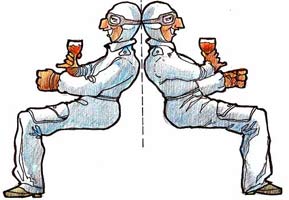
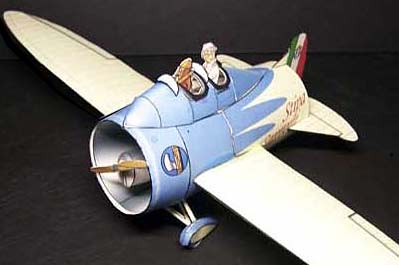 Dave built this beta and then decided that the nose needed a circular piece. Also the blue needed a thin black outline to bring it out better. The pilots WILL fit if you cut and jam a little. |
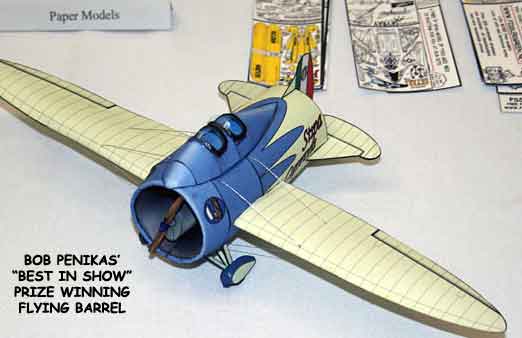
Caproni-Stipa
Count Gianni Caproni di Taliedo designed many wonderful aircraft and even owned or sat on the boards of of some 20 of Italy's best known aircraft companies in the 20s and 30s.
In 1932 Caproni financed and built this amazing ducted-fan flying barrel that was designed by the controversial Italian designer Luigi Stipa.
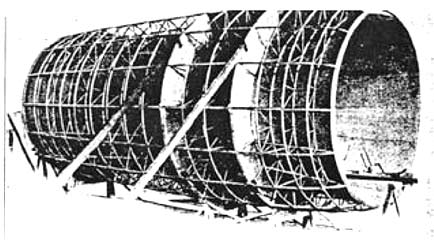
This- ugliest of all airplanes- bizarre and ungainly are a couple more good descriptions- was used to investigate the characteristics of the 'Ducted-Fan propulsion unit in conjunction with the 'Hollow-Chord fuselage.'
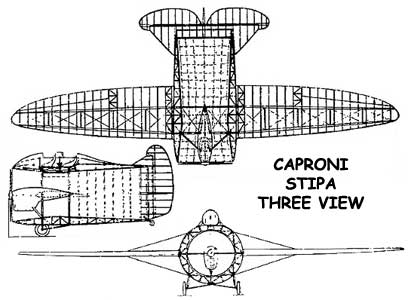 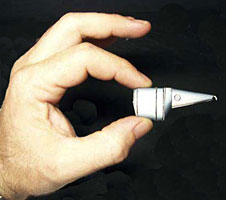 The original Flying Barrel and an old rough plan. (RH) Dave shows of the engine for the large version.
|
||
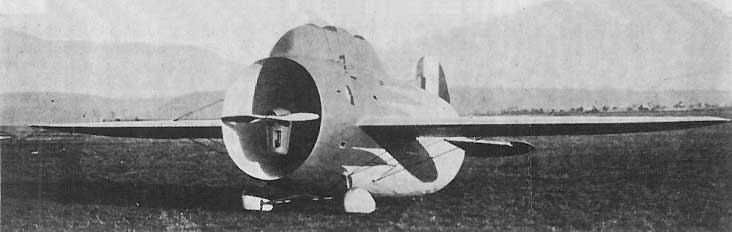 Old photo of the full scale Caproni Stipa Flying Barrel |
||
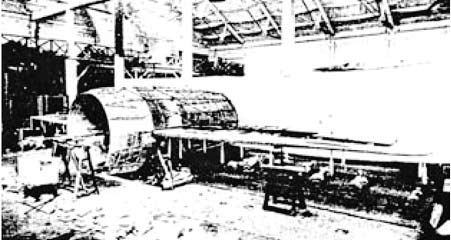  |
||
  |
||
 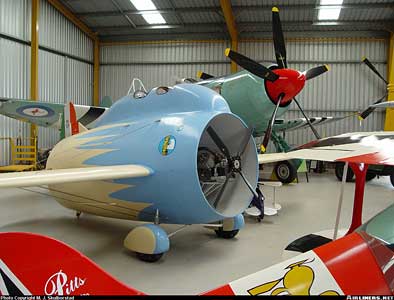 |

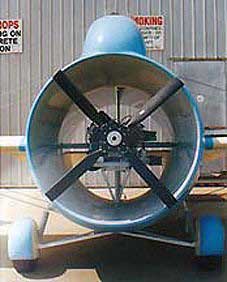 |
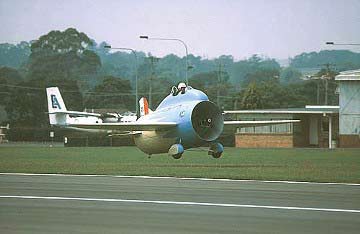 This is the 65% scale version of the Flying Barrel |
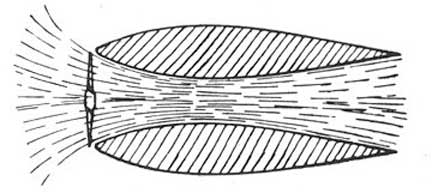 Interesting
stuff about about Ducted Fans:
Interesting
stuff about about Ducted Fans:
A ducted fan is a propulsion arrangement whereby a propeller is mounted within a cylindrical shroud or duct. The duct prevents losses in thrust from the tips of the propeller and, if the duct has an airfoil cross-section, it can provide additional thrust of its own. Ducted fan propulsion is used in aircraft, airboats and hovercraft. A kind of ducted fan, known as a fantail or by the trademark name Fenestron, is also used to replace tail rotors on helicopters.
In aircraft applications, ducted fans normally have more and shorter
blades than propellers and thus can operate at higher rotational
speeds. The operating speed of an un shrouded propeller is limited
since tip speeds approach the sound barrier at lower speeds than
an equivalent ducted propeller. The higher rotational speed of a
ducted fan may require a gearbox when used with piston engines,
which adds weight and negates some of the advantages. Instead, electric
or Wankel rotary engines are the preferred method of power, and
efficient home-made examples exist for both. 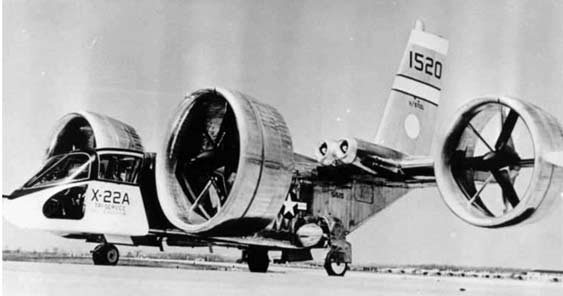 A
turbine can also be used to power the fan; in this configuration
the ducted fan is referred to as a turbofan. Ducted fans usually
have an odd number of blades to prevent resonance in the duct.
A
turbine can also be used to power the fan; in this configuration
the ducted fan is referred to as a turbofan. Ducted fans usually
have an odd number of blades to prevent resonance in the duct.
Advantages
* By reducing propeller blade tip losses and directing its thrust
towards the back only, the ducted fan is more efficient in producing
thrust than a conventional propeller at low speeds (normally considered
under 80 knots or approximately 90 miles per hour for an aircraft).
* Ducted fans are quieter than propellers: they shield the blade
noise, and reduce the tip speed and intensity of the tip vortices
both of which contribute to noise production.
* Ducted fans can allow for a limited amount of thrust vectoring,
something normal propellers are not well suited for. This allows
them to be used instead of tilt rotors in some applications.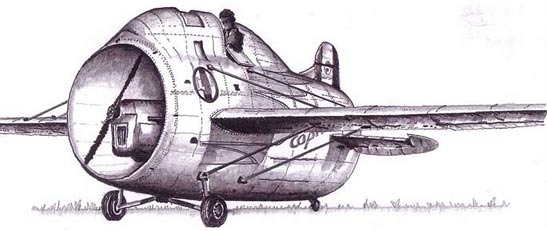
Disadvantages
At higher speeds (above about 80 knots), the presence of the duct
may create more drag than the extra thrust it provides and therefore
its comparative advantage to an open prop is reduced.
USES
Ducted fans are favored in VTOL and other low-speed designs such
as hovercraft for their higher thrust-to-weight ratio.
Among model aircraft hobbyists, the ducted fan is popular with builders
of high-performance radio controlled model aircraft. Internal-combustion
glow engines combined with ducted-fan units were the first achievable
means of modeling a scaled-size jet aircraft. Despite the introduction
of model-scale (miniature jet engine) turbines, ducted fans remain
popular today as they are more affordable, and because ducted fans
are compatible with electric-powered flight systems.
CAPRONI-MORONI C2 "SCUD" EXPERIMENTAL FIGHTER
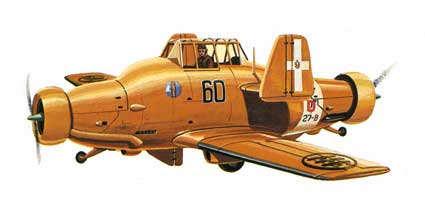
When the tide of war turned against it, Fascist Italy turned with
the tide. The C2, or "SCUD," was one direct result. The
engineers of Aeronautico Piccolino Abagano Elari Quattori in Turin
were charged with designing an aircraft of modern fighter type that
could, should word come in mid-air of another change in Italian
allegiance, instantly reverse course and become part of the now
friendly force.
Thus the unique two-engine configuration, central cockpit with swivel seat and dual controls facing fore and aft. Time for the SCUD (mean "Scuderia con curso il travala," or "turncoat") to switch directions and sides was set a less than two minutes from a top speed of 265 mph by air force consultants. This performance criterion was never tested, much less met, since pilots refused to attempt it, except on the ground with an ambulance close by. One pilot did take the sole SCUD prototype aloft, but once airborne decided to visit his mother in Salerno and wrecked the craft crash-landing on a nearby beach. The SCUD was painted gold by artisans formerly employed in upkeep of the Sistine Chapel.
A remarkable feature of the plane, considering its fighter designation, was it total lack of armament. The designers successfully resisted all attempts to ruin its unbroken lines with ugly guns. (from Bruce McCall's Zany Afternoons)
Specifications for the Caproni-Stipa
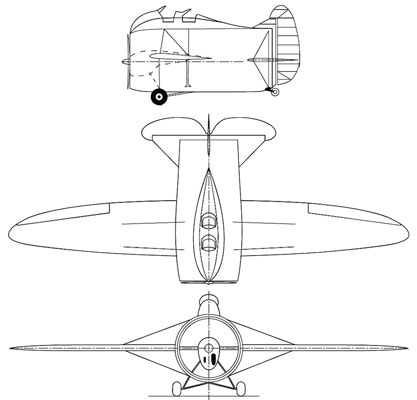 |
Crew: 1 or 2 Length: 18 ft 3 in Wingspan: 46 ft 10 in Height: 9 ft 10 in Loaded weight: 1,760 lb Powerplant: 1× de Havilland Gipsy III inline piston engine, 120 hp Propellers: 1 propeller Performance Maximum speed: 81 mph Landing speed: 42 mph |
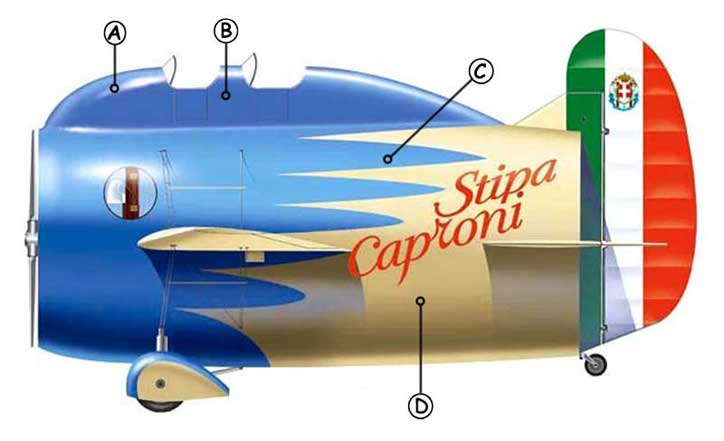 |
|||
| A: Humped surfaces around the cockpits would have seriously impeded the view of pilot and passenger unless they leaned to one side. | B: The Stipa's pilot and passenger had to sit in cockpits perched atop the fuselage. | C: Stipa claimed that the outer fuselage was profiled to generate lift. It was said that this contributed 37 percent of the total. | D: The Caproni-Stipa replica made only a few short hops before being placed on static display in Australia. |