

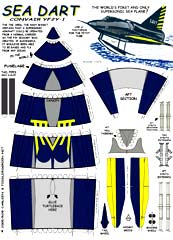
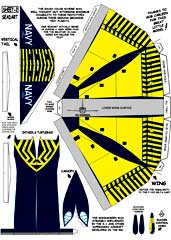
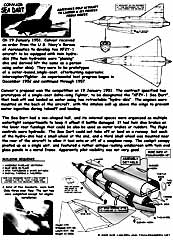
Convair Sea Dart - $$5.95
The Convair F2Y Sea Dart was a unique American seaplane fighter aircraft that rode on twin hydro-skis for takeoff. It only flew as a prototype, and never entered production, but it is still the only seaplane to exceed the speed of sound.

Convair YF2Y-1 Sea Dart:
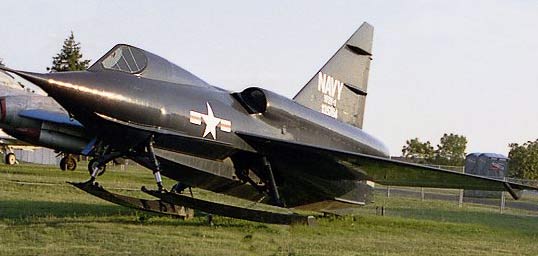
A supersonic jet fighter that was supposed to take off and land on water? Well, that was the idea, anyway, and it worked-to the extent that it did indeed fly off and land on water.
The biggest problem with airplanes is that they need runways, and in wartime, the average runway might as well have the words "Bomb Here" painted on it in big block letters. Runways are among the first targets bombed when a war starts, so over the years people have hatched various schemes to build combat airplanes that don't need a vulnerable stretch of pavement.
The 1950s was an era of aggressive innovation in aircraft design, not all of which was successful. One of the more interesting was the Convair "Sea Dart" hydro-ski fighter. Seaplanes substitute water for concrete, but when the Jet Age came along, seaplanes proved ill-suited to the higher speeds. The Navy's Convair Sea Dart, essentially a jet fighter on water skis, experienced such severe vibration on takeoff that the testing program was scrapped after only five had been built. However, once aloft, the Sea Dart handled well.
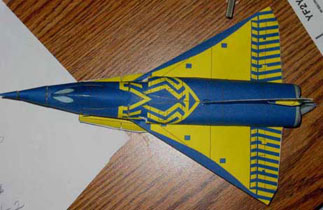
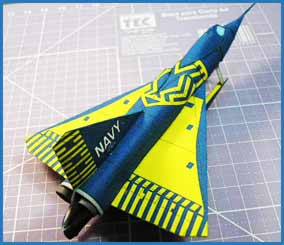
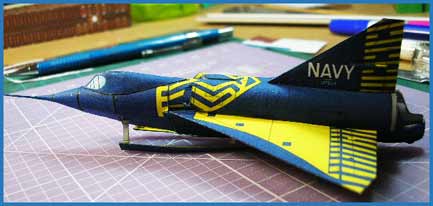
This is the Convair Sea Dart model that won the FG Modeling Madness (FGMM) 2010 best in class prize. Thanks to Péricles Lopes Gomide Filho for his entry !! |
|
 |
 |
I think very few would recognize the F7 designation--the current listings of cross references between the old and current systems leave that number out completely. Remember--that system was McNamara's idea, after being embarrassed by not knowing the difference between the F4D and F4H. He nearly cancelled the Phantom--based on cost differences between the " model variations".
There weren't enough planes still in the inventory to neatly fit between the F1-- (the FJ) and the F11 (F11F-1) The F3D became the F10. His sense of order put this long since retired aircraft as the F7....in order to fill a gap. Remember he was a theoretical economist by training and numbers and order were his prime concern. I recommend dropping the F7 designation and only footnoting it in the end paragraphs. Since the plane never went beyond the prototype stage--it would have to be referred to as a YF7-A, if you were to call it by that designation. Rob
Convair Sea Dart
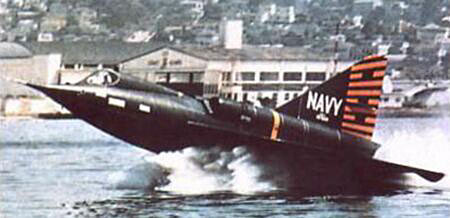
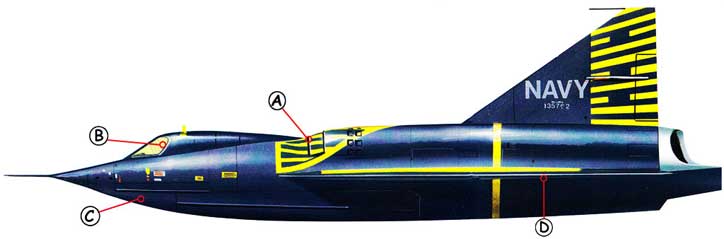
The dark blue paint with yellow markings provided aircraft attitude reference in instrumentation photos of taxi tests including take off and landing.
 Convair was a pioneer in exploring the properties of tailless
aircraft with delta shaped wings and control surfaces. It might
have been a failure as a seaplane, but it contributed a great
deal to Convair's widening database on high performance delta-wing
aircraft.
Convair was a pioneer in exploring the properties of tailless
aircraft with delta shaped wings and control surfaces. It might
have been a failure as a seaplane, but it contributed a great
deal to Convair's widening database on high performance delta-wing
aircraft.
The Navy sponsored a competition that was won by a Convair design featuring unique retractable hydro-skis on which the aircraft could operate from the water. These skis produced enough hydrodynamic lift to raise the aircraft up and out of the water during takeoff, and they could be retracted into the fuselage during flight. The goal of the contest was to develop a high-performance supersonic naval fighter aircraft which could operate in forward areas without the need for land bases.
At that time, the Navy assumed that it would be impossible to operate high-performance supersonic jet aircraft from the decks of aircraft carriers. For this reason, the Navy actually stuck with lower-performance straight-winged carrier-based jet aircraft such as the F9F Panther and the F2H Banshee long after land-based air forces had switched over to higher-performance swept-winged fighter aircraft.
Convair entered the seaplane fighter contest on October 1, 1948.
Initially, Convair's proposal was for a delta-winged design with
a blended hull which rested on the water and rose up onto a retractable
step for takeoff and landing. Convair also tested a large number
of seaplane designs equipped with hydro-ski configurations.
Unfortunately, the Sea Dart became mired in a number of problems
before its true potential could be realized. The greatest technical
challenge remaining was severe vibration experienced by the hydro-skis.
Convair used the XF2Y-1 to test a new approach using a single
ski that corrected much of the problem. Additional ski designs
were also tested on this aircraft and the second YF2Y-1, the final
test model to fly, but none was entirely satisfactory.
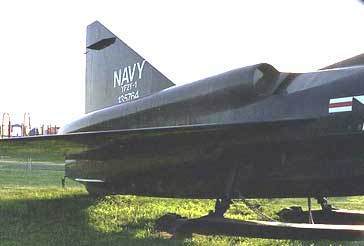
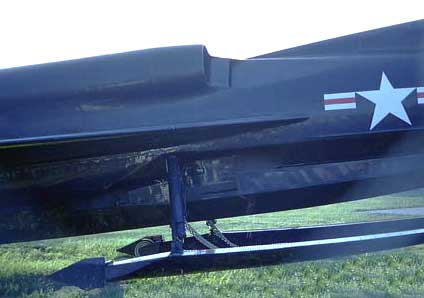
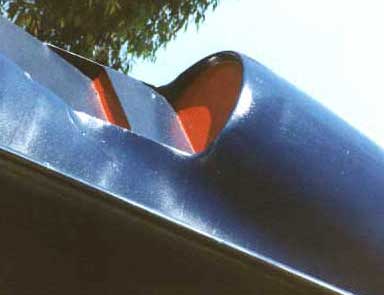
The unusual plane was powered by two Westinghouse turbojet engines with inlets mounted above the wings to minimize ingestion of water spray. A total of five test aircraft were built including one XF2Y-1 prototype and four YF2Y-1 pre-production aircraft. A further twelve F2Y-1 production models were also ordered.
The XF2Y-1 prototype equipped with Westinghouse J34-WE-32 turbojets made its first test flight on 9 April 1953, but was found to be underpowered. Later aircraft were upgraded with the more powerful J46-WE-2 after burning turbojets that required modification to the aft fuselage to accept the afterburners.
It was in this form that the initial YF2Y-1 became the first (and so far only) seaplane to reach supersonic speeds on 3 August 1954. Flown by Convair test pilot Charles Richbourg, the Sea Dart was only able to exceed the speed of sound while in a shallow dive and not while in level flight. This limitation was probably surmountable if the fuselage had been shaped to conform to the area rule, a modification that was planned for an improved model called the F2Y-2.
Although operating from the oceans would allow such an aircraft
to operate from forward areas, there was another reason for wanting
to build such an aircraft: the Navy wasn't certain that a supersonic
aircraft could be operated from a carrier of any reasonable size.
 Convair's proposal won the competition on 19 January 1951. The
contract specified two prototypes of a single-seat delta-wing
fighter, to be designated the "XF2Y-1 Sea Dart", that
took off and landed on water using two retractable "hydro-skis".
The engines were mounted on the back of the aircraft, with the
intakes well up above the wings to prevent water ingestion during
takeoff and landing.
Convair's proposal won the competition on 19 January 1951. The
contract specified two prototypes of a single-seat delta-wing
fighter, to be designated the "XF2Y-1 Sea Dart", that
took off and landed on water using two retractable "hydro-skis".
The engines were mounted on the back of the aircraft, with the
intakes well up above the wings to prevent water ingestion during
takeoff and landing.
The Sea Dart had a vee-shaped hull, and its internal spaces were
organized as multiple watertight compartments to keep it afloat
if battle damaged. It had twin dive brakes on the lower rear fuselage
that could be also be used as water brakes or rudders. Flight
controls were hydraulic.
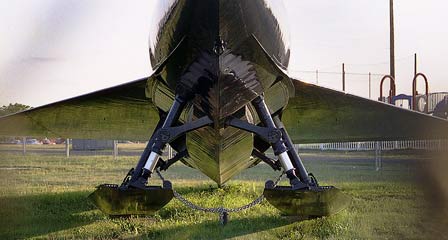
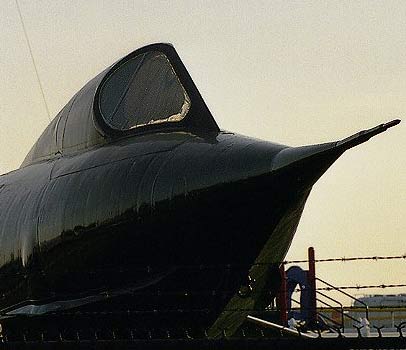
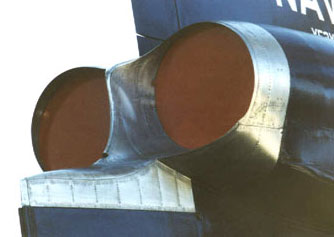
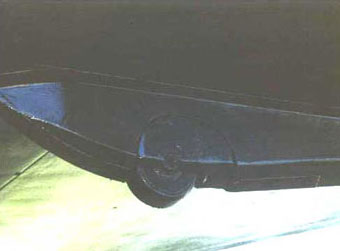
The Sea Dart could not take off or land on a runway, but each of the hydro-skis had a small wheel at the end, and a third small wheel was mounted near the rear of the aircraft to allow it taxi onto or off of a seaplane ramp. The cockpit canopy pivoted up as a single unit, and featured a rather antique-looking windscreen with twin oval glass panels in a metal frame. Apparently pilot visibility was not very good.
The Sea Dart was originally planned to be powered by twin Westinghouse XJ46-WE-02 engines. The XJ46 engine, an after burning derivative of the Westinghouse J34 axial-flow turbojet, was expected to give the aircraft a top speed well in excess of Mach 1. The aircraft was to be armed with four 20 millimeter cannon and a pack of 70 millimeter (2.75 inch) folding-fin air rockets (FFARs), though in fact no Sea Dart would ever be armed. The Navy was so enthusiastic about the Sea Dart that even before it flew, the service ordered a total of four "YF2Y-1" service evaluation aircraft and 16 "F2Y-1" production aircraft.
* As the first Sea Dart prototype was finished before the XJ46 engines were available, it was fitted with twin Westinghouse J34-WE-32 engines with 3,400 lb maximum takeoff thrust each. Taxi trials began in San Diego Bay in mid-December 1953, with test pilot Sam Shannon at the controls, leading to first official flight on 9 April 1953.
 |
 |
The Sea Dart was, to nobody's surprise, badly underpowered with its J34 engines and remained solidly subsonic. The hydro-skis turned out to give an extremely rough ride on takeoff and landing, though a redesign effort helped reduce this problem.
The XJ46 engines were installed in the prototype later that year, but they failed to meet their designed thrust levels. The detestable Vought F7U Cutlass carrier would use production J46 engines, and the lack of engine power and poor fuel economy would be high on the list of pilot complaints against the "Gutless", as it was known.
At this point, the Navy began to rethink the program. The second prototype was cancelled, with development moving on to the first service evaluation YF2Y-1, fitted with J46 engines, although the Navy was seriously looking for a better powerplant. The YF2Y-1 was similar in appearance to the XF2Y-1 but had a longer, redesigned exhaust, and the little beaching wheels were removed from the hydro-skis and the fuselage, meaning it had to be fitted with external beaching gear to be brought up on shore.
The YF2Y-1 began test flights in 1954, and on 3 August 1954, Convair test pilot Charles E. Richbourg took the machine through Mach 1 in a shallow dive. The Sea Dart is believed to be the only seaplane to ever achieve Mach 1. However, as it had been designed before the new "area ruling" scheme was introduced, its supersonic handling characteristics were poor.
The YF2Y-1 was lost in a crash during a low-level demonstration on 4 November 1954, killing Richbourg. It seems that the aircraft had gotten pushed past its safety margin during a low-altitude, high-speed fly past, and the plane disintegrated in midair as a result of pilot-induced pitch oscillations. Bits and pieces of flaming debris fell into the bay.
All Sea Dart operations were temporarily suspended after the crash. This accident essentially killed the program as well. The Navy was no longer particularly frightened of operating supersonic aircraft off of carriers, and despite improvements in the hydro-ski design, the Sea Dart still suffered from serious vibration on takeoff and landing.
The Navy had begun cutting back the program in December 1953, before the delivery of the YF2Y-1, canceling ten of the production aircraft. The other six were killed off in March 1954, well before the fatal accident. Following the accident, the program was further scaled back to a test exercise, and plans to produce an "F2Y-2" with area ruling and a single Pratt & Whitney J75 turbojet with 15,000 lb thrust were abandoned.
 The XF2Y-1 was then refitted with twin J46 turbojets and a single-ski
configuration in hopes that would solve the takeoff and landing
problems. The fit was strictly experimental. The ski was not fully
retractable and the wells for the old twin skis were not faired
over. The new single ski had a pair of retractable beaching wheels
at the end, allowing the aircraft to beach itself.
The XF2Y-1 was then refitted with twin J46 turbojets and a single-ski
configuration in hopes that would solve the takeoff and landing
problems. The fit was strictly experimental. The ski was not fully
retractable and the wells for the old twin skis were not faired
over. The new single ski had a pair of retractable beaching wheels
at the end, allowing the aircraft to beach itself.
The modified XF2Y-1 first flew in late December 1954, and after
some initial problems the single-ski scheme proved remarkably
successful, allowing safe takeoffs and landings even in fairly
rough seas.
The second YF2Y-1 performed its first flight in March 1955. It
was powered by twin J46 turbojets and had a modified twin-ski
system, with pivoting beaching wheels at the end of each ski.
The twin-ski system didn't work much better than before, and the
aircraft was put into storage at the end of April 1955, never
to fly again.
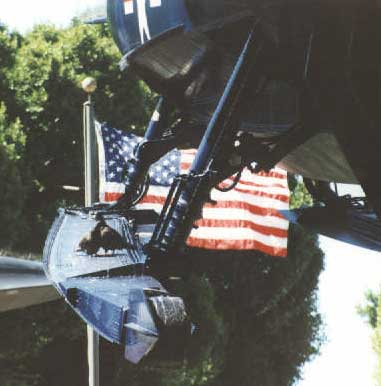
The original XF2Y-1 was used for further tests of various ski systems until the fall of 1957, when it was finally withdrawn. Two more YF2Y-1s were built but never flown, and all four aircraft are now in museums. One YF2Y-1 serves as a "gate guard" on a pylon in front of the the San Diego Aerospace Museum at Balboa Park, and certainly provides a distinctive and unusual display.
Sea Dart Details:
The hull of the Sea Dart had multiple watertight compartments
in the lower fuselage to prevent sinking in the event of a puncture.
The lower fuselage of the Sea Dart had the V-shaped profile of
a boat, as would be expected for a water-based aircraft. Both
the elevens and the rudder were hydraulically-powered. The aircraft
was fitted with a set of dive brakes on the lower rear fuselage
which also doubled as water brakes and as a water rudder while
taxiing on the surface. When sitting at rest in the water, the
Sea Dart floated with the trailing edge of the wing and the elevens
being flush with the water, and the leading edge of the delta
wing at the juncture of the fuselage being about 18 inches above
the water.
The one-piece cockpit canopy structure was hinged from behind
the cockpit. When open, there was no windscreen in front of
the pilot. The canopy was provided with two small windows on
either side, separated from each other by a center post which
obstructed the directly forward view. By all accounts, the view
from the cockpit was rather poor, and would certainly have to
had been substantially improved had the Sea Dart ever entered
service as a combat aircraft.
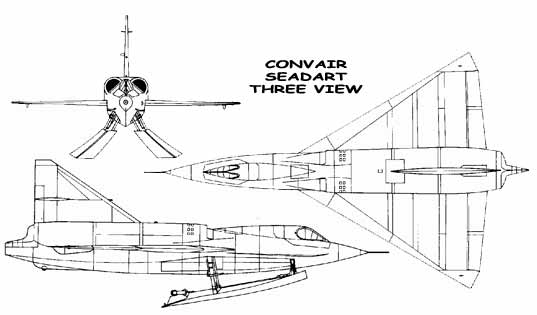
The aircraft took off and landed on a pair of retractable hydro-skis
that extended outward on oleo legs from recesses cut into the
lower hull, one ski on each side of the hull. During takeoff,
the skis were initially fully retracted into their wells.
Then as power was applied and the leading edge of the ski broke the water at 9-11 mph, the skis were extended to an intermediate position until 45-55 mph was reached. The skis were then extended to their fully-extended position, and the aircraft accelerated to a takeoff speed of about 145 mph.
When the aircraft was sitting on dry land out of the water,
it tilted backwards on its extended skis, its tail resting on
the ground. Each of the twin retractable hydro-skis had a small
fixed wheel at its aft end, and there was a small fixed swiveling
tail wheel mounted underneath the rear fuselage.
This provided for a limited amount of ground maneuverability, which made it possible for the aircraft to enter or leave the water via a long ramp under its own power. However, the aircraft could not take off or land on conventional runways.
Proposed armament for the production F2Y-1 aircraft was a set
of four 20mm cannon and a battery of 2.75-inch folding-fin unguided
rockets. These aircraft were to be powered by a pair of J-46
after burning turbojets, each offering a thrust of 6000 pounds.
Shortly thereafter, the contract was amended so that the the
first four F2Y-1s would be built as YF2Y-1 service test aircraft.
In the late autumn of 1952, the completed aircraft was transferred
from the experimental shop at Convair's Lindbergh Field facility
to the Convair seaplane ramp area on San Diego Bay. On December
14, 1952, E. D. "Sam" Shannon began taxiing trials
in San Diego Bay with the XF2Y-1 prototype. On January 14, 1953,
he made an inadvertent first hop of 1000 feet during a high-speed
taxiing run. The XF2Y-1 prototype made its official maiden flight
on April 9, 1953.
In 1953, the XJ46 engines finally became available and was installed
in the prototype. However, they failed to reach their projected
thrust output. In search of more power, the Navy proposed that
a single 12,000 lb.s.t Wright J67 or 15,000 lb.s.t. engine be
fitted in an improved version of the Sea Dart, the XF2Y-2.
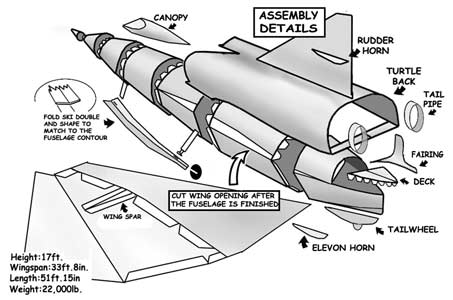
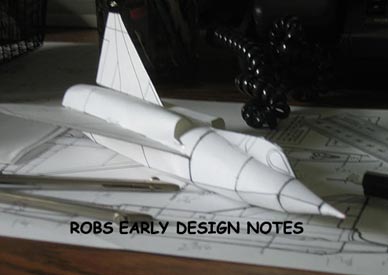 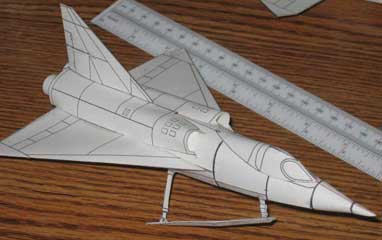 These are a couple photos of the Sea dart model early stages |
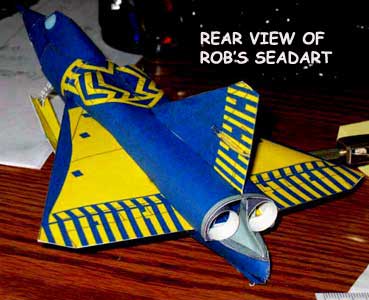
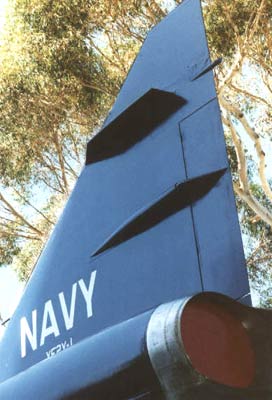
Since the Sea Dart had been designed before the advent of the area rule, the aircraft experienced high transonic drag and was unable to exceed the speed of sound in level flight. Flight tests indicated some wing span wise airflow, and a single airflow fence was mounted on each upper wing surface near the tip. No other Sea Dart was fitted with wing fences.In the meantime, the Navy had been gradually losing interest in the Sea Dart project.
By this time, the Navy had overcome its earlier reluctance and was already planning for the introduction of supersonic carrier-based fighters, and the need for a water-based supersonic fighter did not now seem to be as critical as before. In addition, the problems with the vibrating water skis had continued to plague the Sea Dart, and seemed to be insoluble. As a result, the Navy cancelled ten of the sixteen production F2Y-1 aircraft in December of 1953, even before the first of the YF2Y-1 service test aircraft had been delivered. The remaining six production F2Y-1s were cancelled in March of 1954. The fatal crash of the first YF2Y-1 aircraft later that year, with the surrounding bad publicity, did not help matters any, and the Sea Dart program was relegated to test status only.
Also cancelled was the F2Y-2, which had been envisaged as the
definitive production version of the Sea dart It had a single sikorsky r-4 helicopter
water ski, an area-ruled fuselage, plus a single after burning
Pratt and Whitney J-75 turbojet of 15,000 pounds of thrust.
 In spite of the project cancellation, tests continued with the
sole XF2Y-1. During the summer of 1954, the XF2Y-1 was extensively
reworked. The aft fuselage was brought up to YF2Y-1 configuration
with after burning Westinghouse J46 turbojets. The aircraft was
fitted with a large, single hydro-ski in place of the original
pair of skis. The single-ski installation was not fully retractable,
since high-speed flight was never planned.
In spite of the project cancellation, tests continued with the
sole XF2Y-1. During the summer of 1954, the XF2Y-1 was extensively
reworked. The aft fuselage was brought up to YF2Y-1 configuration
with after burning Westinghouse J46 turbojets. The aircraft was
fitted with a large, single hydro-ski in place of the original
pair of skis. The single-ski installation was not fully retractable,
since high-speed flight was never planned.
The previous twin-ski fuselage wells were not filled in or covered over for the single-ski installation, and during flight, the single ski was held below the fuselage in an external position parallel to the aircraft's longitudinal axis. The rear part of the ski was extended downward for takeoff or landing.
The rear part of the single ski had a pair of retractable wheels on either side for use in moving the aircraft into and out of the water, the aircraft resting nose-up on a small tail wheel. Like the dual-ski XF2Y-1, the aircraft could be launched or recovered from the water without the need for auxiliary beaching gear. The XF2Y-1 flew for the first time in this configuration on December 29, 1954, with Convair test pilot B. J. Long at the controls.
The first tests with the single sky encountered the divergent
and uncontrollable hydrodynamic longitudinal pitch oscillations.
These were corrected by adding a new ski oleo damping device
what sensed stroke rate and varied the oleo hydraulic orifices
and provided the needed damping qualities. Lateral directional
control problems that had been encountered were corrected by
doubling the lateral deflection of the elevens relative to the
pilot control stick movements. The single ski could even safely
handle crosswind takeoffs There is a rather odd postscript to
the Sea dart story.
In 1962, five years after the official termination
of the Sea dart project, the Navy was ordered to redesignated
all of its fighter aircraft in order to conform to the new tri-service
unified aircraft designation scheme. For some obscure reason,
the Sea dart was assigned the designation F-7. Why would the
Navy bother to redesignated an aircraft which had never entered
service? Perhaps some clerk in the Defense Department had some
fond memories of this warplane, and decided to honor it posthumously
with an official F-number.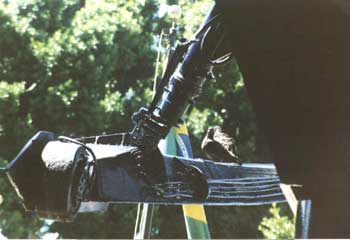
Normal landing and takeoff procedures for both the twin-ski and single-ski configuration were to maintain a heading parallel to the major wave or swell condition and into the wind as much as possible. Usually, this involved a crosswind component of 30 to 60 degrees. Landing or takeoff directly into any sizeable wave pattern or swells was unacceptable and not attempted. A smoke float deployed during operations indicated wind conditions. Except for being underpowered, the open-sea handling characteristics were considered excellent by the test pilots. This was despite the 120-knot takeoff speed and 125-knot landing speed.
The large single-ski and oleo configuration finally derived
for the XF2Y-1 aircraft was a very sound and satisfactory design
for use on a delta wing, water-based, supersonic aircraft. The
Sea dart test program also proved the feasibility of designing
and developing supersonic water-based aircraft for support of
Navy Fleet Operations. Because of the lack of an approved operational
requirement and the lack of funds for such an aircraft, the
U.S. Navy did not continue Sea dart development.
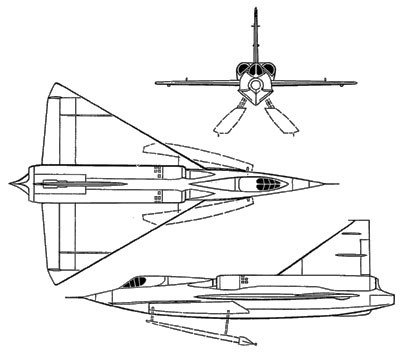
F2Y Sea Dart Design
When stationary or moving slowly in the water, the Sea Dart
floated with the trailing edge of the wings touching the water.
The skis were not extended until the aircraft reached about
10 mph during its takeoff run.
 |
 |
 |
 |
Specifications for the Convair Sea Dart
 |
Length: 52 ft 7 in Armament |
 |
|||
| A: To avoid excess water ingestion on takeoff, the main jet intakes were mounted on top of the fuselage. | B: The Sea Dart had a fairly conventional cockpit, roomy and well thought out controls. Pilots found it easy to work in. | C: The underside of the hull had a shallow boat like section, which aided low-speed handling in the water. | D: At rest, the wings of the Sea Dart lay on the water, serving as floats to provide some measure of stability. |