
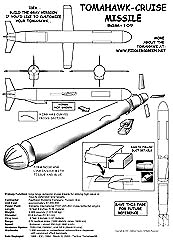
Cruise Missile - $$5.95
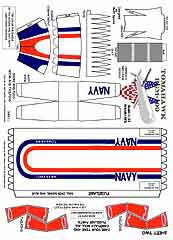
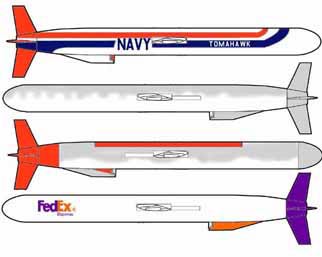
The Cruise MIssile is a long-range, all-weather, subsonic cruise missile. Introduced by General Dynamics in the 1970s, it was designed as a medium- to long-range, low-altitude missile that could even be launched from a submerged submarine. Included in the folder are a few fun versions with markings like FED-EX, AmTrak. The launcher was a separate model earlier but is now included with the Cruise Missile.

The Raytheon Tomahawk BGM-109 Cruise Missile

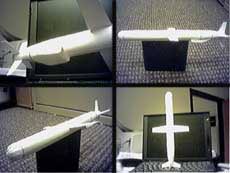 The Tomahawk long range, subsonic cruise missile can be used for land attack warfare, launched from surface ships and submarines. Not all that clever, however, at finding folks hiding in caves.
Designed to fly at extremely low altitudes at high subsonic speeds, and are piloted over an evasive route by several mission tailored guidance systems. The first operational use was in Operation Desert Storm, 1991, with immense success. The missile has since been successfully used in several other conflicts. In 1995 the governments of the United States and United Kingdom signed a Foreign Military Sales Agreement for the acquisition of 65 missiles, marking the first sale of Tomahawk to a foreign country. After a November 1998 launch and live warhead test, the U.K. declared operational capability.
The Tomahawk long range, subsonic cruise missile can be used for land attack warfare, launched from surface ships and submarines. Not all that clever, however, at finding folks hiding in caves.
Designed to fly at extremely low altitudes at high subsonic speeds, and are piloted over an evasive route by several mission tailored guidance systems. The first operational use was in Operation Desert Storm, 1991, with immense success. The missile has since been successfully used in several other conflicts. In 1995 the governments of the United States and United Kingdom signed a Foreign Military Sales Agreement for the acquisition of 65 missiles, marking the first sale of Tomahawk to a foreign country. After a November 1998 launch and live warhead test, the U.K. declared operational capability.
Just downloaded the Tomahawk and am so anxious to build it I can hardly type this missive. My wife asked me where I was going to put it once I finished it. Why at work of course... I think all the other FedEx employees would like this one too! ...Live from Geezerworld Bob K (10/30/01)
Hi, Chip. The FedEx Tomahawk is a real hoot! On Monday one will grace my wife's desk and another, mine. The long body tube was a bit of a challenge,but . . .hey. John (10/29/01)
Should have put a Domino's Pizza Logo on the cruise missile -With the slogan - If your don't get the first one in 30 minutes - The next one's free :) ...(Keith 11-5)
Matt, when building your hilarious FedEx Express Tomahawk, I took a small paper circle and cut a slit. I then preformed it into a cone, then unrolled it slightly. I precurled the petals and began gluing the tips side by side on top of the circle, their tips touching the center. As I continued, the nose gradually took shape and the slittled circle also took on a slight conical appearance(don't glue over the slit until the end). After I was finished,the petals were all secured at the tips, and I could then concentrate on joining the remainder of the seams. I admitted cheating a bit and using super glue to stiffen the nose and then applying paint to cover some mistakes, but I needed a solid nose. With just a little nose weight (and another layer of paper laminated in the wings to give more strength, the large 1:16 scale cruise missile actually glides fairly well if you give it enough of a toss. The nose has withstood multiple"impacts", which is more than I can say about the real thing. ;-) The kids at the IPMS/Northrop meeting loved playing with it until one of the tail fins broke (I've reinforced the joints now), while the adults had a good laugh at the FedEx markings.It will take to the skies once more next week at the IPMS/Orange County meeting, and then go to a deserving youngster. Right now,it's getting its share of "grins and giggles" at my local hobby shop .Thanks for a wonderful model, Matt. David T. Okamura(11-5)
I just love the cruise missile in Fed Ex Livery. Of course the immediate temptation is to "address" it to Osma binLaden, Kabul, Afghanistan. D. Rorer (11/8/01)
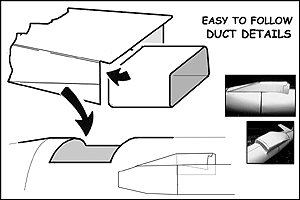
This nose is the same, basically, as the Messerschmitt Swallow.. These are from the ME-262 page..
After having filled a waste paper basket with partially built models, I just finished 2 Fiddler's Green, ME262's that are now part of my collection. One is WSAM scale and the other is an HO scale model.They are both really fantastic. The way the engines build up is really ingenious. I found that the trick to building this model, is to make the center section of the model,which has tabs on both ends, oversize. In HO scale, I made the fuselage section about 1/16 of an inch oversize and on the 1/60scale model, it is about 1/8 inch oversize. The HO scale model is so cool, that I immediately started work on a Texan in the same scale. How cool is it? Its so cute that my 13 year old daughter offered to take it and make it the first model in her own paper plane collection. Roger Cousineau, 3/14/01
RE: forming the rounded nose ...I am no expert ( as I have only built 1 paper model ! ) but this is the method I adopted. Take some tissue ( toilet roll , around 1/2 a sheet ) and soak it in dilute PVA glue ( around 50/50 )then form it into the shape you want for the nose. Coat the inside of the nose with PVA and push the tissue shape into the nose. From the outside put a small amount of PVA (to trying to avoid the ink running ) on the nose petals and wait for the paper/card to soften then gently form it down onto the tissue till you get the desired shape. I did find it a help to stick the nose to the next section of the body this makes the nose easier to hold/handle. Yes I was very skeptical of the method , especially as at the moment I use paper and not card for my models but it works. Probably a good idea to print out a few noses i.e Me262 or Me163and try them to get the hang of it. I am sure someone with more skill/experience than me will add/correct this for you.
Forming noses are a pain, The last model I designed had a big one and I had to make it again and again and again. I hated it.But I found a trick that made it easy and I got pretty good at it. First I had been doing it by forming them around a ball of tissue paper with some glue on it, very messy but it works if you are careful.
I was sitting at my desk and on it was a track-ball mouse. This is one of those logitech track balls with the control ball sitting in a cup shaped holder on top of the mouse. I removed the ball and looked in the hole. it was a spherical shaped depression in the top of the mouse. It occurred to me the hole was also just a little bigger diameter then the cruise missile nose. I cut out a cruise missile nose and formed it into a ring and let that dry. I put some glue on the insides of the petals. Then I took the ring, petals downward and pushed it into the hole on the mouse.
The curved sides of the hole formed the petals together smoothly. I was able to hold the ring in the hole (all petals formed together with just two fingers.) Then with the other hand I took a small swatch of tissue and pressed it over the back of the petals and held it for a few seconds while the glue set into the tissue. I pulled the nose back out and voila a perfect nose.
Since then I have been looking for items with similar shaped depressions (spherical) but with different diameters. I found a couple that will work (shot glasses) I will just keep collecting an assortment of shapes and keep them in a box til needed Matthew Sparks
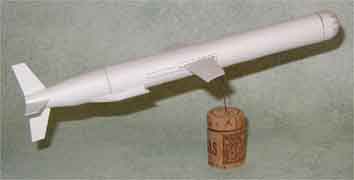 Wayne White helped by proofing a BETA model...but polished off a bottle of wine for the cork mount.. |
Raytheon Tomahawk BGM-109 Cruise Missile
Since its development in 1972 there have been four distinct
types of Tomahawk cruise missiles. Two versions, the U.S.A.F.
ground launched version and the Navy BGM-109A have been removed
from the U.S. inventory - or have had the W-80 thermonuclear warhead
removed and replaced with a conventional high explosive.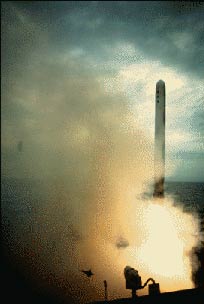
Although most publications list the Tomahawk accuracy at 30 feet the real truth lies in the computer guidance system. Tomahawk is designed to fly through a one meter square window on earth at a redesignated time. The Tomahawk has about a 85% direct hit record over its use in the Gulf war, and further firings since then. Tomahawk uses a combination of GPS (Global Positioning Satellite), TERCOM or a special terrain way-point radar map and two types of terminal guidance systems to place the warhead with pinpoint accuracy, DSMAC and an Infra-red map per. DSMAC is a high resolution satellite radar image of the target area which the Tomahawk follows to within feet of the intended target. An additional Infra-red scene mapper is also employed for a dual spectrum picture fed to the targeting computer.
The two conventional warheads used in the August 20, 1998 attacks
on the Sudan and Afghanistan were the conventional 1,000 pound
high explosive and the 1,000 pound cluster bomblet warhead which
showers a target with a rain of softball sized bombs. The heavy
warheads were used mainly against the factory in Sudan and caves
or hardened bunkers in Afghanistan. The bomblet versions were
deployed directly against "soft" targets such as people,
trucks, buildings and light armored vehicles.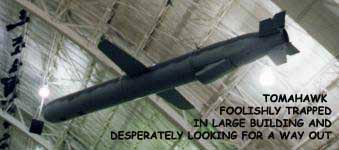
One version of the Tomahawk used in the Gulf war deployed small spools of carbon-carbon fiber thread over Iraqi power plants and electric grids. The fiber spools unwound and fell over the live wires. The resulting shorts blew most of the Iraqi electric power grid for the remainder of the war. Iraqi efforts to clear the spools and restart the electric plants were foiled by desert winds which blew more spools back into the live wires.
Features of the Raytheon BGM-109 Tomahawk Cruise Missile:
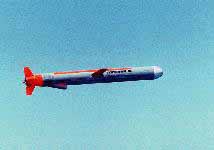 Tomahawk Block II uses a Terrain Contour Matching (TERCOM)
and Digital Scene Matching Area Correlation (DSMAC) missile guidance
system. Block III adds a Global Positioning Satellite guidance
capability to TERCOM and DSMAC. Radar detection of the missile
is extremely difficult because of the small radar cross-section
and low altitude. Tomahawk has two warhead configurations: a 1,000-lb.
blast/fragmentary unitary warhead and a general-purpose submunition
dispenser with combined effect bomblets. Because of its long range,
lethality, and extreme accuracy Tomahawk has become the weapon
of choice for the U.S. Department of Defense.
Tomahawk Block II uses a Terrain Contour Matching (TERCOM)
and Digital Scene Matching Area Correlation (DSMAC) missile guidance
system. Block III adds a Global Positioning Satellite guidance
capability to TERCOM and DSMAC. Radar detection of the missile
is extremely difficult because of the small radar cross-section
and low altitude. Tomahawk has two warhead configurations: a 1,000-lb.
blast/fragmentary unitary warhead and a general-purpose submunition
dispenser with combined effect bomblets. Because of its long range,
lethality, and extreme accuracy Tomahawk has become the weapon
of choice for the U.S. Department of Defense.
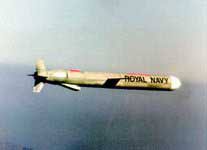 |
 |
 |
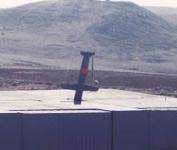 |
U.S.A.F. M.A.N.
Truck and
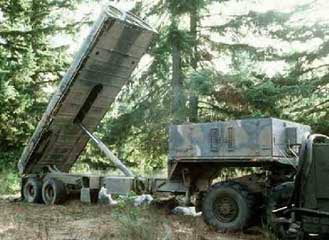
Cruise Missile Transporter-Erector-Launcher
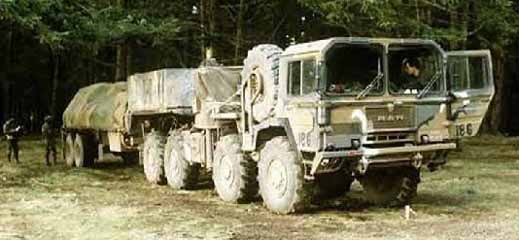
 The
M.A.N tractor was a design built by the Maschinenfabrik Augsberg-Nurnberg
company in Germany to support the USAF Ground-Launched Cruise
missile program. It towed either 4 Gryphon cruise missile housed
in the Transporter-Erector Launcher (TEL) or 2 launch control
officers housed in the Launch Control Center (LCC).
The
M.A.N tractor was a design built by the Maschinenfabrik Augsberg-Nurnberg
company in Germany to support the USAF Ground-Launched Cruise
missile program. It towed either 4 Gryphon cruise missile housed
in the Transporter-Erector Launcher (TEL) or 2 launch control
officers housed in the Launch Control Center (LCC).
This 8-wheel drive tractor was the ultimate off-road vehicle with the 2 front axles being steer able to provide excellent maneuverability.The V-24 diesel engine gave the M.A.N. tractor awesome power and it's crews became attached to them just like the bomber crews of World War II to their airplanes; often naming their tractors, placing the names on the cab windshields.
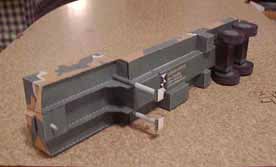
Here's something for all you Cruise Missile enthusiasts..
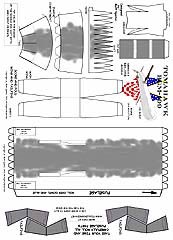
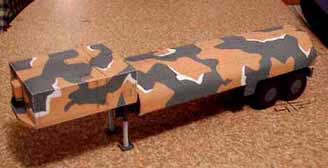
Four sheets in all, with great instructions and it measures in at 9.5 " long, 2.5 " high, and 2" wide...it's a real clean model and fairly easy to build..This is the first model from our newest designer, Ron Caudillo who promises many more in the near future..
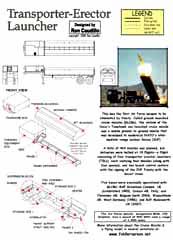
Cruise Missile Transporter-Erector-Launcher
(was) A separate model and now included with this Cruise Missile
Ron has spent a lot of time and effort getting some great assembly drawings together and we thank him for all his work on this model. A lot of effort went into it.
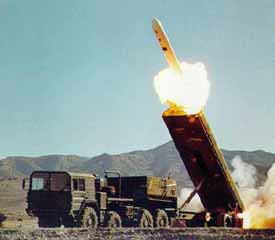
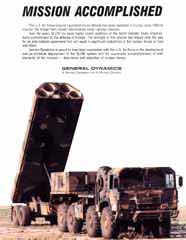
Ron writes... 'The poster was produced by General Dynamics for
the Ground Launched Cruise Missile program. I download it from
an unofficial history web site (as were all of the other pictures'
(basically, it was about being proud to be part of the NATO
Missile Defense Treaty.
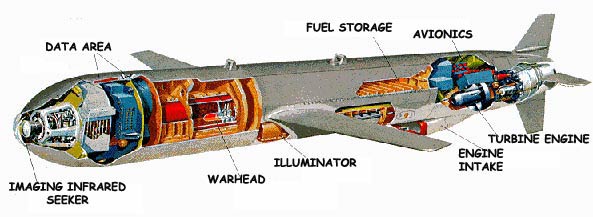
Specifications for the Tomahawk BGM-109 Cruise Missle
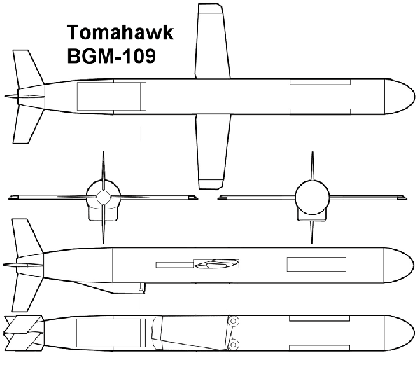 |
Length: 18 feet 3 inches TERCOM, DSMAC, and GPS (Block III only) Warheads 1000 pounds or conventional submunitions dispenser |