

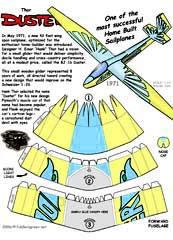
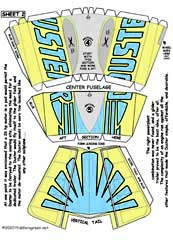
Duster Sailplane - $$8.50
The BJ-1 Dyna Mite was a sailplane designed by Ben Jansson in the United States in the 1960s for homebuilding. A conventional shoulder-wing design with conventional empennage, no component of the BJ-1 exceeds 18 ft (5.5 m) in length, in order to facilitate building and storage in a domestic garage.

BJ-1B 'Duster' Sailplane
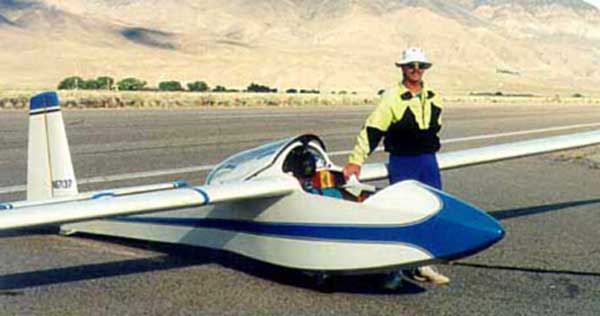
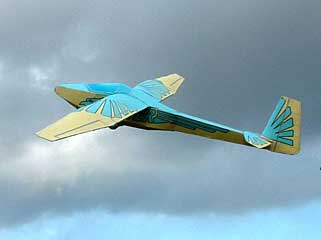
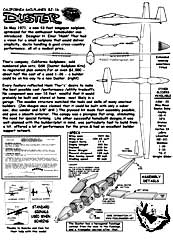
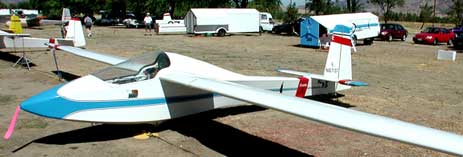
In May 1971, a new 43 foot wingspan sailplane, optimized for the enthusiast homebuilder was introduced. Designer H. Einar “Hank" Thor had a vision for a small glider that would deliver simplicity, docile handling and cross-country performance, all at a modest price, called the Duster.
This small wooden glider represented 8 years of work, all directed toward creating a new design that would improve on the Schweizer 1- 26.
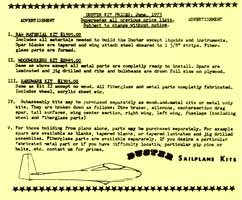
Thor’s company, California Sailplanes, sold numbered plan sets; DSK (Duster Sailplane Kits) founded by Jim Maupin and Norm Barnhart, sold kits to registered plan owners. For an even $2,000 - about half the cost of a used 1-26 - a builder could be on his way to a new Duster.
Plastic (composite gel coat/fiberglass) gliders don't like to be hot. These gliders are required by the manufacturer to be maintained in a white finish to minimize solar heating of the structures.
Carbon composite structures are a bit less picky, and more vivid yellows and oranges are occasionally seen in use there. Heat is not the friend of glued wooden structures, either. As a result, wooden gliders tend to painted in pastels and other light colors, like the yellow and blue employed on the Australian Duster. Aluminum structures are not affected by the thermal effects of color pigment, so these can be painted almost any color of the rainbow. The glider's occupants are frequently more comfortable in light colored machines, so white remains the most popular color for sailplanes, regardless of what they are made from. Yellow school buses and Navy P-3 Orion's are white on top for the same heat load reason. Cam
Just downloaded your Duster sailplane and was a tad confused over the page numbering! Somehow I think you numbered page 7 as page 8 or didn’t number the instruction sheet…no matter, all the bits seem there! Nit picky maybe but I write flight manuals and we have to be spot on…lol.
I do enjoy your models - the last one I built was the Flettner Kolibri and THAT has created some interest with all the aviators!
Have had a good look at the Duster…maybe a 2X or 3X printed out and cut from correx (real estate signage) for a bullet proof cheapie or foam art board, either way 4 channel radio. By the way, washout on the outer wing panels is a sort of induced dihedral, allows the center wing to go into stall and the outer tips still fly. Regards Marty
I am enjoying the Duster a lot- and so are many other glider pilots. The glider underground is abuzz. Know of at least two sales to glider pilots. I really enjoyed building mine- though I did cheat and add some rolled and glued tube paper "spars" to stiffen the wings a bit. That was my beta build, and when I get back home in a week, I'd like to try again with the knowledge of this one behind me. Cam (Duster owner)
BJ-1B 'Duster' Sailplane Downloadable Cardmodel
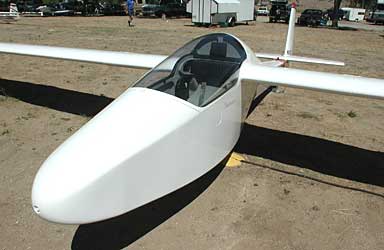
The 1-26 was a nimble, responsive and forgiving sailplane, but with a best L/D of 21.5, its performance was limited. While Hank Thor had completed successful badge and Diamond flights in the 1-26, he realized how challenging such flights were - most soaring days are less than ideal, and pilots don't want to be limited to a 10-mile radius around the field. A simple, compact sailplane with a best L/D in the high twenties would have obvious appeal.
Soaring Society of America membership had been growing steadily and Hank correctly assumed that he was not alone in his desire to build and fly his own machine. As an aeronautical engineer and former airframe designer, Hank Thor knew it would be easy to get the modest cross-country performance he wanted. Keeping it buildable, practical and affordable were going to be the real challenges. In the early 1960’s, Hank met Ben Jansson, an aerodynamicist with Saab, Ben shared Hank’s enthusiasm for the small sailplane concept, and they quickly sorted out the essential characteristics for a new glider, Over a period of 2 years, they designed and built the BJ-1 "Dyna Mite" in Hank's garage. Flying for the first time from El Mirage in August 1966, the BJ-1 delivered - it performed well, was fun to fly and easy to rig. And, at a total out-of-pocket cost of $800, it was affordable.
Although
the BJ-1 was a success in the eyes of its builders, it was not
ready to market. Four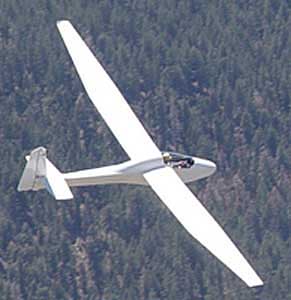 years of flying had shown the need for refinements,
Ben Jansson had returned to Sweden, leaving Hank Thor to carry
out the development of the Duster.
years of flying had shown the need for refinements,
Ben Jansson had returned to Sweden, leaving Hank Thor to carry
out the development of the Duster.
It was like starting from scratch. The Dyna Mite had been built from rough sketches. Thor invested 1,400 hours doing air load and structural calculations and preparing detailed design drawings. The basic plywood structure was simplified and lightened to permit the substantial payload increase many potential pilots would need. The Jansson-developed airfoil, a "Wortmannized" NACA 4415 non-laminar section was retained, but span was increased to 42ft 8in. The cockpit profile was lowered significantly, reducing drag.
The
result was a new glider with a best L/D of 28, a two-point increase
over the Dyna Mite. Although Ben Jansson was no longer involved,
Thor retained the original "BJ' designation as a reminder
of the role he had played. No doubt this helped initial marketing
efforts (photos of the Dyna Mite were used in early Duster ads),
but it has caused many, even Jane’s All the World’s
Aircraft, to overlook Hank Thor’s primary role.
Hank Thor selected the name “Duster" for his new design.
Plymouth's muscle car of that name had become popular, and Hank
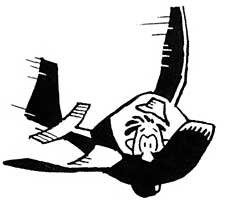
enjoyed the car's cartoon logo - a caricatured dust devil with
eyes. In August 1971 the first ad for the Duster plans and kit
appeared in Soaring magazine, and the first "real”
Duster, built by Jim Maupin and Norm Barnhart took to the air.
The ad emphasized the key features: amateur construction from
wood, medium performance, low cost, and garage storage.
|
 Every
feature reflected Hank Thor's' desire to make the best possible
cost /performance /utility tradeoffs. No component was over 18 feet,
mindful that it would probably be built and stored at home, most
likely in a garage. The wooden structure matched the tools and skills
of many amateur builders. (Jim Maupin once claimed that it could
be built with only a saber saw, disc sander and 3/8" drill.)
The plywood kit made fast assembly possible, and gave a smooth exterior.
The canopy was a plexiglas flat wrap, eliminating the need for molding.
Every
feature reflected Hank Thor's' desire to make the best possible
cost /performance /utility tradeoffs. No component was over 18 feet,
mindful that it would probably be built and stored at home, most
likely in a garage. The wooden structure matched the tools and skills
of many amateur builders. (Jim Maupin once claimed that it could
be built with only a saber saw, disc sander and 3/8" drill.)
The plywood kit made fast assembly possible, and gave a smooth exterior.
The canopy was a plexiglas flat wrap, eliminating the need for molding.
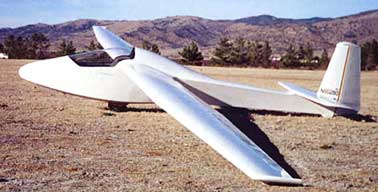
The fixed center section of the wing kept the outer panels light, and made the Duster easier to rig. The wing had a high aspect ratio (17.4) for a wooden home built glider, which gave it the look of a "real" sailplane, especially in the air. Everything was optimized to make the Duster appealing to the motivated enthusiast home-builder.
In 1973 the Duster Sailplane Association was formed, and the Dust
Rag newsletter provided a sense of identity for builders. By 1974
over 150 sets of plans had been sold (in the US and 10 other countries),
and a handful of Dusters had flown. As completed Dusters began to
log time in the air they demonstrated the performance that was Hank
Thor’s initial objective. The time required to complete a
Duster varied greatly. Hank Thor’s initial estimate was 800-900
hours. Two editors of the Dust Rag reported different experiences:
Bob Walters s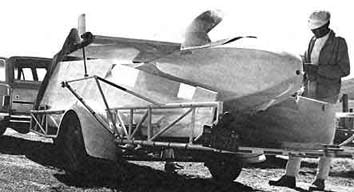 pent 950 hours spread over 13 months, and doug Bell
took 1600 hours over 8 years. One exceptionally meticulous builder
reported 3,400 hours! The record for longest elapsed time is held
by Terry Whitford and Peter Raphael from Australia, who reported
completing their Duster in March of 2000.
pent 950 hours spread over 13 months, and doug Bell
took 1600 hours over 8 years. One exceptionally meticulous builder
reported 3,400 hours! The record for longest elapsed time is held
by Terry Whitford and Peter Raphael from Australia, who reported
completing their Duster in March of 2000.
Many were indeed built at home in the garage, and stored there when not flying. The 7-foot wing stub permanently mounted to the fuselage made it a bit of a challenge to enclose a Duster trailer. An open trailer for a design intended to fit into a garage in the first place is a fair trade. even today.
The Duster proved easy to handle on the ground and fast to rig. The most common comment is that it took half the time of the familiar 1-26, from trailer to flight line. Every builder seemed pleased with the performance and handling. First light accounts trace a predictable sequence of emotions, beginning with uncertainty at takeoff, guarded relief on tow, elation during the flight, and a deep sense of accomplishment at day's end.
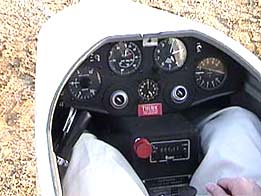 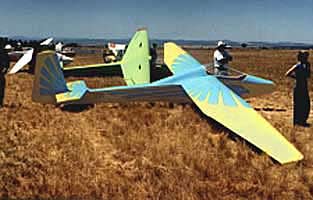 Duster instrument panel (left) and Aussie Duster (right) |
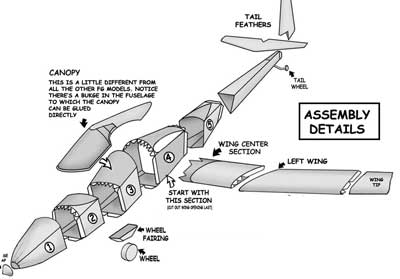
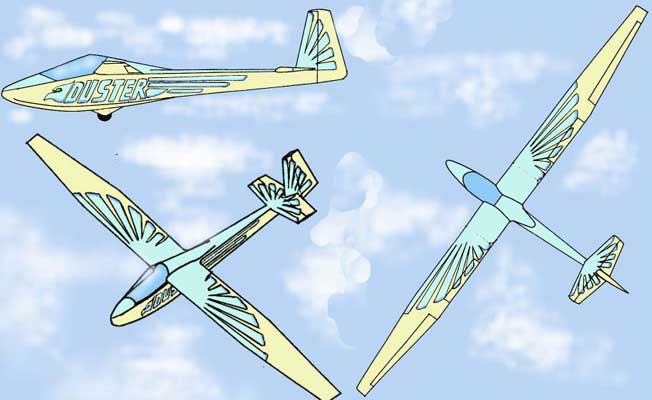 This layout (above) was used to design the main version of the Duster Glider. |
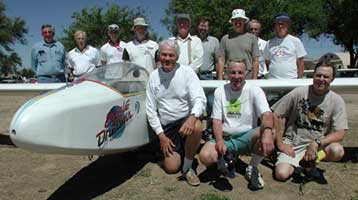 Designer Hank Thor is kneeling next to the fuselage- left of the the Duster instruction sheet |
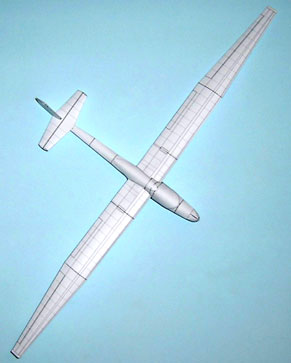 Hank Thor's BJ-1B Duster is truly a piece of sculpture in black and white |
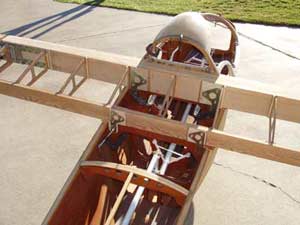 |
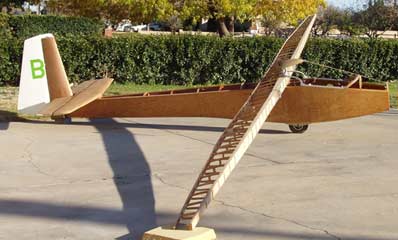 |
| Here's a couple views of the Duster's structure. Tons of thanks to Kancho and Cam for all the help and support with this Duster model !! | |
Some interesting gliding stuff..
L/D (lift over drag) is a very handy way to express the efficiency
of a particular glider, and its potential for cross-country flight.
Actually, many of the other important qualities can be, and are,
described numerically. These include things like wing loading, sink
rate, roll rate, etc.
Glider airspeeds have a big effect on how efficiently a glider is
being flown. Best L/D is the optimum cruising airspeed for maximizing
the distance covered from a given altitude.
Minimum sink airspeed is the airspeed used to loiter, and maximize time airborne, but not distance covered. It is the best airspeed for climbing.
The faster you can fly, the longer your range, because the length of a soaring day is tied directly to the amount of daylight available, and to solar heating. So experienced glider pilots strike a compromise, and generally fly faster than best L/D, and slow down when they find themselves flying through lift. Glider pilots stop to thermal only when they must. Cars don't stop at every gas station along the way, and glider pilots don't stop for every thermal they find.
Glider performance numbers are used to develop the "Handicap" which allows gliders of different wing spans and aerodynamic "eras" to compete against each other in "Sports Class Contests".
By comparison, a Piper J-3 has an L/D of about 10 and a Boeing 747 has an L/D of about 17. Glider L/D averages about 20 for utility class trainers, 40 for racers, and as high as 60 for super-refined open class long span sailplanes.
As an interesting and totally unrelated aside, glider L/D numbers
are almost directly comparable to automobile gas mileage in MPG.Two
seat training gliders have L/D ratios in the High Teens (18), refined
racers have L/D of about 40, and really expensive high end machines
have an L/D of 60. A car that gets 60 mpg would be thought of as
very efficient, and a glider with an L/D of 60 is just about the
maximum you'll see in actual practice.
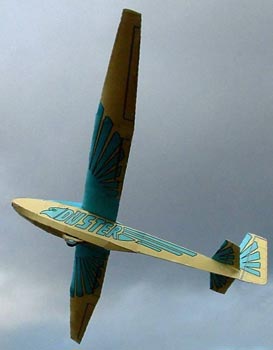
Specifications for the DSK BJ-1B 'Duster' Sailplane
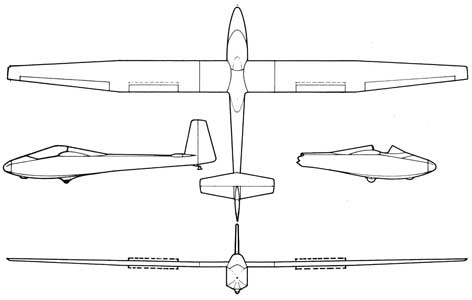 |
Length: 20 ft 6 in Wingspan: 42 ft 8 in Wing area: 103 ft² Aspect ratio: 17.7 Empty weight: 620 lb Gross weight: 580 lb Performance Maximum speed: 128 mph Maximum glide ratio: 29 Rate of sink: 148 ft/min |
Important links:
South West Soaring Museum,
Moriarty, NM
The Duster Prototype BJ-1b, N11BJ, is now in the
collection of the Southwest Soaring Museum. The current nose art
"Eagle Dreams" is some of the more elaborate paintwork
applied to a Duster.