

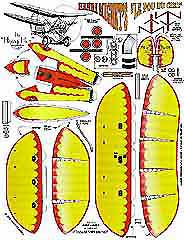
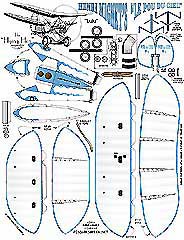
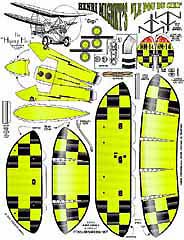
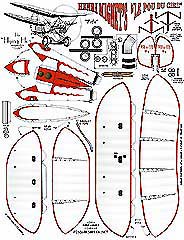
Flying Flea - $$6.95
Mignet had failed to be accepted as a military pilot and decided to build his own plane. Between 1931 and 1933 he built prototypes in Paris and tested them in a large field northeast of the city. He successfully flew the first successful model, HM-14, in September 10, 1933.

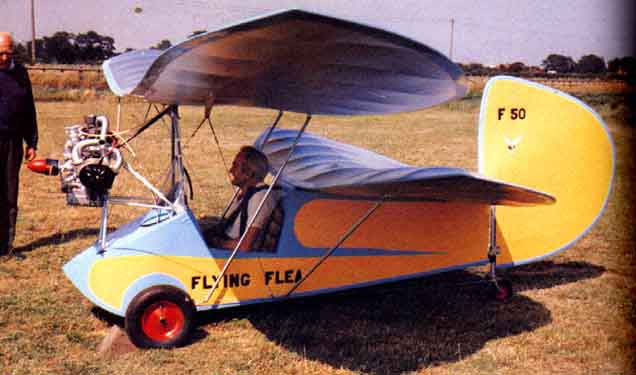
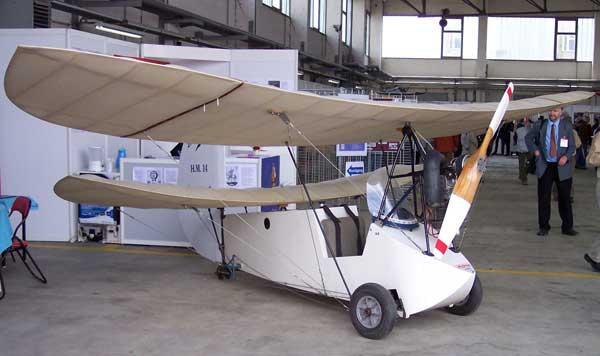
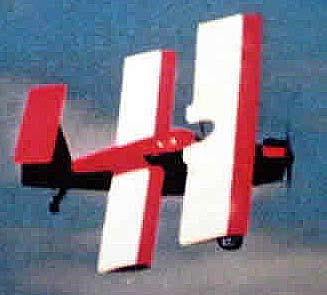
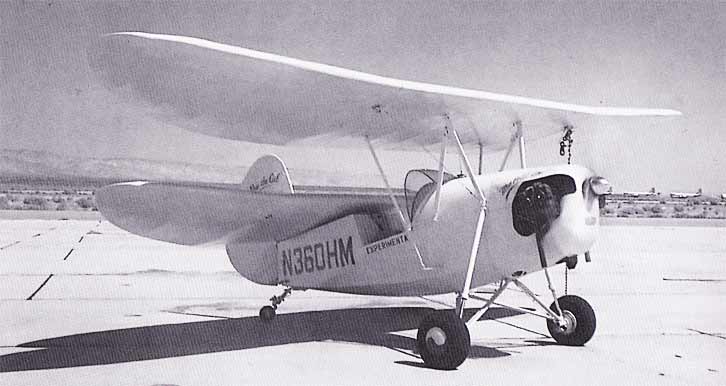
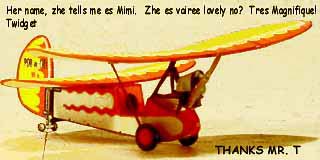
Henry Mignet's Flying Flea (Pou Du Ciel) in FOUR flavors!


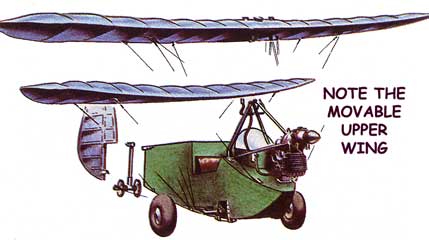
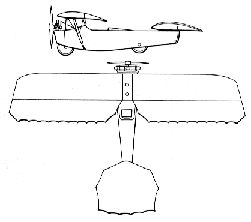
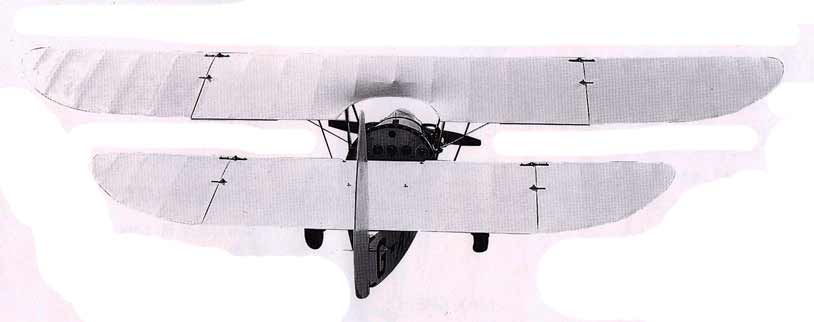
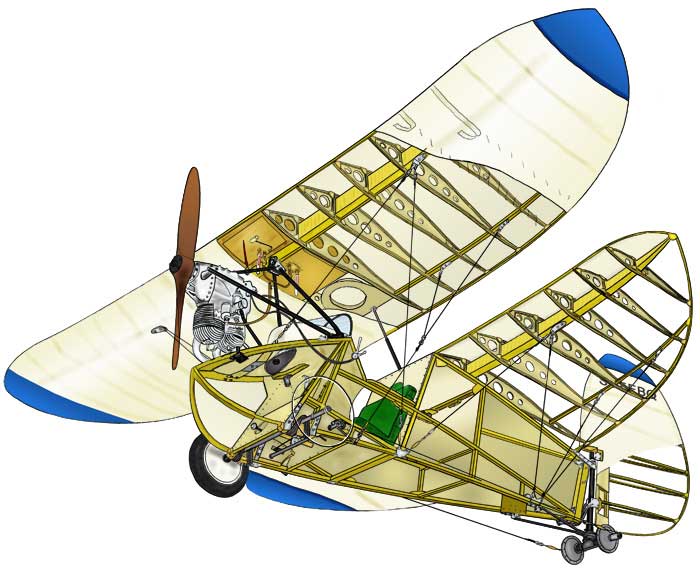
The Flying Flea was designed in 1934 by Henri Mignet. It features an 18 ft pivoting front wing and 13 ft. fixed, tandem rear wing, and two-axis controls. Originally powered by low horsepower motorcycle and auto engines, modern Fleas can utilize a variety of engines including Rotax, Citroen, DAF, etc. The earliest version of the Flying Flea, 60 years ago, had problems leading to a dozen crashes, However, since 1936, they have flown accident-free in large numbers in countries around the world.
This outstanding model and the other three versions of the Flea were designed and are offered courtesy of Chauncy Green.
Chauncy's second design is a gem. I feel that he has a real feel for what translates well into paper. I also appreciate his choice of subject matter (one gets a little tired of P51s,Spits etc.) The Flying Flea is great.
Thanks for the freebie, you can bet it will be built in 1/32nd scale. I've finished the ME 209-V1 and ME209-V4 in 1/32nd and am presently building MR. MULLIGAN in that scale. I think FIDDLERS GREEN has done for this generation of card modelers what Jack Armstrong and Wheaties did for mine. Regards, Jim. Nov 12, 2000.
I have gotten many of you fine little models,as a matter fact seeing your ad in one of my model mags, got me curious about them. I ordered a few and thanks to you got hooked on this hobby. Thank You, Keep up the fine work, please. kindest regards, Jeff Orcutt Nov 12,2000.
Outstanding! Outstanding! Outstanding!!! nice design, nice colors, OK history (..but could eliminate reference to it...most all planes can and do crash).
Hello at Fiddlersgreen,...Great work you are doing there with cardborard models. I notice you have a Mignet HM14 aircraft to model. I am a retired commercial bush pilot and I built up an example of Mignet HM293 and test flew it. I never new there was a cover up with true information with this aircraft and its a great shame. However the aircraft is very dificult to fly and very un-stable and dangerous in certain flight modes.
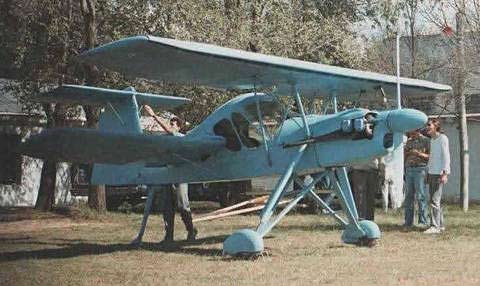
A couple of my friends in the world have built them and killed themselves in this type of aircraft. The problems were solved by putting a tailplane on the back of the mignet aircraft and that pioneering work was done by the late Jean De La Frage in South America. It would be great if you could develop a model for this and add it to your range. If you would like photos and drawings let me know.....regards, Mal Keep on the sunny side of life.
The Flying Flea
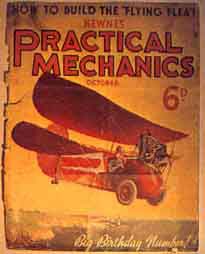 It was with his friend Pierre Colin,
an instructor during the First World War, that Mignet tried to
learn to fly a conventional aeroplane, the Potez 43.0 F-AMJS.
In the summer of 1932, Mignet accumulated about thirty hours in
the Potez, some in the pilot's seat, but many just as observer
and navigator on trips around northern France and Belgium. 'A
machine quite beyond me,' was Mignet's assessment of the Potez.
It was with his friend Pierre Colin,
an instructor during the First World War, that Mignet tried to
learn to fly a conventional aeroplane, the Potez 43.0 F-AMJS.
In the summer of 1932, Mignet accumulated about thirty hours in
the Potez, some in the pilot's seat, but many just as observer
and navigator on trips around northern France and Belgium. 'A
machine quite beyond me,' was Mignet's assessment of the Potez.
No matter what, these flying experiences were to have a major influence on Mignet's philosophy about flying and the mechanics of piloting a flying machine. In his flowery and prophetic style he grouped his experience of both types of aircraft into a comparison: 'Luck has so arranged - oh my guardian angel that I should pilot the Pou du Ciel before taking in hand seriously the control of an aeroplane. My reactions were formed by sane instinct. All the stuff learned in ten consecutive hours of flying an aeroplane vanished in 100 meters of flight on the Flea.'
His denigration of the conventional aeroplane, or perhaps just himself as a pilot of a 'normal' aeroplane, then comes to a monumental conclusion: 'What is it in fact, this leaning to fly? To be precise, it is to learn NOT to fly wrong.'
Did the Flea come into existence because of Mignet's dissatisfaction at his skills in piloting a conventional aeroplane, or was it the Flea and its unconventional design and controls that caused Mignet, its creator, to crusade for it with the tunnel vision of a zealot? A classic chicken and egg argument. Whatever the origins of the venom, Mignet was not just disillusioned with the conventional aeroplane: 'The aeroplane is frightening,' he wrote.
This character assassination of the conventional aircraft was because throughout his design experience so far, Mignet had found the 'normal' aircraft to be wanting as an amateur-built, fun aeroplane. He was looking for a cheap, safe, easy-to-fly, lightweight aeroplane for the man in the street.
Mignet was quite content to accept the use of conventionally controlled aeroplanes for air transport but another system would be needed for true amateur aviation. The tenets Mignet listed for his concept still hold true today -and work just as well on today's designs.
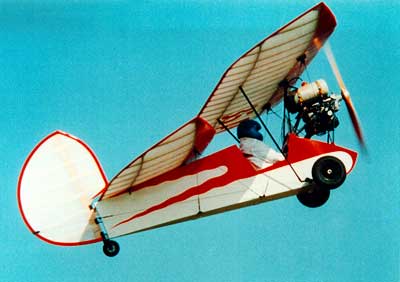
Mignet's criteria were: Security of construction. Security by means of a margin of speed. Security by means of stability of shape. Security by rational controls for flight. Economy - of materials, dimensions, powerplant and running costs. Lightness of the aircraft; which implies smallness, small powerplant and cheapness. |
Mignet wrote at length about these in the French aviation magazine Les iiles for 28 January 1932 in relation to aeroplanes of less than 220 lb empty weight and concluded that it was possible to make such a craft that was no heavier than the average pilot 176 lb 'To fly very cheaply one must make something very small.
By combining the idea of a small lightweight aeroplane with Mignet's enthusiasm for the simplicity of piloting an aircraft the stage was set for the Flea to be born. But how did the unique Flea formula come about?
The Flea was the culmination of many years of research, study and experimentation. Even before the Wright brothers had flown in 1903, Mignet had concluded that birds were so free in the air because they could control directly the amount of lift employed at any moment. Model kites and aeroplanes towed behind a bicycle showed him that the kite remained stable, but the aeroplane was unstable, spinning around and around. Mignet concluded, rightly, that an aeroplane needed a pilot to control it, whereas a kite did not.
Mignet was openly hostile about the control of conventional aeroplanes in which aileron had to be corrected by rudder to achieve a balanced turn, and the fact that it was possible to cross these controls could lead to a spin and disaster. If one of these controls could be removed, he argued, it would be impossible to cross them and, voila, the problem would be solved. Mignet observed that a kite does not possess ailerons yet is perfectly stable, only needing to be controlled in altitude and direction. Thus he decided that it was ailerons that he could afford to do without on his new design.
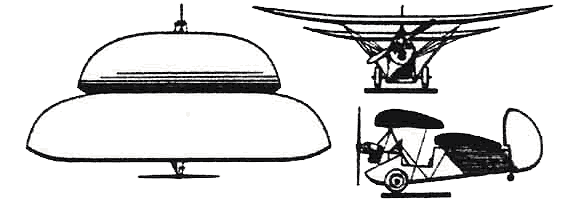
Using his earlier design, the conventional HM.8, Mignet made a brief study of aerodynamics - the center of pressure, balance and controls. He dismissed bombastically the follies that had accumulated in the design of aircraft to date: 'Leave aviation to the aviators - let us go off on our own voyage of discovery.'
In a conventional aeroplane the pilot alters lift by varying
the angle of incidence of the wing, using the elevators at the
 tail. This system, Mignet believed, introduced a delay in the
controls and, just as a horse rider can establish a direct feel,
or control, between himself and the horse, Mignet wanted a control
system that gave immediacy to the aircraft's control.
tail. This system, Mignet believed, introduced a delay in the
controls and, just as a horse rider can establish a direct feel,
or control, between himself and the horse, Mignet wanted a control
system that gave immediacy to the aircraft's control.
If the tail (elevators) were fixed, he argued, and the main wing detached from the fuselage and allowed to pivot through direct control ]linkage with the control column, this immediacy of control could be achieved. Mignet realized the importance of the center of pressure (Cp) in his system; it could only work if the pivot point of the wing were placed so that in all flight conditions the center of pressure was behind it. This would ensure that the trailing edge of the wing was always trying to lift, creating a continuous 'feeling' on the control column and automatically tending toward a condition where the angle of incidence, and therefore the lift, decreased.
Mignet realized also the importance of the aerofoil shape required to stabilize the movement of the Cp, and his new aerofoil had an upturned trailing edge. Any increase in incidence would increase the pull on the control column. This would be a force instantly recognizable to the pilot; in Mignet's terms: "He has a living wing'.
Landing with the new wing presented problems. The conventional arrangement of the HM.8 meant that, upon cutting the engine for a landing, the aircraft was still going too fast, necessitating a pull back on the stick to increase the wing's incidence. At 30 mph, still flying, Mignet pulled back still further with the aeroplane dropping alarmingly to the ground. The craft had run out of lift and stalled - displaying, in fact, the characteristics common to conventional aircraft when flown inaccurately.
vMignet considered the installation of a Handley Page Slot on the leading edge to overcome this condition. He eventually viewed this unfavorably because it worked best at an exaggerated angle of incidence - not a good attitude for a landing or take-off. His solution used the slot principle, but in such a way that it was unrecognizable.
One has to admire the Mignet solution to the design problem. It was simple and logical yet totally revolutionary. What would happen if a trailing edge of a wing from which the air was about to 'un stick' was positioned close to another wing that was in an un stalled state? Mignet figured that, given the pressure on the underside of the front wing and depression on the upper surface of the rear wing, air would rush between the gap. This gap would act as a venturi and would help further in pulling down the air leaving the front wing, delaying the breakaway and in so doing delaying the stall.
Mignet had arrived at a kind of biplane with wings of the utmost
stagger, almost a tandem, but not really one or the other. Mignet
claimed that this arrangement's major attribute was that if the
rear wing lifted too much and the front wing would not lift at
all, then the craft would fall forward and dive. A real stall
would be impossible.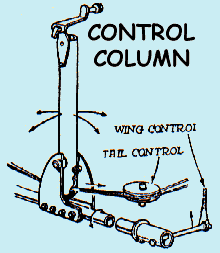
So the configuration of the HM.14 Pou du Ciel came to be. Mignet summed up his findings in Le Sport de lAir. 'The slot or gap effect gives the rear wing progressive independence of the front. A tailplane becomes superfluous. Our tandem biplane, which is neither thing in fact, becomes a single wing with a gap . . . a tailless plane.'
This philosophy Mignet termed Aerotechnique in Le Sport de lAir going on to discuss fore-and-aft balance, sudden loads, lateral balance, lateral control, defects and finally the art of turning. To turn the Flea the pilot simply moved the control column to the side, the aeroplane taking up its own bank proportional to the amount of rudder. 'Whether one turns wide or short, whether one is a new or experienced pilot, one turns correctly because ONE CANNOT TURN OTHERWISE!' Pleased with his conclusions, Mignet often highlighted his final sentences with block capitals.
His progression through what must have been virgin territory for many of his readers was presented in an easily readable and understandable manner - though his conclusions were not always the result of classical logic. His style was infectious, bringing the reader to peaks at crucial conclusions and concreting ideas as he progressed through the book. He broke the barrier protecting the world of aviation from the man in the street with statements such as '. . . all the work of pilot age is entrusted to the hand.' 'The technique of flight control is that of a bird.' 'The Flea is a kite with an auxiliary engine. Isn't that another kind of flying?'
 |
 |
 |
 He cut through jargon and mystique with ease, making flying seem
a natural extension of human exercise. His affable style and new
ideas uncorked the champagne bottle. His formula for a lightweight
'aenal motorcycle' that anyone could fly was what many handymen
with a latent interest in aviation had been waiting for.
He cut through jargon and mystique with ease, making flying seem
a natural extension of human exercise. His affable style and new
ideas uncorked the champagne bottle. His formula for a lightweight
'aenal motorcycle' that anyone could fly was what many handymen
with a latent interest in aviation had been waiting for.
Having got the theories onto paper through Les Ailes and his book, it was time for Mignet to become practically involved, both in the new craft's design and its test flying. He described the Flea as the grown-up brother of the HM.8, the HM.14 using the same method of construction as the HM.8 for both the wings and the fuselage. The Flea benefited from the considerable feedback from HM.8 builders and Mignet's own experiences.
The HM.14 design conformed to two chief principles: to be safe and easy to pilot to be small, simple, solid and practical -it should be possible to build a Flea in a 13 foot long room.
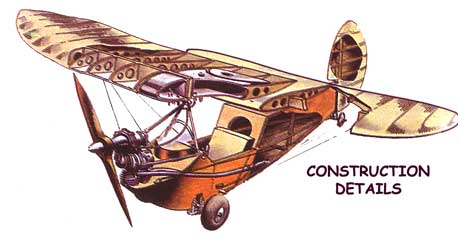
Wing span for each of the Flea's wings was initially 13 ft but improved efficiency was sought and the forewing's span became 16 ft 5 in and later 19 ft 6 in. Simplicity of construction without sacrificing strength was claimed for the wings. The wings were basically similar with a single box spar, and most of the same ribs, the whole being covered with varnished fabric. There were no ailerons, no slots, no elevators, no complicated movements, no hidden cables, levers or mechanisms. Mignet claimed that both of these very simple structures could be built in eight days. He did not, however, state how many working hours per day would have to be devoted to achieve this target. The fuselage concept was identical basically an empty box. His dislike of conventionnal aircraft and their enclosed cockpits, and the need for simplicity, gave rise to the 'flying armchair' style of cockpit, giving excellent visibility in all directions, including forward.
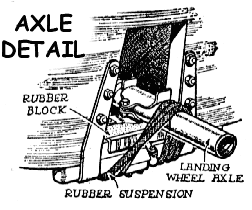
On to this structure was assembled the control column and linkages
to the front wing and rudder, the axle and wheels and of course
the engine and its accessories. With the exception of the lower
portion of the control column, all mechanisms were readily accessible.
Mignet anticipated a favorable reaction from airworthiness authorities
because of this 'open' construction -no cowlings to hide the engine,
no ailerons and their controls. If the wing covering were transparent
this would be the final accolade! The cardinal aspect of 'security of construction' was dealt with
quickly, Mignet deducing that being of simple design it could
be made so strong that only 'a real crash would smash it to pieces'.
Mignet supports this analysis with the survival of his prototype
Flea during his wintertime experimentations in the Bois de Bouleaux.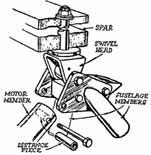
Materials were given little attention, wood and mild steel being readily accessible to the amateur. Today's guardians of the homebuilder, the Experimental Aircraft Association (IJSA), the Popular Flying Association (U10 and the Reseau du Sport de l'Air (France), would be horrified. All materials now have to come from approved suppliers whose stocks are regularly checked and inspected. Though the concept of the 'Flea' was by now crystallized in Mignet's mind, there was still a long way, and a number of important intermediate designs, to go before its materialization as the HM.14.
These were the steps to the Flea, paving the way for the crystallization of Mignet's thoughts and ideas. On 10 August 1933 he started to build his prototype HM.14. Exactly one month later this first 'real' Flea took to the air from the Bois de Bouleaux on its maiden flight. From this moment on the frustrations and elation's in mastering the Flea, together with the fine-tuning of the basic design were recorded in Mignet's diary. Extracts from his flying diary appear separately.
Flying flea information.
'I have the right to write a book.' Mignet's construction diary closes with this claim. This book was to be his second book entitled Le Sport de lAir published in France in November 1934 a year after his experiments in the Bois de Bouleaux had been concluded and with some ten hours' flying under the HM.14's wheels. Prior to this Mignet had gone into print in September 1934 in the French aviation magazine Les Ailes, writing an article entitled Le Pou du Ciel. Readers were already familiar with the name Mignet as he had made several contributions to it, including the famous article LAviation de le mateurestelle une Possibilite?
No sooner had Le Sport de lAir been published than further exposure of the Flea to the world of aviation was assured by its display at the 14eme Salon de lAeronautique au Grand Palais held between 16 November and 2 December 1934. The real test came a week later when Mignet organized the first public flying demonstration of his HM.14 at Orly Airport, then an all-grass airfield.
Painted red and white and powered by a 17 hp Aubier et Dunne the HM.14 was 'hopped and flown all around the airfield'. These demonstration flights certainly helped to capture the public's imagination, and Mignet was carried shoulder high in triumph by one ecstatic group who witnessed his flying. The weather for this flying was very poor with winds of 20 mph, gusting to 40 mph. Les liles for 13 December reported the event, stating that Mignet was not put out by the conditions, making one landing with the engine cut.
Both Les Ailes and 7Le Aeroplane referred to 'the joke' that neither Mignet nor his aeroplanes were licensed by the French authorities. 77Le Aeroplane had reported on the Flea a few months earlier in their Paris Salon edition noting that this machine warranted more serious attention than its obscure position in the Salon and curious appearance were likely to make for it'. Their edition of 13 March 1935 brought to the British aeronautical public their first detailed taste of the 'Sky-Louse' as the magazine christened the Flea.
The. Book, the Salon and the Orly demonstration had further opened
the flood gates. By March 1935 popular gossip put the total number
of Fleas already under construction at 500. As with every new
craze there were equal amounts of hard fact and fiction. With
the craze gathering momentum in France, Britain was rife with
reports of all-metal Fleas, retractable undercarriage Fleas, acrobatic
Fleas, night flying Fleas and family cabin ve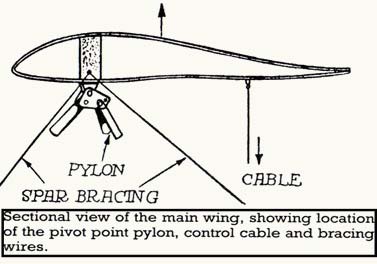 rsions of the Flea.
With so many Fleas under construction in France the Reseau des Amateurs) was formed for Flea builders to have a central organization to look after and promote their interests. Henri and Annette toured the country visiting regional groupings of the RKA. Pictures taken in 1935 already show gatherings of two, three and sometimes four Fleas. All would be basically similar, often with different powerplant's, but all perpetuating 'the joke': Flying without licence's for either aeroplane or pilot.
On 13 August 1935 'the joke' invaded Britain. Mignet' piloting his Flea powered by a 17 hp Aubier et Dunne, crossed the English Channel from St. Inglevort to Lympne in 52 minutes. The invasion of Britain was to be achieved with the embodiment of French officialdom supporting a meeting of aircraft and aviators that were, strictly speaking, illegal. Mignet had flown in the face of authority by launching amateur aviation on a wide scale in France with the HM.63 and was set for even bigger things with the HM.14. Few people believed such a movement was possible, least of all those in the French administration. Mignet had earlier recommended builders of his designs to make sure there were no Grenadines around when wanting to fly. If forced to land away from home there was a real possibility of the pilot ending up in court.
At Orly 'the joke' presented the authorities with a fait accompli and virtually forced them to change their attitudes. The Ministry of Air backed down, but not without considerable resentment from many quarters. Around 15,000 spectators turned up at Orly to see the Fleas, proof - if it were needed - of the wide public appeal that the Flea had created in such a relatively short period of time. Nine Fleas attended the event, including Mignet's prototype, now fitted with a 27 hp Aubier et Dunne.
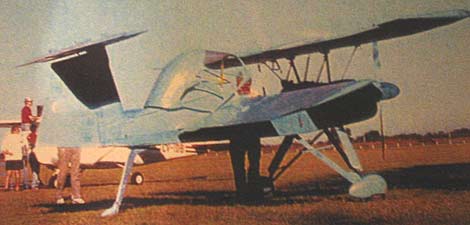
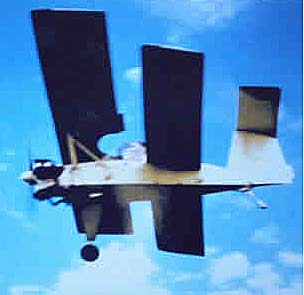
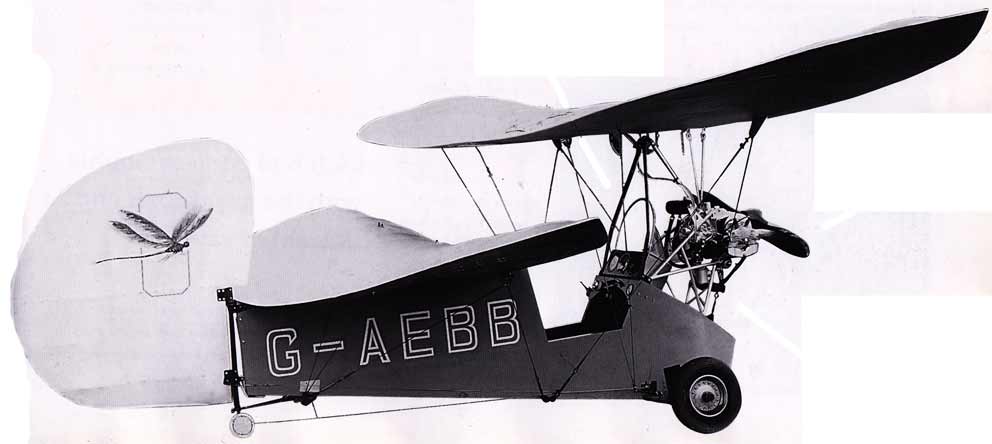
Great work you are doing there with cardboard models. I notice you have a Mignet HM14 aircraft to model. I am a retired commercial bush pilot and I built up an example of Mignet HM293 and test flew it. I never new there was a cover up with true information with this aircraft and its a great shame. However the aircraft is very difficult to fly and very un-stable and dangerous in certain flight modes. Great that you can look at doing a Jean De La Farge cardboard model. Jean passed away at 90 years in South America. He was the son of a French Aristocrat and had a degree in aeronautical engineering. He built an flew the early Mignet HM 14 and found they had nose dive problems. He survived a nose dive roll up side down crash and so he went ahead to fin a fix which was adding a tailplane to the top of the fun. The word Flea in South America Spanish is Pulga. So he called his creations Pulgas. I enclose a full detailed story from him and some very good side elevation drawings and photos. About 17 have been built and there has never been an accident with them. Mignet never like his modifications. Do let me know if you would if you plan on making a Pulga model. regards Mal Gilmore |
 |
 |
 |
 |
 |
 |
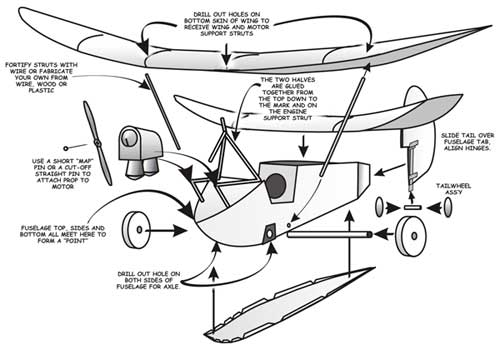
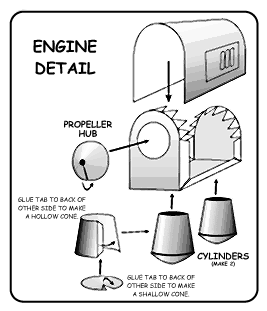
Specifications for the Flying Flea
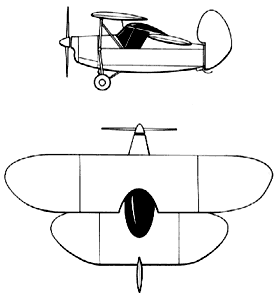 |
Length: 14 ft Wingspan: 20 ft Height: 5 ft 6 in Empty weight: 410 lb Max takeoff weight: 700 lb Powerplant: 1× McCulloch, 72 hp Performance Maximum speed: 85 mph Cruise speed: 80 mph Stall speed: 35 mph Range: 275 mi at 8,000 ft Service ceiling: 16,400 ft Rate of climb: 600 ft/min Power/mass: 9.72 lb/hp |
 |
||
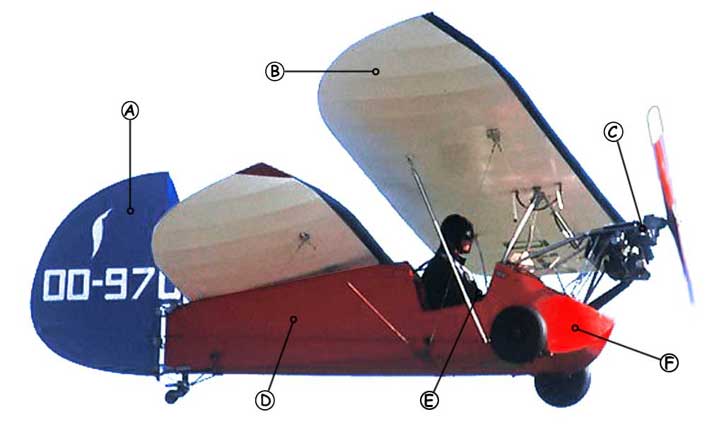
| A: Many Flying Fleas are preserved in museums in Britain and France, monuments to a dream that still remains unfulfilled. | B: The main feature of the Flea was its tandem wing layer. If the wings were mounted too close together the controls could reverse when the main wing was at high incidence. | C: The original Flea, and many of its successors, made use of commonly found components such as motorcycle engines and wheelbarrow wheels. |
| D: The Flea was banned in 1939 because of design flaws, and it never again regained its reputation. Though people are still building aircraft based of the flea. | E: The Flea was controlled by a single lever, which moved thc whole wing up and down and the rudder from side to side. There was no tailplane, no elevators and no ailerons. | F: A series of fatal crashes in 1936 finally warranted a wind-tunnel test of the Flea, proving that if the nose lowered below 15 deg a crash was inevitable. |