
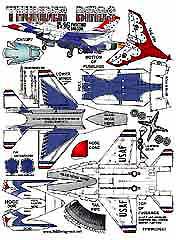
F-16 Fighting Falcon - $$4.95
he Fighting Falcon is a dogfighter with numerous innovations including a frameless, bubble canopy for better visibility, side-mounted control stick to ease control while under high g-forces, and reclined seat to reduce the effect of g-forces on the pilot. Weapons include a M61 Vulcan cannon and various missiles mounted on up to 11 hardpoints

US Fighter F-16 Fighting Falcon
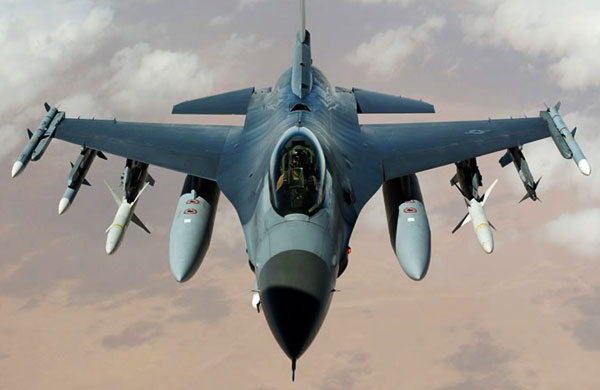
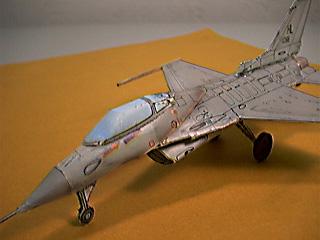
F-16 Fighting Falcon
This aircraft makes up the bulk of America's air strength and numerically,
is the most important present fighter of the western world.
Because of the recent state of "Heightened Security" two types of photo ID may be required to buy this model.
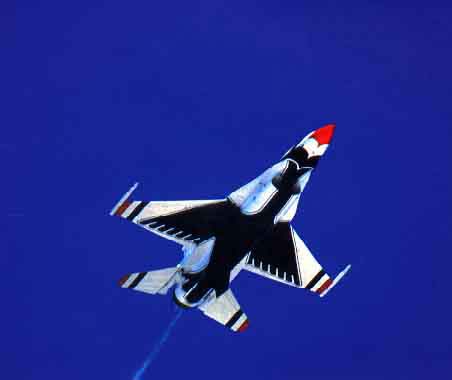
Flying from their base at Luke AFB in Arizona, the thunderbirds
thrill millions worldwide with their air antics weaving their magic
in the blue sky.
This model will inspire you to download 6 more models and build the entire team. Hmmmm...all for the price of ONE.
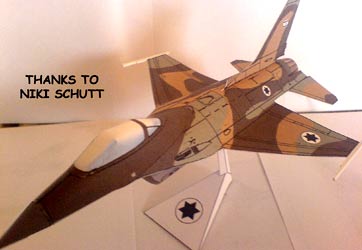 Howzit... Here's my newest repaint, an F-16 in Israeli colors. Hope you like it. Niki |
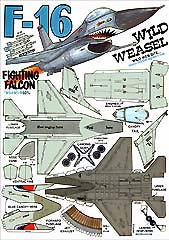
F-16 Fighting Falcon (Wild Weasel)
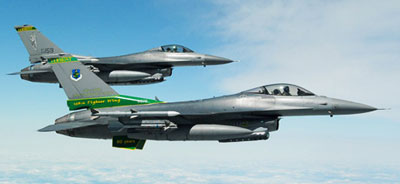
Design of the General Dynamics F-16 was initiated during 1971 to meet a US Air Force requirement for a new highly manoeuvrable lightweight fighter (LWF). Five US companies submitted proposals on February 28, 1972 and less than two months later General Dynamics and Northrop were each contracted to build two prototypes. Required for competitive evaluation, the rival designs were allocated the respective designations YF-16 and YF-17, and the first YF-16 flew on 2 February 1974. On 13 January 1975 it was announced that the YF-16 had won and full-scale engineering deveLopment authorized under the designation F-leA, together with the F-16B two-seat fighter/trainer. On 7 June 1975 came confirmation that four NATO allies. Belgium, Denmark, the Netherlands and Norway, had also selected the F-16 to meet the requirements of their air forces. Thus was initiated a massive production program, with some 67 major and almost 4000 other sub-contractors supplying avionics, components and equipment to the General Dynamics plant at Fort Worth, Texas. In Europe there were 33 major and nearly 400 additional sub-contractors keeping the production lines supplied in Belgium and the Netherlands.
The first production F-16A was flown on 7 August 1978 and was
handed over formally to the US Air Force 10 days later. The first
European F-16s were delivered to the air forces of Belgium on
26 January 1979. the Netherlands on 6 June 1979, Norway on 25
January 1980 and Denmark on 28 January 1980. The first F-16 for
Israel, a two-seat F-16B, was handed over officially at Fort Worth,
Texas, on 31 January1980, and initial deliveries to Egypt began
early in 1982.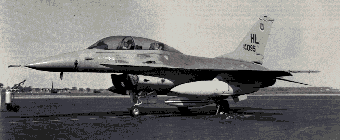
The current order book for the F-16, officially named Fighting Falcon in 1980, shows that the USAF plans to acquire a total of 2.261. with the US NaW operating 26 Falcons, comprising 22 F-iON, and four TF-1SN two-seaters. all converted from F-10CID models. Other users include Bahrain (12), Belgium (160), Denmark (70), Egypt (128), Greece (40), Indonesia (12), Israel (210), South Korea (164), Netherlands (213), Norway (74), Pakistan (111), Portugal (20), Singapore (8), Thailand (18), Turkey (160) and Venezuela (24). Iranian plans to buy 160 F-l6s were cancelled in January 1979.
By August 1990 more than 2,600 F-165 had been delivered out of 3,530 ordered and were in service with 17 customers in 16 countries, with Portugal scheduled to join the Fighting Falcon club in 1993. Some of the latest technology can be seen in the structure and avionics systems of the F-16. For example, the wings are blended into the fuselage, which not only helps to save weight, but also increases the overall lift at high angles of attack and reduces drag in the transonic speed range. Movable leading and trailing-edge flaps, controlled automatically by the aircraft's speed and attitude, enable the wing to assume an optimum configuration for lift under all conditions of flight. The highly-swept strakes that lead forward alongside the nose provide further lift: they also prevent wing-root stall, reduce buffeting and improve directional stability and roll control.
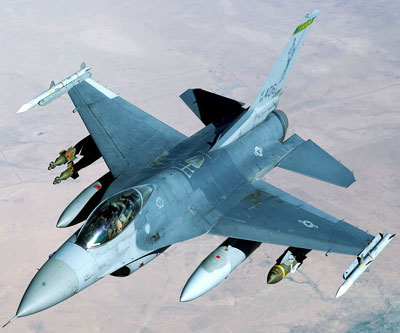 All flying controls are operated by a 'fly-by-wire'
electrical system, replacing mechanical linkages throughout the
airframe, and enabling the aircraft to respond faster and more
accurately to pilot commands. Advanced avionics include communications
with a secure voice system, inertial and TACAN navigator, pulse-Doppler
ranging and angle track radar, radar warning system, flight control
computer, and central air data and fire control computers.
All flying controls are operated by a 'fly-by-wire'
electrical system, replacing mechanical linkages throughout the
airframe, and enabling the aircraft to respond faster and more
accurately to pilot commands. Advanced avionics include communications
with a secure voice system, inertial and TACAN navigator, pulse-Doppler
ranging and angle track radar, radar warning system, flight control
computer, and central air data and fire control computers.
Development continues by the company, as well as the US Air Force under programs such as the Multi-national Staged Improvement Program (MSIP).This was intended to ensure that throughout production the necessary steps were taken to make possible the easy incorporation of systems then under development. As an example, aircraft delivered from November 1981 onwards had structural and wiring provisions to allow precision strike, night attack and beyond-visual range interception missions when the equipment became available. Brief details of some of these developments are given below.
Production F-16A and B models were powered by 23,770-lb thrust Pratt & Whitney F100 turbofans, but following a US government directive to double-source engine supplies, F-16Cs and D's built after July 1986 can also be fitted with General Electric turbo fan powerplant's giving 28,984-lb thrust.
The F-16 Fighting Falcon was by far the greatest fighter success story of the 1970s. Yet its only reason for existence is the enormous expense of the F-15 program. In I 972 the US Air Force decided that there might be value in discovering the potential (if any) for an LWF (lightweight fighter) that would be smaller and cheaper than the F-15 Eagle. This was a purely academic exercise; there was not the slightest intention of buying such as LWF for service.
Following an initial design competition, two companies were asked to produce two prototypes each. The result was the Northrop YF-17 with twin vertical tails and two General Electric YJ 101 turbojets and the General Dynamics Model 40 K which cleverly used one F100 engine as fitted to the F-IS. The GD40 flew for the first time on 2 February 1974. Even at that time there was no thought of producing the aircraft in quantity, but foreign interest helped the Americans to realize that a relatively low cost LWF could bring substantial overseas orders without hurting the F-15.
And so, following General Dynamics' development of the 40 into a slightly larger aircraft with far more comprehensive avionics, full-scale development was ordered on 13 January 975. Within five months, four European countries - Belgium, Denmark, Holland and Norway.- had entered into a Joint development contract, sharing production with General Dynamics.
The F- 16 is conventional in configuration, with cropped delta wing and a rear tailplane, but its design is extremely advanced. Flying surfaces are all electronically (fly-by-wire) controlled, including leading-edge flaps and trailing-edge flaperons (combined flaps and ailerons). This combination of leading-and-trailing-edge flaps allows the wing camber to be changed at will, if necessary under automatic control.
In sharp contrast to fighter design from World War I onward, the F-16 has virtually no inherent stability, and it is thus kept under computer control. The pilot is seated under a completely transparent canopy in an almost fully reclining position. This is not in order to accommodate him within the slim fuselage lines, but to resist violent acceleration loads: the F-16 can pull a sustained 9g in turns, more than any other Western aircraft, The control column is not placed centrally, but is a short handgrip on the right-hand side, with a special arm-rest: the stick senses the pilot's input forces and transmits to the control system signals that cause the exact rate of maneuver demanded.
Most F-16s so far have been powered,by the same advanced Pratt
& Whitney F 100 turbofan as the much bigger twin-engine F-15
Eagle. The engine is fed by a chin inlet of simple fixed type,
because no attempt was made to achieve very high Mach numbers. With thrust greater than
clean gross weight Mach 2 can be attained without such complication.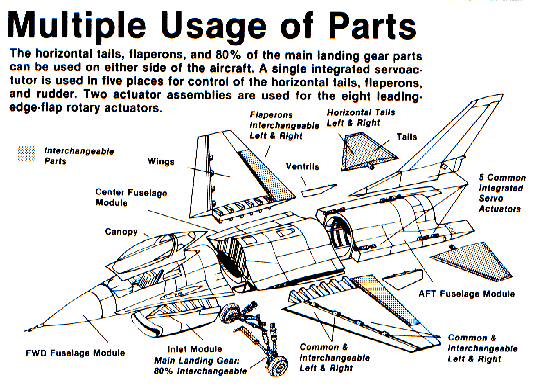
Armament is impressive for a lightweight fighter and comprises a single 20mm General Electric M6 IA-I cannon, a central under-fuselage pylon capable of carrying almost 22001b and three pylons under each wing able to support a total of I 7,3991b, together with another 4251b on the wing tips. These limit loads are not used, and maximum external load is I 2,000 lb of assorted bombs rockets, cluster dispensers, Maverick, Durandal and other attack missiles, with Sidewinders for defense. This load has to be slightly reduced when the aircraft is to carry out maneuvers resulting in forces of up to 9g.
In addition to the countries who are participating in the F-16's manufacture (European customer aircraft are assembled in Belgium and the Netherlands), it has also been ordered by Egypt, Israel, Pakistan, Singapore, South Korea, Turkey and Venezuela.
Continuing a procedure that is standard for most modern fighters, a proportion of all production aircraft are ordered as two-seat trainers.
The initial production F-16A and two-seat F-16B were succeeded in 1983 by the F-16C and two-seat F-16D, with new radar, totally upgraded avionics, a new cockpit and many extra items including two Lantern pods filled with infra-red, laser and other types of sensor which assist in night attack.
 General Dynamics also developed a totally new F-16XL with
a giant 'cranked arrow' wing and no tailplane. Immediate further
development of this into a two-seat multi-role combat aircraft
was lost to the two-seat McDonnell Douglas F-15, but its performance
is so incredible that there is a good chance that the USAF will
buy a production version, probably the F-16F, in due course.
A proposed simplified variant powered by the J79 turbojet of 18,000 lb thrust did not find buyers, but General Electric's far
bigger and newer F-110 engine in the 30,000 lb thrust class has
already been adopted for future production, and has also been
selected by Turkey and for the third batch for Israel.
General Dynamics also developed a totally new F-16XL with
a giant 'cranked arrow' wing and no tailplane. Immediate further
development of this into a two-seat multi-role combat aircraft
was lost to the two-seat McDonnell Douglas F-15, but its performance
is so incredible that there is a good chance that the USAF will
buy a production version, probably the F-16F, in due course.
A proposed simplified variant powered by the J79 turbojet of 18,000 lb thrust did not find buyers, but General Electric's far
bigger and newer F-110 engine in the 30,000 lb thrust class has
already been adopted for future production, and has also been
selected by Turkey and for the third batch for Israel.
In its own way the Fighting Falcon is already a legend. It is certainly respected by pilots of older MiG's who may have to dogfight it. But one thing is certain. The amount of research and development that is continuing with this relatively young LWF means that we shall continue to see new and even more advanced versions of the F-16 in the years to come.
FIRST FLIGHT 1974
IN April 1974, the US lightweight fighter program received a change of emphasis. The increased Cost of the F-IS led to the adoption of a 'high-low mix' policy by the USAF: the F-15 being the 'high' end, and a new air combat fighter (ACF) being the 'low' end, to be procured in larger numbers than the F-is. Spurred on by foreign Interest in the USAF's selection, from the governments of Belgium, Denmark, Norway and the Netherlands, it was announced that the General Dynamics YF-16 had been selected for full-scale engineering development.
The F-16 represents a fresh approach to fighter design, having a flared wing-body shape and the Fl5's FIQO engine, with a simple fixed intake below the fuselage. The pilot lies back in a reclining seat, and flies the aircraft with a side-stick controller in place of the conventional control column. It is a simple day air-combat fighter, armed with a 20mm (0.79-in) M61 cannon and wingtip AIM-9 Sidewinder AAMs.
The prospect of a European order meant the original air-superiority role had to be expanded to give equal emphasis on the air-to-surface mission, to include radar and limited all-weather navigation capabilities. Six single-seat F-16A and two twin seat F-I 6B trainers were ordered as pre-production aircraft; the first development F-16A flew on December 8, 1976, and the first F-16B on August 8, 1977. The initial orders were for 116 F-16s for Belgium, 58 for Denmark, 72 for Norway and 102 for the Netherlands. Of the 348 ordered, 58 were to be two-seaters.
During weapons development trials the second prototype YF-16 had demonstrated its ability to carry and fire bath the AIM-7 Sparrow and Sky Flash AAMs. Company-funded trials have produced an F-16B Wild Weasel variant, which although not fulfilling any USAF requirement, has sparked interest with other customers of the F-16.
In October 1976 Iran ordered 160 F-16s, but this was later cancelled, following the fall of the Shah in January 1979. In January 1977 the USAF increased its buy by 738 aircraft, and as part of the three-way arms deal of August 1977, Israel is to receive 75 F-16s.
The first production F-16A flew on August 7, 1978, and was handed over to the USAF ten days later. It entered operational service with the USAF at Hill AFB in January 1979. The first European aircraft flew from the Belgian line in December 1978, and entered Belgian air force service in January 1979. The first Dutch aircraft, an F-16B, flew in May 1979, and was handed over to the Royal Netherlands Air Force on June 6, 1979. The first Norwegian F- 16, also a two-seater, was first flown on December 12, 1979 and handed over on January 15, 1980. Israel received its first aircraft on January 31, 1980.
General Dynamics is also proposing a simplified version of the F- 16 as a follow-on fighter for the F5E supplied under Mutual Aid Programs. This version would be powered by a J79 turbojet of 180001b thrust, in place of the F100 turbofan. Structural changes would be limited to the rear fuselage and air intake, which would be resized to be compatible with the smaller J79.
In 1993 General Dynamics sold their Fort Worth Division (the division that produced the F-16) to Lockheed Corporation, who became Lockheed Martin in 1995 after a merger with Martin Marietta. The F-16 is scheduled to remain in service with the U.S. Air Force until 2025.
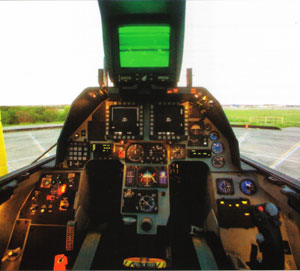 |
The Cockpit of the F-16 Fighting Falcon. |
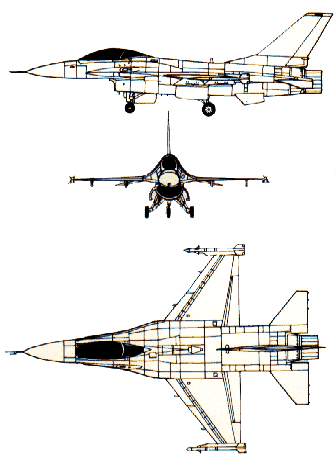
Specifications for the F-16 Fighting Falcon
|
Armament |
 |
||
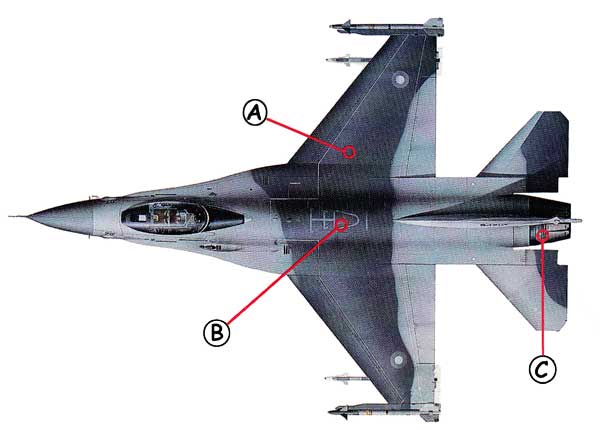
| A: Nearly all F-16s are painted light gray. This color was found to be the most difficult to see across a wide range of different weather conditions. | B: Halfway along its back, the F-16 has a refueling receptacle so that it can take on fuel in flight. This feature is now standard on most military fighting planes. | C: F-16s are powered by a Pratt & Whitney F100 engine. lt is very powerful and very resistant to changes in airflow. |
 |
||
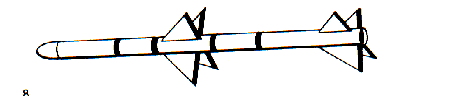
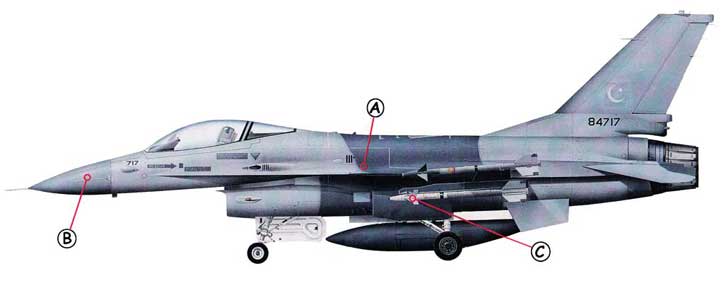
| A: With its curved surfaces blending the fuselage and wing together, and its fly-by-wire electric flight control system, the F-16 ushered in a new era of fighter design. The radical shape had far better aerodynamics than earlier designs, making the F-16 far more agile for dogfighting. | B: The radar of the F-16 is as versatile as the aircraft. With a flick of a switch the pilot can change from air-to-air operation to air-to-ground. When dogfighting, the radar automatically follows the enemy and gives the pilot a steering cue on the large heads-up display in front of him. | C: AIM-9 Sidewinders are the main air-to-air weapon of the F-16, seen here carried on the wingtips and on underwing pylons. The AIM-9 is a heat-seeking missile, homing in on the heat of the enemy's exhaust. It is more maneuverable then an aircraft. |
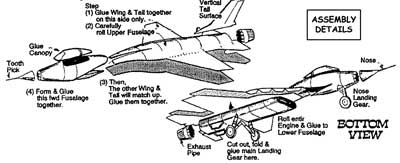
Watch our step-by-step F-16 model assembly video.
Expanded History and Facts
History and Development of the F-16 Fighting Falcon
The General Dynamics F-16 Fighting Falcon, originally conceived in the early 1970s as part of the U.S. Air Force's Lightweight Fighter (LWF) program, emerged from a need for a cost-effective, agile day fighter to complement heavier aircraft like the F-15 Eagle.
Initiated in 1971 by a group known as the "Lightweight Fighter Mafia"—a team of engineers and analysts pushing for simpler, maneuverable designs post-Vietnam War—the F-16 prototype (YF-16) first took to the skies on January 20, 1974, during an unplanned high-speed taxi test that turned into an accidental flight.
Full-scale development was approved in 1975, with the first production F-16A delivering to the USAF in 1979.
Production ramped up quickly, involving international partners like Belgium, Denmark, Netherlands, and Norway through NATO agreements. By 1980, the aircraft was officially named the "Fighting Falcon," though pilots often call it the "Viper."
General Dynamics built the F-16 until 1993, when the division was sold to Lockheed Corporation (now Lockheed Martin), leading to ongoing evolutions.
As of 2025, over 4,600 F-16s have been produced, serving in 25+ countries, with the latest Block 70/72 variants featuring advanced radars and conformal fuel tanks.
Technical Specifications
- Length: 49 ft 5 in;
- Wingspan: 32 ft 8 in; Height: 16 ft.
- Weight: Empty: 18,900 lb;
- Max Takeoff: 42,300 lb.
- Powerplant: Typically a Pratt & Whitney F100 or General Electric F110 afterburning turbofan, delivering up to 29,000 lbf thrust with afterburner.
- Performance: Max Speed: Mach 2+ (1,500 mph) at altitude;
- Combat Radius: 340 mi;
- Service Ceiling: 50,000+ ft;
- Rate of Climb: 50,000 ft/min;
- G-Limits: +9/-3.6.
- Armament: 20mm M61 Vulcan cannon (511 rounds);
- Up to 17,000 lb on 11 hardpoints, including AIM-9 Sidewinder, AIM-120 AMRAAM missiles, bombs, rockets, and electronic warfare pods.
- Innovations like fly-by-wire controls, a 30-degree reclined seat for g-force tolerance, and a heads-up display set new standards for fighter jets.
Variants Overview
The F-16 has evolved through blocks (e.g., Block 1-10 early models, Block 50/52 with upgraded engines).
Key variants include:
- F-16A/B: Single/two-seat early models, focused on air superiority.
- F-16C/D: Multirole upgrades from the 1980s with better avionics and ground-attack capabilities.
- F-16E/F (Block 60): Advanced for UAE, with AESA radar.
- F-16V (Viper): Modern retrofit with APG-83 radar and auto ground collision avoidance.
- Specialized: Wild Weasel for suppression of enemy air defenses; QF-16 drones for target practice.
Notable Facts and Operational History
- Combat Proven: The F-16 has seen action in over 400 air-to-air victories with no losses in dogfights, including Israeli operations in 1982 (destroying 44 aircraft) and the Gulf War (1991), where it flew 13,500 sorties.
- Surprising Feats: It can pull 9g maneuvers, has a thrust-to-weight ratio over 1:1 for vertical climbs, and was the first fighter with a side-stick controller.
- One F-16 famously landed safely after losing a wing in a 1983 collision.
- Global Impact: Exported to allies like Israel (first combat kill in 1981), Pakistan, and recently Ukraine for modern conflicts.
- The USAF plans phase-out by 2025-2030, replaced by F-35s, but international service continues.
- Fun Fact: The Thunderbirds demonstration team flew F-16s from 1983-2023, showcasing its agility at airshows worldwide.