

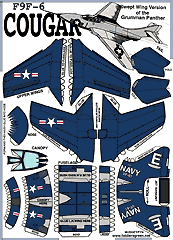
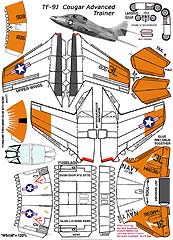
Grumman Cougar - $$4.95
Based on the earlier Grumman F9F Panther, the Cougar replaced the Panther's straight wing with a more modern swept wing. The Navy considered the Cougar an updated version of the Panther, despite having a different official name, and thus Cougars started off from F9F-6 upwards.

Grumman F9F-8 Cougar
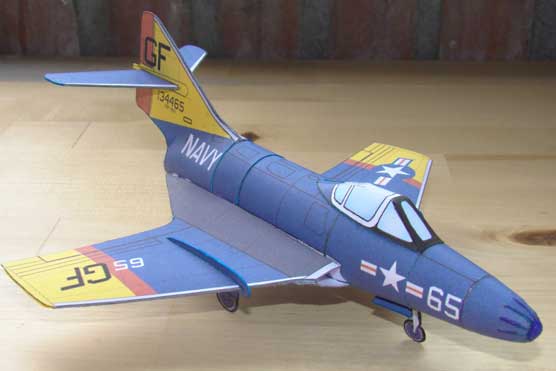
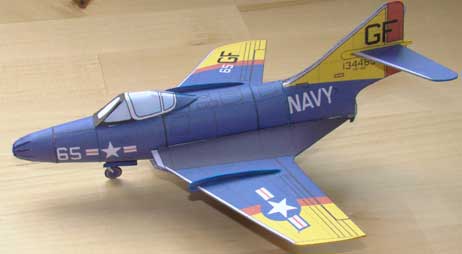 Well-made cardmodel of the Fiddlersgreen downloadable Grumman F9F-8 Cougar. This model comes with these versions: 2 Drones, 1 Trainer, Blue Angels and the regular blue version |
 |
The Grumman Cougar:
The maiden flight of the XF9F-6 was made on September 20, 1951. Although the same designation series was used for both straight and swept wing versions, Grumman continued their cat nomenclature and called their new machine the Cougar.
A word from Rob...There are four versions, plus the B&W redraw. Cougars were some of the most colorful planes in the Navy's inventory in the fifties and sixties, and I've chosen several colorful versions.
BTW, the Grumman F9F-6 Cougar, was too late for the Korean War. Initial production was the F9F-6, delivered from mid 1952 through July 1954. F9F-8s were withdrawn from front-line service in 1958-59, replaced by Grumman F11F Tigers and Vought F8U Crusaders. Reserves used them until the mid-1960s, but none of the single-seat versions saw Vietnam War service. Ernie (we stand corrected thanks. chip)
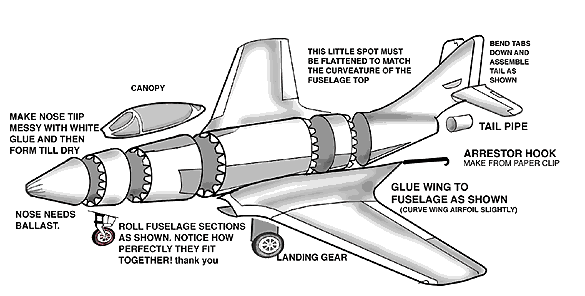
Thanks for the encouraging words, but this build is not going well. First, the wings were in two separate units (top and bottom), which made it near-impossible to get the usual clean leading edge. Second, the inboard, fat blended parts of the wing need heavy crown to fit the fuselage which, with the fold-line at the beginning of the thin part of the wing results in a kink which takes out the airfoil shape. Those inboard sections should have been a separate piece(s), easily conformable to the fuselage, to where the actual wings could then be made conventionally (leading edge fold) and glued to the "blended fuselage" portions. But they weren't. I didn't realize it, or I would have cut the wings apart and done it that way,(minus the folded leading edge). This was a design fault by "Fiddler's Green", who normally do an excellent engineering job. I'll try to overwhelm it with detail: good landing gear, refueling probe (from old squadron pictures), extended speed-brakes, tail hook, etc. It will have to be hung way, way high! I hate producing crap! When I was a kid, bad models would have "crash and burn" accidents. This one may suffer that fate! - Team Lutz
Gosh, I can recall trying to build that one many years ago from a printed postcard model and it came out much worse than that. It was awkward, frustrating, and no fun at all. I thought it was just my lack of skills, so I tried it again and it didn't come out much better. It still ended up in the trash. I think part of my problem was that I didn't have a picture of the completed model so I wasn't quite sure how it was supposed to come out. Any aviator worth his salt (or would that just be for sea captains?) is going to hate a flat wing that lacks the proper curvature of an airfoil just as much as I do. I suspect that most of the problems with this model are based on that design oversimplification and that the end builders are not in any way at fault. I eventually had to settle for a flat wing and I wasn't too happy with it. Any help in redesigning this would be greatly appreciated (mail to chipfyn at gmail dot com)- Scott Fyn
Grumman F9F-8 Cougar
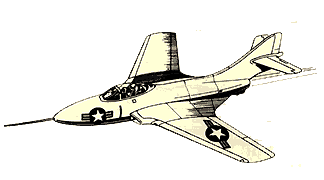
In 1951 the US Navy accepted Grumman's proposal for a swept-wing version of the F9F Panther, and this first flew in September 1951 as the XF6F-6 with a 3289-kg 17,250-Ib) J48P-8 and a new 35degree swept wing carrying larger flaps, fences, leading-edge slats and spoilers in place of ailerons. Service deliveries of 706 F9F-6s began in November 1952, and this total included 60 F9F-6P reconnaissance aircraft.
 The 168 F9F-7s were identical
to the F9F-6s apart from their Allison J33-A-t6A turbojets. Then
came 712 F8F-8s with the wing redesigned for an effective 15 per
cent increase in chord, a re contoured cockpit canopy and a 20.3-cm
18-in) increase in fuselage length to provide additions fuel volume;
the F9F-8 total included F8F-9B attack version with missile armament,
and 110 F9F-8P reconnaissance aircraft. There were also 399 F9F-8T
tandem-seat trainers.
The 168 F9F-7s were identical
to the F9F-6s apart from their Allison J33-A-t6A turbojets. Then
came 712 F8F-8s with the wing redesigned for an effective 15 per
cent increase in chord, a re contoured cockpit canopy and a 20.3-cm
18-in) increase in fuselage length to provide additions fuel volume;
the F9F-8 total included F8F-9B attack version with missile armament,
and 110 F9F-8P reconnaissance aircraft. There were also 399 F9F-8T
tandem-seat trainers.
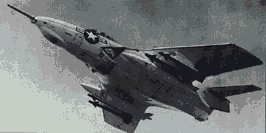 Accompanying the Cougar's wing change was an increase of 1,000
lbs. of thrust from a Pratt & Whitney J48-P-8 rated at 7,250
lbs. These factors gave the 706 F9P-6 Cougars an 85 mph increase
over the Panther series. The second Cougar order gave the fighter
a 6,350 lb. thrust Allison J33.A-16A, but water injection increased
the rate to 7,000 lbs. One hundred sixty eight of these F9F-7's
were delivered.
Accompanying the Cougar's wing change was an increase of 1,000
lbs. of thrust from a Pratt & Whitney J48-P-8 rated at 7,250
lbs. These factors gave the 706 F9P-6 Cougars an 85 mph increase
over the Panther series. The second Cougar order gave the fighter
a 6,350 lb. thrust Allison J33.A-16A, but water injection increased
the rate to 7,000 lbs. One hundred sixty eight of these F9F-7's
were delivered.
The Cougar lived up to its expectations and its advancement
over the Panther was obvious. But it was felt chat the swept-wing
design was still at the low end of its development cycle. One
area needing improvement was the low speed handling characteristics,
This directed attention to the wings which were given wider outer
panels and a cambered leading edge eliminating the slats. An increase
to the trailing edge gave a thinner wing section raising the critical
Mach number. Reworking the wing had the added benefit of increasing
the fuel capacity. Lengthening the fuselage improved the fineness
ratio and also allowed for another fuel tank, adding a total of
140 more gallons to the Cougar's capacity. As the F9F~8, the first
of the revised fighters flew on December 18, 1953, and displayed
a high speed of 714 mph - a difference of 24 mph over the F9F-7.
This merited an order for 711 more F9F-8 Cougars making the type
the most prevalent jet fighter in the Navy at the time, winged
trainer. Grumman built 399 of this model which had a maximum speed
of 705 mph.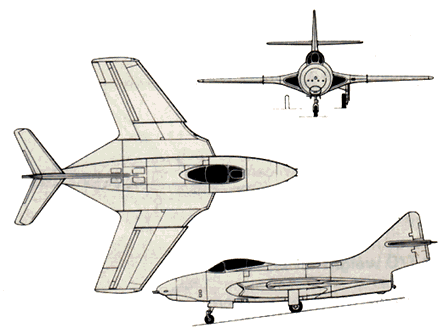
Other versions of the F9F-8 were the camera-equipped F9F.8P's and the F9F-SB missile platform capable of launching four air-to-air missiles. Many cougars were fitted with refueling probes to extend their range to the requirements of their specific missions. On their retirement from front line duty, the Cougars continued serving as radio-controlled drones and drone controllers. These were usually redesignated QE-9's in keeping with the new classification.
The definitive F9F-8 Cougar had a wingspan of 34 feet 6 inches, length of 40 feet 10 inches and a height of 15 feet. Maximum launch weight was 20,000 pounds, service ceiling was 50,000 feet. Fixed armament was four 20 mm M3 cannons, and up to 3,000 pounds of bombs could be hauled on the under wing racks.
Summary
Grumman F9F-8 Cougar
The Grumman F9F-8 Cougar, a carrier-based fighter evolved from the F9F Panther with swept wings, first flew on September 20, 1951, as an improved subsonic jet for the U.S. Navy and Marines, missing Korea but serving through the 1950s. Powered by a Pratt & Whitney J48-P-8 turbojet of 7,250 lbf thrust, it featured a 34-foot 6-inch wingspan, 41-foot 9-inch length, 12-foot 3-inch height, empty weight of 11,860 pounds, and maximum takeoff of 24,760 pounds, reaching 645 mph, 50,000-foot ceiling, and 1,050-mile range; armed with four 20mm cannons and provisions for missiles or bombs. The F9F-8 final fighter variant included fuselage stretch, larger wings for better low-speed handling, and refueling probes; 601 built, later redesignated F-9J. Flown by Blue Angels from 1954-1957, it saw Vietnam combat as TF-9J trainers for forward air control, retiring in 1974 after influencing designs like the F11F Tiger.
Grumman F9F Cougar YouTube video
This video talks about the US Navy's first swept wing fighter while showing walk-around footage in a hangar. (runtime 4:49)