

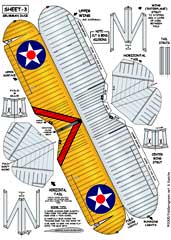
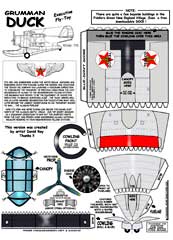
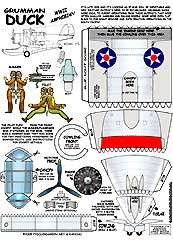
Grumman Duck - $$8.50
The Grumman F2F was a single-engine, biplane fighter aircraft with retractable undercarriage, serving as the standard fighter for the United States Navy between 1936 and 1940. It was designed for both carrier- and land-based operations.

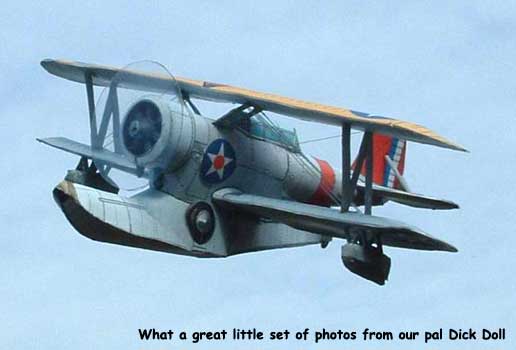
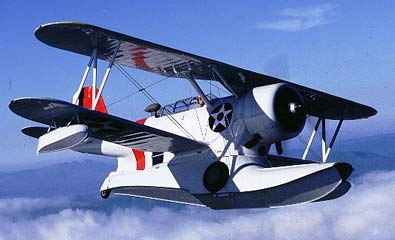
J2F Grumman Amphibious Duck
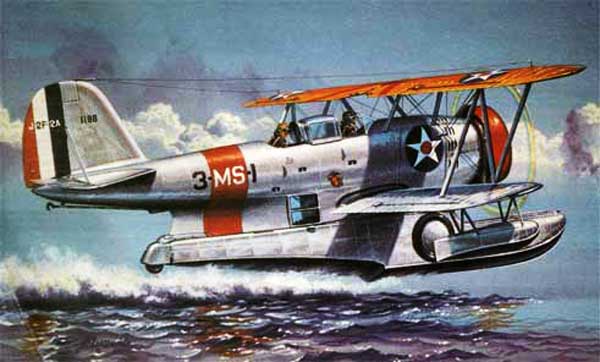
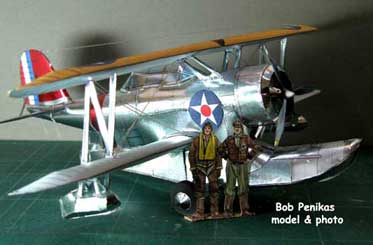
In late 1939 and early 1940, as war loomed closer to America's borders, new military outpost were established. Grumman Ducks were needed to support the extended patrol areas, mandated by this added vigilance. The Grumman Duck was ideal for operations from these improvised outposts, which were usually shallow inlet facilities or single ramp docking facilities.
Their primary mission being search and rescue, Ducks were used during WWII in the Zone of Interior and combat areas including the Aleutians, the Pacific and the Philippines due to their ability to handle rough water.
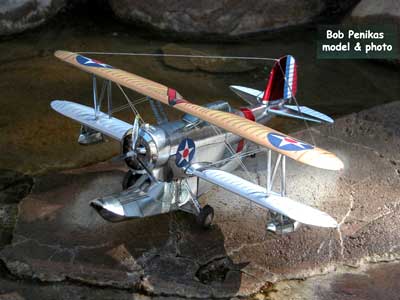
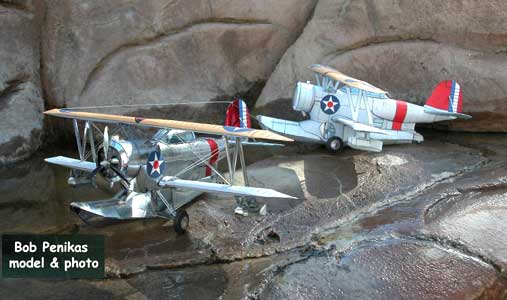
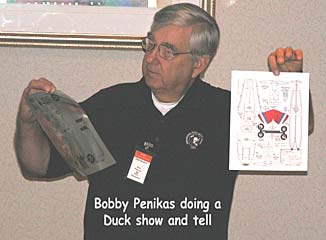
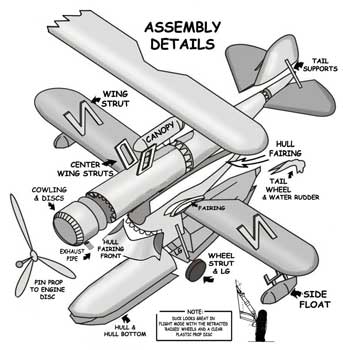
From Bob Penikas-Minister of Card modeling..
This one is going together much nicer. Though I should have
given the red river silver paper a protective coating. I
was being very careful during the assembly but still some
tiny bits of glue touched the surface and trying to free
the glue spots damaged the silver finish.
I glued black craft paper to the inside of the engine cowl
and added an extension so that the prop will not hit the cowl
front ring. The Star insignias were cut from 20 lb letter
paper. Using the FG page 3 rib pattern I made a couple for
each wing, included a wing spar connecting the ribs and
attached the lower wings before adding the fuselage float.The
engine disc was backed up with cardboard giving support
to the thin Red River silver paper. (http://www.redriverpaper.com)
The Duck is fantastic! Congratulations to all involved. It is nice to see more sea planes. I was really looking forward to see how this came out. It beats all expectations. John Dell
Nice Duck! You need more 'teen the wars planes in the collection. Great addition. Looks like a real winner. Rob Carleen
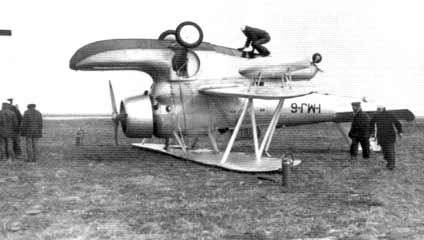
The Duck has always been one of my loves too. We were recently down at the Pima Air Museum where they have a single winged version (experimental) that came out about the same time the R-4 helicopter did. Talk about bad timing. I overheard someone mention how very UGLY it is.chip
Agreed! Sooper job on this amphibian. Heading out of town over T-Day but will try to get after this one as soon as possible...The printer's at work as I type...Wayne Z
Awesome subject. I've always loved the Duck.TW
Now there's a fun one. Super addition to the line-up. My hat's off to you and Kancho for this one! I wonder if she was somehow involved in coining the phrase "odd duck". I like how you're doing the natural metal these days. cheers, T.
HOLY COMPOUND CURVES, BATMAN!
Complex subject translated to an easy-to-build model. Congrats
to you and Kancho for distilling it down to this beautiful
result. This thing *screams* for some nice glossy cardstock,
doesn't it? Love it, Chauncy G
The Duck is fantastic! Congratulations to all involved. It is nice to see more sea planes. I was really looking forward to see how this came out. It beats all expectations. BB
Wonderful build of a very cool subject. Shawn
Hi. I've started to build the Grumman Duck and rememered that I've seen it in a movie. Sure enough, Peter O'toole's character flew one in the movie MURPHY'S WAR. So, the Duck is a movie star. Just thought that info might be a nice addition to the write up about the Duck you've crafted the card model after.
Can't wait to get it finished and hang if from my ceiling. Thanks for many great models. Bill Myers
That's a beautiful model Bob...the Duck has always intrigued me - kinda like Grumman's F4 Wildcat and A6 ..Adam
In the files pictures of my last model:1/200 Duck. Jean
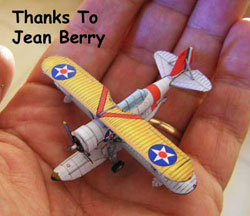
More pictures/info
The first J2F-1 flew on April 3, 1936 and was delivered to NAS
Anacostia, Washington D.C. 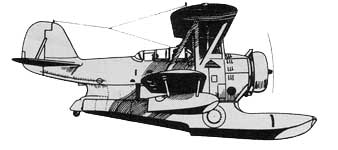 that
same day. The J2F-1 was equipped with fittings for a flexible dorsal
.30 caliber machine gun, bomb racks on the lower wings, and a tail
hook. One year later, the production run of twenty-nine J2F-1s was
completed.
that
same day. The J2F-1 was equipped with fittings for a flexible dorsal
.30 caliber machine gun, bomb racks on the lower wings, and a tail
hook. One year later, the production run of twenty-nine J2F-1s was
completed.
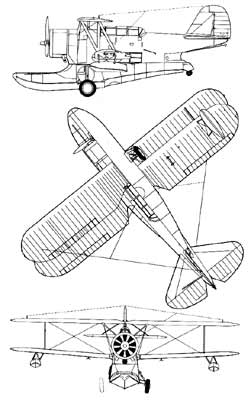
The Duck was classified as a "single bay" bi-winger, meaning
there was only a single set of struts outboard of the fuselage and
a single set of bracing wires between the upper and lower wings
on each side. Power for the XJF-1 and the JF-1 came from a 14 cylinder
Pratt & Whitney R-1830-62 "Twin Wasp" engine of 700
hp and a Hamilton Standard three blade prop.
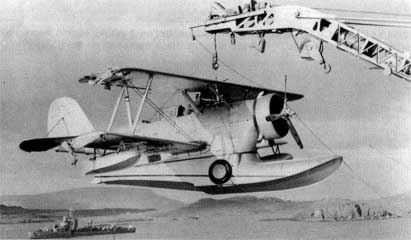
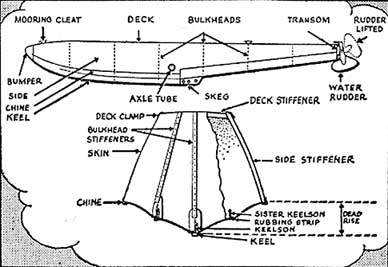
To keep it afloat, a single large float was mounted under the centerline of the craft. Faired flush into the sides of the main float was the main landing gear which could be raised and lowered by a system of motors, sprockets, chains and gears. A small outrigger float was mounted near the tip of each wing. The crew consisted of a pilot and rear gunner under the telescoping canopy. There were also provisions for two passengers located just aft of the lower wing in the main float.
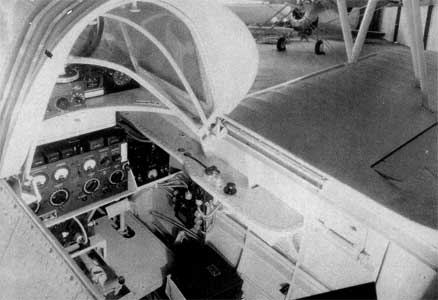
The pilot flies from the front cockpit while a passenger/gunner would sit in the rear. There is a 'downstairs' that has room for 2 additional passengers or downed pilots. There is also a 'hatch' in the bottom of the hull that can be opened in flight from which to take reconnaissance pictures.
Ducks have been used in several movies and TV shows such as “Ba
Ba Black Sheep” and Murphy's War.
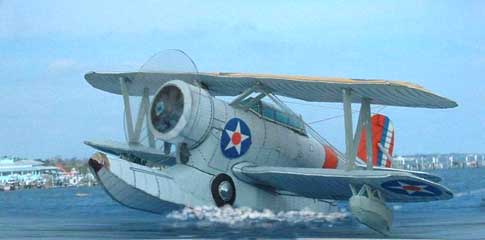
Grumman J2F Duck
 |
 |
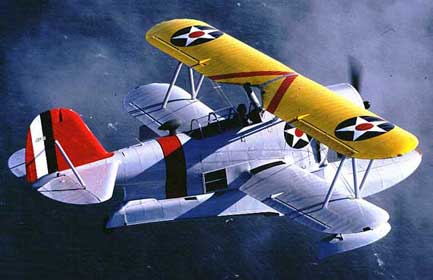
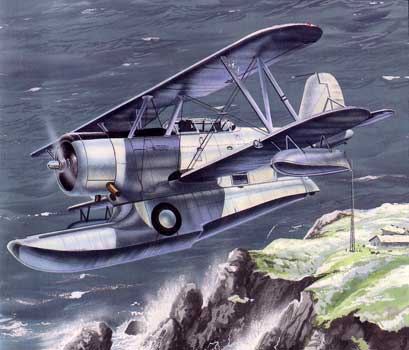
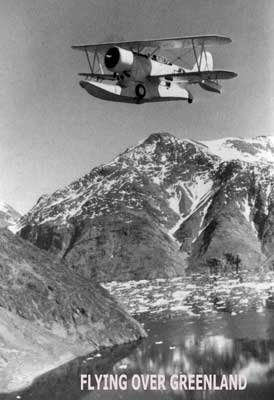
The Grumman JF/F2F Duck was the first amphibian aircraft from the still very young Grumman Aircraft Engineering Company. The aircraft was the design of Leroy Grumman and Bill Schwendler and was a direct descendent of the Loening amphibians of the 1920s.
In the 1920s, Loening Aeronautical Engineering Corporation amphibian aircraft designs held great sway with the rich and elite, earning them the appellation "air yachts." Likewise, these amphibians, procured by the Army Air Corps as the OA series and by the US Navy as the OL series, defended the role of utility aircraft. These amphibians, during then years of service, opened up new areas for aircraft in military operations. During the late 1920s, despite constant upgrades and improvements the US Navy had begun looking for a replacement for their Loenings.
 In 1929, following the Curtiss-Wright takeover of Loening Aeronautical,
a small, talented group of Loening employees; Leroy Grumman, Jake
Swirbul, William Schwendler, Julius Holpit, and Albert Loening,
left (not wanting relocate to Pennsylvania) and formed the Grumman
Aircraft Engineering Corporation. Grumman was completely and privately
financed by Grover Loening, who also provided the manufacturing
rights to the Loening retractable landing gear hull, and float
designs. This led directly to the development of the Grumman Model
A and Model B floats which equipped the Vought 02U and 03U observation
aircraft, and provided Grumman with their first US Navy contacts.
In 1929, following the Curtiss-Wright takeover of Loening Aeronautical,
a small, talented group of Loening employees; Leroy Grumman, Jake
Swirbul, William Schwendler, Julius Holpit, and Albert Loening,
left (not wanting relocate to Pennsylvania) and formed the Grumman
Aircraft Engineering Corporation. Grumman was completely and privately
financed by Grover Loening, who also provided the manufacturing
rights to the Loening retractable landing gear hull, and float
designs. This led directly to the development of the Grumman Model
A and Model B floats which equipped the Vought 02U and 03U observation
aircraft, and provided Grumman with their first US Navy contacts.
In 1931, the Navy reassigned the aircraft designator "J" from transport aircraft (such as the Ford JR-1 Trimotor navy transport) to a new type of general utility aircraft. These utility aircraft would be purpose built for deployment with utility flights aboard aircraft carriers, at shore bases with the newly created Utility Squadrons and attached to aviation utility ships.
The Grover Loening Aircraft Company, formed in 1928 when the original Loening Aeronautical Engineering Corporation combined with Curtiss-Wright submitted the privately developed XO2L-1 amphibian. This amphibian retained many of the Loening OL's features, but presented them in a more streamlined form.
 |
 |
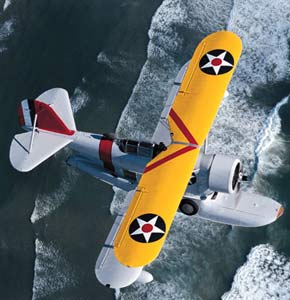 Although the US navy had high praise for the XO2L-1 as it was
being tested in 1932, Grover Loening had no production facilities.
At the Navy's suggestion, Grumman began redesign work on the XO2L-1
with the idea of producing the redesigned amphibian. Preliminary
work on Design 7 began at the Grumman plant in Baldwin, Long Island
and a prototype was ordered as the XJF-1 during 1932. The first
flight was made on 24 April 1933 from a grass field in front of
Grumman's Farmingdale, Long Island plant with Paul Hovgard at
the controls.
Although the US navy had high praise for the XO2L-1 as it was
being tested in 1932, Grover Loening had no production facilities.
At the Navy's suggestion, Grumman began redesign work on the XO2L-1
with the idea of producing the redesigned amphibian. Preliminary
work on Design 7 began at the Grumman plant in Baldwin, Long Island
and a prototype was ordered as the XJF-1 during 1932. The first
flight was made on 24 April 1933 from a grass field in front of
Grumman's Farmingdale, Long Island plant with Paul Hovgard at
the controls.
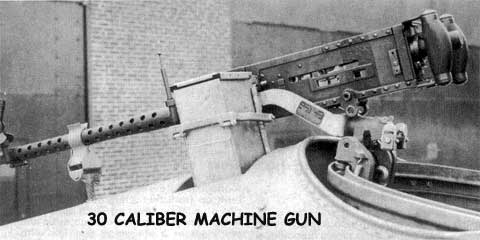
The XJF-1 was a compact, single-bay biplane which had a crew of two, seated in tandem under a fully enclosed canopy. The ungeared Pratt & Whitney R-1830-62 fourteen cylinder air-cooled radial engine drove a three-blade Hamilton Standard propeller. Armament consisted of a single .30 caliber flexible machine gun, operated from the rear cockpit, and provision for a single 100 pound general purpose bomb under each lower wing.
Accommodations for two passengers, seated side-by-side, were also provided in the rear of the float. Access to this compartment was through a set of folding doors in the floor of the rear cockpit. The float was faired into the fuselage, similar to the earlier Loening amphibians. The main landing gear retracted into the float. The non-retractable tail wheel, which was mounted in the rear of the float, doubled as a water-rudder. The arresting hook was mounted on the rear of the fuselage.
The XJF-1 was delivered to Naval Air Station Anacostia, Washington D.C. for flight evaluations on May 4, 1933. The only minor redesign that resulted from the Navy's evaluations was to the vertical tail surfaces. The original triangular surfaces resulted in some longitudinal instability. The surfaces were redesigned to the broader, squarer vertical surfaces found on the production JF and J2F series aircraft. The XJF-1 was redelivered and immediately accepted into service. The XJF-1 crashed in the James River on March 8, 1934 (a naval test and development unit at NAS Norfolk, Virginia).
JF Duck Series
The Grumman Duck was ordered into quantity production in 1934. The production JF-1 differed from the early prototype in that the fin and rudder were more squared off, similar to the redesigned prototype. The Navy issued Grumman a contract for twenty-seven JF-1s. The first JF-1 entered naval service at Naval Air Station Norfolk, Virginia during May of 1934. The Marine Corps took delivery of their first Duck during February of 1935.
The JF-1s served in VJ-1 (Utility squadron 1) attached to the USS WRIGHT, with utility units aboard the USS SARATOGA, USS LEXINGTON, USS RANGER, and aboard the USS HERON in the Asiatic Fleet. JF-1s were also present at the Fleet Air Bases at Coco Solo in the Canal Zone, at Pearl Harbor in Hawaii, and the Navy Yard at Cavite in the Philippines. The JF-1 was similar in appearance to the redesigned XJF-1, however, while the provision for armament was retained, the armament itself was usually deleted in the JF-1 and a third position added for a radio operator.
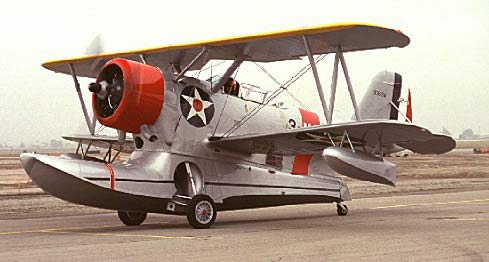
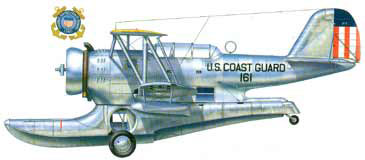
The JF-2 (Design 9) was built in 1934-35 as an unarmed utility aircraft for the US Coast Guard. JF-2s differed from the JF-1 in that they were powered by a 700 hp Wright R-1820-102 nine cylinder engine with a narrow chord cowling in place of the 700 hp Pratt & Whitney engine used in the JF-1.
Externally, the JF-2s were easily identified by the radio direction finder loop antenna installed on the fuselage spine behind the canopy, and the lack of arresting gear. The JF-2s served from land stations in New Jersey, Washington, Florida, North Carolina, South Carolina, Mississippi, and California.
The JF-2s also served aboard the USCG cutter TANEY in Honolulu, Hawaii, the USCG ice-breaker SPENCER in Cordova, Alaska, and with the Bering Sea Patrol. Four JF-2s were later transferred to the US Navy.
JF-3s (Design 10) were built for Navy and Marine Corps reserve units in 1935. The five JF-3s differed from the earlier variants in that they were powered by 750 hp Wright R-1820-80 nine cylinder engines with narrow chord cowlings. Like the earlier JF-2, these aircraft also had the arresting gear deleted.
J2F
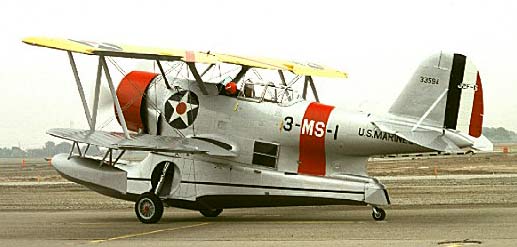 When the last JF-3 was delivered on October 18, 1935,
Duck production was halted until March of 1936 when an entirely
new series was ordered. The revised design, Grumman Design 15,
was given the Navy designation J2F. The J2F differed from the
earlier JF series in a number of ways.
When the last JF-3 was delivered on October 18, 1935,
Duck production was halted until March of 1936 when an entirely
new series was ordered. The revised design, Grumman Design 15,
was given the Navy designation J2F. The J2F differed from the
earlier JF series in a number of ways.
The 700-750 hp engines and long chord cowlings used on the earlier variants was changed to the 750 hp Wright R-1820-20 air cooled radial, with a short chord engine cowling. The float was extended forward one foot, for an overall length of thirty-four feet instead of the thirty-three feet for the earlier JF series.
The J2F series Duck carried additional equipment to make it more of a multi-mission aircraft capable of target towing, smoke-laying, photographic survey and reconnaissance, and medical evacuation (a stretcher could be carried in the passenger compartment in place of the two seats normally installed), in additional to its usual light transport role. With the exception of the new float, the airframe remained basically the same as the earlier JF series, and the wing remained unchanged with a span of thirty-nine feet.
|
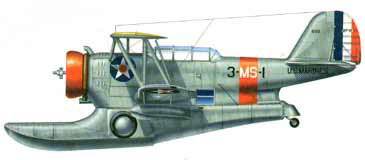
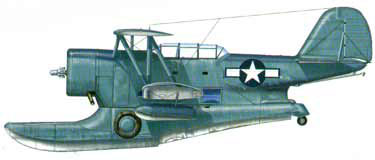
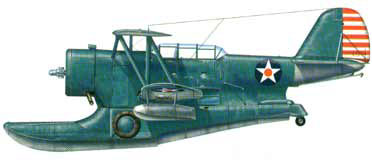
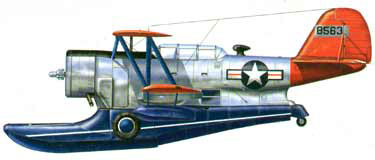
Below are a few more Grumman Duck versions 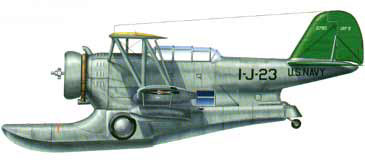
|
|
|
|
|
 |
 |
 |
 |
 |
The first J2F-1 was retained at NAS Anacostia for experimental purposes. One of the tests involved the installation of full span flaps on the trailing edges of the upper wings in an attempt to lower the landing speeds to sixty-five mph. This aircraft may have been unofficially known as the J2F-1A.
During 1938, Grumman received an order for thirty J2F-2 Ducks. These aircraft were built largely for the US Marine Corps and were powered by a 790 hp Wright R-1820-30 engine driving a two position adjustable pitch Hamilton Standard propeller. Armament included a forward firing .30 caliber machine gun and a flexible .30 caliber machine gun in the rear cockpit.
During 1939 and 1940, nine J2F-2s were stationed at Charlotte Amalie, Saint Thomas, Virgin Islands, to participate in the Neutrality Patrol over the Caribbean Sea. Assigned to VMS-3, these J2F-2As were modified with twin, versus single, rear cockpit guns, and two additional bombs racks under the lower wings.
Twenty unarmed J2F-3s were ordered in January of 1939 for US Naval Attaches and the Commandant of the US Naval Academy. Outfitted for VIP use, these "Admiral's Barges" were plush and painted Dark Blue and Silver. Improvement included a 790 hp Wright R-1820-36 engine driving a three blade constant speed propeller.
In late 1939/early 1940, as war loomed closer to America's borders, new military outpost were established. More Ducks were needed to support the extended patrol areas, mandated by this added vigilance. The Grumman Duck was ideal for operations from these improvised outposts, which were usually shallow inlet facilities or single ramp docking facilities. In September of 1939, production of thirty-two J2F-4 Ducks began at Grumman. This Duck variant was the same as all previous variants with minor modifications in cockpit instrumentation and engine operation.
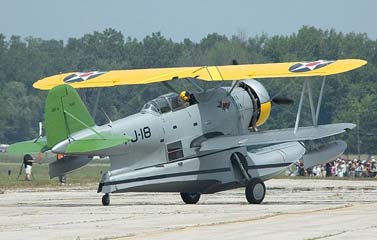 The final model of the Grumman-built Ducks appeared in July of
1941, when the first of 144 J2F-5 Ducks was delivered to the Navy.
The J2F-5s (the first wartime production Duck) were powered by
a 950 hp Wright R-1820-50 engine housed
in a broad chord cowling which incorporated the oil cooler. The
aircraft was also modified with stronger bomb racks (capable of
carrying 325 pound depth charges), and the standard rear cockpit
.30 caliber machine gun mount.
The final model of the Grumman-built Ducks appeared in July of
1941, when the first of 144 J2F-5 Ducks was delivered to the Navy.
The J2F-5s (the first wartime production Duck) were powered by
a 950 hp Wright R-1820-50 engine housed
in a broad chord cowling which incorporated the oil cooler. The
aircraft was also modified with stronger bomb racks (capable of
carrying 325 pound depth charges), and the standard rear cockpit
.30 caliber machine gun mount.
Although most J2F-5s (and later Columbia-built J2F-6s) were retained at bases in the United States or away from the front during the Second World War, other Ducks distinguished themselves in the Pacific, being used by the Marines and Navy to recover downed flyers from the sea and Japanese held islands.
It was J2F-5s assigned to the Fleet Air Base at Cavite that provided supplies and medical evacuation for the Bataan garrison at the outbreak of the Second World War. On April 8, 1942 a J2F-5 left Cabcanen in the Philippines carrying six men, including Carlos Romulo, who would later became President of the Republic of The Philippines.
To free Grumman for production of fighters and torpedo-bombers, the US Navy had Grumman transfer J2F production to Columbia Aircraft Corporation in Valley Stream, Long Island. Under the designation J2F-6, Columbia built 330 Ducks during the Second World War. The only difference between the J2F-5 and J2F-6 variants was the introduction of the 1,050 hp Wright R-1820-54 air-cooled radial engine on the J2F-6.
The final mission for the Duck in Coast Guard/Navy service, came in 1946 and 1947. A J2F-6, assigned to the Coast Guard ice-breaker NORTHWIND, participated, as part of Navy Task Force 68, in the Antarctic Expedition dubbed Operation HIGH JUMP, with Rear Admiral Richard E. Byrd, USN (Ret.) as Officer-in-Charge of Scientific Programs. This Duck was responsible for making reconnaissance flights over the South Pole region, liaison and supply flights, weather reconnaissance, and acting as standby rescue and medical evacuation aircraft. The J2F-6 and the crew of the NORTHWIND, under the command of Captain Charles W. Thomas, USCG, won the praise of Byrd and Commander Task Force 68, receiving much of the credit for the success of supporting operations for the scientific programs.
OA-12
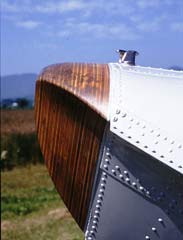 The Duck entered Army Air Force service when a single
naval J2F-5 was transferred to the Army Air Force during
1942. Designated as the OA-12 it served mostly in the North Atlantic,
stationed at Newfoundland and Fort Mc Andrews, Nova Scotia. It
returned to the U.S. in 1945 and was disposed of as surplus at
Bush Field in Augusta, Georgia on June 15, 1945.
The Duck entered Army Air Force service when a single
naval J2F-5 was transferred to the Army Air Force during
1942. Designated as the OA-12 it served mostly in the North Atlantic,
stationed at Newfoundland and Fort Mc Andrews, Nova Scotia. It
returned to the U.S. in 1945 and was disposed of as surplus at
Bush Field in Augusta, Georgia on June 15, 1945.
Later OA-12s were drawn from surplus US Navy stocks and overhauled at Warner Robins AMC, Georgia for Arctic operations. Five 0A-12As were assigned to the 10th Air Rescue Squadron (later 10th Air Rescue Group). As part of the Alaskan Air Command. The Ducks operated from Elmendorf AFB in Anchorage and at Ladd AFB in Fairbanks from 1948 into the 1950s.
One of the OA-12As crashed on landing on Lake Chekatna in August of 1948. It was recovered by collectors during the 1970s and was completely rebuilt.
Argentina
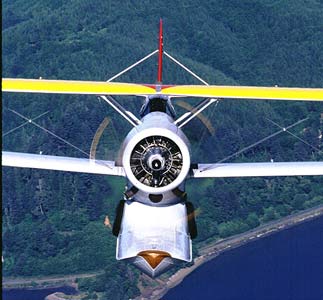 During 1937, the government of Argentina purchased eight Grumman
Model G-20 Ducks directly from the Grumman plant. This marked
the first direct export of assembled aircraft by Grumman.
During 1937, the government of Argentina purchased eight Grumman
Model G-20 Ducks directly from the Grumman plant. This marked
the first direct export of assembled aircraft by Grumman.
The G-20 was similar to the JF-2 used by the US Coast Guard. The first Argentine G-20 flew in December of 1936 and all were delivered by February of 1937. The argentine Ducks replaced Vought 02U-1As in the Naval Aviation Observation Squadron. This squadron operated from BAN Commandant Espora and the aircraft were often sent of detachment aboard the cruisers ARA ALMIRANTE BROWN and ARA VEINTICINCO DE MAYO. The G-20's were powered by Wright R-1820 engines. They served with the Aviacion de la Flota de Mar and initially carried the serials M-O-1 through M-O-8 on the fuselage sides.
During 1939, the G-20s were augmented by four Grumman Model G-15s. The G-15s were similar to the J2F-4s with the tail hooks removed. These Ducks were distributed among two observation units -- one at BAN Commandant Espora (Squadron 2) and the other at BAN Punto Indio (Squadron 3). Few of the G-20s and G-15s remained airworthy by the end of the Second World War.
In 1948, Argentina took delivery of twenty-two J2F-5s and nine J2F-6s from surplus Navy stocks. Some of these Ducks took part in the 1955 operations that ousted Juan Peron. Although Naval Observation Squadrons were disbanded during 1956, a number of Ducks flew on in Argentina until 1959.
The acquisition of the Ducks had facilitated the creation of the first, true naval aviation observation squadrons in the Argentine Navy. The Ducks were the eyes of the fleet during times when radar equipped ships did not exist or, later, when they were absent. The Ducks also served in the general utility role and were used to direct naval gunfire, as torpedo spotters, as aerial photographic platforms, target towers, medical evacuation aircraft, search and rescue and in the submarine support operations role. For a period of time (1946-1950), at lest one Argentine Duck was painted in an overall Flat Black color scheme for night operations with the fleet and for undisclosed "special missions."
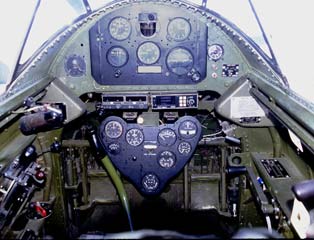 |
 |
Columbia
After becoming a signatory to the Inter-American Treaty of
Reciprocal Assistance ("Rio Pact"), Colombia took delivery
of three ex-USAF OA-12Bs during 1948. They carried US Air Force
serial numbers 48-1373 through 48-1375, while being overhauled
at Warner-Robins AMC, Georgia. There are no details available
of their service in Columbia after their delivery.
Mexico
Two Columbia-built J2F-6 Ducks were acquired by Mexico during
1947 for use with Aviacion Naval Mexicana. Carrying side codes
MV-07 and MV-08 they operated in the Vera Cruz area from 1947
to 1951. MV-08 survived and was sold in the US during 1951.
Civil Ducks
A number of J2F-5s and -6s went to the US civil register after
the war. The best known J2F-6 was N67790 which starred in the
1974 movie "Murphy's War." A Duck was also used in the
television series "Baa Baa Blacksheep" (aka "Blacksheep
Squadron" in syndication). Ducks were also used by the Dawn
Patrol Seaplane Base to ferry businessmen from Long Island to
Wall Street. Still other Ducks have been used as firefighters.
Most surviving Ducks are now in civilian/military museums.
Grumman J2F Duck Specifications
 |
Crew: two (pilot and observer) |
 |
|
Summary
Grumman J2F Duck
The Grumman J2F Duck, an American single-engine amphibious biplane, evolved from the 1933 JF Duck with a longer float and 900-hp Wright R-1820 Cyclone engine, first flying on April 2, 1936, and serving U.S. forces from the mid-1930s to post-World War II in utility and air-sea rescue roles. Featuring equal-span wings of 39 feet, length of 34 feet, height of 13 feet 11 inches, empty weight of 4,400 pounds, and maximum takeoff of 7,700 pounds, it achieved 190 mph maximum speed, 750-mile range, and 25,000-foot ceiling; armed variants carried machine guns and depth charges. Produced in variants like J2F-5 (950-hp engine) and J2F-6 (1,050-hp by Columbia Aircraft), totaling 564 units, it performed scouting, anti-submarine patrols, and rescues, famously in films like "Murphy's War." Exported to Argentina, Colombia, and Mexico, it served until the 1950s, symbolizing versatile amphibious aviation.
Grumman Duck YouTube video
What Happened to the Crew of this WW2 J2F Grumman Duck? (runtime of 21 minutes)