

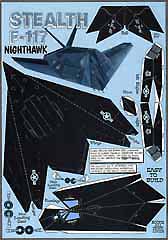
F-117 Nighthawk - $$3.95
The Lockheed F-117 Nighthawk is a stealth ground attack aircraft formerly operated by the United States Air Force. The F-117A's first flight was in 1981, and it achieved Initial Operational Capability status in October 1983.

The Lockheed F-117 Nighthawk Stealth Fighter

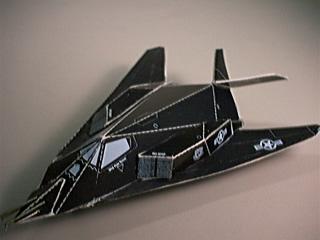
The Lockheed F-117 "Stealth" Fighter is one of the most sophisticated warplanes ever built. Almost invisible to radar, the
F-117 has revolutionized air warfare. It was operated at first under conations of total secrecy, but in 1991 the U.S. Air Force deployed it openly to Saudi Arabia for service in the Gulf War. Ranging the skies over Baghdad with impunity it struck the most heavily defended Iraqi targets with stunning effect.
F-117 Nighthawk
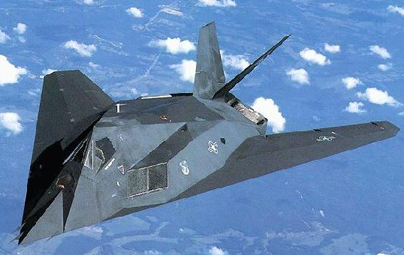
The first Air Force fighter aircraft designed to cruise virtually
undetected by radar and infrared sensor systems, doesn't look
like any other airplane. Its flat, black, faceted surface reflects
little visually. And its appearance even in flight-is that of
something alien, of something which doesn't belong.
The Nighthawk weighs 52,500 pounds and is roughly the size
of an F-15. Its length is just under 66 feet, wingspan is 43 feet,
four inches, and height is about twelve-and-a-half feet. The wings
are swept back 67.5 degrees. While the F-15 Eagle has what could
be called gracefully flowing lines, the F-117 is a pile of trapezoidal
shapes. Where the Eagle's wings and tail "naturally"
flow into its fuselage, the Nighthawk's wings and other pieces
are jammed into its middle.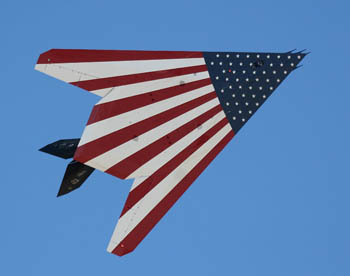
Perhaps the most unusual-or even disturbing-aspect is the mostly aluminum alloy F-117's appearance is the illusion that the aircraft changes shape significantly as the viewer walks around it. For example, in the view of it offered by the grainy, black and white picture released by the Air Force in 1988 from the front just off starboard, the aircraft appears to be short and stocky. If one continued around the wing toward the tail, the aircraft would elongate into a surprisingly long and thin rear fuselage, and the swallow-tail fins, each of which pivots on a center pin, sweep back dramatically.
The odd facets are there to control as much as possible the reflection of radar beams. Curved surfaces scatter beams in several directions, thus making radar returns possible. The F-117's surfaces are arranged so that radar beams are reflected off in directions away from radars. These features include sharp facet intersections which are similarly angled to reduce radar returns. If one looks closely at the Nighthawk, he'd see saw tooth edges on access panels, on cockpit/fuselage intersections, and on the two bomb bay doors. Every facet is angled at least 30 degrees from the vertical.
Other important stealth design features include engine inlet grills on either side of the forward fuselage area which shield engine compressor stage blades from prying radars. On the aft end of the fuselage in the shape of thin, horizontal slits stretching from the inner wing trailing edges to the base of the tails, the outlets serve dual purposes: again, reducing radar detection; and minimizing the aircraft's infrared signature by causing the exhaust plume to rapidly dissipate.
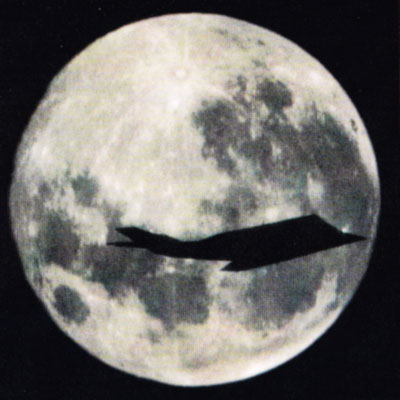
A pair of modified General Electric engines, designated F404-F1D2, power the Nighthawk. Each of these non-after burning engines is made to minimize smoke. Also, each has a wide fan to mix cool air from the nozzle with the hot air from the engine core; this cooling and the fact that the Nighthawk flies subsonic keeps the infrared signature to a minimum Having a thrust-to-weight ratio of six-to-one, the F404 originally was developed as an after burning engine for the U.S. Navy F/A-18 fighter. The F1D2 modifications saved weight savings and maintained enough power to make the F-117 a very high subsonic speed aircraft.
The F-117's sharp surface facets required careful design so as not to incur performance penalties. The facets cause vortices to form when the aircraft is in motion and these vortices tend to complement the overall airflow around the aircraft. They not only help maintain lift and. reduce drag, but also direct airflow into the engine inlets.
 The Nighthawk's F-16-like, quadruple-redundant fly-by wire controls,
combined with a state-of-the-art digital avionics suite and automated
mission planning system, keep the aircraft flying nicely. To remain
stealthy, the Nighthawk can carry nothing externally, including
fuel tanks.
The Nighthawk's F-16-like, quadruple-redundant fly-by wire controls,
combined with a state-of-the-art digital avionics suite and automated
mission planning system, keep the aircraft flying nicely. To remain
stealthy, the Nighthawk can carry nothing externally, including
fuel tanks.
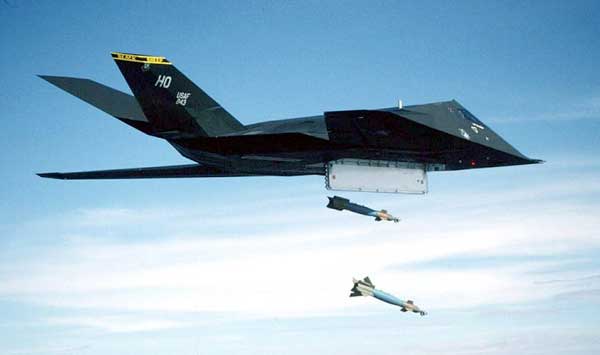
It relies upon aerial refueling for long range flights. Its ordnance load of two 2,000 pound GBU27 laser-guided bombs hang inside twin bomb bay compartments on trapeze racks resembling wishbone automobile suspension members turned vertical.
When the bombs are ready to be dropped they are electronically activated, the bomb bay doors open, and each bomb swings down on its trapeze carriage and is released (some sources cite the F-117's capability of carrying the AGM-65 Maverick or AGM-88 HARM air-to-surface missiles, as well as the AIM-9 Sidewinder air-to-air missile) .
The windscreen consists of five segments, giving the pilot
enough visibility to the front and sides to land and take off.
The windscreen material itself is very non reflective of light
and may contain some radar absorbent material. Radar absorbent
material covers wing leading edges and parts of the forward fuselage.
Also, it is believed that the air craft paint is radar absorbent.
Trailing edge parts are made of a new kind of resin which is not
only damage- resistant, but also very tolerant of high temperatures.
Design and material features have resulted in an aircraft which
has an RCS of probably that of a small bird or less.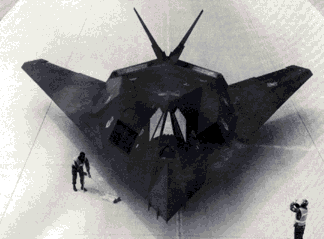
Business for the F-117 Nighthawk is attacking ground targets at night. A FLIR, or Forward-Looking InfraRed sensor, is one of the pieces of equipment which enables the aircraft to carry out its missions. FLIRs produce clear images to 1 the pilot and, since they do not radiate like radars, they cannot be detected. Their limitation, compared to radar, is a relatively narrow field-of-view likened to "searching for a target while looking through a straw."
To overcome-this limitation, the FLIR is used in conjunction; on with an inertial navigation system (INS) which "keeps track" of every acceleration, deceleration, pitch, roll, etc.7 of the aircraft and computes present position. Although the modern INS is not perfect, it is accurate to within a few hundred yards or less and operational experience has demonstrated its adequacy.
The F-117's FLIR sensor is just ahead and below the front windscreen, and sits behind a RAM-coated screen. It is both (relatively) wide and narrow field-of-view settings. -here is also a downward-looking infrared (DLIR) sensor mounted under the fuselage which has a laser designator.
The pilot locates his target using the FLIR/INS, attacks it using the laser designator and precision munitions, and leaves the scene. The laser designator and DLIR remain trained on the target to ensure a very high probability of success. The BU-27 bomb, by virtue of its on-board electronics, controls direction of its descent towards the area designated by the laser.
Inside the cockpit, the pilot gets the information he needs to navigate and carry out his mission primarily by means of a large cathode ray tube, multifunction display. There are also smaller multifunction displays on each side of the central CRT which provide the pilot with the status of aircraft systems, communications, and weapons.
The FLIR sensor is housed in a steerable turret containing a dual field of view sensor. A second unit is located under the fuselage on the starboard side of the nose wheel well. This bay houses the downward looking infrared (DLIR) sensor. Both sensor turrets contain a bore sighted laser for illuminating the target for laser-guided weapons. These sensors are backed up by a highly accurate internal navigation system (INS) that uses an electrostatic suspended gyro.
The INS guides the aircraft to the approximate target area and points the FLIR's wide field of view lens toward the target (when the FLIR is not being used it is rotated 180 degrees to keep debris from damaging the sensor). When the F-117A approaches the target (or a turn point)7 the pilot monitors the target on the FLIR/DLIR.
When the specific target is located, the pilot selects the narrow field of view, confirms identification, selects the aim point and locks on.As the target disappears underneath the F-117A, the DLIR acquires and continues to track the target. The DLIR laser illuminates the target approximately 7 to 10 seconds before impact allowing the weapon to be guided accurately (DOD released FLIR video tapes taken over Baghdad showed that the F-117A has the ability to hit a I meter target from 25,000 feet, at night).
All operational F- 117As are single seat aircraft. There was a proposal for an elevated cockpit two seater trainer, which was to use the wreckage of the first production aircraft. Since the F-117A flies so well, however. it was felt that there was no need for a trainer.
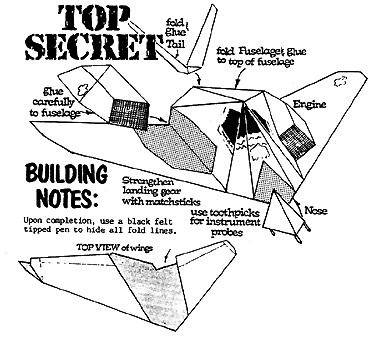
Specifications for the Lockheed F-117 Nighthawk
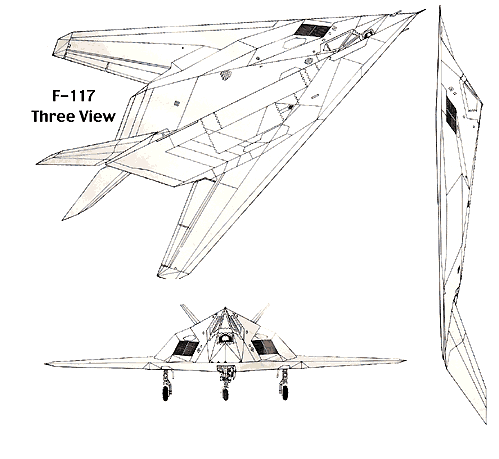 |
Length: 65 ft 11 in Wingspan: 43 ft 4 in Height: 12 ft 9.5 in Wing area: 780 ft² Empty weight: 29,500 lb Loaded weight: 52,500 lb Powerplant: 2× General Electric F404-F1D2 turbofans, 10,600 lbf each Performance Maximum speed: Mach 0.92 (617 mph) Cruise speed: Mach 0.92 (617 mph) Range: 1069 mil Service ceiling: 69,000 ft Wing loading: 65 lb/ft² Thrust/weight: 0.40 Armament 2 × internal weapons bays with one hardpoint each (total of two weapons) equipped to carry: Bombs: BLU-109 hardened penetrator GBU-10 Paveway II laser-guided bomb GBU-12 Paveway II laser-guided bomb GBU-27 Paveway III laser-guided bomb JDAM INS/GPS guided munition |
 |
|
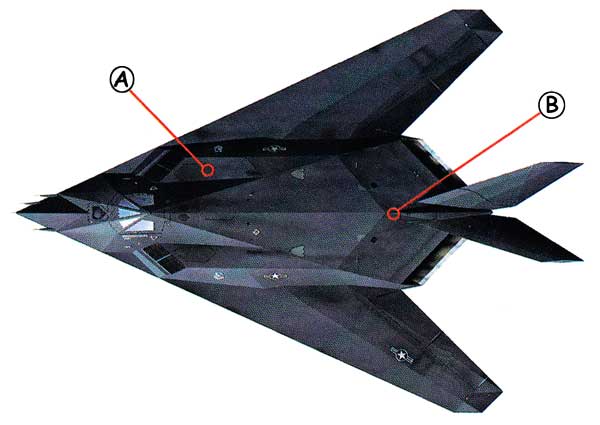
| A: The skeleton of the F-117 is made mainly from aluminum. The aircraft's skin, by contrast, is mostly composite RAM, or radar-absorbent material. | B: The F-117 can be refueled in flight through a receptacle on its dorsal spine. |
 |
||
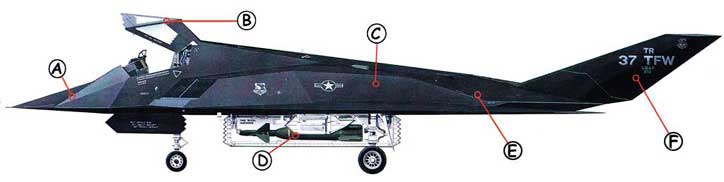
| A: Two imaging infrared turrets are recessed into the nose of the F-1 17. One looks forward to acquire targets; the other is on the underside and is used for tracking and laser designation. | B: The edges of the F-1 17's cockpit canopy, like all surfaces on the aircraft , have no right-angles-these are strong reflectors of radar. | C: The unique arrow shape of the F-117 is naturally unstable. Stability is maintained by computerized fly-by-wire controls. |
| D: Bombs are strong radar reflectors, so the F-1 17 carries its weapons internally. The bomb doors only open for a moment when the warload is released. | E: The Nighthawk's twin General Electric engines are buried deep in the fuselage. They have shallow "platypus" exhausts, which cool and deflect the exhaust gases upward to minimize heat emissions. | F: The twin butterfly tail obscures the exhaust plume from infrared sensors aboard pursuing fighters. |
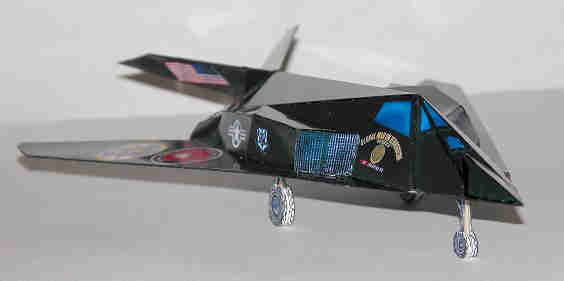 |
This repaint was designed and built by Gary Dare whose efforts as "Director of Repaints and New Model Development" are always appreciated. It will be made available for Memorial Day. |
Slide show of a Lockheed F-117 Nighthawk Crash. |