

Messerschmitt Me-109 - $$5.95
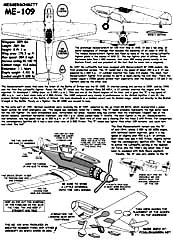
The Bf 109 was the most successful fighter of World War II, shooting down more aircraft than any of its contemporaries. Originally conceived as an interceptor, it was later developed to fulfill multiple tasks, serving as bomber escort, fighter bomber, day, night, all-weather fighter, bomber destroyer, ground-attack aircraft, and as reconnaissance aircraft. 1/12-19

German ME-109 Messerschmitt WWII Fighter
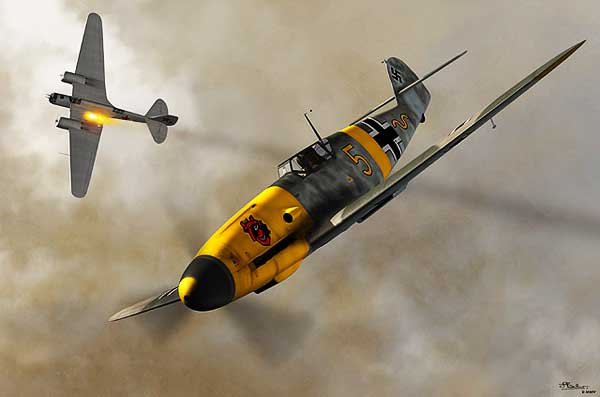
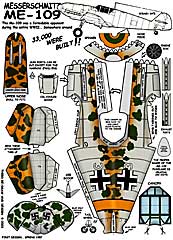
Herr Willy Messerschmitt really outdid himself with the Bf109. This incredible machine was not only a great flyer, it was a masterpiece of engineering designed to be produced quickly and cheaply by the thousands. It ruled the skies until the later versions of the Spitfire came along. Over 33,000 109s were built?! and about 75 are still around.
This webpage is for the single Messerschmitt Me-109, the Messerschmitt Me-109 Collection which has 10 different versions.
Click HERE to get to the Messerschmitt Me-109 Collection model offer.
 For
25 years the Bf 109 was in production somewhere in the world. It
served the Luftwaffe for eight years, production during the years
1936-45 accounting for nearly two-thirds of Germany's entire output
of single-seat fighters; and exported or license-built versions
equipped the air forces of nearly a dozen other nations.
For
25 years the Bf 109 was in production somewhere in the world. It
served the Luftwaffe for eight years, production during the years
1936-45 accounting for nearly two-thirds of Germany's entire output
of single-seat fighters; and exported or license-built versions
equipped the air forces of nearly a dozen other nations.
The total number built was well in excess of 33,000. Designed by the Bayerische Flugzeugwerke AG in 1933 around Germany's most powerful aero-engine of the time, the 610hp Junkers Jumo 210A, the Bf 109 VI first prototype (D-IABI) actually made its first flight, on 28 May 1935, using a 695hp Rolls-Royce Kestrel V.
It served the Luftwaffe for eight years, production during the years 1936-45 accounting for nearly two-thirds of Germany's entire output of single-seat fighters; and exported or licence-built versions equipped the air forces of nearly a dozen other nations. The total number built was well in excess of 33,000.
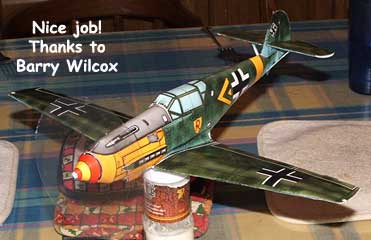
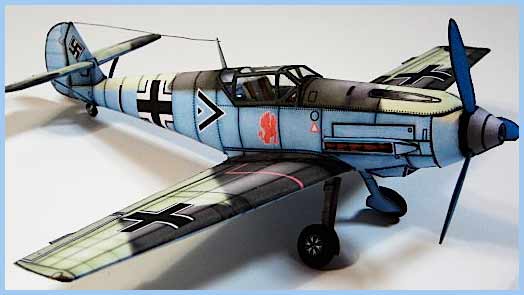
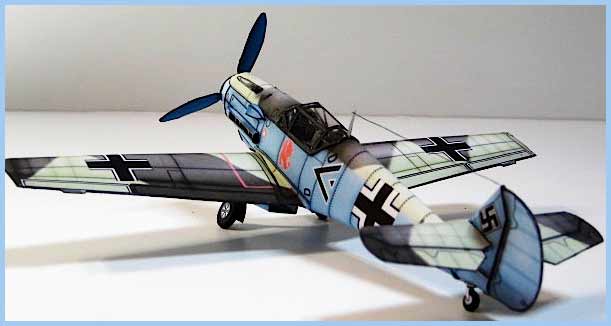
This Messerschmitt-Me109 is the model that won the FG Modeling Madness (FGMM) 2010 best in class prize. Thanks to Chris Walas who donated his $20 prize money toward modeling materials for hospitalized vets!! |
|
 |
 |
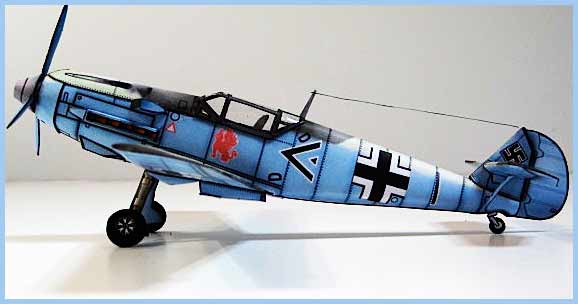 |
This is a nice kit of a great plane. I especially like the color scheme on this one, but all of the FG 109’s look just as good. I added some detail to this one; a quick interior, clear canopy, individual exhaust pipes, foam tires I made from a styrofoam meat tray (really easy!). These 109’s have a great finished look for a relatively simple model. -Chris |
ME-109 Messerschmitt WWII Fighter
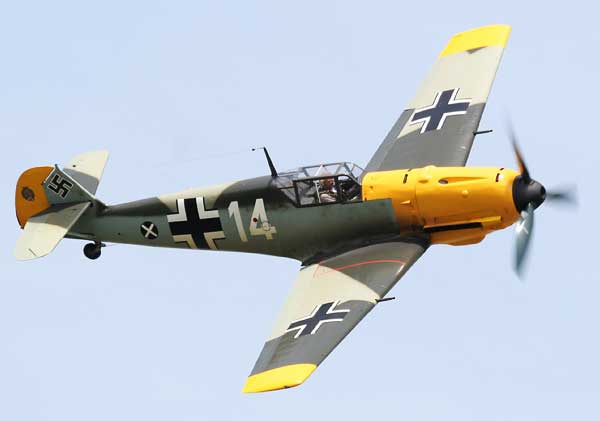
The legendary story of the Messerschmitt Bf 109 began in 933 when the German Air Ministry announced a competition for a new fighter. Very reluctantly they allowed Willy Messerschmitt to take part. They thought his entry would come last, The prototype Bf 109 flew in late May 1935, powered by a British Rolls-Royce Kestrel engine because the jumo 20 was not ready. Having seen it, the officials almost laughed. The rakish small-wing monoplane looked more like a racer, Luftwaffe procurement chief Ernst Udet proclaimed: 'That thing will never make a fighter! That was before he flew it.
 Subsequently the 109 so turned the tables on its detractors
that by the start of World War II was the standard single-seat
fighter of the Luftwaffe. It swept opposition from the sky all
over Europe, was built in larger numbers than any other single
type of fighter, and shot down approximately twice as many aircraft
as any other aircraft in history.
Subsequently the 109 so turned the tables on its detractors
that by the start of World War II was the standard single-seat
fighter of the Luftwaffe. It swept opposition from the sky all
over Europe, was built in larger numbers than any other single
type of fighter, and shot down approximately twice as many aircraft
as any other aircraft in history.
The Bf 109 cut its fighting teeth several years previously, during the Spanish Civil War, The He 51 biplanes of the German Kondor Legion were being severely mauled by the faster and much more deadly Polikarpov I- 6s supplied to the Republicans by the Soviet Union. However, when in 1937 the Kondor Legion was re-equipped with some of the first production Bf 109s, the tables were turned with a vengeance.
Only a handful of Bf 109s saw service in Spain, but they were so superior to anything then in the sky that their effect was tremendous. Meantime, back in Germany, a totally unrelated Messerschmitt racer, with a specially boosted engine, set a world speed record which stood unchallenged for 30 years. The Nazi propaganda machine called the racer the 'Messerschmitt 109R' to give the impression that it was a version of the fighter.
Following the Spanish conflict, the next serious test for the Bf 109 came when 200 of them formed the spearhead of Germany's attack on Poland on 1 September 1939. The Poles had around 160 fighters, mostly their own PZL P. 11c gull-winged monoplanes, and something like the same number of modern bombers. When the smoke cleared, Germany had lost fewer than 80 fighters, while Poland's casualties totaled some 350 aircraft, although around 120 of these (both fighters and bombers) had been interned in neutral Rumania.
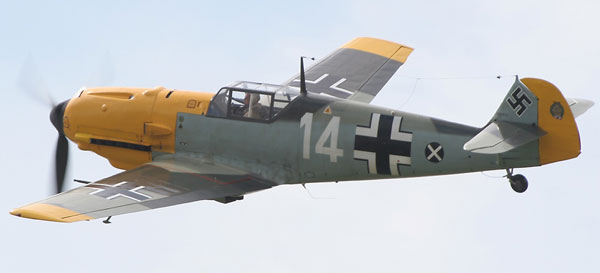
So Messerschmitt's new fighter was flying high, but a little under one year later, when the Battle of Britain began in earnest in August 1940, the hitherto victorious Bf 109 finally met with some real opposition. One of its problems was that it had an operational endurance over southern England of only 20 to 30 minutes, and the Hurricanes and Spitfires of the Royal Air Force proved to be formidable adversaries.
On the day planned for the Luftwaffe's major assault in the Battle of Britain, code-named Adlertag (Eagle Day), 30 Messerschmitt Bf 109Es, headed by Major Gunther von Maltzahn, took off from Dinan and set a course for the sky high over Dorset, One of the pilots in the second wave of fighters, Leutnant Heinz Pfannschmidt, very quickly found himself in the worst kind of trouble.
The Spitfires of 609 Squadron had scrambled from Warmwell to intercept the raiders and were already airborne and waiting. Pfannschmidt was caught in the gun sight of a Spitfire flown by Pilot Officer 0. M. Crook, and a two-second burst from eight 0.303in Browning machine guns sent the German machine spiraling crazily down to crash in the waters of Poole harbor.
This was the first recorded shooting-down on Adlertag of a Bf 109: but it proved, as the Battle of Britain progressed, to be the first of hundreds. The Luftwaffe was forced to accept the simple truth that the Bf 109 was not at all suitable as a bomber escort. Its range was far too limited. So its role was switched to that of defensive fighter and fighter-bomber. With the introduction of the improved Bf 109G, the type took on a whole new lease of life, It was in a Bf 109G- 14 that Major Erich Hartmann scored most of his unrivalled total of 352 confirmed 'kills', and Bf l09 Gs and Ks remained largely unchanged right to the end of hostilities in May 945. From the start of development, the 109 excelled in most flight maneuvers, its climb and dive capability was unrivalled and general handling at low speeds exceptional. Spinning trials showed behavior better than any existing German biplane fighter, and even the much criticized narrow landing gear was a deliberate design feature with many advantages. At high speeds the control forces increased dramatically, until at speeds near 644km/h in a dive, the rate of roll was almost zero, unless the pilot was very strong.
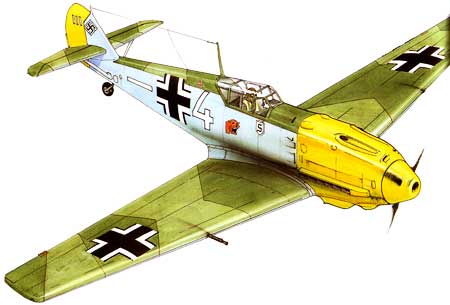
Oddly, trivial deficiencies such as the lack of a rudder trimmer - which made flight very tiring when trying to fly straight at high speed - lasted almost to the end of production in 1944. Many experts on the 109 considered the 1941 version, the Me-109F, the nicest to fly. Many stuck to it in preference to the more powerful, heavier and much more heavily armed Gustav, the 109G. which was far more numerous than all the other versions added together. A little-known fact about the Bf 109 is that in 1939 the German High Command, worried by Britain's naval superiority, ordered a sea-borne version of the fighter for operation from the aircraft carrier Graf Zeppelin. The main structural difference, apart from the fitting of an arrester hook and catapult spools, was an increase in wing span of 08cm, folding down for hangar storage to an overall width of 4.95m, This naval version was designated the Bf 109T.
Though it was on the losing side, the Messerschmitt Bf 109 was
probably the most important fighter of World War II, Not only
did it shoot down far more aircraft than any other type in history,
but it also, initially backed up by no other fighter except the
big twin-engine Bf110, took on the air forces of Spain, Poland,
Denmark, Norway, the Netherlands, Belgium, France, Yugoslavia
and Greece and eliminated them as fighting forces. It is calculated that some 30,500 were produced, and this figure
does not include those which were built in Czechoslovakia for
service with the' Czech Air Force and Israel, or those built by
Hispano in Spain. Many of these Spanish post-war productions,
known as Ha-1109s and Ha-1112s. were still on active service as
late as the mid-1950s, and one curious aspect of this longevity
is that the wheel had turned full circle. The final Iberian version,
the Ha-1112 was powered, as was the original prototype, by a British
Rolls-Royce engine, in this instance a Merlin. These in fact acted
the part of Daimler-Benz powered Bf 109Es in the film Battle of
Britain.
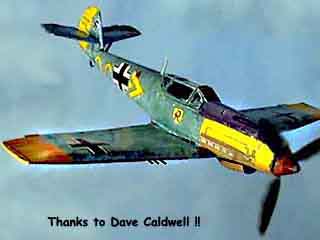
At the outbreak of World War 2 the Luftwaffe had a strength of 1,056 BE 109s. Many of these were Bf l09Ds, but this series was already being replaced in increasing numbers by the BE 109E. This had first appeared (as the V14) in mid-1938, and the E-l was produced both as a fighter (with four MG 17s) and as a fighter-bomber (carrying one 550lbs or four 110lbs bombs). Later E-1's standardized on 20mm MG FF cannon in place of the two wing-mounted MG 17s. Against all types of opposing fighter throughout Poland, Czechoslovakia, France, Belgium, Holland and southern England, with the exception of the Spitfire (which it greatly outnumbered), the Bf 109E proved itself superior in both performance and maneuverability; only its range let it down.
Production accelerated to the extent that Germany could afford to export substantial numbers of the Bf 109E-3 (which appeared at the end of 1939 and was the principal version to be used in the Battle of Britain) to Bulgaria, Hungary, Japan, Romania, Slovalda, Switzerland, the USSR and Yugoslavia. In addition, a small batch was built during 1941-43 by Dornier's Altenrhein factory in Switzerland. In July 1940 the Gerhard Fieseler-Werke began to convert 10 Bf 109E-1s to Bf 109F (for Tratger: carrier) extended-span configuration. These were to have been development aircraft for the Bf 109 l,intended for use aboard the proposed aircraft carrier Graf Zeppelin, but after the carrier program was terminated the 60 T-1's ordered were completed instead as land-based T-2s.
Various other E models, up to E-9, were produced for fighter and/or reconnaissance duties, with powerplant or equipment variations. Meanwhile, Messerschmitt had been developing what was to become the finest of all the many versions, the Bf 109F. Powered by either a 1,200hp DB 601N or a l,350 hp DB 601E engine, the Bf 109F represented a considerable advance over earlier series in terms of both performance and cleanliness of line, and at last gave the Luftwaffe a fighter that could outmaneuver the Spitfire V. The entire fuselage was cleaner aerodynamically, culminating in a more rounded rudder, an unbraced tailplane and a retractable tail wheel: the wings, of slightly increased span, were rounded off at the tips; and performance at all altitudes was better than that of earlier models.
Production series ran
from F-1 to F-6, with various sub-types. Several F-series aircraft
were used as testbed's, the items evaluated including BMW 801
(radial) and Jumo 213 engines, a V-type tail unit, rocket weapons,
and a nose wheel landing gear. A prototype never flown, but none
the less of interest, was the Bf 109s of 1943, in which two
Bf 109Fs were twinned' by connecting them by a new, common
wing center-section and tailplane, the sole pilot being intended
to occupy a cockpit in the port fuselage. By 1942 the Bf 109F
had been supplanted in production and service by the most numerous
version, the Bf 109G. Heavier and less maneuverable than the
F's, with DB 605 engines and additional equipment, the 'Gustav's'
were individually less successful.
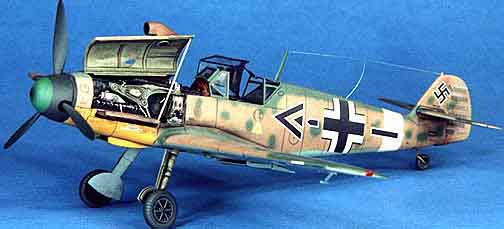
An exact total for production of all variants of the Messerschmitt Bf 109 is virtually impossible to determine, but it was approximately equal to the combined output of its great wartime opponents, the Hurricane and Spitfire, and thereby one of the most extensively produced aircraft of all time. Its final version, the Bf 109, was alone built in numbers comparable to those of the Hurricane. Moreover the bf 109, unlike its British contemporaries, remained basically a tighter or fighter-bomber all its operational life, apart from a few unprofitable excursions into other potential roles. First operational experience was gained in 1937 with Jagdgruppe 8S of the Condor Legion in Spain, and in the same year the Bf109B entered service at home with the celebrated Richthofen' Geschwader.
The Bf 105E series, which began to reach Luftwaffe fighter units at the beginning of 1939, formed the substantive service version right through the Battle of Britain. Superior in speed to the Hurricane at all altitudes, and faster in both climb and dive, the Bf 105E could, moreover, approximately match the Spitfire I in these areas, though it could be out-turned by both British fighters. But its very short tactical radius, leaving it fuel for only about 20 minutes combat once arriving over southern England, put it at a considerable disadvantage, and in the tour months July-October 1940 the number of bf 109s lost or damaged - not all due to combat - reached some 877. Best of all variants was the Bf 109F, which was the first version able to out-climb the Spitfire V. In the late summer of 1942, it was supplanted by the Bf 109G; but this version, despite its more powerful engine, was so much heavier that its performance was in fact poorer than the F. Post-war production of the Messerschmitt 109 took place in Czechoslovakia and Spain, and the type continued in service for some years after the end of hostilities in Europe.
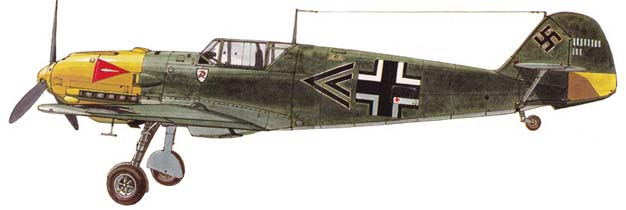
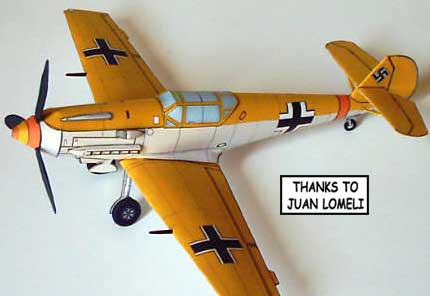
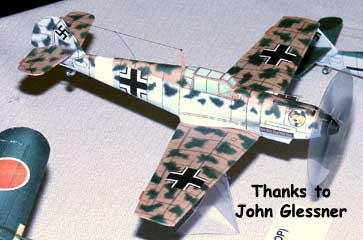 Model makes up nicely as John shows us. There are 5 versions in the Me-109 folder along with a B-W version.. |
 |
 |
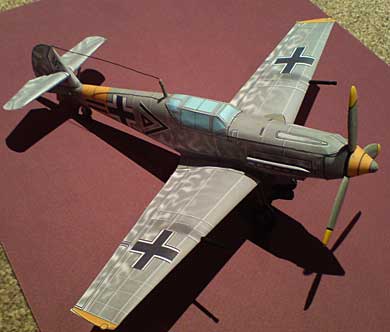 |
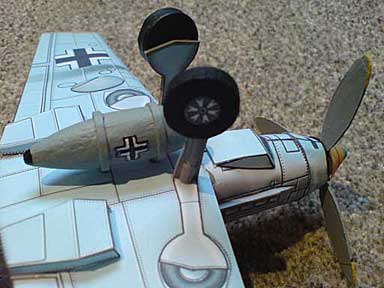
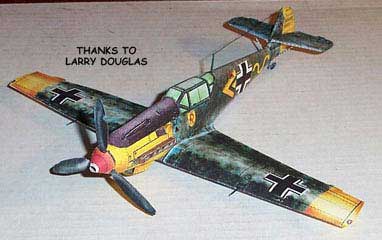
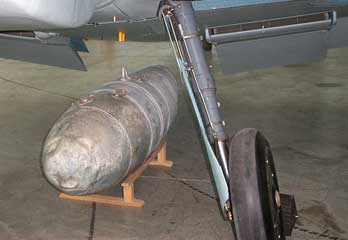
I have attached images (above) of my Me-109 with a few custom extras added including the following *Balsa wood carved Fuel Drop tank located under the wheels. P.s im currently working on my second model as that me 109 was a beginner practice but i am currently working on the F84 Thunder Streak and i am adding in several added features to this one including LED lighting throughout and a fully visible cockpit and a payload of weapons plus a fully detailed engine that fits into the plane. From Richard Whittingham :) |
|
 |
MESSERSCHMITT Bf 109: The German Luftwaffe flew numerous models of the 109 from 1936 to 1945. More 109s were built (about 35,000), than any other single-engine fighter in history.
The first 109 made its first flight in September 1935 and by the beginning of WWII 1056 were being flown by the Luftwaffe. They were small, fast, had great performance and were relatively cheap to build.
|
The aircraft fought on all fronts and became the mount of some of Germany's leading aces, including Erich Hartman, top scorer with 352 victories flying Bf 109s.
Probably the most popular model of the entire series is the G-series or the Gustav as it was widely but unofficially known. (Over 70 percent of all 109s were Gustav's). The overall appearance of the shark like 109 brings to mind the adjective "sinister". It looks lethal from any angle as indeed it was.
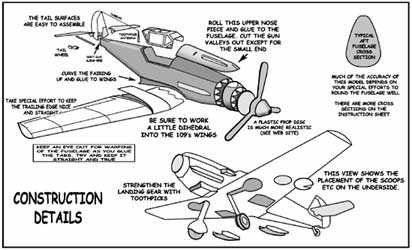
Construction Tips! The horizontal tail is glued to the aft fuselage in TWO pieces via little tabs that get bent down before gluing. There are several scoops and bulges that Messerschmitt's were known for. If these are a bit boring, tough! Deal with it and make your model PROUD. Note: That at this time (4/98) there seems to be a restriction about displaying the swastika on models in Germany, so to all our German Pals, will you please scratch off the tail graphics from your model ?! |
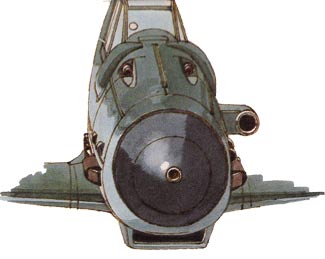 There was, in fact, nothing mysterious about the Bf-109.
It was simply a well conceived, soundly-designed fighter
that stayed in the forefront of fighters for three quarters
of a decade.
There was, in fact, nothing mysterious about the Bf-109.
It was simply a well conceived, soundly-designed fighter
that stayed in the forefront of fighters for three quarters
of a decade.
|
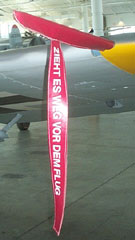
This was an interesting touch McMinnville, Oregon |
 |
 |
 |
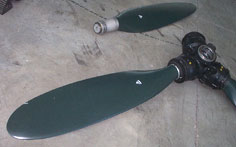 |
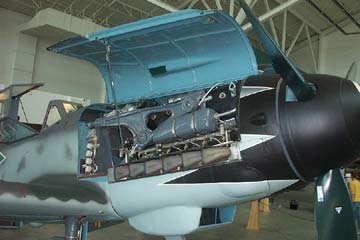
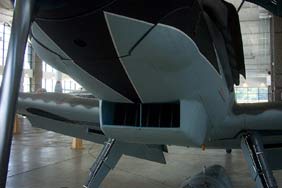
The Evergreen Air Museum, located at McMinnville, Oregon, has quite a few pretty neat airplanes.. Most special is the actual "Spruce Goose"..the one that Howard Hughes accidentally flew.. |
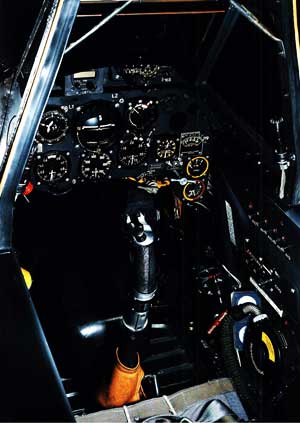 |
Messerschmitt Bf-109 Cockpit. |
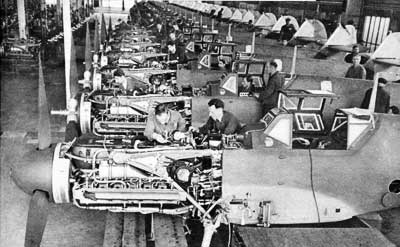 |
Messerschmitt Bf-109 Factory. |
Specifications of the
Messerschmitt Bf-109
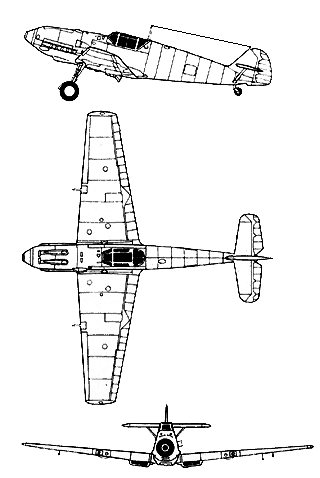 |
Wingspan: 32ft 6in Performance |
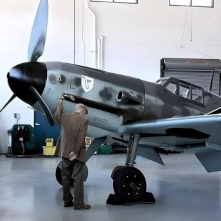 |
Luftwaffe ace Hans Meyer is reunited with a Bf 109G
Source: @RealAirPower1 on X/Twitter |
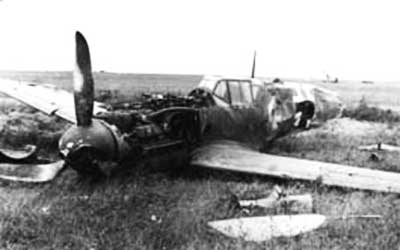 |
A shot down Bf 109 from I./JG 54. |