

Messerschmitt-P1109 - $$5.50
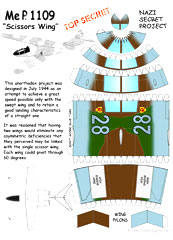
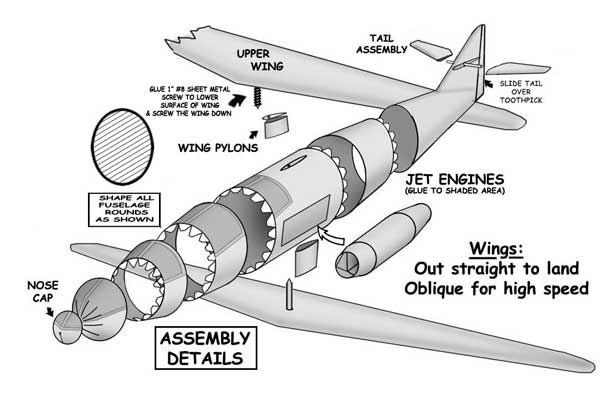
This unorthodox project was designed in July 1944 as an attempt to achieve a great speed possible only with the swept wing and to retain a good landing characteristics of a straight one. 25 years later the US developed and test flew the AD-1 Scissorswing to prove the concept..

Me P 1109 ScissorsWing (Oblique Wing) Nazi Xplane

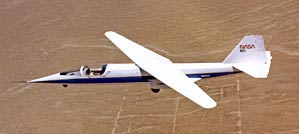
Twenty-five years before the Ames-Dryden AD-1 ScissorsWing experiment, (see left) and most probably a major inspiration for the same, this Messerschmitt Me-P-1109 was being developed in February 1944 as yet another 'last ditch' WWII effort to thwart the Allies.
The Messerschmitt Me-P-1109 research aircraft tested a wing that could pivot fore and aft to form oblique angles up to 60 degrees. Tests revealed that the scissor wing decreased aerodynamic drag, permitting higher speeds and longer range. The concept was not new. Dr. Vogt designed the BV P 202, with a similar scissor wing that could pivot up to 35 degrees.
Messerschmitt P-1109
Perhaps one of the most unorthodox of all the German project designs was the highly unusual Blohm & Voss BV P 202 twin-jet single-seat fighter. This project was characterized by a high wing, designed to swivel in flight on its vertical axis, giving the effect of a variable sweep back on one side, and a variable swept forward on the other, without altering the center of lift. In effect, one wing was swept-forward and the other sweptback.
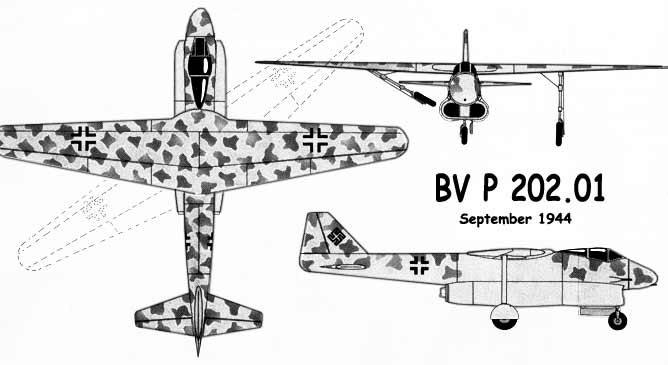
In theory, when the wing was swung from its central position, the normal velocity of the air flow over the leading edge was progressively reduced in relation to the forward speed of the aircraft. Since it is the speed of normal flow which determines the onset of compressibility effects at high speeds, it would theoretically have been possible with this wing design to obtain higher speeds with a given thrust.
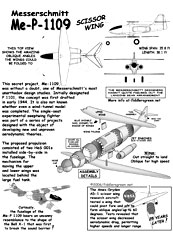
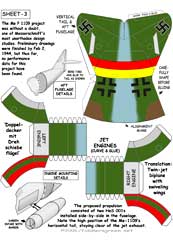
It was difficult to predict the possible effects of this peculiar arrangement upon the flight characteristics, and the concept remained unproven until 25 years after the war. Maximum swivel of the wing was thirty-five degrees. For takeoff and landing, the wing was set in its normal position, since it was only in this position that the flaps and main undercarriage could be operated. In this way, one of the major drawbacks of the swept wing, namely control problems at low speeds, was overcome. Two BMW 003 A-I turbojets were enclosed in a bulge in the lower fuselage, with a common intake in the nose. The empennage (arrangement of stabilizing surfaces at the tail of an aircraft) was conventional. A fixed armament of one 30mm MK 103 and two 20mm MG 151120s was thought possible.An extremely innovative design with movable wings was evolved by Messerschmitt as a 2-TL-Doppeldecker mit Drehschiebeflügel (twin-jet biplane with swiveling wings).
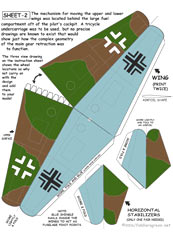
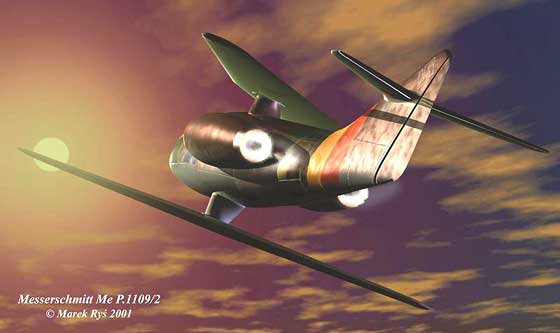
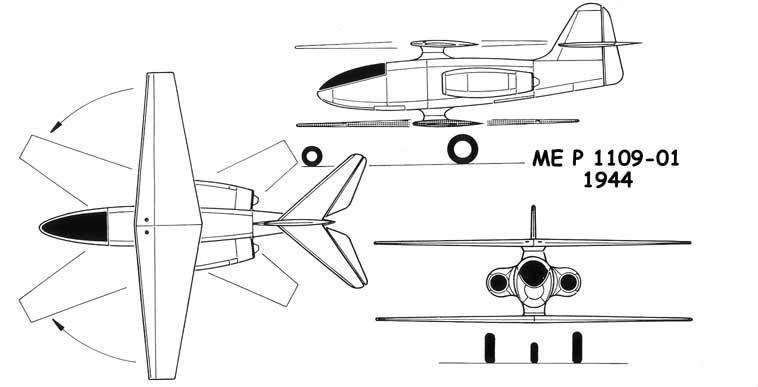
The Me P 1109, was without a doubt, one of Messerschmiff's most inventive design studies. Initially designated P 1101, the concept was first drafted in early 1944. It is also not known whether even a wind-tunnel model was completed. The single-seat experimental swept wing fighter was part of a series of projects designed with the object of developing new and unproven aerodynamic theories. The proposed propulsion consisted of two HeS 001s installed side-by-side in the fuselage. The mechanism for moving the upper and lower wings was located behind the large fuel tank.
This more advanced model (above) the Me P 1109-02, was a slightly
larger aircraft powered by two HeS 011 A turbojets.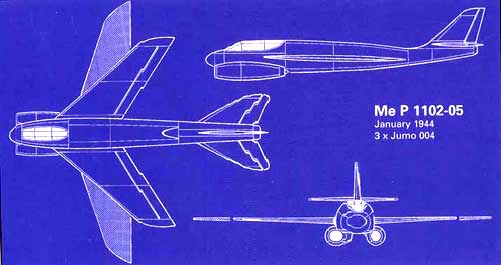 Messerschmitt engineers believed, as did Dr. Vogt of Blohm &
Voss, that a scissor wing layout would facilitate higher speeds.
It was reasoned that having two wings would eliminate any asymmetric
deficiencies that they perceived may be linked with the single
scissor wing. Each wing could pivot through 60 degrees.
Messerschmitt engineers believed, as did Dr. Vogt of Blohm &
Voss, that a scissor wing layout would facilitate higher speeds.
It was reasoned that having two wings would eliminate any asymmetric
deficiencies that they perceived may be linked with the single
scissor wing. Each wing could pivot through 60 degrees.
Another less radical (at least by modern standards) fighter aircraft design submitted to the RLM during 1944 was the Messerschmitt Me P 1102. It featured a single-seat aircraft with a variable wing sweep back mechanism. This basic aircraft design, powered by three turbojet units, (one of them in the rear fuselage), was to have been adapted to other combat roles, including that of the fighter-bomber.
 |
A tricycle undercarriage was planned,
but it is unclear how the main wheels would be stowed. |