

F-86 Sabre - $$4.95
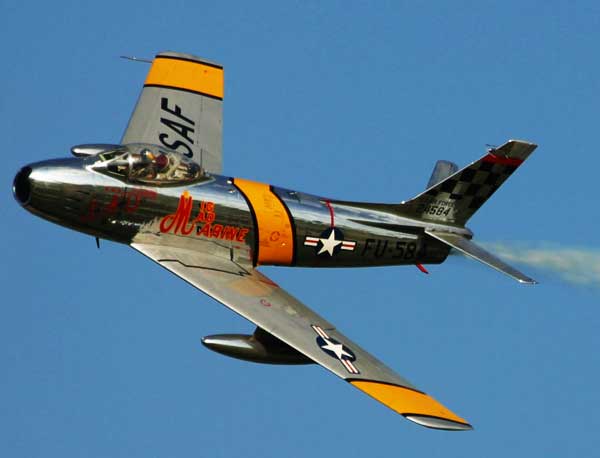
The North American Aviation F-86 Sabre (sometimes called the Sabrejet) was a transonic jet fighter aircraft. The Sabre is best known for its Korean War role where it was pitted against the Soviet MiG-15 and obtained UN air superiority

North American F-86 Sabre Jet
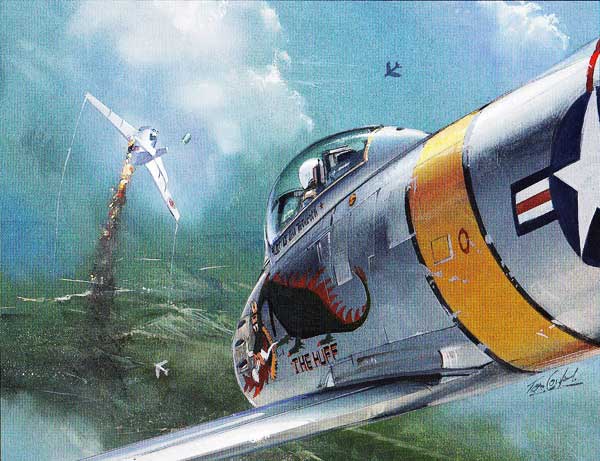
Touted as the best fighter of it's age along with it's rival the MiG-15. Much more advanced engineering-wise, Sabre Jet pilots boasted the aircraft seemed to know what they were gong to do in advance.
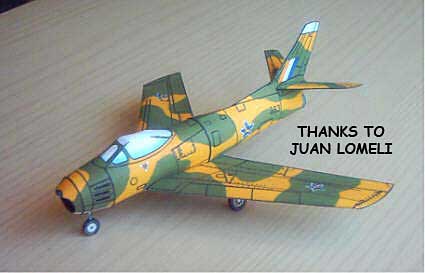
Together, the F-86 Sabre and the MiG-15, brought swept wings and the sonic boom to modern warfare. Developed at the same time, both aircraft were just supersonic in a dive. In 1950 the Sabre was rushed to Korea to confront the MiG in a new kind of combat with closing speeds and performance never before experienced. High over the Yalu River, Sabres and MiGs tested each other in the biggest jet-vs-jet battles in history.
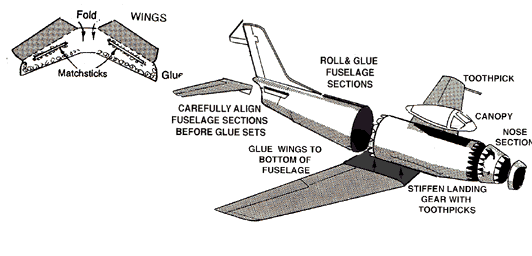
This model likes to be printed by laser jet on 'silvered' paper but does fine on any white cardstock. We print it on plain paper. Be sure to check out the MIG-15 model as well.
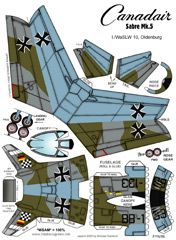
The BB-133 is one of 75 former RCAF Sabre Mk 5 that the GAF used for training. The Mk5 kept their canadian paint scheme of Dark Green/Dark Sea Gray over PRU Blue. The checker board on the fin was added by canadian maintenance personnel.
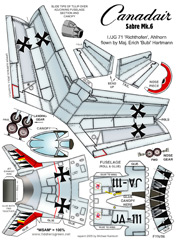
The JA-111 was the preferred machine of
the wing commander Major Erich "Bubi" Hartmann,
a WW-II ace and, with 352 confirmed victories, the highest
scoring fighter pilot ever. Hartmann has already flown Bf-109s
with a black tulip painted on the nose and it was his idea
to add this feature also to
the Sabre's. Like with all machines of the first squadron
of JG 71 fighter wing, the nose is red.
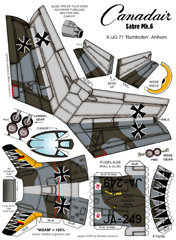
The JA-249, like all machines of the second
squadron of JG 71 fighter wing, has a yellow nose. In contrast
to the JA-111, this machine is already painted in the standard
camo scheme of RAL 6014 Yellow Olive/RAL 7012 Basalt Gray
over RAL 7001 Silver Gray. Photos suggest that the machines
of I./JG 71 remained much longer unpainted than the machines
of II./JG 71. Therefore one is perfectly well entitled to
put the JA-111 and JA-249 side by side!
The JC-367 is from the final years, when
the Sabre's already were replaced as day fighter by the F-104G
but still served as fighter-bombers (a role they were not
too well suited for) until eventually the FIAT G 91 was
introduced. At that time they were fitted with launch rails
near the fuselage to operate the Sidewinder air-to-air missile.
Alternatively, they could be loaded with 16 12" HVAR
rockets or 8 launch pods for 2.75" FFAR rockets, but
that meant that no drop tanks could be carried and as a
consequence the effective range of the plane shrank to about
50 miles. The Sabre's of the JaBoG 42 fighter
bomber wing carried distinctive red and white drop tanks....Michael
Kaintoch
I have put several of your planes together and I really enjoy it. I have been modeling for years. I have done wood, plastic R/C planes boats and heli's and doing the paper models is the best. It is relaxing and the planes look really good. I have just the F-86 and whoever designed it did a great job! The Best plane I have done so far. Keep up the good work! Armand V. Ciuffo (3/25/02)
 |
 |
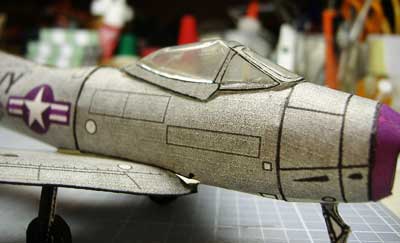
North American F-86 Sabre Clear Cabin Model Submitted by Bob Martin. Thanks Bob! |
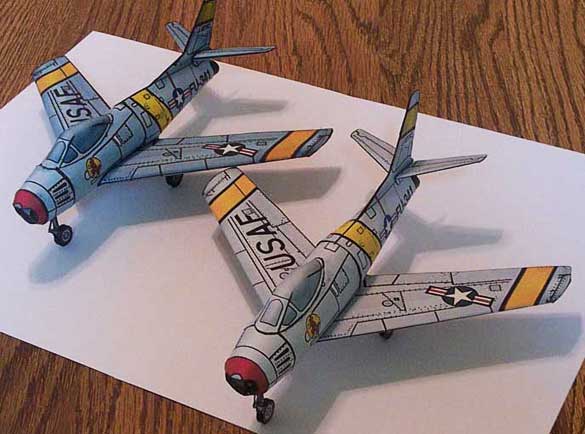
Twin F-86 Sabre Jet models thanks to Jim Zotz |
North American F-86 Sabre
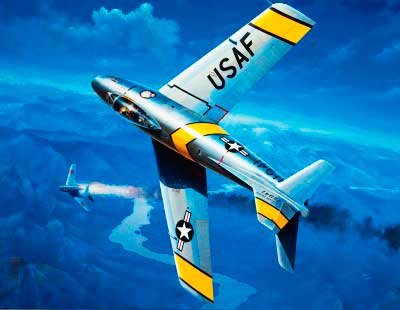 North American Aviation,
riding high on the late model P-51s at the end of World War II, was
well-placed to grab a major share of the market for first-generation
jet fighters. Instead, like Boeing with the B-47 bomber, it had
the courage to delay its program a year while it cranked in all
the new aerodynamic knowledge gained from defeated Germany. In particular,
it replanned the XP-86 fighter with wings and tail swept back like
an arrowhead at 35 degrees.
North American Aviation,
riding high on the late model P-51s at the end of World War II, was
well-placed to grab a major share of the market for first-generation
jet fighters. Instead, like Boeing with the B-47 bomber, it had
the courage to delay its program a year while it cranked in all
the new aerodynamic knowledge gained from defeated Germany. In particular,
it replanned the XP-86 fighter with wings and tail swept back like
an arrowhead at 35 degrees.
The result was the best fighter of its age - apart from an unexpected rival, the Soviet MiG- 15. The two met over Korea in large numbers and, had the F-86 (as the XP-86 became) been built in its original form the Allies would have had nothing in the class of the MiG- 15 at all. As it was, the F-86 Sabre became not only the fastest and most glamorous fighter of the post-war era, but it ushered in a new era with speed brakes, powered controls, all flying tailplane's, pressurized cockpits (yet with enormous goldfish-bowl canopies) and 'bonedome' helmets and partial pressure survival suits that completely changed the image of the combat pilot. So outstanding an aircraft was bound to have a long career, with many versions, and at all times the Sabre was loved and respected as a fighter that almost never malfunctioned (despite amazing new complexity) and seemed to obey its pilots commands before they were issued!
Historically, the F-86 Sabre and the MiG-15 are fixed in parentheses, and it is difficult to write of one without referring to the other. Quite contrasting in appearance, there were also many important internal differences, one of them being in the armament. Whereas the MiG design allowed for the mounting of an integrated package of heavy cannon, the Sabre was designed to perpetuate the P-51 armament of six 0.5in guns, three on either side of the nose. Early Sabre's were equipped to carry two 1000lb bombs but these could only be accommodated at the expense of drop tanks, so reducing the operative radius to 50 miles. With drop tanks replacing the bombs the radius of action was stretched to 250 miles.
Unlike the MiG-15, the F-86 was an instant success and was especially popular with the men who flew it. lt had a good rate of climb and could dive so fast that the only early limitation was the pilot's capacity to absorb 'g'. lt was by far the most important air-combat weapon of the Allies throughout the Korean war, and for five years (1949-54) it remained the only fighter in the world even remotely competent to take on the MiG- 15, although the fact that it did so with such devastating effect was due very largely to the greater skill of its pilots.
The Sabre was subject to a program of constant design improvements, some of them resulting directly from Korean experience. The F-86E was fitted with an 'all-flying tail', the tailplane becoming the primary control surface in the pitching plane. The F-86F replaced the leading-edge slats by a 'hard' leading edge extended forwards by 6in at the root and 3in at the tip.
These important developments increased operating Mach limit to 0.92, improved control and maneuverability especially at high altitudes, and delayed the onset of air-compressibility effects at near the speed of sound. But curiously not all modifications were introduced by the designers. During the Korean war there existed a body of Sabre pilots known as the 'chuck-it-out brigade', most notable of its members being Major Vermont Garrison of the famous 4th Fighter Wing. Garrison and his cohorts exercised no scruple in stripping their Sabre's of any component they considered to be superfluous, in their eagerness to reduce weight and outperform the MiG- 1 5. Garrison himself even advocated removal of the APG-30 radar gun sight, stating that he would just as soon aim his guns using 'a gun sight' - a lump of chewing gum stuck on the windscreen.
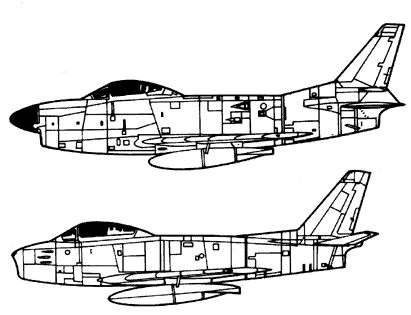 One of the Sabre pilots' greatest irritations was the apparent
reluctance of their North Korean opposite numbers to engage in dogfights.
All along the Yalu river, MiG- 15s could and did take evasive action
by zooming across the border into airspace over 'neutral' Manchuria.
ln November 1951 however, two Sabre pilots of USAF No 336 Squadron,
Captain Ken Chandler and Lieutenant Dayton Ragland, spotted 12 MiG-
15s parked on the ground at Uiju, definitely inside North Korean
territory. Chandler and Ragland swooped in and strafed, destroying
four MiG's and damaging several others.
One of the Sabre pilots' greatest irritations was the apparent
reluctance of their North Korean opposite numbers to engage in dogfights.
All along the Yalu river, MiG- 15s could and did take evasive action
by zooming across the border into airspace over 'neutral' Manchuria.
ln November 1951 however, two Sabre pilots of USAF No 336 Squadron,
Captain Ken Chandler and Lieutenant Dayton Ragland, spotted 12 MiG-
15s parked on the ground at Uiju, definitely inside North Korean
territory. Chandler and Ragland swooped in and strafed, destroying
four MiG's and damaging several others.
Only two days later, 31 Sabre's of No 4 Fighter Wing on a sweep along the Yalu encountered 12 Tupolev Tu-2 piston-engine bombers escorted by 16 Lavochkin piston fighters and a further high cover with 16 MiG- 1 5s Minutes later, the Sabre's had destroyed eight of the Tupolev's, three of the Lavochkin's and one of the MiG's.
Due without doubt to the very heavy Sabre-inflicted losses, the beginning of 1952 saw a change in Chinese tactics. They began to send up several flights at medium altitude, with others flying top-cover several thousand feet above. The Sabre squadrons caught on quickly, using their high-flying F-86Es to engage the upper echelons, while other F-86s hit those at lower levels. This way, Sabre's destroyed eight MiG's in January; the Chinese switched tactics again, changing from large formations to flights of just two or four, and flying at 40,000ft.
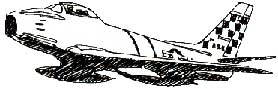 Thus they were able to penetrate further south before
dropping down to 20,000ft in attempts to stop attacks on their ground
forces by American fighter-bombers, mainly F-84 Thunderjets. This
greatly reduced air contact by Sabre's.
Thus they were able to penetrate further south before
dropping down to 20,000ft in attempts to stop attacks on their ground
forces by American fighter-bombers, mainly F-84 Thunderjets. This
greatly reduced air contact by Sabre's.
The most numerous version of all (2504 built) was an extremely complex radar-equipped all-weather interceptor, the F-86D. Distinguished by its chin inlet under the radome, the 'Dogship' version had no guns but a retractable box of rockets, aimed and fired automatically under computer control.
Other versions of the Sabre went on long after Korea to form the fighter backbones of a score of air forces all over the world.
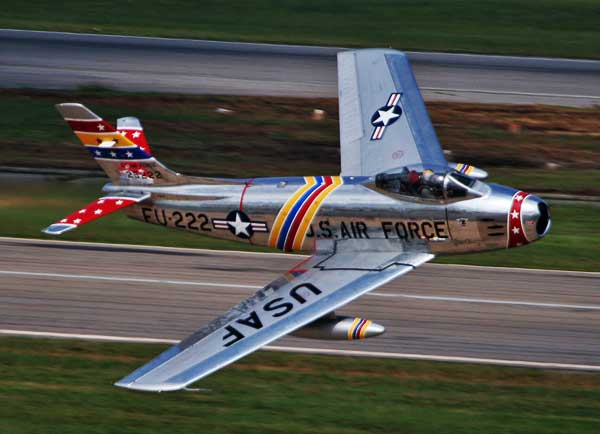
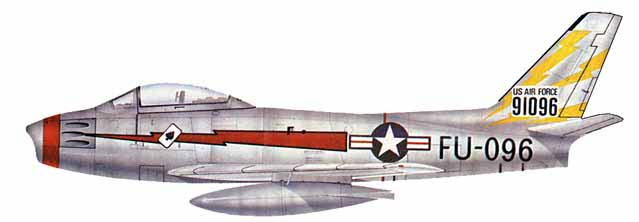
The XP-86 prototype flew on 1 October 1947, powered by a 4,000 lb General Electric J47. The first production F-86A flew in May 1948, powered by a 5,200lb engine; 554 F-86As were built, entering service in early 1949. It was followed in late 1950 by the F-86E, with an all-flying-tail. The F-86B and C were experimental. The F-86F, the last day fighter variant, was developed from the E, having a more powerful J47 and structural redesign. Originally a day fighter, with six OSO in machine-guns, the F-86 proved itself in Korea, where it had an devastating 11:1 kill ratio over the MiG-15, but was also extensively employed as a fighter-bomber. The F-86, principally the F, served over 20 NATO and friendly air forces.
The open nose early variants were licence-built by Canadair (Orenda engines), by CAC in Australia (RollsRoyce Avons), and by Mitsubishi in Japan. All-weather interceptor version. Development of the F-MD. began early in 1949, and a YF-86D prototype (one of two built) flew on 22 December 1949. The F-86D was unusual in being single-seat, when contemporary practice dictated a second crew member for radar and electronics. Problems with this equipment kept the F-86D from full effectiveness until mid-1953, although it had entered USAF service in 1951. The F-86D had virtually a new fuselage, embodying a chin' intake under a nose radome, and a retractable ventral pack of 24 275in rockets replacing a gun armament.
From 1958 the US dispersed many of its F-86Ds to other countries, recipients including Nationalist China, Denmark, Greece, Japan, South Korea, the Philippines, Turkey, and Yugoslavia. A total of 2,504 F-B6Ds were built the largest production of any Sabre; 981 were converted to extended-span F-86Ls, with more advanced avionics, to serve as a part of America's SAGE (Semi-Automatic Ground Environment) defense system. Some F-86Ls were delivered to Thailand. An export version of the D, evolved for NATO, was the F-86K, which had four 20mm M24A-l cannon and two Sidewinders to replace the rockets. F-86K production totalled 341, between 1954 and 1958.
North American built 120, the remainder being assembled by Fiat in Italy, the final 45 being completed with the extended-span wings, with modified leading-edges, of the L, American-built F-86Ks were supplied to Norway and Denmark. Italian-built examples were delivered to the Italian Air Force, France, Germany, Netherlands, and Norway. The 74 surviving Luftwaffe F-86Ks were sold to Venezuela in 1966; the Dutch aircraft were transferred to Turkey.
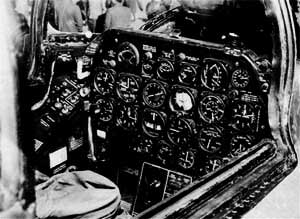 |
North American F-86 Sabre Cockpit. |
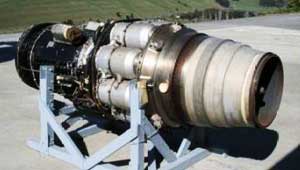 |
General Electric's J47-GE-## the North American F-86 Sabre Jet Engine. |
Specifications (F-86F-40-NA)
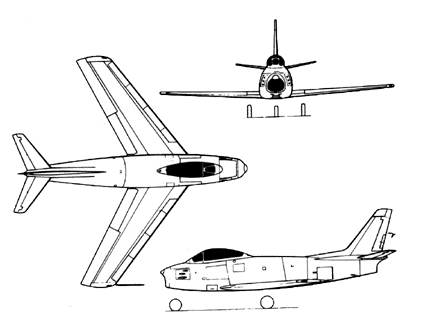 |
Length: 37 ft 1 in |
 |
|||
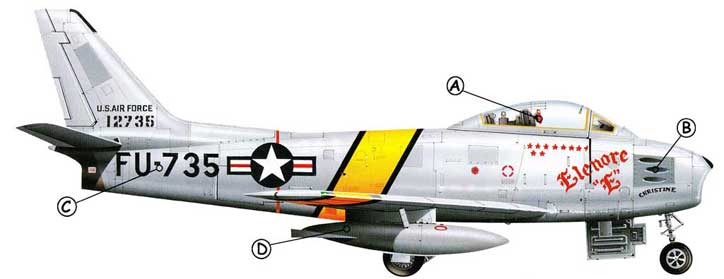
| A: North American developed and built the ejection seat used in the F-86. Such escape systems were vital at the high speeds reached by the new jets. | B: Guided missile development was some way behind the technology of the jet aircraft and both the F-BG and MiG-15s were gun-armed in Korea. | C: Both F-86A and E models were powered by the General Electric J47-GE-13, which improved time taken to reach 30,000 ft, by almost one minute and added an extra 800 ft to its maximum altitude. | D: Sabres always flew with drop- tanks. The extra fuel allowed a transit to North Korea and increased loiter time in the combat zone. The tanks were jettisoned as soon as MiGs were sighted. |
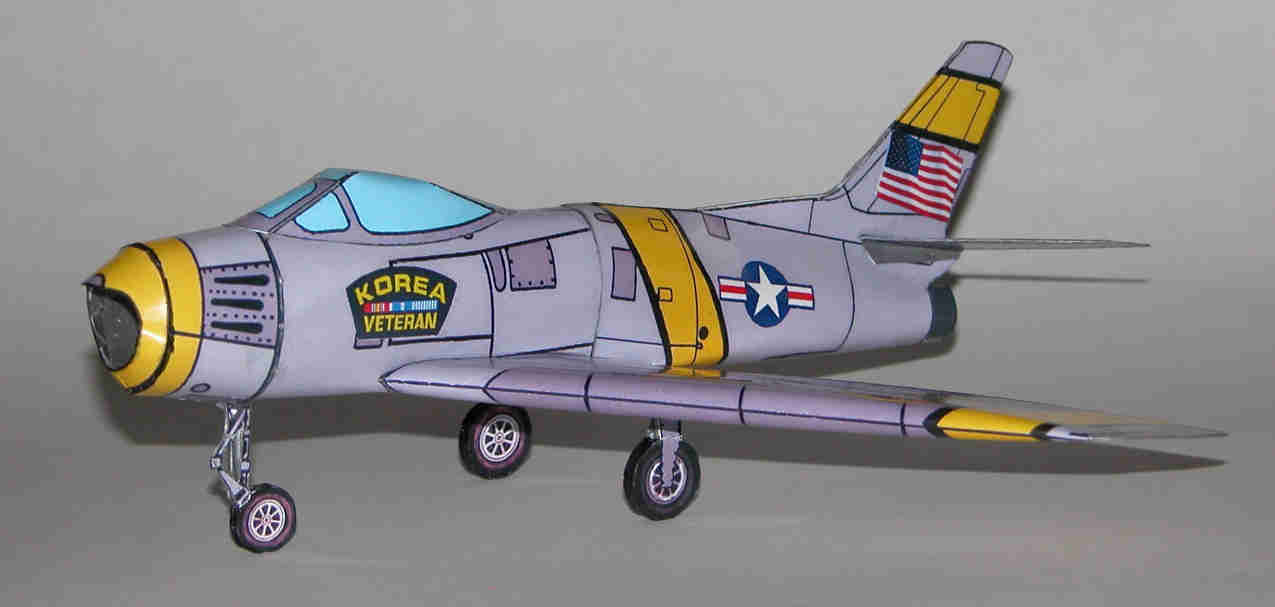 |
This repaint was designed and built by Gary Dare whose efforts as "Director of Repaints and New Model Development" are always appreciated. It will be made available for Memorial Day. |
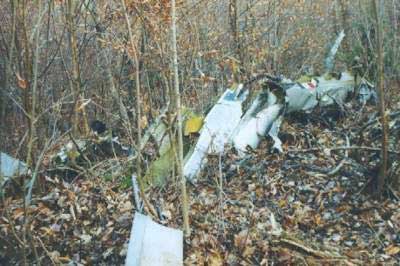 |
North American F-86 Sabre
F-86A s/n 49-1148
10 MAR 52
5 miles southwest of Patten ME. |