
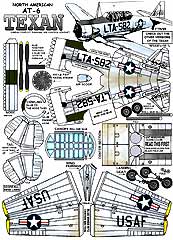
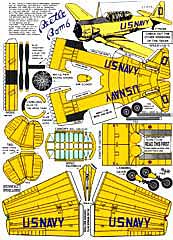
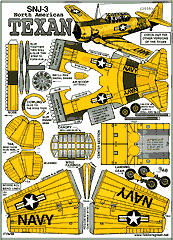
SNJ Texan - $$5.95
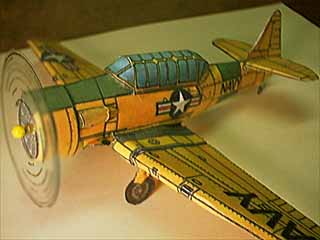
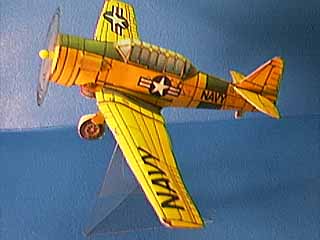
Arguably, the best and most loved trainer ever. Produced by the thousands, many still fly today- often at airshows dressed up as scarce but noisy Zeros. The T-6 Texan was a single-engine advanced trainer aircraft designed by North American Aviation, used to train fighter pilots from all over the world..

AT-6 Harvard Texan SNJ-4 Trainer

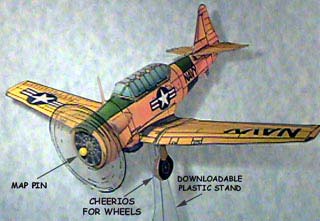
More American combat pilots trained in this single-engine tandem seater than in any other WW II trainer. Designed in the late 1930s, it was still being used in the Korean War on spotter missions. Known to the U.S. Air Force as a Texan, the Navy as an SNJ, and the British and Canadians as a Harvard, this low-cost trainer had high speed fighter characteristics. Almost 600 of the nearly 17,000 AT-6s built for the military are still flying today.
This widely used trainer has many names and you see them often still flying-especially at air shows. The growl of the 600hp P&W radial is wonderful to hear. This is one model you'll really love and quite colorful to hang from the ceiling.
Harvard (named after the American university) was produced as an export version of the AT-6 Texan advanced trainer. It became the standard advanced trainer for the BCATP in Canada and the RAF in England. It was utilized to train thousands of Commonwealth pilots in preparation for combat flying in fighters and fighter-bombers.
The Harvard was well suited to its training role, as it had enough bad habits to teach inexperienced pilots to respect their future high-performance fighters. The RCAF kept the Harvard on strength as a trainer until 1966. The distinctive snarl of the Harvard has long been a familiar sound in the Canadian skies and is produced by its propeller tips approaching sonic speeds when in fine pitch a high rpm.
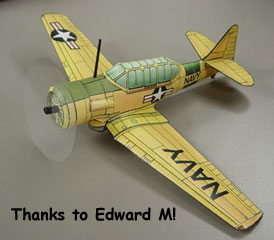
As you may know, the people over at www.papermodelers.com are having a Fiddleresgreen contest! I am entering your Texan, but I did a repaint in Israeli colors. The original is in the IAF museum in Israel....please include it in your "versions" folder for the Texan....Thank you for providing such excellent models!
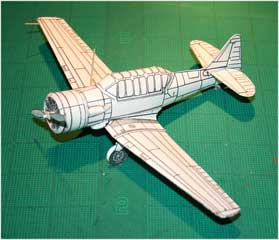
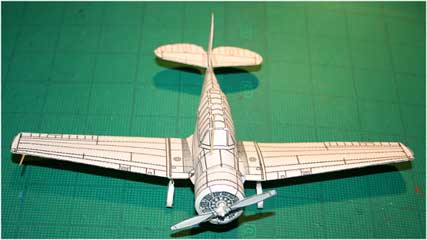
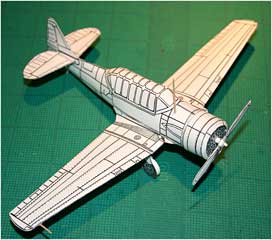
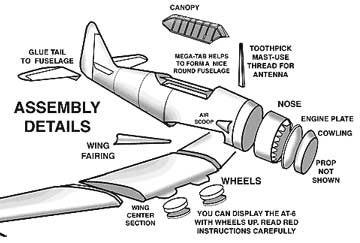
hi Chip! Just thought I would let you know how I feel about the Texan model....it really needs to be redesigned! The wings just do not fit properly into the wing "slot"! I tried getting some help on the Forum, even saw the photos, but I still could not figure out how it was meant to go together. Too bad as it would be a really fine model otherwise. Doug (4/07)
Doug
Really...Thanks for your email. Although no one has ever
complained about that model, it IS pretty old and should
be re-drawn as you say..We'll move it higher up the list.
YMP chip (see below)
 |
 |
 |
|
 I
love your drawings and was hooked after downloading
and building the free Texan SNJ (large) plans. I
love your drawings and was hooked after downloading
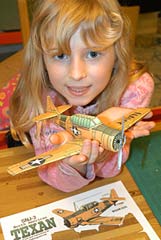
and building the free Texan SNJ (large) plans.What a great model. After about 2 and a half hours, and with a plug of Plasticine as a propeller spinner, it actually flies! Here's my daughter Tara, 8, modeling the SNJ. Wade |
I just read on the FG website that "Doug 4/07"
was having trouble with under-
Thanks, Bob Penikas |
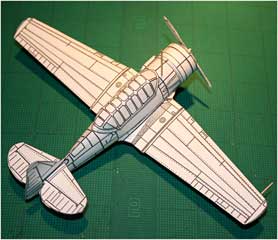
North American NJ, SNJ Texan-Harvard
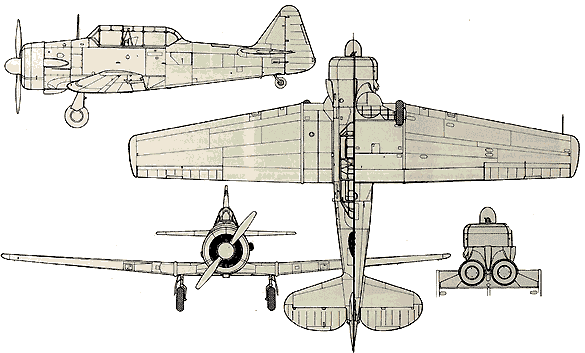
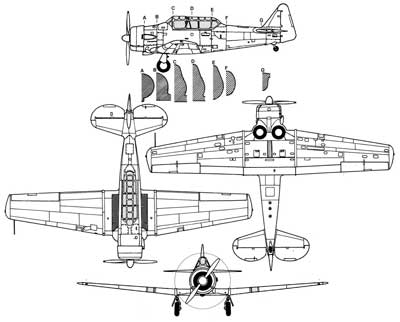
Three view of the SNJ Texan - Harvard
North American's NA-16 basic trainer, built as a private venture in 1935, proved to be the progenitor of a long series of similar aircraft which remained in production for a decade and achieved wide fame and popularity as the AT-6 Texan and Harvard. By the time production of the series ended, North America had produced well over 16,000 examples of the same basic design and many hundreds more had been built in Canada, Australia, Sweden and elsewhere.
 The US Navy first ordered a version of the North American trainer
late in 1936, with a contract for 40 NJ-Is (designated NA-28 by
the manufacturer). These were similar in most respects to the
USAAC BT-9s with fixed landing gear but had the 500 hp Pratt &
Whitney R-1340 Wasp engine in place of the BT-9's 400 hp R-975.
The final aircraft on the order was temporarily fitted with a
Ranger XV-770-4 inverted V-12 engine as NJ-2 but was reconverted
to NJ-I standard. As well as serving as trainers at Pensacola,
the NJ-Is were used as command and staff transports.
The US Navy first ordered a version of the North American trainer
late in 1936, with a contract for 40 NJ-Is (designated NA-28 by
the manufacturer). These were similar in most respects to the
USAAC BT-9s with fixed landing gear but had the 500 hp Pratt &
Whitney R-1340 Wasp engine in place of the BT-9's 400 hp R-975.
The final aircraft on the order was temporarily fitted with a
Ranger XV-770-4 inverted V-12 engine as NJ-2 but was reconverted
to NJ-I standard. As well as serving as trainers at Pensacola,
the NJ-Is were used as command and staff transports.
Use of the R-1340 engine in the NA-16 airframe had been planned by North American, prior to the appearance of the NJ-i, in the NA-26 prototype built as a demonstrator to meet a USAAC requirement for a basic combat trainer. As well as the new engine, the NA-26 featured retractable landing gear and provision for armament.
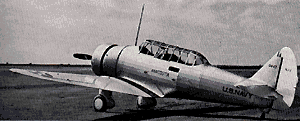 It was produced for the Army as the BC-I, and the Navy ordered
16 of an improved model in 1938. Designated SNJ-1 (NA-52), they
had metal-covered rear fuselages and were assigned to the 13 Naval
Reserve Air Bases but retained by the Navy. The Reserve bases
received, instead, new SNJ-2s from a batch of 36 ordered in 1939;
25 more were ordered in 1940, the two batches being NA-65 and
NA-79 respectively. Minor differences and an R-1340-56 engine
distinguished the SNJ-2.
It was produced for the Army as the BC-I, and the Navy ordered
16 of an improved model in 1938. Designated SNJ-1 (NA-52), they
had metal-covered rear fuselages and were assigned to the 13 Naval
Reserve Air Bases but retained by the Navy. The Reserve bases
received, instead, new SNJ-2s from a batch of 36 ordered in 1939;
25 more were ordered in 1940, the two batches being NA-65 and
NA-79 respectively. Minor differences and an R-1340-56 engine
distinguished the SNJ-2.
Also in 1940 the Navy placed its first orders for the SNJ-3, similar to the Army Air Corps' AT-6A and featuring the triangular fin and rudder and blunt wingtips already introduced on the Army BC-IA. Orders totalled 270, with 120 built at Inglewood as NA-77, and 150 built at the North American plant in Dallas, Texas, with R-1340-AN-1 engine.
Minor improvements were incorporated in 2,400
SNJ-4s built in Texas, and a further 1,357 SNJ-5s differed only
in having a 24-volt electrical system replacing the 12-volt system.
Respectively similar to the USAAF's AT-6C and AT-6D, these two
versions were both NA-88. A few SNJ-SCs were fitted with arrester
hooks and used for carrier deck-landing training.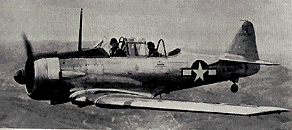
Final Navy version of the North American trainer was the SNJ-6 of 1944 with strengthened wing panels and redesigned rear fuselage. It was identical with the AT-6F procured by the USAAF, which acted as the procuring agency for the 931 SNJ-6s (NA-121). The Navy Texans remained in service in large numbers well into the fifties as primary, basic and instrument trainers and some became SNJ-7s and armed SNJ-7Bs after modernization at NAS Pensacola in 1952.
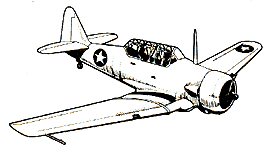 The AT-6 was a development from a big family of North American
training aircraft, which began in 1935 with NA-16 model. These
include the BT-9, (BT=Basic Trainer) BT-14, BC-1, (BC=Basic Combat),
and A-27 (exported to Thailand). Early members of this family
had open cockpits, fixed landing gear, a fabric-covered fuselage
and a rudder with a rounded trailing edge. The AT-6 (first known
as BC-1A) had retractable landing gear, a fully closed 'greenhouse'
cockpit, a metal-covered fuselage and a straight cut-off rudder.
The Texan was derived from an earlier NA-16 prototype (BT-9),
built by the General Aviation Factory at Dundalk, Maryland, to
the specification for a basic trainer.
The AT-6 was a development from a big family of North American
training aircraft, which began in 1935 with NA-16 model. These
include the BT-9, (BT=Basic Trainer) BT-14, BC-1, (BC=Basic Combat),
and A-27 (exported to Thailand). Early members of this family
had open cockpits, fixed landing gear, a fabric-covered fuselage
and a rudder with a rounded trailing edge. The AT-6 (first known
as BC-1A) had retractable landing gear, a fully closed 'greenhouse'
cockpit, a metal-covered fuselage and a straight cut-off rudder.
The Texan was derived from an earlier NA-16 prototype (BT-9),
built by the General Aviation Factory at Dundalk, Maryland, to
the specification for a basic trainer.
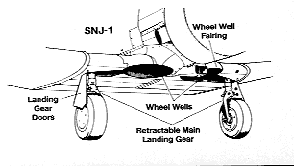 The maiden flight of the NA-16 took place on April 1, 1935
at Dundalk, only six months after the original design drawings
had been submitted to the Army and was piloted by Eddie Allen.
Later when the USAAC changed the role designations to advanced
trainer, subsequent production models carried the "AT"
designation. After the war, the simply became known as T-6's.
The maiden flight of the NA-16 took place on April 1, 1935
at Dundalk, only six months after the original design drawings
had been submitted to the Army and was piloted by Eddie Allen.
Later when the USAAC changed the role designations to advanced
trainer, subsequent production models carried the "AT"
designation. After the war, the simply became known as T-6's.
These AT (AT stands for Advanced Trainer) models were derived from the NA-26 prototype and had a Pratt & Whitney R-1340-47 radial engine rated at 600 hp. They drove a two-blade variable pitch Hamilton Standard metal propeller. The cockpit was revised with a two-way radio and had a provision for both fixed and trainable guns so that the type could be used for armament training for both pilots and an observer/gunner.
The NA-26 won the USAAC design competition in March 1937 and was ordered into production after a few minor modifications were made. It was known as the NA-36 model and to the USAAC as the BC-1. In 1938 the USAAC decided that the BC designation was unnecessary and adopted the AT designation instead. The AT series began with orders for 94 AT-6 Texans which included the last nine of the BC-1A order in 1938.
The next production variant was the AT-6A. The AT-6A had a Pratt & Whitney R-1340-49 radial engine rated at 600 hp. The center-section integral fuel tank was replaced by removable metal tanks. 517 of this variant were produced at Inglewood, CA before all production was moved to Dallas, Texas where North American had already established a second production line. This was due to the fact that the Inglewood plant could not cope with the huge increase in demand for the AT-6A. A total of 1,847 AT-6A's were produced. (1,330 from the Dallas plant.)
The next variant, model NA-84, resulted in the all-in-one feature-full AT-6B. This was an attempt by North American to manufacture a version with as many as possible likenesses to what the USAAF and the US Navy required, thereby reducing total production time. These were powered by an R-1340-AN-1 engine rated at 600 hp. The model was equipped as a standard gunnery training platform with a .3 in gun in the nose, two in the wings and one in the rear cockpit. Production totals for the AT-6B were 400 aircraft, all manufactured from the Dallas facility.
The AT-6C variant was the result of the American effort to reduce the use of strategic light alloys in aircraft other than first-line warplanes. These aircraft incorporated a large measure of low-grade steel and wood in the airframe for a savings of 1,276 lbs of aluminum alloy per aircraft. Total production of the AT-6C was 2,970 aircraft.
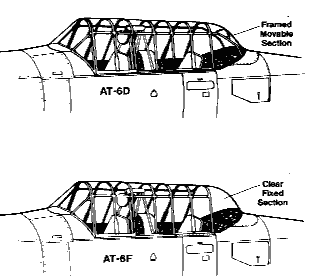
The AT-6D variant was a return to the use of light alloys in recognition that the alloys would not become as scarce as originally thought. One other change in the D version was a switch from a 12-volt to a 24-volt electrical system. Total production of the AT-6D was 4,388 aircraft.
The AT-6F variant (model NA-121) had a revised rear "clear-view" canopy section. In addition had a revised wing and rear fuselage to permit sustained 6-G maneuvers. Production totaled 956 aircraft.
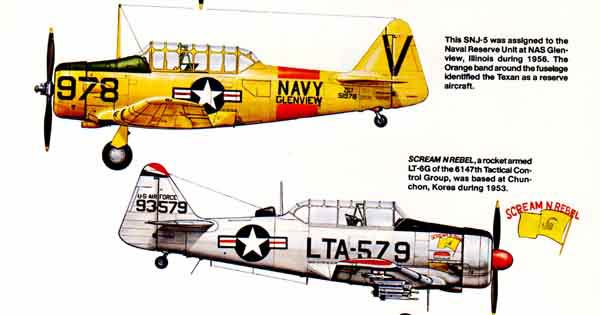
The US Navy aircraft were designated SNJ. The SNJ-1 and -2 corresponded to the BC-1. However, the SNJ-2 featured a R-1340-56 engine. The SNJ-3 was similar to the AT-6A, while the SNJ-4 was identical to the AT-6C. The C model production for the US Navy totaled 2,400 aircraft. The SNJ-5 corresponded to the AT-6D with no fewer than 1,573 were delivered to the Navy. The SNJ-6 corresponded to the AT-6F. The only major difference between the USAAF and US Naval aircraft were the arresting hooks that were added to train Naval Cadets how to land on an aircraft carrier.
After the war, in 1949, 2,068 newly designated T-6G's were remanufactured from many earlier models that were still in service. These were also made available to the Navy as SNJ-7's and had a revised cockpit layout, an improved canopy, relocated aerial masts, a square-tipped propeller, F-51-type landing gear, and flap-actuating levers and a steerable tail-wheel.
The AT-6 was the most famous WWII trainer and continued in service for a long time. It was also built in Canada and Australia. The latter aircraft were known as 'Wirraway'. It was used by the USAAF, USN and RAF. Total production of the trainer family was 21,342. The AT-6also often modified to represent WWII combat aircraft which are no longer available to movie-makers, such as the Mitsubishi A6M2/5 'Zeke'.
In such cases, the typical wing layout usually identifies the aircraft as an AT-6.
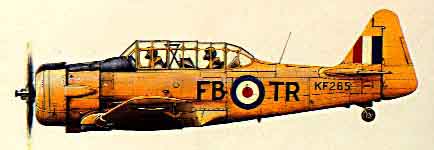
The first thing that strikes you about the plane is its distinctive mustard yellow fuselage ? especially for a war-time plane. In fact, it's unmistakable. And that was just the way it was intended. Because of their role as a training plane for nearly 137,000 pilots from Britain, Australia, New Zealand and Canada, they truly make a point of standing out. After all, as a trainer plane, the last thing the pilots wanted was to be mistaken for a combat machine by people on the ground.
"With all the different climate changes in Canada, yellow was the color that stood out the most in all four seasons and that's the reason they picked it," says Sean Voskamp, a 21-year-old University of Toronto student and member of the Canadian Harvard Aircraft Association. But Voskamp isn't just an aviation buff, he's also a Harvard pilot. In fact, he's been flying vintage Harvards since he was 17! So what's his impressions of the plane?
"It's a wonderful plane to fly," he says. But he admits the plane does have its quirks. "One odd thing about it is that because it's a tail-dragger aircraft, it has some unique ground handling qualities. With the tail on the ground, the nose is so high, it's hard to see over the nose. So when you see us taxiing down the runway, we have to do S-turns ? zigzagging back and forth ? so we can look out the side."
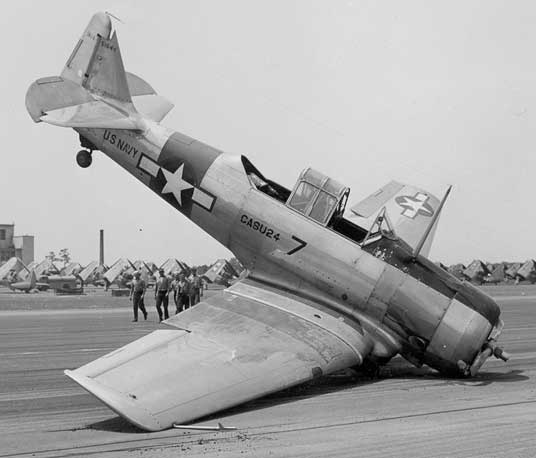
And although it's never happened to Voskamp, he says that during WWII there was another problem with the plane. "When you're landing a plane like that and the tail wheel goes off to one side and it starts to turn, it has a tendency to want to turn all the way around," he explains. "That's called a ground loop, and it's particularly dangerous on landing. That's happened quite a few times, where the tail wheel spins around and then a wing tip will dig into the ground and the plane crashes."
But those two quirks aren't enough to keep Voskamp nor other
Harvard fans away from the plane. In fact, once it's in the air,
the Harvard flies like any normal plane,except it's better ? according
to the seasoned 21-year-old pilot. "It's different from most
airplanes you fly in that it was designed as a trainer plane for
fighters, so it is set up as such. Therefore it's really light
on the controls and it's a dream to fly."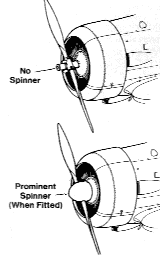
That fact wasn't lost on the British Commonwealth Air Training Plan directors either. As Voskamp points out, "the pilots that trained on the Harvards went on to fly pretty much anything ? Spitfires, Hurricanes, even Mosquito fighter bombers."
But despite their attention-grabbing color and handsome vintage design, one thing really stands out about Harvards ? their roar. "People really notice the roar of the Harvards," remarks Voskamp. "The Pratt & Whitney R-1340-S3H-1 engine has no gearing from the actual crankshaft to the propeller, so at takeoff power at 2250 R.P.M. the tips of the propellers are actually breaking the speed of sound and that's what makes that nice loud roar."
So it comes as no surprise why the planes in formation became dubbed 'The Yellow Horde'. And, although the horde's numbers have dropped significantly over the years, their ability to live up to their reputation doesn't appear to show any signs of letting up.
 One of the best advanced training air craft ever built, the Harvard
became a mainstay of the British Commonwealth Air Training Plan.
Harvard IIBs were first ordered from Noorduyn in Montreal in January
1940. Noorduyn eventually built 2 800 harvards for the RAF and
RCAF. Canadian Car and Foundry made 550 Mk.4s for Canada and the
United States in the 1950s. The Mk.4 had an improved cockpit canopy
and fuel capacity.
One of the best advanced training air craft ever built, the Harvard
became a mainstay of the British Commonwealth Air Training Plan.
Harvard IIBs were first ordered from Noorduyn in Montreal in January
1940. Noorduyn eventually built 2 800 harvards for the RAF and
RCAF. Canadian Car and Foundry made 550 Mk.4s for Canada and the
United States in the 1950s. The Mk.4 had an improved cockpit canopy
and fuel capacity.
The Harvard must be considered one of the outstanding aircraft of World War II and the early postwar years. From 1940 to 1955, nearly all American and British Commonwealth pilots received some training on Harvards. Strong yet unforgiving, requiring a delicate touch to keep straight during landing and take-off, it was an ideal training airplane.
Canada built more Harvards than any other aircraft, with a total of 3 350 produced. In anticipation of a possible aluminum shortage, a wooden rear-fuselage and set of wings were developed and built, but not produced. Gunnery trainer and target tow versions were also developed but never produced. Skis were produced but never installed because a strengthened undercarriage was required.
Specifications
 |
Span, 42 ft Performance Armament |