

Panzer Tank - $$5.95
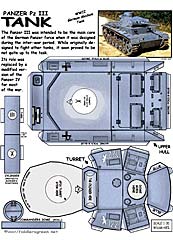
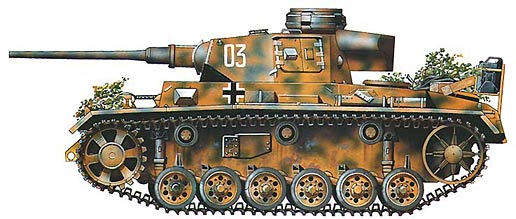
The Panzer III was a tank developed in the 1930s by Germany and used extensively in World War II but It soon became obsolete in this role and for most purposes was replaced by up-gunned Panzer IVs, though some would continue to be used for infantry support until late in the war. This tank model is included FREE with the Me-321 Gigant Transport Glider.

WWII Panzerkampfwagen III (PzKpfw III) German Tank
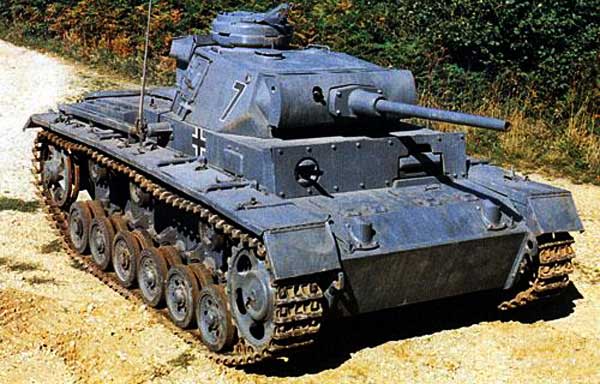
Panzer PzIII German WWII Medium Tank
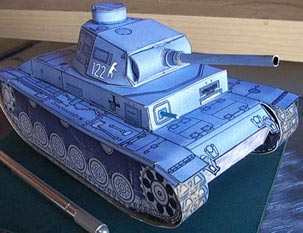 The first medium tank developed by Nazi Germany was the Pz. III,
which did not enter active service in large numbers until 1939.
The Pz. III was initially armed with a 37-mm antitank gun and
two machine guns. It weighed about 20 tons, had a top road speed
of 25 miles per hour, and carried a crew of five.
The first medium tank developed by Nazi Germany was the Pz. III,
which did not enter active service in large numbers until 1939.
The Pz. III was initially armed with a 37-mm antitank gun and
two machine guns. It weighed about 20 tons, had a top road speed
of 25 miles per hour, and carried a crew of five.
About 100 Pz. III's fought in the Polish campaign and about 350 in the invasion of France. The need for greater firepower and more protection was apparent by 1941, so newer versions were given a 50-mm gun and fitted with armour 30–50 mm thick. The Pz. III could accommodate these improvements because it had been designed with a larger turret and a 12-cylinder, 300-horsepower engine.
I'd love to see an entire collection of WWI & WWII tanks and vehicles and will pay someone to design them. Chip
Kell, Someday we'll have a line of
tanks, I suppose, Fingers.. I've been asked for them for
as long as I can remember and the Gigant needed one real
badly.. I salivate over those old WWI tanks, don't you?
I can see a great CD collection of them someday. Chip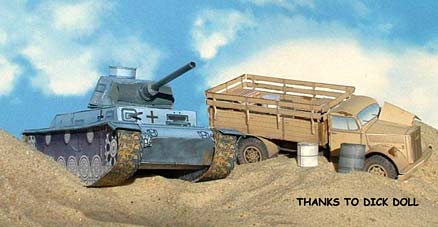
I can just it now - "FG does the Maginot Line". Bunkers, pillboxes, dropped rifles, white flags.....8-)Bonz
I found your site when I was in Bosnia in 2000-2001. I have been building your models since then and giving them to children in the local towns of everywhere that I have been deployed. I have been to Bosnia twice (once in 2000, and the other in 2001) and In Iraq in 2003 and now in 2007. The kids love your models and you without you knowing it you have been covertly helping win hearts and minds here in Northern Iraq. I have built almost every one of the models you have produced most as I have said are out with the kids of the world, But , our commander and the rest of the pilots like them so much that I have built some and they are hanging in the command post. Thank you for helping me make everyones job easier and bringing me some relaxation in this high stress environment. Paul Shetler,,Test Pilot
For example, the Panther III tank had very
heavy frontal armor but thin side and rear armor.
Do you mean Panther or Panzer V? Just bean a rivit counter.
David D
Great little model! I hope it's the first of many...a whole line possibly. Dave Donahue
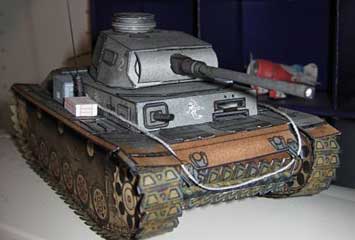 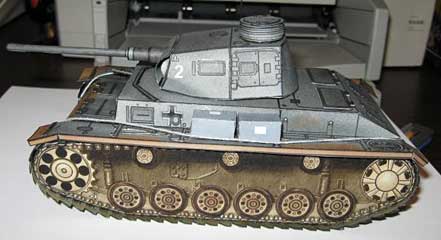 |
Here is a re-paint I did of the PzrIII.
I made it up in the colours of the 11 Panzer Division,
as found on the Russian 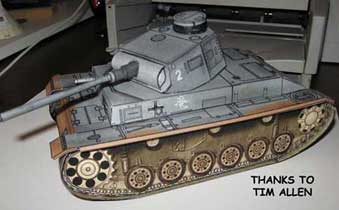 Front
in 1942. I've added a fair amount of dirt and
mud to it, so it looks like it would after a prolonged
campaign. I also included some pictures.
the first ones are the straight build, the second batch
are of a second build I did with some detailing.
I added on some storage boxes from the Opel Blitz accessories
page (they fit great). Oh, and I fixed the minor error
with the pzrIII getting mixed up with the KV2.
I found a picture of the SIG 150mm assault gun and replaced
the KV2 line drawing with it. Tim Allen (pictures of Tims version
are included in the Panzer folder) Front
in 1942. I've added a fair amount of dirt and
mud to it, so it looks like it would after a prolonged
campaign. I also included some pictures.
the first ones are the straight build, the second batch
are of a second build I did with some detailing.
I added on some storage boxes from the Opel Blitz accessories
page (they fit great). Oh, and I fixed the minor error
with the pzrIII getting mixed up with the KV2.
I found a picture of the SIG 150mm assault gun and replaced
the KV2 line drawing with it. Tim Allen (pictures of Tims version
are included in the Panzer folder)
Thanks for the Panzer III. Its a nice quick build. I took it upon myself to do a bit of re-painting; the blue-gray scheme just didn't seem quite right to me. I used 67poud gray cardstock and the only alteration I make was to put a couple of bands around the commanders copula in order to keep it from looking like a stove-pipe. You will note that they are black- too dark really. The markings are for a Pzr III of the 11th Panzer Division, as found on the Eastern Front in 1942. Tim Allen |
 |
Winning hearts and minds in Iraq |
The 1,500 Pz. III's that took part in the invasion of the Soviet Union in 1941 outfought most Soviet tanks but were in turn completely outclassed by the new Soviet T-34, which had a lethal 76.2-mm gun, sloping armour, and excellent speed and mobility.
Even Pz. III's fitted with a high-velocity 50-mm gun and protected by armour 50–70 mm thick could not cope with the T-34, so the tanks were taken out of service on the Eastern Front, though they continued to fight in the Mediterranean theatre into 1943. By the time production was halted early that year, about 5,660 Pz. III's had been built.
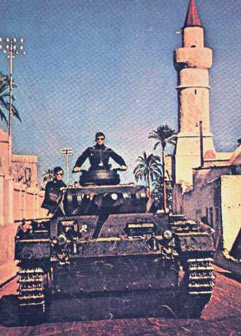
Panzerkampfwagen III (PzKpfw III), more commonly referred to as
the Panzer III, was a tank developed in the 1930s by Germany and
used extensively in World War II. It was designed to fight other
AFVs, serving alongside the infantry-support Panzer IV. It soon
became obsolete in this role and for most purposes was supplanted
by up-gunned Panzer IVs, though some would continue to be used
for infantry support until late in the war.
Development & History of the PZ III Panzer Tank
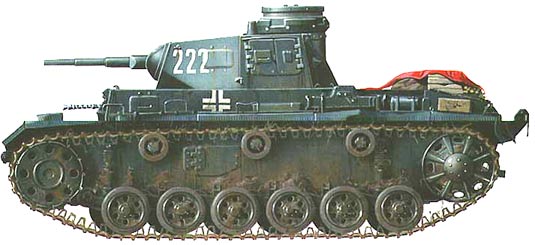
On January 11, 1934, following specifications laid down by Heinz
Guderian, the Army Weapons Department drew up plans for a medium
tank with a maximum weight of 24,000 kg and a top speed of 35
km/h. It was intended as the main tank of the German Panzer divisions,
capable of engaging and destroying opposing tank forces.
Daimler-Benz, Krupp, MAN, and Rheinmetall all produced prototypes.
Testing of the prototypes took place in 1936 and 1937, leading
to the Daimler-Benz design being chosen for production. The first
Panzer III A came off the assembly line in May of 1937, and a
total of ten, two of which were unarmed, were produced in 1937.
Mass production of the tank, then in model III F, began in 1939.
Between 1937 and 1940, attempts were made to standardize parts
between Krupp's Panzer IV and Daimler-Benz's Panzer III.
Much of the early development work on the Panzer III was a quest
for a suitable suspension. Several varieties of leaf-spring suspensions
were tried on ausf A through D before the torsion-bar suspension
of the ausf E was standardized. The Panzer III, along with the
Soviet KV heavy tank, was one of the first tanks to use this suspension
design.
The Panzer III was intended as the main battle tank of the German
forces. However, it proved to be inferior to the T-34 tank of
the Soviet Union and was replaced by an upgunned version of the
Panzer IV, which could carry a high-velocity 75 mm gun. Additional
frontal armor meant the Panzer III during 1941 and 1942 was impervious
to most British and Russian anti-tank guns at all but close ranges
when shot at from the front. The sides were still vulnerable to
many enemy weapons including anti-tank rifles.
The unusually heavy rear armor of the Panzer III was a weight
penalty that was not in line with its combat value. Although several
tanks of the early war period had heavy rear armor, in general
the design trend during the war was to thin the side and rear
armor as much as possible, concentrating heavy armor in the frontal
area. For example, the Panther III tank had very heavy frontal
armor but thin side and rear armor.
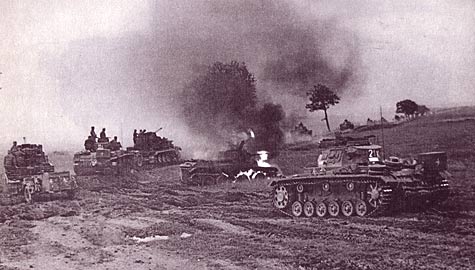 |
A column of Pz-IIIs
advancing across the Russian plain leave a trail of devastation |
The Panzer III was intended to fight other tanks and a high-velocity 5 cm gun was initially called for. But the infantry were being equipped with the 3.7 cm anti-tank gun, and it was felt that in the interest of standardization the tanks should carry the same. As a compromise, the turret ring was made large enough to accommodate a 50 mm gun should a future upgrade be required. This single decision would later assure the Panzer III a much prolonged life in the German army.
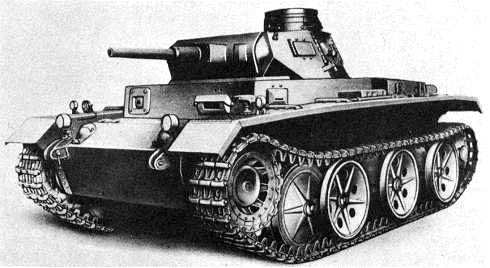 |
The Panzer
III models A through C were powered by a 230 hp, 12-cylinder
Maybach HL 108 TR engine, giving a top speed of 20 mph
and a range of 95 mi. |
Mobility:
The Panzer III was used in the campaigns against Poland, France,
the Soviet Union and in North Africa. Some were still in use in
Normandy and Arnhem in 1944. In the Polish and French campaigns,
the Panzer III formed a small part of the German armored forces.
By the time of the German invasion of the Soviet Union (Operation
Barbarossa), the Panzer III was numerically the most important
German tank. However, Soviet tank units were mainly composed of
the much lighter-armed and armored T-26 and BT tanks. This, along
with superior German tactical skill, crew training, and the good
ergonomics of the Panzer III all contributed to a rough 6:1 favorable
kill ratio for German tanks of all types in 1941.
The Panzer III was a good, but not outstanding, tank in terms
of armor, armament and mobility. However, it was well-designed
in that it had a three-man turret crew (gunner, loader and commander),
leaving the commander free to concentrate on commanding the tank
and maintaining situational awareness.
Although other medium tanks of the time also had this feature, most tanks of the late 1930s had fewer than three men in the turret crew. These other tanks, which may look impressive on paper, lacked this key element of "fightability".
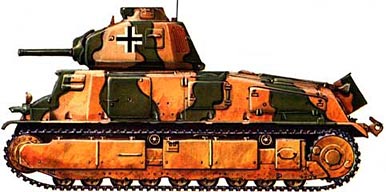 The
French Somua S-35 was a classic example of a tank that
appeared to be the equal of the Panzer III on paper, with
a good gun and strong armor, but with its one-man turret
crew it was hopelessly outclassed by the Panzer
III. The
French Somua S-35 was a classic example of a tank that
appeared to be the equal of the Panzer III on paper, with
a good gun and strong armor, but with its one-man turret
crew it was hopelessly outclassed by the Panzer
III. |
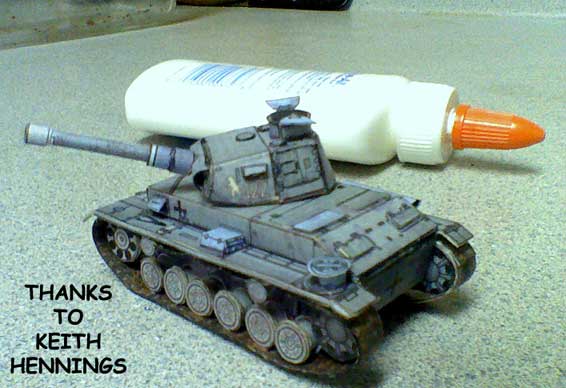 |
I wanted to thank you for your site and the cheap prices. I work in a P.S. i included some shots of the Panzer III free models with a little Keith |
|---|
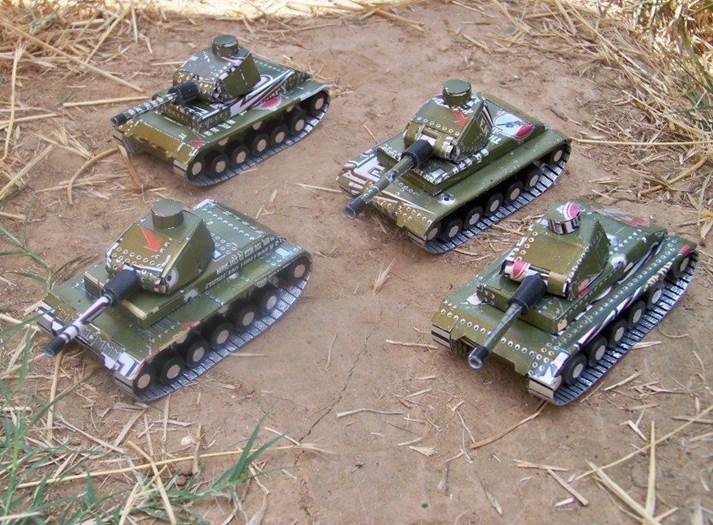 |
Here are some Fiddler’s Green Mini Panzer III’s (4 inches long) conducting an afternoon patrol in my backyard. The whole Corps is headed off to a movie shoot in North Carolina. It will be sad to see them head off to do battle with giant ants! Roy Greenwood |
|---|
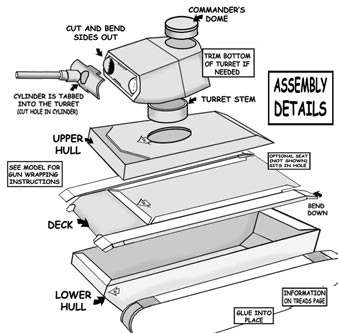
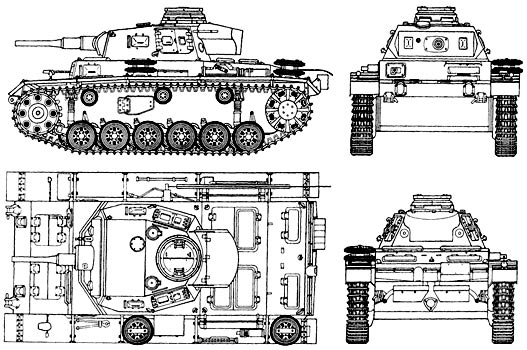
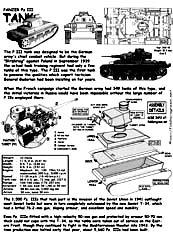
Specifications Armor 5 - 70 mm Engine 12-cylinder Maybach petrol 265 hp (197 kW) Power/weigh:t 12 hp/tonne Suspension torsion bar Operational range: 155 km Speed: 40 km/z (road) 19 km/h (off-road |
Best news of all is that wonderful instructions are included Crew 5 (commander, gunner, loader, driver and radio operator) |
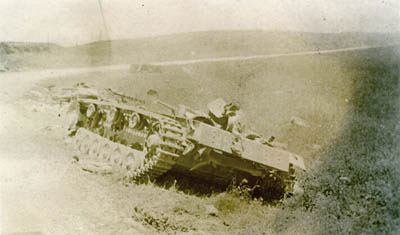 |
A photo taken from a U.S. convoy shows a destroyed Panzer III chassis in North Africa |
Deutsches Panzermuseum - German Tank Museum WWI Tanks in the Fiddlersgreen collection (Feb 2011) |