
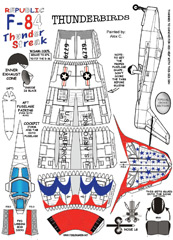
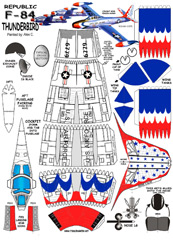
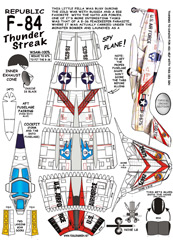
F-84 Thunderstreak - $$6.49
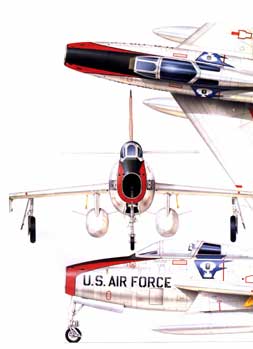
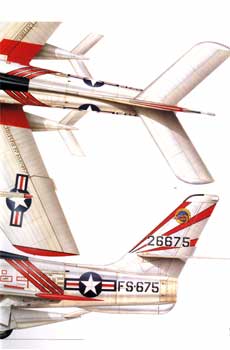
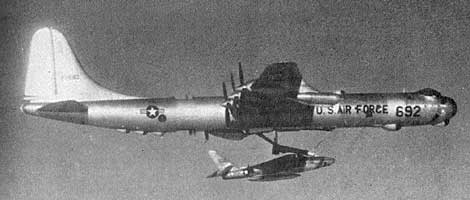
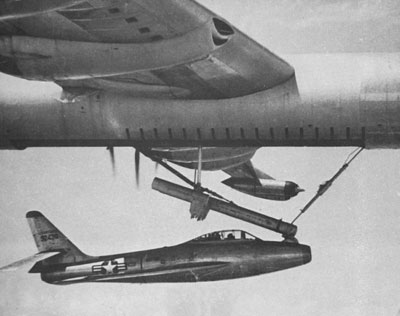
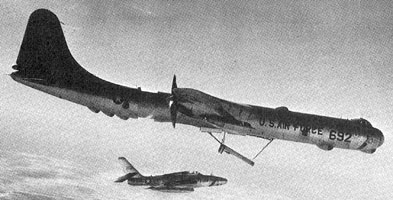
This one sported the new fangled coke bottle waist that allowed it to (fairly) easily fly past MACH 1. This model can be used as a hitch hiker under the B-36 FG model.

Republic F-84 Thunderstreak/Thunderbird
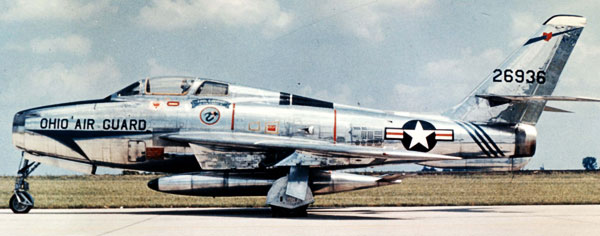

Originally designated YF-96A and first flying on June 3, 1950, the Thunderstreak was a company-sponsored swept-wing development of the F-84C Thunder jet. Official interest, lukewarm at first, hardened soon after the outbreak of the Korean War and the type was ordered into production with a designation in the F-84 series and various design improvements.
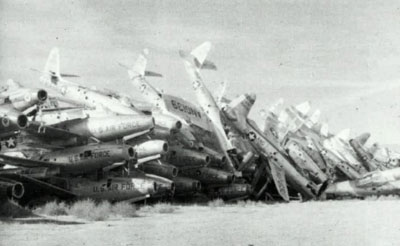
The Thunderstreak's basic roles were interception or ground attack, but its excellent range also made it a useful escort aircraft. That excellent range was vastly improved when it flew as a parasite for the giant.
In June 2005. Our designer pal, Rob Carleen, put together a 'conversion kit' for the F-84G that, as you know, was the straight winged earlier version of this important aircraft.. It comprises of the straight wings, straight tail feathers and a couple wing tip tanks that fit into the basic fuselage..It's included in the folder along with bw, large and regular versions..(see bottom right)
NOTE: If you're going to use this for your B-36, simply bend the
horizontal stabilizer downward a bit.
Have just downloaded the F84 and it looks terrific. Thanks.
Peter
..What I especially like is how you guys include bits and
pieces along with most models..Keep up the GREAT work chaps!!
Don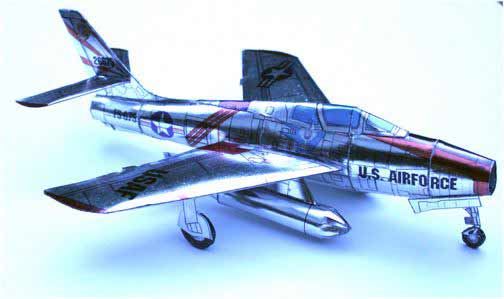
Howdy Folks, Here is a 1/2 size FiddlersGreen Republic F-84 Thunderstreak printed two parts pages on one 8.5 X 11 Red River Metallic Silver .006" paper resulting in a wing span of four and a half inches. The parts page was given four coatings of Krylon Clear Acrylic Gloss and allowed to dry overnight. Aleene's Tacky Glue spots and smudges were easily removed without damaging the printed surface during assembly. Constructing the model in this size did not require any stiffening of the Red River paper. Cardboard discs were sandwiched in-between the tires for thickness and thin wire was used for landing gear support.
Bob Penikas
Republic F-84
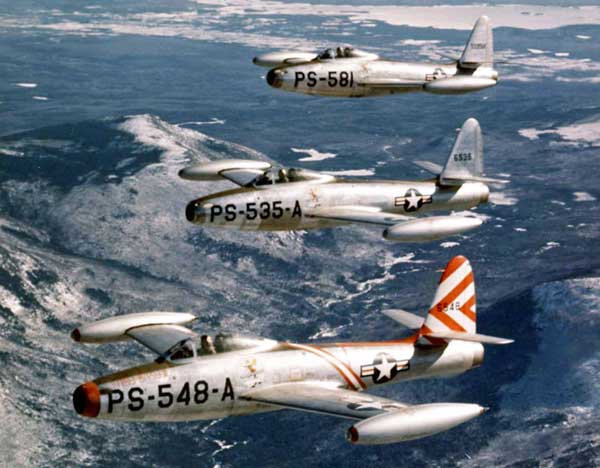
Originally designated YF-96A and first flying on June 2, 1950, the Thunderstreak was a company-sponsored swept-wing development of the F-84C Thunder jet. Official interest, lukewarm at first, hardened soon after the outbreak of the Korean Way and the type was ordered into production with a designation in the F-84 series and various design improvements, among them the substitution of the Wright 165 (Sapphire) in place of the original underpowered Allison. By August 1957, Republic and General Motors had built 1,410 F-84 's for TAC and SAC (USAF) and 1,301 for various NATO forces.The US Thunderstreak's were relegated to units of the ANG in the early 1960s.
Originally designated YF-96A and first flying on 3 June 1950, the Thunderstreak was a company-sponsored swept-wing development of the F-84C Thunder jet. Official interest, lukewarm at first, hardened soon after the outbreak of the Korean Way and the type was ordered into production with a designation in the F-84 series and various design improvements, among them the substitution of the Wright 165 (Sapphire) in place of the original underpowered Allison. By August 1957, Republic and General Motors had built 1,410 F-84 's for TAC and SAC (USAF) and 1,301 for various NATO forces.
The US Thunderstreak's were relegated to units of the ANG in the early 1960s The Thunderstreak's basic roles were interception or ground attack, but its excellent range also made it a useful escort aircraft.
Republic F-84F Thunderstreak of the Turkish Air Form, circa 1964
|
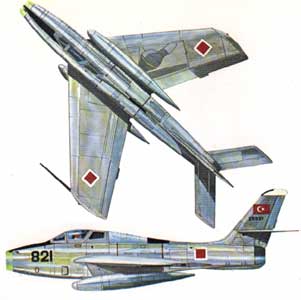
Like the Thunderstreak, its range was considerably extended by twin drop-tanks, and the Thunder flash had four 0.50in guns. Of 715 RF-84Fs built, 386 were supplied to Belgium, Nationalist China, Denmark, France, West Germany, Greece, Italy, the Netherlands, Norway and Turkey. The Dutch aircraft were replaced by the F-104 Stair fighter. ANG units in the USA also employed the RF-84F.
REPUBLIC F-84 THUNDERJET, THUNDERSTREAK, THUNDERFLASH
 |
|
Alexander Kartveli and his design team started to explore possible layouts for a jet powered fighter-bomber which might be a worthy successor to the P-47 towards the end of 1944, at the same time that Lockheed and North American were initiating design studies on prototypes which were to result in the P-80 and the P-86. In the early stages, the Thunderbolt's creator considered the simple expedient of installing a jet engine in the P-47 airframe but he very soon decided to start from scratch again, with a completely new design for a cantilever low-wing monoplane, with straight and laminar flow wing and cantilevered horizontal tail planes mounted half way up the vertical fin.
Structure was all-metal with a duralumin skin and for the first time in an American jet fighter, the air inlet for the turbine engine was to be located in the nose. The pressurized cockpit was equipped with ejector seat and had a teardrop canopy; a large airbrake was installed in the belly of the plane, below the cockpit.
The USAAF's Materiel Division liked the look of this aircraft with its classic lines and ordered three prototypes and 400 additional aircraft, designated P-84, in March, 1945. The end of the war caused the cancellation of the remainder of the Thunderbolt production program which left Republic fully committed to this new program, on which its future depended. On February 28, 1946, Major William Lien took off from Muroc Dry Lake (later renamed Edwards AFB) the first XP-84, powered by the 3,7501b (1,701kg) General Electric 5-GE-7 turbojet.
The Thunder jet, as it was called, was the first new American fighter to have its maiden flight after the end of World War and on September 7, 1946, it set a new American speed record, at 612 mph (983km/h), having the world speed record snatched from it by the British Gloster Meteor that same day, over in England.
With victory for the United States and its allies, all existing orders had been suspended but then, on January 15, 1946, the USAAF confirmed its order for 15 YP-84A research aircraft and 85 series P-84Bs. The YP-84A was powered by13 Allison engine instead of the General Electric power plant, had tip tanks and was armed with six .50in machine guns, four mounted in the nose and two in the wings.
The 15 YP-84A aircraft and the third prototype (which were virtually identical) were delivered for evaluation by the user by April, 1947, and the aircraft proved satisfactory all respects. Production of the P-84B, redesignated F-84B in mid-1948, totaled 226 aircraft, lasting from June, 1947, until February, 1948, and the first of these went to 14th Fighter Group (37th, 48th and 49th Squadrons).
After a batch of 191 F-94Cs which were identical to the F-84B except for the engine used and for some detail changes and refinements, production switched to 154 F-8413s in 1948: this was a much improved variant, with the new, more powerful J35-A-17D engine, it was followed by 843 of the F-84E longest-range version with stretched fuselage, radar and increased stores and armament provision. One hundred of these F-84Es were the first Thunder jets to enter service with the air forces of America's NATO allies, followed by 1,936 of the series F-84G which had the traditional wing and was the variant built in the largest number.
The F-84G was the last un swept wing aircraft deployed by the USAF and was used by Strategic Air Command until 1956, and afterwards by Tactical Air Command for a few years longer; it was more effective than its predecessors, equipped with LABS (Low Altitude Bombing System), flight refueling probe, autopilot and the ability to carry and deliver bombs with nuclear warheads.
The first Thunder jets to have a taste of battle were the F-84E series aircraft of 27th Fighter-Escort Wing (522nd, 523rd and 524th Squadrons) in December, 1950, in Korea and they were joined during the course of that campaign by the F-84s flown by 49th Group (7th, 8th, 9th Squadrons); 58th (69th, 310th, 311th); 474th (428th, 429th, 430th) in 1951, and 1952. At first the Thunder jets were used to escort bombers but when the swept-wing MiG-15 appeared on the scene, which could out fly all the American fighters, they were used as fighter-bombers to outstanding effect, earning widespread respect for their effectiveness.
The Republic F-84 Thunder jet, the best of the first generation jet fighters. It was designed by the creator of the outstanding P-47 Thunderbolt, Alexander Kartveli, and the F-84 echoed in a more modern and aggressive way the success of its illustrious predecessor. As many as 7,889 aircraft in numerous variants (amongst which the last one, the F-84F, was a major redesign of the original version, having a swept wing) left the assembly lines and of these almost half, 3,723 aircraft equipped the air forces of NATO countries within the context of American post-war military aid programs. In Italy for example the Aeronautica Militare put F-84s into service in 1952 and kept the RF-84F photo-reconnaissance variant in use until 1974. In the USAF the Thunder jet/Thunderstreak/Thunder flash (these were the names of the principal variants of the F-84) stayed in first line service until the middle of the sixties.
The design of the F-84 had originated as far back as 1944 when Alexander
Kartveli had started to think about developing a jet version of
the P-47 Thunderbolt.. The basic design of the F-84 was completed
before the end of that year after a long series of experiments and
plans using various power plants which were being developed at that
time. The prototype was built round the General Electric TG-180
turbojet (subsequently called J35). and at the beginning of 1945
this design effort was rewarded by an order for three aircraft which
were designated XP-84 and for 400 series aircraft.
The first prototype had its maiden flight on 28th February 1946 and the second followed in August. At the end of the test flights, production started off with 25 pre-series models designated YP-84 and subsequently went on to the manufacture of the definitive variant, the F-84B. The new fighter reached units from the summer of 1947 onwards and procurement was 226. The following version was the C model (which first flew in April 1948) which had structural details changed, and of which 191 were built. In November the following year the first F-84Ds appeared (154 built) which had stronger airframe and more powerful engines. These Thunder jets were the first to be used in the Korean War where they gave a good account of themselves.
On 18th May 1949 the prototype of the following production variant was flown, the F-84E (843 built) which was again modified and the fuselage was about 30 cm longer. Finally, in November 1950, the fifth and last straight-winged-version appeared, the F-84G (3,025 built) which was developed specifically at the request of Tactical Air Command who needed a light fighter-bomber able to deliver tactical nuclear weapons. The Thunder jets were the first single-seater's able to carry out such tasks.
In the following variant, the F-84F, the configuration of the aircraft was drastically changed when a 45' swept wing was adopted; the prototype flew on 5th June 1950 and the first series aircraft (named Thunderstreak) flew on 22nd November 1952. A total of 2,711 were built which went into service from 1954 onwards and represented the final stage of the design as a straight combat plane. The final version, the RF-84F. was for photo-reconnaissance.
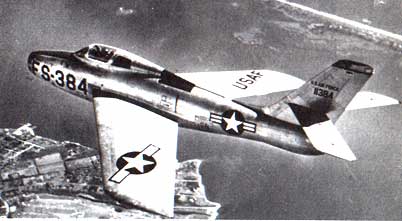
The first of two further YF-84Fs with the J35-A-25 supplanted by the imported Armstrong Siddeley Sapphire engine flew on 14 February 1951, this having a deeper nose air intake and fuselage to accommodate the larger turbojet. The third YF-84F which followed had extended wing roots embodying engine air intakes, but these lateral orifices caused substantial thrust losses and were consequently rejected for the series fighter, although subsequently adopted for the tactical reconnaissance RF-84F Thunder flash.
As the Wright J65, the Sapphire was licence -manufactured for the series F-84F, the first example of which flew on 22 November 1952 with a YJ65-W-1 engine of 7,220 lb st. The -1 power plant equipped the first 275 Thunderstreak's, and a further 100 or so had the improved -1A. These engines then gave place (F-84F-5) to the similarly-rated, but more reliable, J65-W-3 (or Buick-built J65-B-3). The USAF accepted its first F-84Fs on 3 December 1952, these presenting numerous problems, not least of which was inadequate high-speed longitudinal and lateral control.
In consequence, initial operational deployment (506th SFW) was delayed until January 1954, but the F-84F remained of limited use as a result of its unsatisfactory engine and other deficiencies. Some of the less pleasant handling characteristics of the Thunderstreak were alleviated by introduction of an all-flying tail (F-84F-25) in 1954, and NATO began to receive this fighter-bomber early in 1955. The F-84F carried a built-in armament of six 0.5-in (12,7mm) M3 guns and was capable of lifting 6,000 lb of ordnance externally. Late production aircraft (F-84F-50) received the J65-W-7 (or J65-B-7) engine of 7,800 lb st, and the last of 2,348 Thunderstreak's (of which 237 were built by General Motors) was delivered in August 1957.
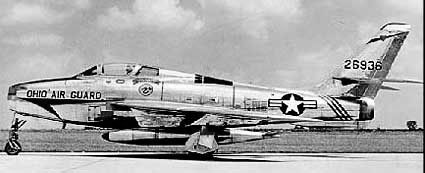
U.S. AIR NATIONAL GUARD SERVICE Above, you'll find a plane from Bach's unit (NJ ANG) just landed at Chaumont AB, France, having completed the ferry light from the US during 'Operation Stairstep' -- Nova Scotia to Greenland to Iceland to Scotland to air bases in England and France. This was the height of the Cold War when we stood toe-to-toe with the Russians and East Germans at the Wall. Apparently the USAF didn't feel they had enough muscle in Europe, so they called up the reserves -- literally. Pilots of Air National Guard units from several states, flying F-84Fs (air to ground and ground troop support) and RF-84Fs (reconnaissance) flew their planes across the North Atlantic to lend support in the event of a confrontation with the Eastern Bloc nations. This was one of the more frightening episodes in this country's post-WWII history, surpassed perhaps only by the Cuban Missile Crisis."Bob Young |
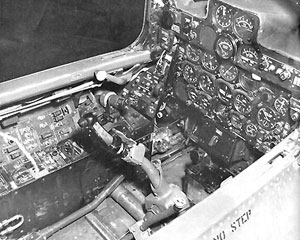 |
Republic F-84 Thunderstreak Cockpit. |
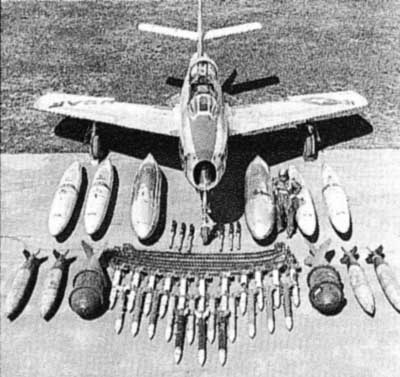 |
Republic F-84 Thunderstreak Arsenal. |
Specifications for the Republic F-84 Thunderstreak
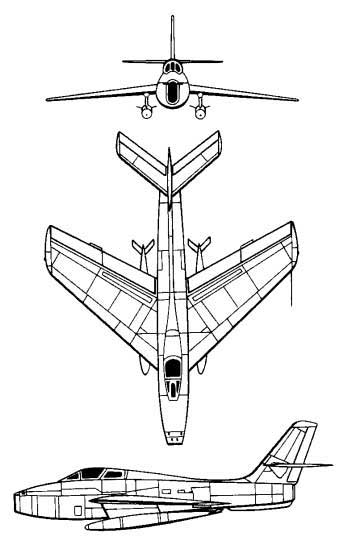 |
Length: 43 ft 4 ¾ in Wingspan: 33 ft 7 ¼ in Height: 14 ft 4 ¾ in Wing area: 325 ft² Empty weight: 13,830lb Max takeoff weight: 28,000 lb Powerplant: 1× Wright J-65-W-3 turbojet, 7,220 lbf Performance Maximum speed: 695 mph at sea level Range: 810 mi combat radius with two droptanks Service ceiling: 46,000 ft Rate of climb: 8,200 ft/min Wing loading: 86 lb/ft² Armament 6× .50 in (12.7 mm) Browning M3 machine guns, Up to 6,000lb of rockets and bombs, including one Mark 7 nuclear bomb Avionics A-1CM or A-4 gunsight with APG-30 or MK-18 ranging radar |
 |
||
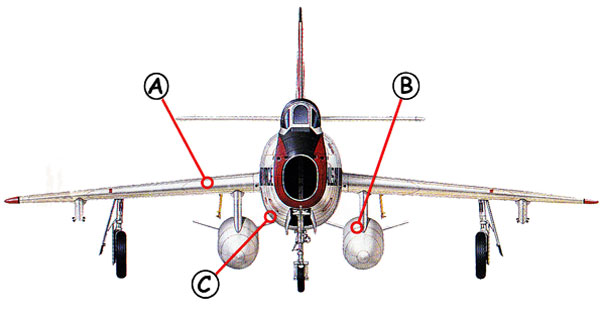
| A: The F-84F wing had a pronounced "anhedra," angled downward from the wing root, giving lively handling characteristics. | B: F-84Fs were usually fitted with two over-sized tanks when flying in the nuclear strike role. The nuclear bomb went on the center pylon. | C: Despite having more thrust than its straight- winged predecessor, the F-84F was not much faster due to the drag of its deeper fuselage. |
 |
|||
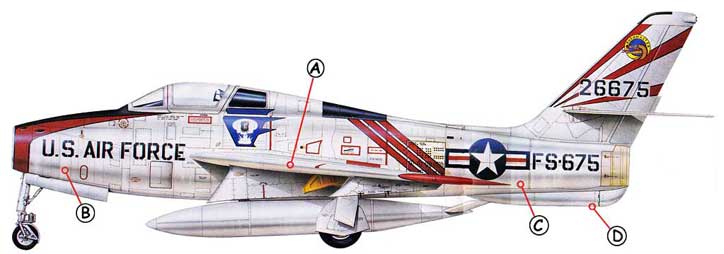
| A: The wing of the Thunderstreak was swept sharply back at 38.5 deg. It was very broad in chord, and incorporated large leadingedge slats and large trailingedge flaps. | B: USAF F-84Fs were left in a natural polished metal finish but most NATO air forces camouflaged their aircraft, especially when they "went nuclear." | C: The Sapphire engine was first chosen for the RAF's Hawker Hunter fighter, but was prone to flame-outs when the aircraft fired its guns. | D: The ventral fairing under the jetpipe housed an emergency brake parachute. |