

Sikorsky S-55 - $$4.95
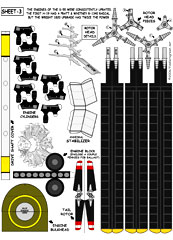
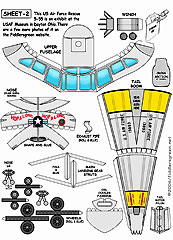
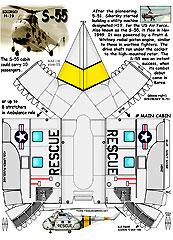
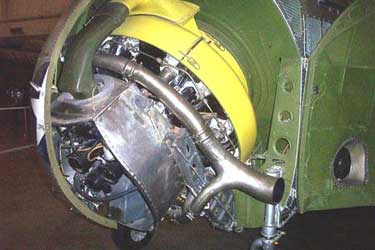
The first BIG helicopter Sikorsky built and the first one tailored utility as well as for war. It could easily carry 10 soldiers to combat and transport 6 returning stretchers of wounded. Several versions in folder..You can even hinge the clam-shell doors and show off the little PW engine. Lovely little model that comes in several versions all the the price of one.

Sikorsky S-55/ H-19
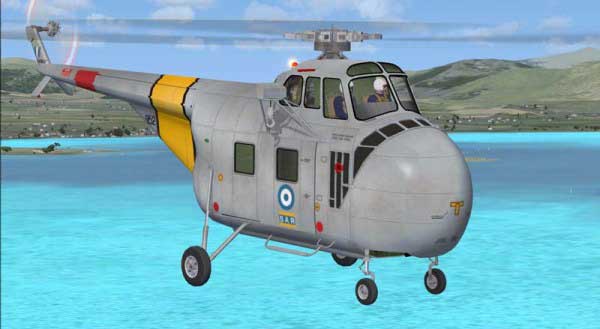

The S-55 received American civil type approval on 25 March 1952
and the model with the Pratt & Whitney R-1340 engines became
the S-55A, while the version with the Wright engine was designated
S-55B. In 1952, the helicopter became the first rotary wing craft
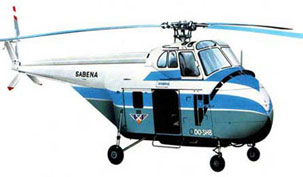
to be used for commercial links in Europe; it was then flown by
the Belgian airline Sabena between the chief towns in Belgium
and Lille, Rotterdam, Bonn and Cologne.
In ten years, Sikorsky produced 1,067 S-55s in military version
for no fewer than 30 operators throughout the world. Another 547
were built under license (notably by Westland in England under
the name Whirlwind).
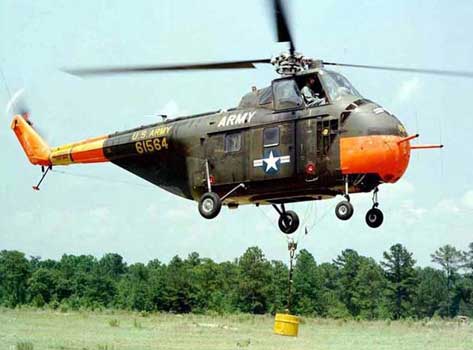
Once I have started, it is hard to stop making new versions. Here is a US Army version of the S-55. Also, I have allowed myself
to do an all yellow US Coast Guard HO4S-3. I hope to do a few more, there are some interesting color schemes around! Kind regards, Guido
These H-19 (Army designation) helicopters were parked next to our H-21 choppers while I attended the US Army Maintenance school in Ft. Rucker, Alabama back in 1957. I actually watched one H-19 slip off a jack and roll onto its side while the H-19 class was changing its wheel. Of course I am looking forward to your FG H-21. Thank you, Bob Penikas
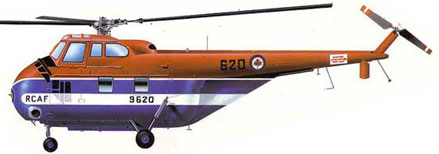
Always loved this one in the orange Arctic markings. Thanks for the memories. Cam
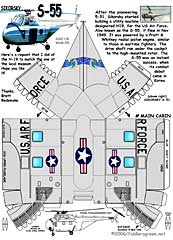
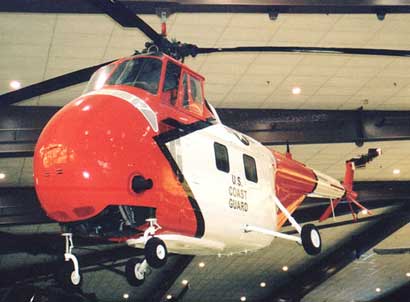
Here's a repaint that I did of the H-19 to match the one at the local museum. If you want, I can send some photos of the real thing too. Hope you like it! Thanks. Brett Redemske.
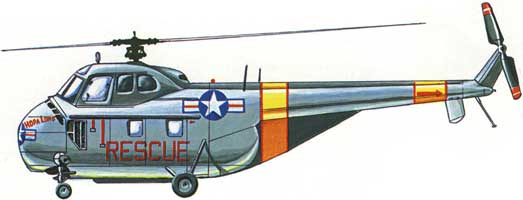
Guido Van Roy is one of Fiddlersgreen most prolific modelers and he's sent us many, many photos as well as actual new designs.. Shown above, is a beta model of the S-55 and it's important to mention a few minor tweaks that have happened since. The forward landing gear is a little shorter, and the cockpit, above, is a little shorter fore and aft. We've since added a cross-section of the fuselage to show how the sides are quite vertical. |
 |
Sikorsky S-55/ H-19
 On
1 May 1949, Sikorsky's technical department was given a very important
task: it was asked to create a new helicopter in just seven months,
which would be capable of carrying ten passengers in addition
to a crew of two.
On
1 May 1949, Sikorsky's technical department was given a very important
task: it was asked to create a new helicopter in just seven months,
which would be capable of carrying ten passengers in addition
to a crew of two.
The first of the five YH-19 prototypes ordered by the US Air Force for evaluation flew on 10 November 1949 and was characterized by a blunt-ended fuselage, which lacked the broad, triangular fillet connecting the fuselage to the tail boom which distinguished all the later series aircraft. Another characteristic of the YH-19 was the horizontal stabilizer applied to the starboard side of the tail, which was replaced in the production aircraft by two anhedral tail surfaces.
Various techniques and roles were first tested with the S-55 in
Korea which were later to form the basis of new military doctrine,
such as landing operations behind enemy lines, troop support,
recovery of damaged vehicles and their capacity for counterattack
and engagement.
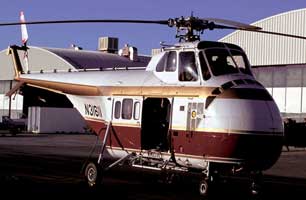
Another primary task of the helicopter was casualty evacuation or the rescuing of pilots who had come down behind the enemy lines. In the ambulance role, the S-55 could carry up to six stretchers, five of which could be hoisted on board using a mechanical winch fixed outside the cabin. The spacious cabin was designed to accommodate various seating arrangements or freight; it could take up to ten men or a load of approximately 2,866 lbs.
 The most distinctive feature of the Sikorsky aircraft was the
location of the engine in the nose, to enable the cabin to be
placed at the center of gravity, thus allowing for considerable
variations in payload without affecting stability. Special attention
was also paid to the question of maintenance. The main parts were
easily dismantled in an average of 12-15 hours and were all designed
for ease of access (the engine, for example, could be changed
in two hours, even without special equipment, and daily inspections
took a maximum of 15-20 minutes).
The most distinctive feature of the Sikorsky aircraft was the
location of the engine in the nose, to enable the cabin to be
placed at the center of gravity, thus allowing for considerable
variations in payload without affecting stability. Special attention
was also paid to the question of maintenance. The main parts were
easily dismantled in an average of 12-15 hours and were all designed
for ease of access (the engine, for example, could be changed
in two hours, even without special equipment, and daily inspections
took a maximum of 15-20 minutes).
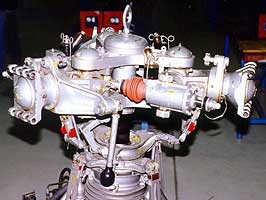
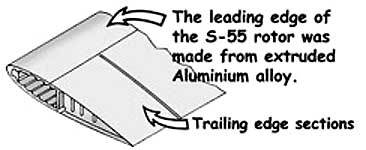
The S-55 had a monocoque metal fuselage with aluminum and magnesium light alloy bulkheads and skin. The three-blade main rotor had long-life metal blades (they demonstrated a life of over 20,000 hours in lab tests). The fuel was contained in two crash resistant tanks situated beneath the cabin in the lower part of the fuselage and had a total capacity of 1154 gallons.
Each leg of the quadracycle undercarriage had its own shock absorber for maximum stability during take-off and landing and maneuvers on the ground. Floats could also be fitted to the legs for emergency landings on water, or the undercarriage could be replaced by permanent metal amphibious landing gear.
 |
 |
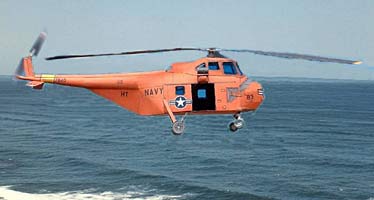 |
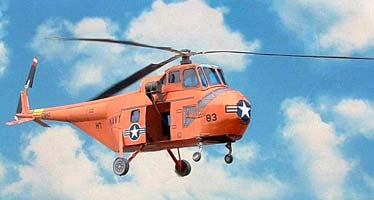
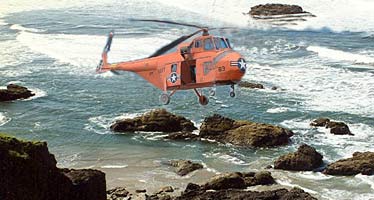
These shots were superimposed
over actual photos we took of a coast guard helicopter rescue
of a drunken teen who had fallen off the cliffs onto the rocks
below. This is very coincidental, we were driving the Pacific
coast photographing lighthouses when we ran into the rescue
at Ecola Beach, Oregon. Besides the stills, we have the whole
rescue on tape. I just cloned out the coast guard chopper
and inserted the S55 in the photos-a perfect match! |
 |
 |
 |
 |
 |
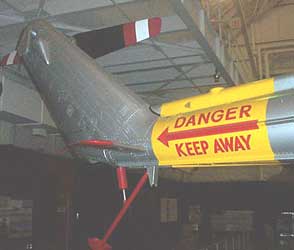 |
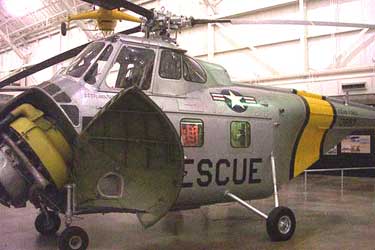
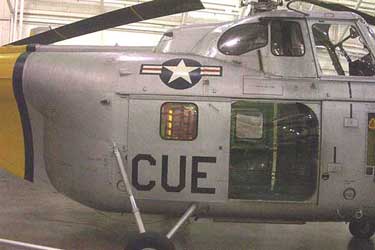
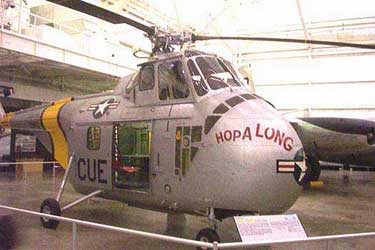
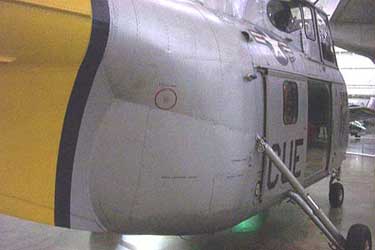
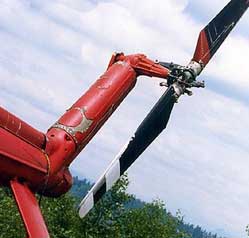
These are
images of the Sikorsky S-55 'Chickasaw' on exhibit at the USAF
Museum, Dayton, Ohio |
|
 |
 |
|
|
 |
 |
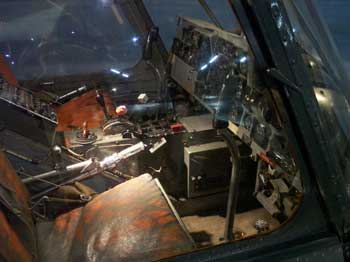 |
| Cockpit of the Sikorsky S-55 |
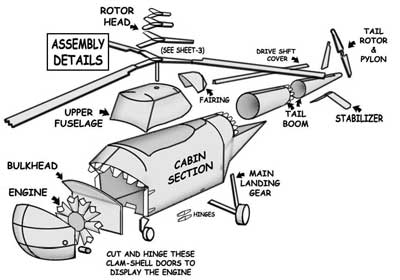
Specifications for the Sikorsky S-55/H-19
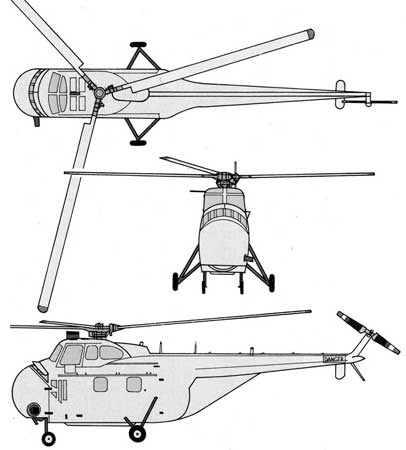 |
Crew: 2 (pilot, copilot) Capacity: 12 troops or 8 litters Length: 62 ft 7 in Rotor diameter: 53 ft Height: 13 ft 4 in Empty weight: 4,795 lb Loaded weight: 7,200 lb Max takeoff weight: 7,900 lb Powerplant: 1× Pratt & Whitney R-1340-57 radial engine, 600 hp Performance Maximum speed: 101 mph Range: 405 mi Service ceiling: 10,500 ft Rate of climb: 700 ft/min |