

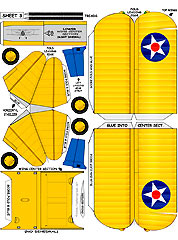
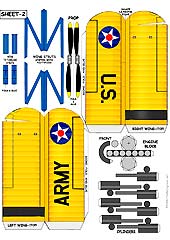
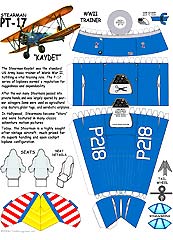
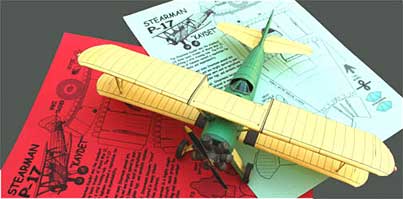
Stearman-PT17 - $$6.95
One of the most widely used basic trainers of the war period was this biplane: the Boeing- Stearman Kaydet which, based on the original Stearman design, was produced by Boeing until February 1945 in a total of 10,346 aircraft to meet the needs of the USAAF and the US Navy. It was also extensively used as a glider tug and crop duster.. 11 different versions

Boeing Stearman PT-17 "Kaydet"
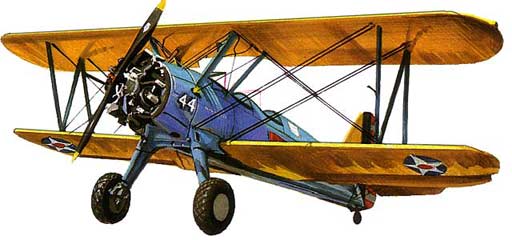
The Stearman Aircraft Company, formed by Lloyd Stearman in 1927,
was bought out by Boeing Airplane Company in 1939.
(Hmmmmm..
Just before the war..??)
In 1933 the Stearman company began design and construction of a new training biplane, derived from the earlier Stearman model C; built as a private venture, this was first flown in December 1933 and, designated originally as the Stearman X-70, was submitted as a contender in 1934 to meet a US Air Corps requirements for a new primary trainer.
What people say...
I remember this one with fond memories!! As a birthday present, I got a metal model of this Stearman Kaydet (US Army version) when I was,, oh,, probably about 7. chip
Good job guys getting this out!! Looking good and nice price. Best of success with this Glenv (the designer)
Oh man, you did a good one here. I've always thought that if I would ever buy a real 'warbird' this would be the one. I had a friend if Phoenix when I lived there, Mike Clarke. Mike owned two of these and a L-4 and we use to go up flying around Saguaro Lake buzzing the sail boats in his Stearman's!! He sold them to buy a P-51D which he quickly crashed out near Prescott in about 1975;-( Anyway, thanks for the great model, hasta, Anthony Golden, Co
Thanks Chip!...The Stearman was great!!!!!!!!Ken
Chip, I think you've made a triple home run with this one.......now, if we could find someone that could make the crop duster version .....the front cockpit was covered over and a spray tank was installed there.....plus the nose was shortened just a tad and a 450 HP Pratt & Whitney was installed in place of the Lycomings....another neat version would be to add the cowling over the Pratt and add wheel pants...that would be the aerobatic version....can you not see the nice young lady standing on the top wing during a loop? I can see this one growing and growing! Thank you for all the great innovation and excitement! Are you on the way back to Arizona? Duck of Flanders Fields.....
Boeing Stearman PT-17
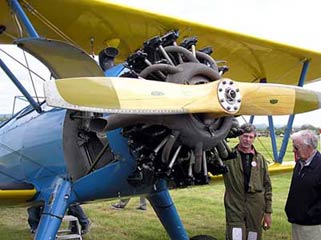 The first service to show positive interest in this aircraft was
the US Navy which, in early 1935.. These, however, received a
different powerplant from that installed originally, primarily
because the US Navy had a lot of 225-hp Wright J-5 radial engines
in storage which were specified for installation in this initial
order, the company changing the model number of these aircraft
to Model 73.
The first service to show positive interest in this aircraft was
the US Navy which, in early 1935.. These, however, received a
different powerplant from that installed originally, primarily
because the US Navy had a lot of 225-hp Wright J-5 radial engines
in storage which were specified for installation in this initial
order, the company changing the model number of these aircraft
to Model 73.
The X-70 supplied for US Army evaluation was subjected to protracted testing and eventually, in early 1936, the USAAC contracted for the supply of 26 aircraft under the designation PT-13 (Primary Trainer, 13). These, powered by 215-hp Lycoming R-680-5 engines, were the first of the Stearman Model 75 series.
This cautious approach by the US Army should not be considered
as a reflection upon the capability of the new trainer. The truth
of the matter was that at that period the USAAC had little money
to spend on new aircraft: not only had this service to be as certain
as possible that it was procuring the best available, but even
then was only able to procure small quantities. Soon, however,
the fortunes of war were to bring Boeing contracts for thousands
of the Stearman-designed trainers. The name Kaydet, bestowed later
by Canada, and adopted generally in reference to these aircraft,
was unofficial except in Canada.
This attractive two-seat biplane was of mixed construction, the single-bay wings being basically of wood with fabric covering, the remainder of welded steel tube with mostly fabric covering. Landing gear was of non-retractable tail-wheel type, the divided cantilever main units having cleanly faired oleo-spring shock absorbers. The powerplant varied considerably throughout a production run which lasted until early 1945, and during which well over 10,000 examples were built.
For the first time both the US Army and US Navy had a common model
in 1942, basically t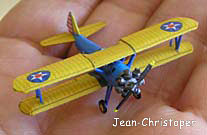 he PT-13A airframe with a Lycoming 8-680-17
engine, and these had the respective designations PT-13D and N2S-5.
he PT-13A airframe with a Lycoming 8-680-17
engine, and these had the respective designations PT-13D and N2S-5.
These were the last major production variants for the US forces, the US Army receiving 318 and the US Navy 1,450. A shortage of engines in 1940-1 had, however, produced two other designations: PT-18 and PT-18A.
The designation PT-27 applied to 300 aircraft procured by the US Army for supply under Lend-Lease to the Royal Canadian Air Force. A small number of these, and of the N25-Ss supplied to the US Navy, had cockpit canopies, cockpit heating, full blind-flying instrumentation and a hood for instrument training.
In North America the Stearman Kaydet retains an aura of nostalgia which Britts equate with such aircraft as the Avro 504 and Tutor, and de Havilland Tiger Moth, or Germans with the Bucker trainers.
When declared surplus at the war's end many served with the air forces of other nations, and large numbers were converted for use as crop dusters. Many remain in operation in this latter role, and the Kaydet is undoubtedly a collector's piece.
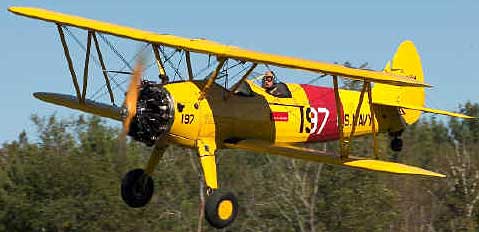 The Stearman Aircraft Company was established by Lloyd Stearman
at Venice, California in 1926, but was soon relocated to Wichita,
Kansas. It eventually became a division of Boeing Aircraft and
was contracted to build training planes for the military, based
on a design by Stearman known as the Army's YPT-9.
The Stearman Aircraft Company was established by Lloyd Stearman
at Venice, California in 1926, but was soon relocated to Wichita,
Kansas. It eventually became a division of Boeing Aircraft and
was contracted to build training planes for the military, based
on a design by Stearman known as the Army's YPT-9.
In the meantime, Stearman, himself, had gone back to California to serve as president of Lockheed while designers at Boeing/Wichita, working under the direction of chief engineer Harold Zipp, continued to make modifications and develop newer versions that resulted in the prototype of the familiar biplanes that we knew in World War IT. Although these were actually Boeing designs known as the type 73 and the type 75, the original name somehow stuck with them over the years and they continued to be known as "Stearmans".
The design was unique in that it met the specifications for both
the Army and Navy. It was a simple, rugged machine that could
withstand a thrashing at the hands of student pilots and it was
easy to maintain and repair.
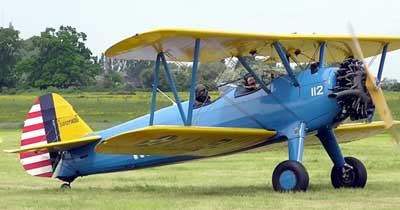
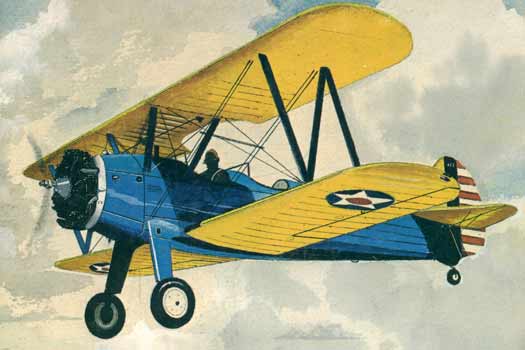
Early versions of the N2S were all yellow while the Army's PT-types
were blue and yellow. Both of them had the old style insignia
with the red ball in the center of each star but the red centers
were discontinued in 1942.
The old Army PT's also had red-and-white stripes with a vertical blue band on their rudders, but these, too, were discontinued at the same time. In 1944, the type 75 was completely standardized for both the Army and Navy and the color scheme for both services by then was overall silver with the later star-and-tab insignia.
After the war, many surplus Stearmans were outfitted with more
powerful engines and adapted for a variety of commercial uses.
Nowadays, many of the remaining Stearmans are being restored to
their original configurations with a noticeable preference for
the original pre-1942 Army or Navy colors and markings.
|
This PT-27 was a result of this confusing system. There were 300 examples and they were all delivered to the Canadian Government. They were basically stock PT-1 7's with a canopy installed, and other minor items that comprised a winterization kit; as they were not identical to the PT-17, they were given the PT-27 designation. Since the airplanes were owned on paper by the U.S.Army, they still had to have a USAAC designation even though the type never was used by the US Army.. |
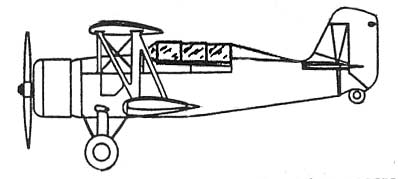
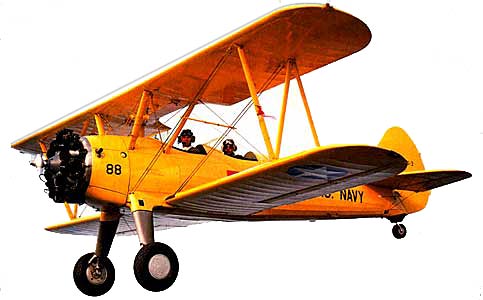
More
about the life after WWII..
After, the war, thousands of Stearmans, as the type was universally
known, came on to the civil market. Some were used for aerobatic competitions
and many were converted to be crop sprayers, then a relatively new
and very dangerous way of making a living as a pilot. Crop-dusting
called for a better performance than the Stearman, when converted
with crop-spraying bars and hoppers, had with the standard engine.
Many were re-engine at low cost with brand-new war-surplus R-985 Wasp junior radials of 450hp - twice the original power. Flying at about 5ft above the crops, the pilots needed good control response and good all-round vision because any obstruction over about 6ft was potentially fatal. The Stearman had good control response but not good all-round vision; however, they were cheap and plentiful.
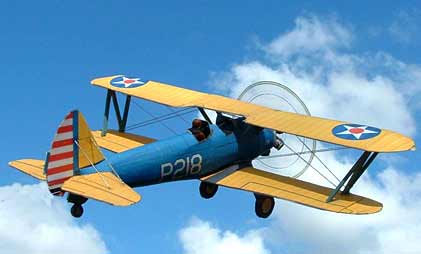
One Stearman, registered G-AROY, was seen in the late 1940s in the UK giving demonstrations of crop spraying. Many remain; most of the surviving crop-dusters have been converted back to the original Second World War P-17 state, as they are now collectors' items. They fly, restored to the gleaming blue fuselage and yellow wings with white ARMY or NAVY emblazoned on them, as in their days of glory.
American and British pilots earning their wings in the prairie states..
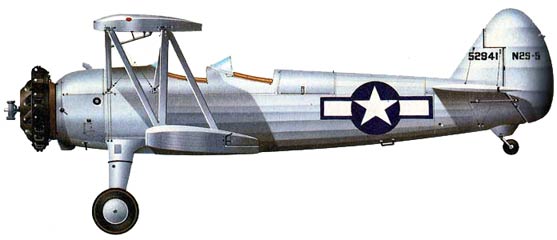
This quite large biplane was the trainer on which nearly all American,
and thousands of RAF and Fleet Air Arm, pilots gained their wings
during the war years. It was the most widely used Allied initial
trainer. After a UK 'grade school', flying DH Tiger Moths, which
removed aspiring RAF pilots who were unlikely to make it, the remainder
were sent overseas to complete the wings course, many to flying
schools in the midwestern United States.
The reason was simply that under wartime restrictions, bad weather and a crowded airspace in the UK. the wide open prairies of the United States offered unbroken training. The Kaydet was built in huge numbers: there were 10,346 total when production was halted in 1945. It was an ideal trainer, easy to fly but difficult to fly well, showing up piloting errors vividly. For a trainer it had a powerful engine, typically an uncowled 220hp Continental R-670-5 radial driving a fixed-pitch two-bladed propeller. The performance was good; maximum speed was 125mph, with landing at 56mph. The biplane handled delightfully and was fully aerobatic.
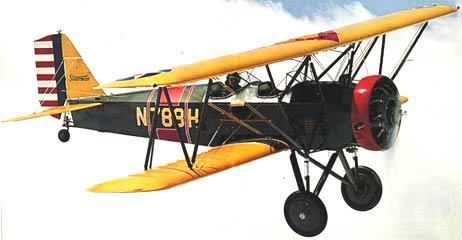
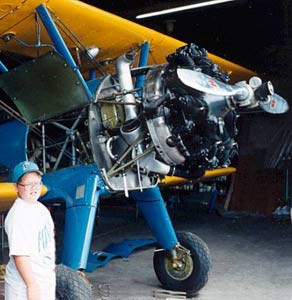 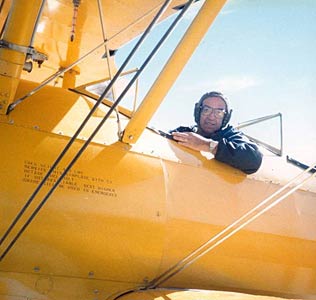 Dick and Bobby Doll getting close up to aviation.. "The attached photos aren't of any model but I thought I'd show you two of the Stearman. The first is me in one in Sonoma around '87, the other is one of our grandsons standing with a Kaydet at an airfield in Pennsylvania." Dick Thanks for the posting of the Stearman pictures. Can't wait for our grandson to see it, he's now 20! Dick D |
 .
. 
Dennis Brooks sends in this valuable (right)
Douglas three view signed by Jack Douglas' wife.
" Dennis.. This is the basic trainer of the WASPS- thought
you might like a copy.. Fern Douglas"
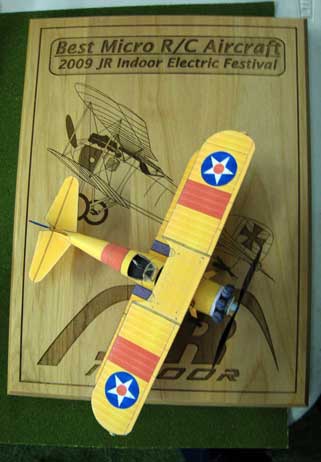 |
Our Stearman PT-17 "Kaydet" cardmodel turned into an R/C Model! |
 |
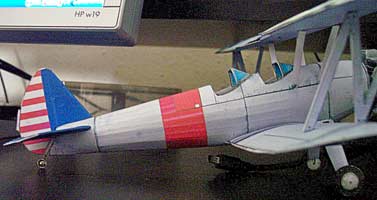 |
Submitted model thanks guys! |
|
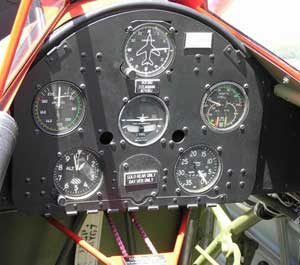 |
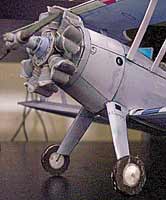
Rear Cockpit of the Boeing Stearman PT-17. |
 |
|---|
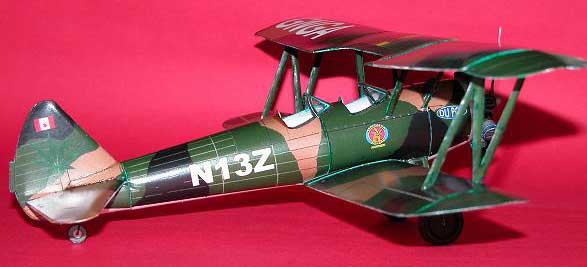
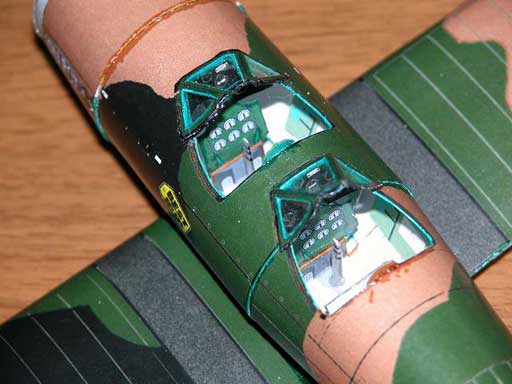 Thanks to Gary Dare ! He writes,, "finished the (Smugglers version) of your PT-17. Very nice model. (FUNNY TOO) Here are a few pictures of it for you to see. Also, I took it to a smoke shop here in town, and The owner let me take pics' of it with his Smoking paraphernalia display. Kinda cool." |
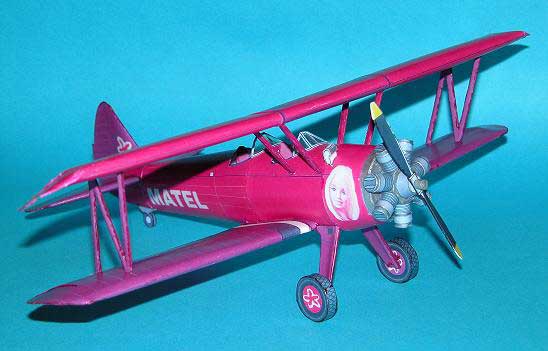
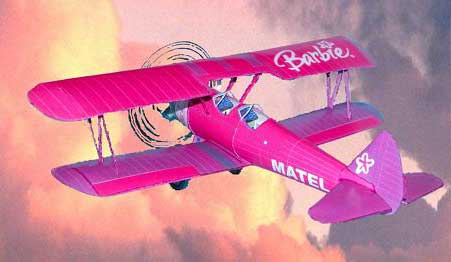 Gary also sends in these Barbie Stearmans that are totally fantasy. We're waiting to hear from the Matel legal dept :)) |
 |
Specifications
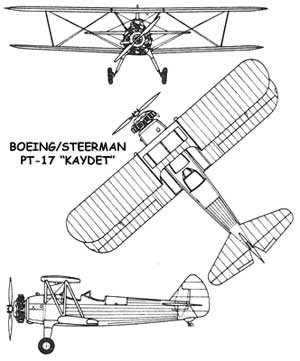 |
Crew: two, student |