

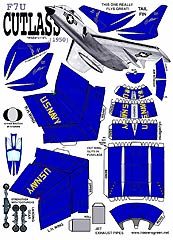
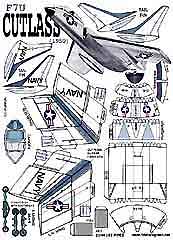
Vought Cutlass - $$5.95
The Vought F7U Cutlass was a United States Navy carrier-based jet fighter and fighter-bomber of the early Cold War era. It was a highly unusual, semi-tailless design, allegedly based on aerodynamic data and plans captured from the Arado company at the end of World War II, though Vought designers denied any link to the German research at the time. It was one of the first combat aircraft to feature a head-up display (HUD), an inertial navigation system (INS), and a turbofan engine.

Vought F7U Cutlass Carrier Fighter Jet
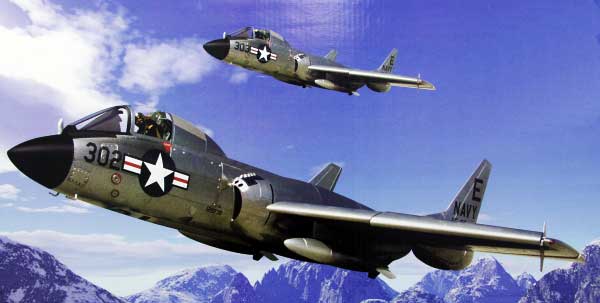
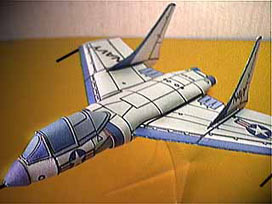
Seeing that the lead in fighter development was falling to the Air Force, the US Navy ordered the radical swept-wing, twin-tailed Cutlass F7U in 1946. It was an extremely aerodynamically advanced and mechanically complicated aircraft for its day. All three of the initial XF7U-1 prototypes crashed. The Cutlass failed its carrier suitability tests and the initial model was retrospectively designated an 'experimental' type. A complete redesign produced the production F7U-3, which proved short-ranged and maintenance intensive. The Cutlass had a complicated hydraulic system, temperamental engines, weak landing gear, and to top it off, unreliable ejection seats.
Although the Cutlass F7U was a dreadful aircraft, it had a claim to fame on several counts. It was the first production naval aircraft to achieve supersonic flight and the first to release bombs at supersonic speed. But its loss rate was phenomenal. In 55,000 flying hours the Cutlass was involved in 78 accidents, of which 21 were fatal, resulting in an accident rate of 17 per 10,000 hours, compared with an average for US Navy combat types of 9.81.
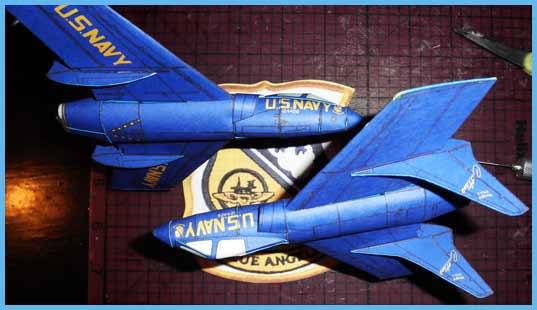
Wishes DO come true! For the kids of the 50s, the Cutlass was the coolest jet in the whole world. As I was building Rob's Cougar last month, I pulled out the Cutlass, looked at it, and wished Rob would work his magic on it. His Blue Angel Cutlass is a significant update (more correctly, a "backdate") that makes into a F7U-1. The changes are much more than a repaint. He has captured the smaller canopy and intakes that make it unique. I hope that he has an F-8 and an F-18 up his sleeve soon. (And I have NASA photo references for him when he does... : - ) Cam Martin
The main body does not fit with the air intake. Had to improvise. Any suggestions? Walter Bartusiak.. Modelers find this is solved with a liittle extra pre-forming..We had little trouble with it ..chip
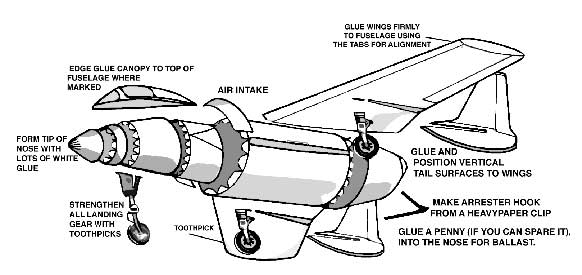
Some airplanes seem to be just perfect for paper modeling!
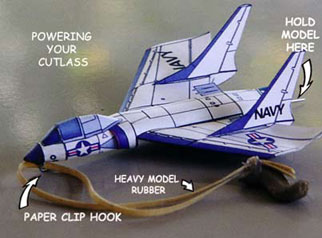
Not only does this model round up perfectly..guess what?! It fly's
fantastically. Simply glue* an opened paper clip under the nose
and launch with a rubber band (see above).
Ballast and balance as needed, Amazing!
It goes straight up, levels off, and glides to the tallest tree
or roof.
|
Vought F7U Cutlass
 The German aircraft industry had built
up a remarkable technical background of
extremely advanced aerodynamic concepts
during World War II. Not only had they
perfected the jet fighter to a degree of
reasonable reliability, they were operating
them in squadron strength. These planes
were so advanced that the speeds at which
they operated brought them onto the
threshold of compressibility. This is a
phenomenon which, expressed in its
simplest terms, means that the aircraft
moves so fast that the air molecules cannot
move out of the way fast enough and
become "compressed" around the airframe,
often causing destructive results.
The German aircraft industry had built
up a remarkable technical background of
extremely advanced aerodynamic concepts
during World War II. Not only had they
perfected the jet fighter to a degree of
reasonable reliability, they were operating
them in squadron strength. These planes
were so advanced that the speeds at which
they operated brought them onto the
threshold of compressibility. This is a
phenomenon which, expressed in its
simplest terms, means that the aircraft
moves so fast that the air molecules cannot
move out of the way fast enough and
become "compressed" around the airframe,
often causing destructive results.
The highly imaginative German engineers had already begun to attack the compressibility problems by designing aircraft with their flying surfaces angled sharply rearward. With the fall of Germany this research material became available to American designers toward the end of 1945. Among the material was found some data on tailless aircraft being studied by the German Arado Company. Guided by this data, Vought engineers devised an unorthodox twin jet carrier fighter which was proposed to the Navy during a design competition in 1946. Though radical in appearance, the tailless configuration promised a substantial performance advancement coupled with carrier compatibility. On June 25, 1946, three XFTU-1 prototypes were ordered, and the raked-wing shape inspired the name Cutlass.
Such a bold departure from the conventional obviously had to produce some new devices for control, and the Cutlass displayed several of these. Since there was no horizontal stabilizing surface, the function of the elevators was taken over by large surfaces built into the wing trailing edges. Called "ailevators," they served the dual function of inducing roll as would conventional ailerons and pitch as elevators. The entire leading-edge of the wing was hinged to slide forward and down to alter the camber of the airfoil for slow speeds. Aerodynamic braking was achieved with a pair of split flaps between the vertical fins and the fuselage side. Operation of the controls from the cockpit was quite normal, however, and the pilot was provided with the conventional stick and rudder pedals for his part in the flight. The Cutlass was the first jet to be designed from the outset to incorporate afterburners. The first flight was made on September 29, 1948, from the Naval Air Test Center, now located at Patuxent River, Maryland. Although the second prototype Cutlass was lost on March 14, 1949, the plane had shown sufficient promise, and 14 F7U-1's had already been ordered for assembly at Vought's new Texas plant.
The teething problems that accompany a
new prototype were found in abundance;
and alterations were 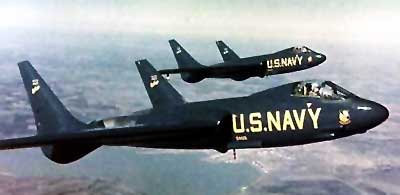 recommended for inclusion in 88 F7U-2's. But a vastly modified
version was.now available, and the -2 stayed
on paper while production turned instead to
the F7U-3.
recommended for inclusion in 88 F7U-2's. But a vastly modified
version was.now available, and the -2 stayed
on paper while production turned instead to
the F7U-3.
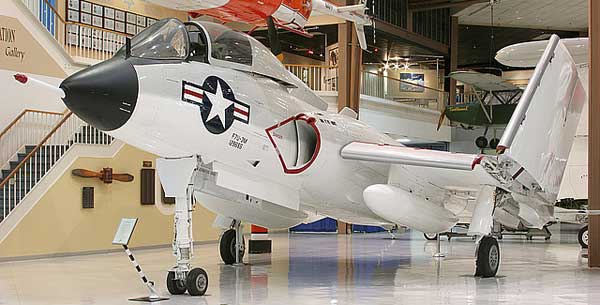
With the F7U-3, only the general arrangement of the original design remained. The XFTU-1 had an elongated nose strut to elevate the ground angle to increase the wing's angle of attack for catapult launching. On the prototypes, this angle was 9 degrees. To further improve the launch characteristics, this angle was increased to 20 degrees on the F7U-3. The four 20 mm cannons were moved from the nose on the F7U-1 to over the air inlets on Vought the later type. This led to some problems of smoke ingestion into the engines when the guns were fired, but this was solved by cut- ting vents into the skin behind the muzzles, Cockpit visibility was improved by enlarging the canopy and cutting the nose sharply down in front of the windshield.
In operations, the Cutlass proved to be structurally sound, and on occasion withstood up to 16 "G's" and -9 "G's" without damage. Its spinning characteristics were looked upon with considerable apprehension, however. Just before entering a stall, the Cutlass tended to flip end over. At that point, the pilot usually parted company with the ship. It was found, however, that by simply releasing the controls, the inherent stability of the design would assert itself and the Cutlass recovered by itself.
The first 16 F7U-3's were constructed with Allison J35-A-29's without after- burners when development problems slowed delivery of the power-booster. Sub- sequent F7U-3's were equipped with after- burning Westinghouse J46-WE-8 units of 4,000 lbs. of thrust normal, but boosted to 5,725 lbs. with afterburning.
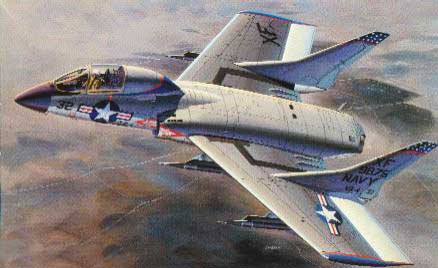 Cutlasses were assigned to four Navy
squadrons-VF-81, VF-83, VF-122 and VF-
124. Two of the tailless fighters were given
to the Marines for high-speed mine-laying
tests. In service, the Cutlass proved to be a
problem child. Maintenance time was high
and the fighter was subject to an excessive
accident rate during carrier operations.
Cutlasses were assigned to four Navy
squadrons-VF-81, VF-83, VF-122 and VF-
124. Two of the tailless fighters were given
to the Marines for high-speed mine-laying
tests. In service, the Cutlass proved to be a
problem child. Maintenance time was high
and the fighter was subject to an excessive
accident rate during carrier operations.
Two of the original F7U-1 Cutlasses were used by the Navy's Blue Angels demonstration team, their unique shape presenting a startling contrast to the rest of the team's F9F Panthers. The F7U-1 had two 3,000 lb. thrust Westinghouse J34-VE-32 engines and a wingspan of 38 feet 8 inches. Wing area was 4)6 square feet. Length was 39 feet 7 inches and height was 9 feet 10 inches. Empty and gross weights were 9,565 pounds and 14,505 pounds respectively. Maximum permissible weight was 16,840 pounds, which included 971 gallons of fuel. This provided a f.erry range of 1,170 miles. Maximum speed of the F7U-i with afterburning was 672 mph at 20,000 feet. Service ceiling was 41,400 feet.
The F7U-3 was somewhat larger than the -1 models. A total of 290 of this tyPe were built, including 98 F7U-3M's armed with four Sparrow missiles on underwing pylons to supplement the four cannons. Also included in the total are 12 F7U-3P reconnaissance machines. The F7U-3 used a pair of Westinghouse J46-VE-8A powerplants with 4,600 lbs. of thrust normally and 6,100 lbs. with afterburning. With this power, the maximum speed was 680 mph at 10,000 feet with a rate of climb of 13,000 fpm. Service ceiling was over 40,000 feet.
The F7U-3 wingspan was 39 feet 8 inches, length was 43 feet 1 inch, and height was 14 feet 7 inches. The Cutlass was not the Navy's first tailless aircraft. That distinction goes to the Burgess-Dunne AH-7 tailless biplane of 1916.
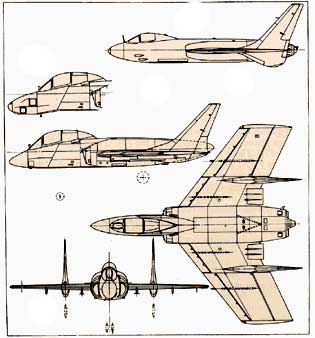
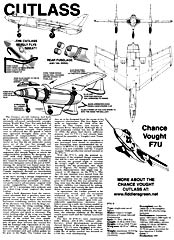
Among the large quantities of German aeronautical research data
which began to reach the USA in the latter part of 1945 were details
of some work on tailless designs done by the Arado company. Development
of these designs by the Chance Vought company led to production
of the highly unconventional F7U Cutlass. The wing, with a sweep back
of 38 degrees, was of very low aspect ratio, 3 :1, and almost
parallel chord. Pitch and roll controls were combined in elevons
on the wing; fins and rudders were located on the wing at the
ends of the center section.It enjoyed only limited success and service, and had a bad safety
record: over about 25% were lost in accidents in three years of
service and was dubbed the “Gutless Cutlass”.
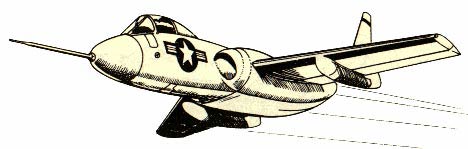
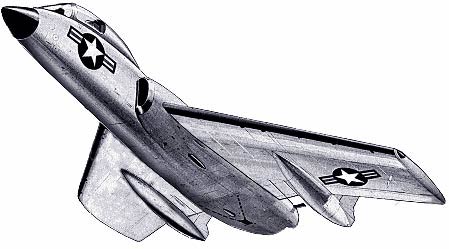
The Cutlass was a very unusual Vought design for a tailless fighter, with a swept wing and twin fins on the trailing edge near mid-span. The original F7U-1 was very unsatisfactory; after much redesign the F7U-3 entered service. 290 built.
Laid out as a carrier-based fighter, this design
offered a high rate of climb and high top speed combined with comparatively
small size when the outer wing panels were folded up for carrier
stowage. The US Navy ordered three XF7U-1 prototypes on June 25,
1946, specifying Westinghouse J34-WE-32 engines with afterburners.
The first flight was made on September 29, 1948, by which time
a production contract for 14 F7U-ls had been placed while development
of the F7U-2 with J34-WE-42 engines and the F7U-3 with J46-WE-8As
was initiated.
The first F7U-l flew on March 1, 1950, and the entire batch of
this model was assigned to the Advanced Training Command at Corpus
Christi Naval Air Station during 1952. Difficulties with the Westinghouse
J34 program resulted in cancellation of the F7U-2 before completion,
while early experience with the F7U-1 airframe led to an extensive
redesign for the F7U-3. First flown on December 20, 1951, the
latter model had a new nose shape, redesigned fins and other changes.
Basic armament of the F7U-3 comprised four 20 mm cannon in the upper lips of the intake fairing, with provision for underwing rocket pods or various other stores. Subsequently, provision was made for the Cutlass to carry four Sperry Sparrow I beam-riding missiles in the F7U-3M version, of which 100 were built, and 12 examples of a camera-equipped variant, the F7U-3P, also went into service. Production ended in December 1955 when 290 F7U-3 Cutlass variants had been delivered.
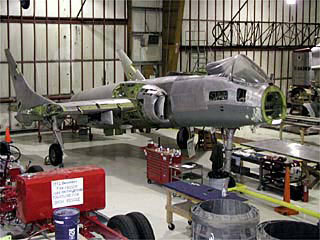 |
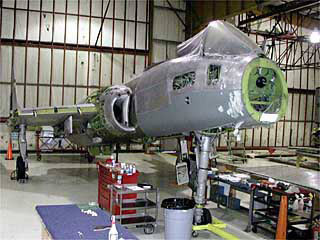 |
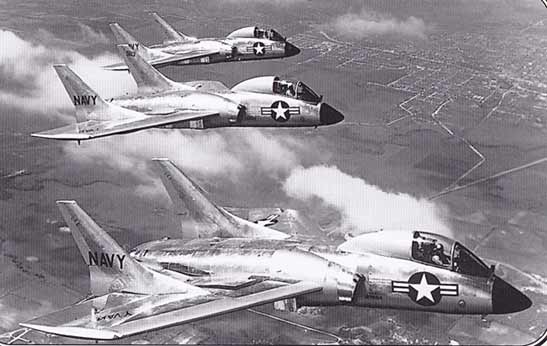 |
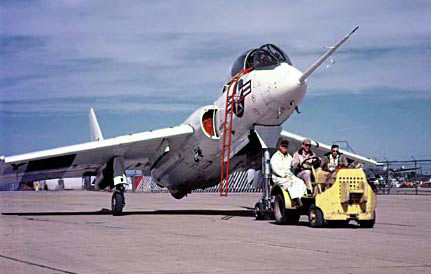

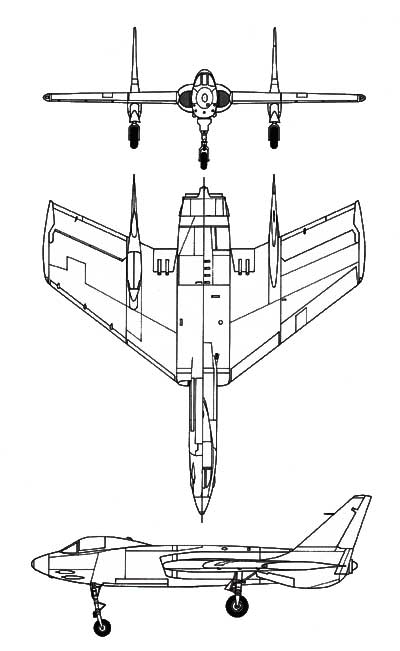
Specifications for the Vought F7U Cutlass
 |
Length: 44 ft 3 in |
 |
||
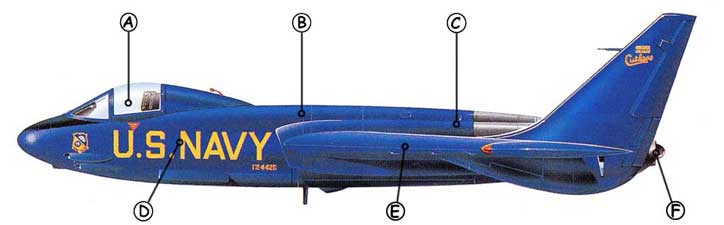
| A: The long nosewheel leg put the pilot 15ft above the ground, and a collapse invariably resulted in injury. The strut was sometimes forced into the base of the ejection seat, causing it to fire. | B: When the hydraulics failed a manual control system kicked in, but only after 11 seconds, during which the Cutlass went where it had last been pointed. | C: Use of the afterburners drained the central transfer tank so fast that it was possible to flame-out the engines just after take-off even though the wing tanks of the F7U were full. |
| D: US Navy pilots disliked the Cutlass so much that they nicknamed it the 'Gutless'. Much of the F7U fleet was non-operational during its seaborne deployments. | E: The Cutlass is usually remembered for its poor safety record, with over a quarter of the 300 F7Us built being lost or involved in serious accidents. | F: The J46 engines intended for the F7U- 1 were not ready in time and the even lower- powered Allison J35 had to be used instead, giving marginal performance for carrier operations. |
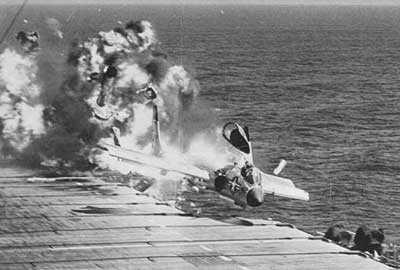 |
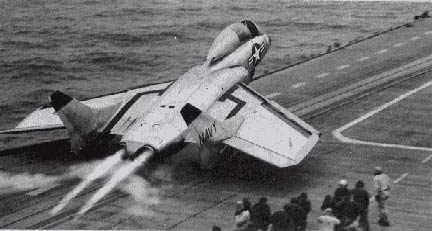
Ramp strike of a Vought F7U-3 Cutlass on the aircraft carrier USS Hancock on July 14, 1955. The pilot, LCDR Jay Alkire, USNR, of fighter squadron VF-124 Stingrays, Carrier Air Group Twelve , was killed. Also killed were two boatswain's mates, and one photographers mate, in the port catwalk by burning fuel. |