

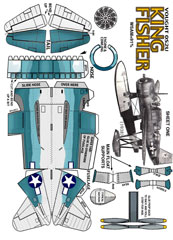
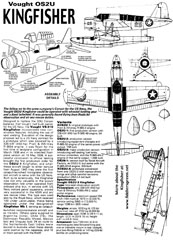
Kingfisher - $$5.95
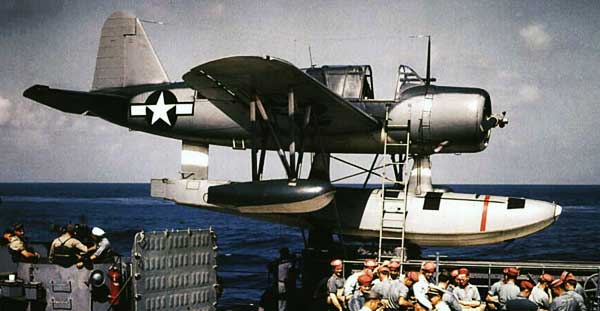
Of the several observation and scouting airplanes available to the Navy when the US entered World War II, the VS-310 Kingfisher was to prove the most useful and the most used predominately as "eyes" for the big guns of the battleships and cruisers and for rescue work.

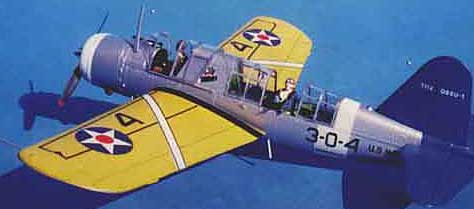
Vought OS2U WWII Kingfisher
Kingfishers were in the action all the way, from the attack on Pearl Harbor to the "signing" on the decks of the Missouri. In between these two momentous events the rugged OS2U served the fleet in numerous capacities but predominately as "eyes" for the big guns of the battleships and cruisers and for rescue work.
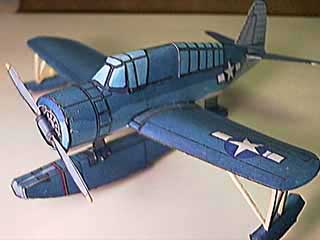
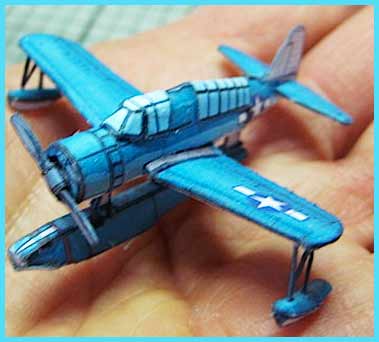
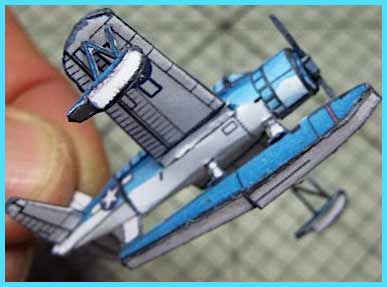
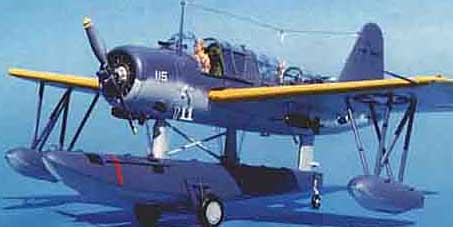
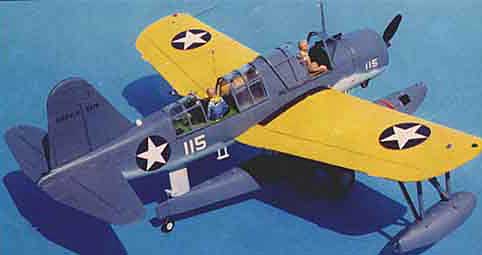
This is the Vought Kingfisher model that won the FG Modeling Madness (FGMM) 2010 best in class prize. Thanks to Chris Walas who donated his $20 prize money toward modeling materials for hospitalized vets!! |
|
 |
 |
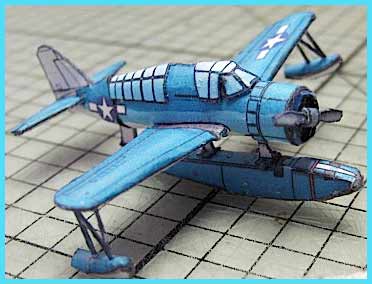 |
This is a relatively early (i.e. simple) FG model, so I shrunk it down a bit. It was a fun and quick little build and I always liked the prototype. Like a number of the early FG designs, I’d love to see this one updated to the new standards. But these early designs do scale down easily. -Chris |
Vought OS2U Kingfisher
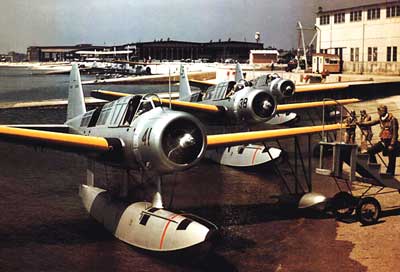
Of the several observation and scouting aeroplanes available to the Navy when the US entered World War II, the VS-310 Kingfisher was to prove the most useful and the most used. Incorporating some revolutionary structural techniques including spot welding, the Kingfisher was based upon the Vought company's considerable experience of observation aircraft and was designed to replace earlier Vought biplanes in a similar role.
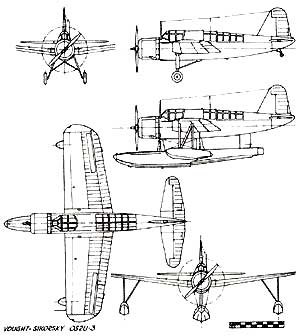
Layout of the fuselage was similar to that employed in the biplane scouts, as also was the use of a large single float plus underwing stabilizing floats. Alternatively, a conventional tail wheel undercarriage could be fitted.
Prior to the widespread use of shipboard and airborne radar, Navy
scout/observation aircraft were extensively used as "eyes
of the fleet." Operating from cruisers and battleships, these
aircraft observed enemy ship movements, spotted own ships' gunfire,
and performed air-sea rescue missions.
The Navy's overworked and aging O2U-1 Corsair scout/observation biplanes, having been in service for many years, needed to be replaced. In 1937, the Navy requested bids for a new dual-purpose scout aircraft that could be operated from either land or water, and be catapulted from cruiser and battleships. Chance-Vought's entry, the XOS2U-1, was a radical departure from the other entries. It was a two place mid-wing monoplane, powered by a 450 hp Pratt & Whitney R-985-4 nine-cylinder Wasp engine. The XOS2U-1 was first designed as a land plane, and the addition of a single main float and wing-tip floats gave it a seaplane capability.
Each version was successfully flown in March and May 1938, respectively. Successful catapult trials aboard the USS West Virginia (BB 48) in August 1938 resulted in a production contract with Vought for fifty-four OS2U-1s to be delivered over a seven-month period from May to December1940. The OS2U-1, now designated as the "Kingfisher," was armed with a fixed Browning .30-caliber machine gun in the nose, and a flexible .30-caliber gun operated by the radio operator/observer from the rear seat position.
In December1939, the Navy issued a follow-on contract for 158
improved Kingfishers, 45 as seaplanes and 113 as land-plane versions.
The improved OS2U-2 included self-sealing fuel tanks, armor, and
additional fuel capacity. The aircraft were delivered to NAS Pensacola
and Jacksonville to form patrol squadrons operating in the Atlantic
along the East Coast, Panama, and bases in the Pacific. The seaplane
version of the Kingfisher, operating from shore stations, utilized
wheeled beaching gear, which was removed by Navy ground crews
after taxiing into the water. The gear was reinstalled upon completion
of the flight. Shipboard catapult versions required no beaching
gear. A large number of OS2Us were also based at NAS Jacksonville,
Pensacola and Corpus Christi, operating as advanced seaplane trainers.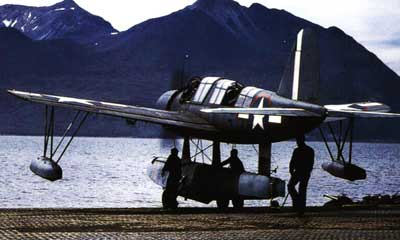
Wheel-equipped land-based Kingfishers operated from the Atlantic, Pacific and Alaskan coasts, flying anti-submarine patrols, carrying a 325-pound depth charge under each wing. They also flew escort to convoys, protecting the ships against submarine attack.
The OS2U-3 was the most widely produced version of the Kingfisher, numbering over 970 aircraft. It was powered by a 450 hp Pratt & Whitney R-985-AN-2 engine, and included additional armor protection over the -2 model. During 1942, Vought transferred production of the Kingfisher to the Naval Aircraft Factory in Pennsylvania to free up its assembly line for the production of the Chance Vought F4U Corsair. Designated as the OS2N-1, the NAF produced some 300 aircraft, including an additional thirty assembled from Vought-supplied spare parts.
Over the years, a total of 1519 Kingfishers were produced. They were also exported to the British Royal Navy, the Royal Australian Air Force, and many South American countries, including Chile, Mexico, Uruguay, Argentina, and the Dominican Republic. Although the Kingfisher was primarily a scout/observation aircraft, it was best known for its daring rescues of downed pilots, many in enemy waters. One of several unbelievable rescue missions occurred on November11, 1942,when Lt.(jg) F.E. Woodward and ARi LB. Boutte found and rescued a crew, including Capt. Eddie Rickenbacker, who were downed in late October 1942 and adrift for three weeks.
Unable to pull all the men into his aircraft, named the "BUG," Woodward lashed Rickenbacker and one other man to the wing and taxied some forty miles to land. The "BUG" was famous, as it also survived the Pearl Harbor attack while aboard the USS Pennsylvania. Another unbelievable rescue mission occurred on February 18, 1944, Lt.(jg) George M. Blair of Fighting Nine was shot down over Truk by antiaircraft fire. His Mae West was his only floatation device, as his rubber raft was riddled with holes. An approaching Japanese destroyer lobbed five-inch shells at him, but his fellow pilots, after radioing his position, set up a strafing circle and repeatedly drove off the destroyer. After several lonely hours of floating around the Truk lagoon, an OS2U Kingfisher from one of the cruisers m the task force suddenly appeared, guarded by several fighters. The Kingfisher, piloted by Lt.(jg) Denver Baxter with Chief Radioman R.F. Hickman flying rear seat, landed inside the lagoon and taxied over to Blair.
Hauling him into the rear seat on Hickman's lap, the OS2U took off. When the OS2U was hoisted aboard its cruiser, only one pint of fuel remained in its tanks, as it carried only enough fuel for the round-trip flight to allow for the extra passenger. A contract to build a single prototype XOS2 U-I was placed by the Navy on March 22, 1937, resulting in an aircraft 1938 with a 450 hp Pratt & Whitney R-985-4 engine, making its first flight on July 20. The first of 54 examples reached the Fleet in August 1940, and six had been assigned to the Pearl Harbor Battle Force before the end of the year. The OS2U-3 itself differed from earlier models in having extra fuel tanks in the wings and better armor protection for the pilot and observer. Starting in 1941, Vought delivered 1,006 OS2U-3s before production ended in 1942.
 The people of Yaptown, Yap Island in the Carolinas, basked in
a pleasant, typical Pacific morning sun on the 27th of July 1944.
The big harbor was peaceful; only an occasional whitecap broke
the monotony of its surface. Overhead were scattered, fluffy cumulus
clouds, cotton-balls hanging listlessly in the rich blue sky.
Then, Task Force 58 with its 125 ships of the line (sixteen carriers)
struck from fifty miles away. Around mid-day Avengers and Hellcats
of VT-31 and VF-31 from the carrier Cabot struck Yaptown from
the inland side of the city. The Avengers, each armed with four
100 pound general purpose bombs, made their bomb runs from 15,000
feet dropping down over the target then leveling off at 500 feet
as they raced out over the harbor.
The people of Yaptown, Yap Island in the Carolinas, basked in
a pleasant, typical Pacific morning sun on the 27th of July 1944.
The big harbor was peaceful; only an occasional whitecap broke
the monotony of its surface. Overhead were scattered, fluffy cumulus
clouds, cotton-balls hanging listlessly in the rich blue sky.
Then, Task Force 58 with its 125 ships of the line (sixteen carriers)
struck from fifty miles away. Around mid-day Avengers and Hellcats
of VT-31 and VF-31 from the carrier Cabot struck Yaptown from
the inland side of the city. The Avengers, each armed with four
100 pound general purpose bombs, made their bomb runs from 15,000
feet dropping down over the target then leveling off at 500 feet
as they raced out over the harbor.
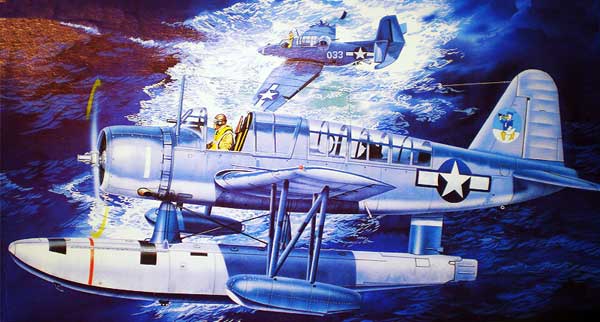
In mid-run to target a TBM of VT-31 is hit in the main fuel tank by flak. The pilot drops his bombs. The cockpit is burning. Still he holds the big ship at 500 feet until his two crewmen finally clear their aft compartment, which is also burning. Only then does the pilot leave the burning aircraft. Three are burned and down in the harbor. The enemy shore installations begin firing on them, but the shots pass overhead. The guns cannot be depressed low enough to get them, and the three are just beyond the range of smaller weapons. While VF-31 Hellcats go to work strafing the shore batteries, a call is Hashed to the anti-sub patrol for a Kingfisher.
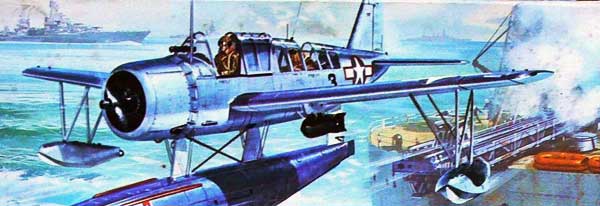
Within minutes a Kingfisher from the cruiser Columbia was on the scene, its pilot bringing the aircraft in low and straight for the wounded Avenger crewmen. Now the shore batteries took him on as a target. The water came alive from exploding shells, still the OS2U came on to the men. After loading the TBM's pilot into the rear seat, his two crewmen sat on the wings and held on. The OS2U pilot would now dash over the water for the pick-up submarine five miles away. On the way out the Kingfisher pilot must pass through the entire effective range of the guns on the beach- and it is this section of the action that you see in the painting.
Thanks to a Kingfisher and her pilot and radioman-gunner, three more American lives were saved. After the long taxi to the submarine, the two Avenger-enlisted crew members were transferred. Then, with the Avenger pilot still snuggled down in the rear seat and its usual occupant setting astride the fuselage just behind him, the OS2U pilot took off for a rendezvous with the Columbia.
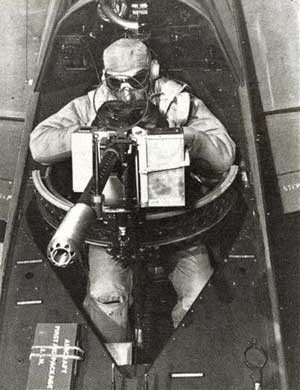 |
The rear gunner's position on the OS2U. He mans a .30 calibre Browning mg which could transverse an arc of 208 degrees, interrupted by the vertical tail. |
 |
 |
 |
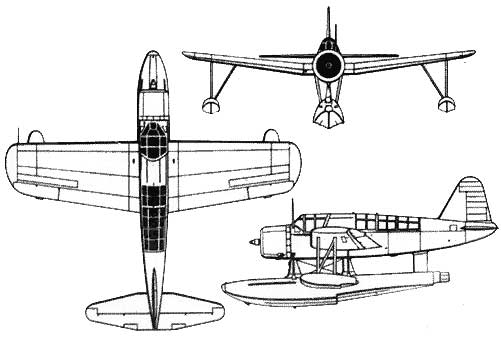
Specifications for the Vought OS2U Kingfisher
 |
Crew: Two, pilot and observer |
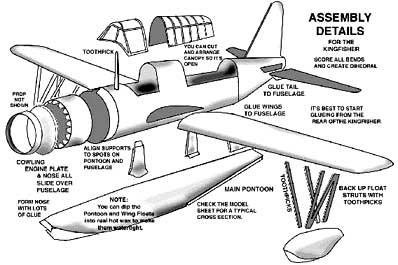
BEGINNERS GUIDE - HOW TO BUILD FIDDLERS GREEN MODEL OS2U KINGFISHER
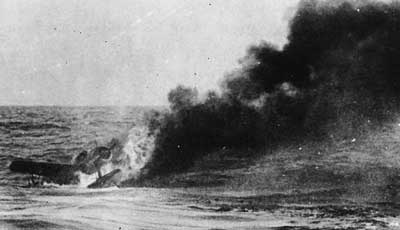 |
Vought OS2U destroyed by gunfire after airmen were rescued by USS Tang near Turk , 1944 |