
Airco-DH2 - $$5.50
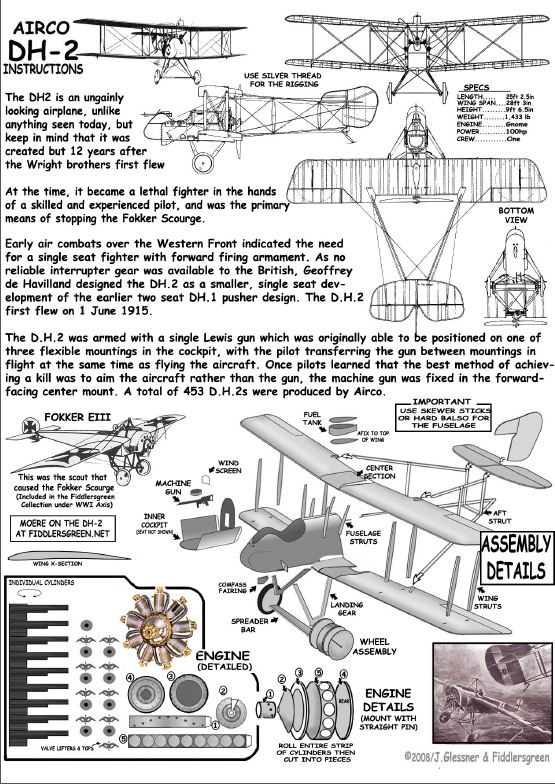
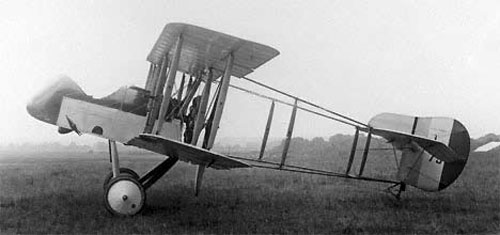
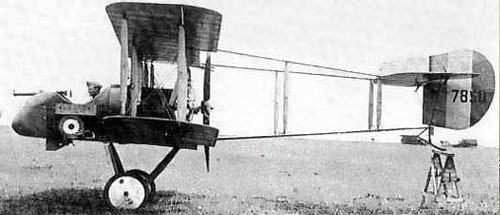
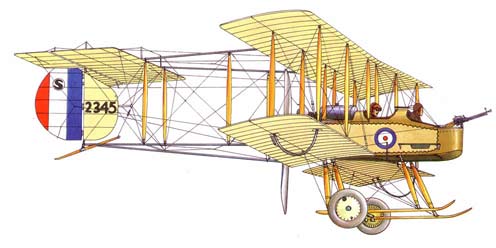
Early air combat over the Western Front indicated the need for a single seat fighter with forward firing armament. As no reliable interrupter gear was available to the British, Geoffrey de Havilland designed the DH.2 as a smaller, single seat development of the earlier two seat DH.1 pusher design.

De havilland Airco DH-2 WWI Scout
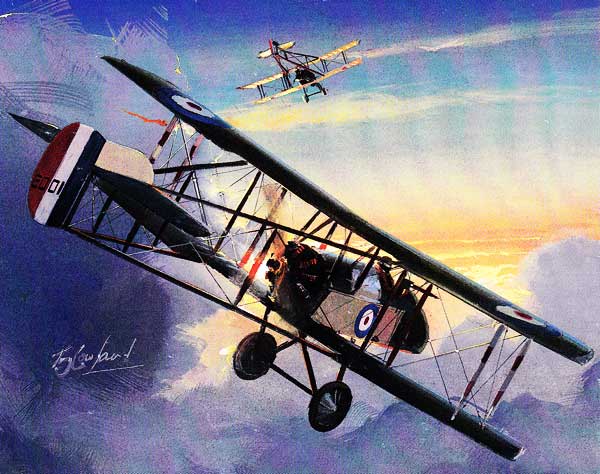

The DH.2 ultimately equipped six fighter squadrons. The little pusher quickly proved itself more than a match for the Fokker Eindecker, and was heavily engaged during the Battle of the Somme, 24 Squadron alone engaging in 774 combats and destroying 44 enemy machines. The DH.2 had sensitive controls and at a time when service training for pilots in the RFC was very poor it terrified some pilots, who nicknamed it the "Spinning Incinerator", but as familiarity with the type increased, it was recognized as very maneuverable and relatively easy to fly.
The arrival at the front of more powerful German tractor biplane
fighters such as the Halberstadt D.II and the Albatros D.I., which
appeared in September 1916, meant that the DH.2 was outclassed
in turn. It remained in first line service in France, however,
until No. 24 and No. 32 Squadron RFC completed re-equipment with
Airco DH 5s in June 1917, and a few remained in service on the
Macedonian front until late autumn of that year. By this time
the type was totally obsolete as a fighter, although it was used
as an advanced trainer into 1918.
Distinguished pilots of the DH.2 included Victoria Cross winner Lanoe Hawker (eight victories), who was the first commander of No 24 Squadron and ace Alan Wilkinson (10 victories). The commander of No 32 Squadron Lionel Rees won the Victora Cross flying the D.H.2 for attacking a formation of 10 German two-seaters on 1 July 1916. German ace and tactician Oswald Boelcke was killed during a dogfight with 24 Squadron D.H.2s, although it should be noted that this was due to a collision with one of his own wingmen.
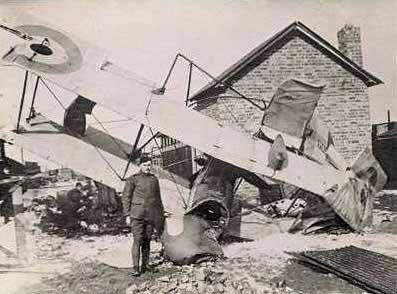
DH.2s were progressively retired by war's end and no surviving airframes were retained. In 1970, Walter M. Redfern from Seattle, Washington built a replica DH.2 powered by a Kinner 125-150 hp engine and subsequently, Redfern sold plans to home builders. Currently a number of the DH.2 replicas are flying worldwide. After evaluation at Hendon on 22 June 1915, the first Airco/De havilland DH.2 arrived in France for operational trials with No. 5 RFC Squadron but was shot down and its pilot killed (although the Airco DH.2 was recovered and repaired by the Germans).
No. 24 Squadron RFC, the first squadron equipped with the Airco DH.2 and the first complete squadron entirely equipped with single-seat fighters in the RFC (or, incidentally, any other flying service), arrived in France in February 1916.
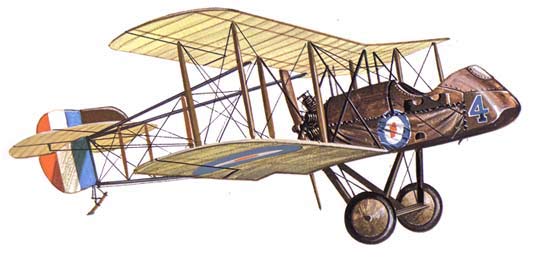
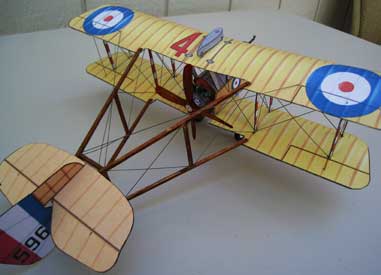
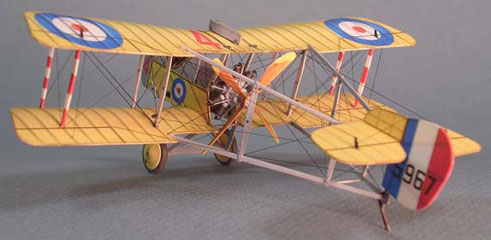
Finally finished the Airco Dh-2. Beautiful plane and beautiful model. Photos attached. The designer did a great job on her. Well worth the effort and timeline to bring this model to fruition. This was a fun build and the most research I've put into a model yet. Will get a review/build write up on my site next week sometime. 11/09 Joe Golden
|
 |
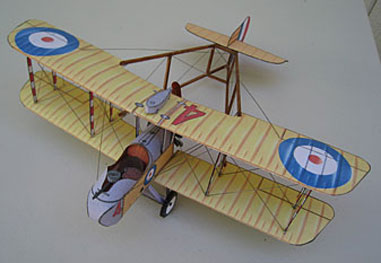 |
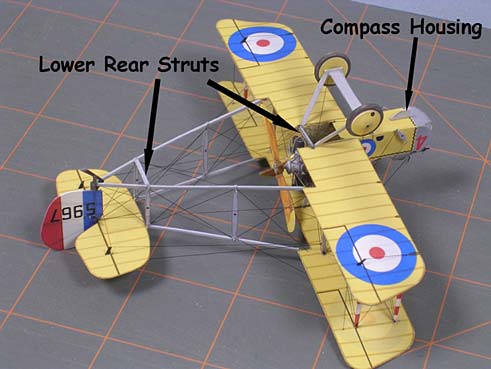
Here are some photos of my DH-2, hope you enjoy them. The rigging is done with fine piano wire, and the prop is hand carved from balsa, Keep up the good work. I would like to see some more bombers in the future, maybe a Lancaster, or a Betty. Steve Scripilliti |
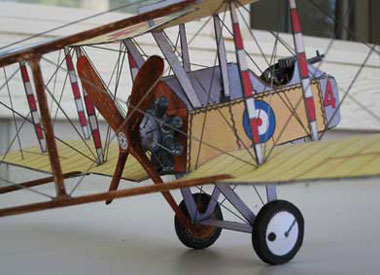
Airco De havilland DH.2
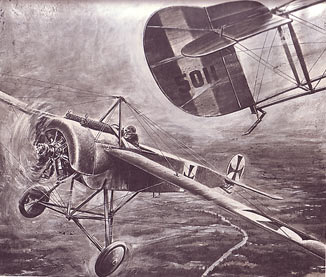 The first prototype of the Airco De Havilland DH2 reached the front
on July 26, 1915, and immediately ran out of luck. On August 9,
the aircraft, piloted by Captain 11. Maxwell-Pike, disappeared behind
the German lines. The pilot had been wounded and the DH 2 was in
German hands. Right up to the end of the war experiments were made
with various engines, and for a short time, DH 2's were used experimentally
against Zeppelins. Though its fame was short-lived, it was still
in service until 1918. The Airco DH.2 was a single-seat biplane "pusher" aircraft which operated as a fighter during the First World War. It was the second pusher design by Geoffrey de Havilland for Airco, based on his earlier DH.1 two-seater. The DH.2 was the first effectively armed British single-seat fighter and enabled Royal Flying Corps (RFC) pilots to counter the "Fokker Scourge" that had given the Germans the advantage in the air in late 1915. Until the British developed an interrupter gear to match the German system, pushers such as the DH.2 and the F.E.2b carried the burden of fighting and escort duties.
The first prototype of the Airco De Havilland DH2 reached the front
on July 26, 1915, and immediately ran out of luck. On August 9,
the aircraft, piloted by Captain 11. Maxwell-Pike, disappeared behind
the German lines. The pilot had been wounded and the DH 2 was in
German hands. Right up to the end of the war experiments were made
with various engines, and for a short time, DH 2's were used experimentally
against Zeppelins. Though its fame was short-lived, it was still
in service until 1918. The Airco DH.2 was a single-seat biplane "pusher" aircraft which operated as a fighter during the First World War. It was the second pusher design by Geoffrey de Havilland for Airco, based on his earlier DH.1 two-seater. The DH.2 was the first effectively armed British single-seat fighter and enabled Royal Flying Corps (RFC) pilots to counter the "Fokker Scourge" that had given the Germans the advantage in the air in late 1915. Until the British developed an interrupter gear to match the German system, pushers such as the DH.2 and the F.E.2b carried the burden of fighting and escort duties.
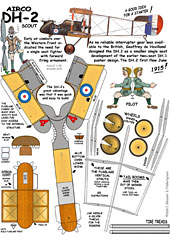
CAMOUFLAGE AND INSIGNIA
With the outbreak of WWI, it became evident that the airplane
had to be rendered less visible, both on land and in the sky.
Up to this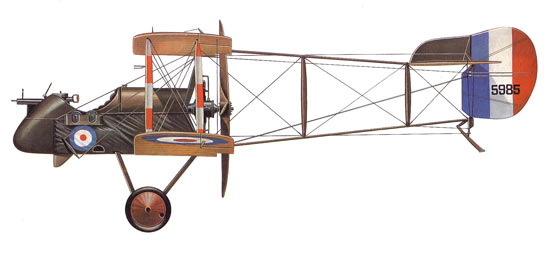 point, no one had really given much thought to an
airplane's appearance, but now every nation had to face the
problem of camouflage, oftentimes coming up with Q quite original
solutions. The colors tended toward dark greens and browns for
the top surfaces, light beige and blues for the bottom. It
was also necessary to be able to distinguish friend from foe,
so each nation developed its own system of identification codes
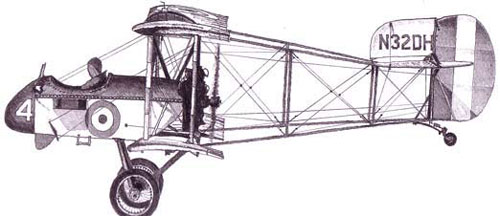
and insignia. The Allies used three concentric circles, their
colors varying from country to country, while the Germans chose
a white square framing a black cross, symbol of the Teutonic
Knights.
point, no one had really given much thought to an
airplane's appearance, but now every nation had to face the
problem of camouflage, oftentimes coming up with Q quite original
solutions. The colors tended toward dark greens and browns for
the top surfaces, light beige and blues for the bottom. It
was also necessary to be able to distinguish friend from foe,
so each nation developed its own system of identification codes
and insignia. The Allies used three concentric circles, their
colors varying from country to country, while the Germans chose
a white square framing a black cross, symbol of the Teutonic
Knights.
An important discovery was the optical effect crested by stripes
of two or more colors, which served to 'dissolve' the plane's
silhouette, a camouflage technique favored mostly by the French
and the Germans. This evolved into even more sophisticated patterns
of interlocking polygons of four or more different colors which
were effective on both the top and bottom surfaces.
THE ROTARY ENGINE
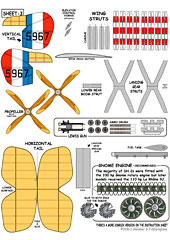
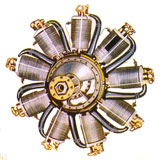
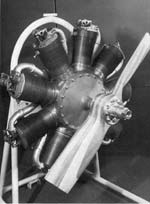
By 1909 their Parisian factory, the Societe des Moteurs Gnome, was producing the first of which would become a long series of ever more powerful engines that dominated airplane manufacture throughout World War I. The main architectural innovation of the rotary engine lay in the mobility of the cylinders: only the crankshaft was bolted down, while the crankcase end radially-arranged cylinders rotated freely around it, thereby driving the propeller.
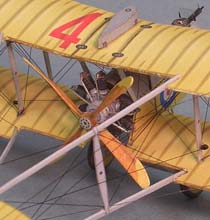
The result was an air-cooled propulsion unit, compact and light, with a particularly favorable weight-to-power ratio ideal for machines that had to be, above all else, lightweight and fast. Moreover, its elevated torque and consequent gyroscopic effect gave the airplane exceptional agility. The rotary engine inevitably became the preferred means of propulsion for fighter planes end, given the times, demand from all over Europe was soon soaring. The Germans, despite having developed several excellent inline engines over the years, turned to the rotary, the most famous of which was the Oberursel, more or less an exact copy of a French engine made by Le Rhone, a company that merged with Gnome in 1919. Over the course of their development, these engines grew' in power from 50 to nearly 200 horsepower by war's end. The most widely used configuration had nine cylinders. |
 |
 |
 |
 |
 |
Help... |
 |
The Vickers company overcame the problem of firing a machine-gun forward, on the Gunbus, by making the aircraft a two-seater with a pusher engine and seating a gunner in the nose. This made it easier on the pilot but also created a large, less nimble fighter for the Allies. |
Specifications for the de Havilland (Airco) DH.2
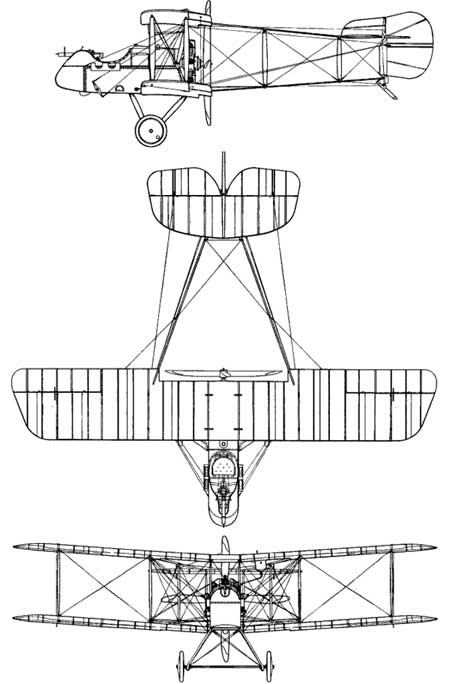 |
Crew: 1
|
 |
||
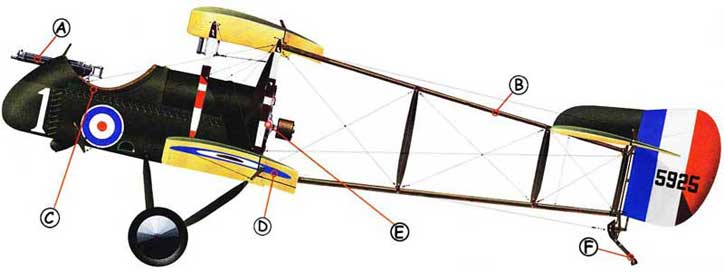
| A: Once pilots had adopted the tactic of aiming the aircraft not the gun, the gun was fixed in position but some movement up and down was allowed for minor aiming corrections | B: While they might appear fragile, the tubular steel tailbooms of the DH.2 were comprehensively rigged, which made them strong and flexible. | C: Not only was the pilot expected to juggle his Lewis gun from side to side while maintaining control of the aircraft during combat, but he also had to change the heavy 47-round ammunition drums as they became empty. |
| D: Top and bottom wings carried ailerons. Once initial structural problems had been overcome and pilots had mastered its tricky handling, the DH.2 proved to be a maneuverable fighter. | E: Most DH.2s were powered by the Gnome Monosoupape rotary engine, but some later aircraft featured the 110 hp. Le Rhone engine. | F: A steerable tailskid aided ground handling, which was also improved, along with flight performance. |