

Bell-Model30 - $$4.95
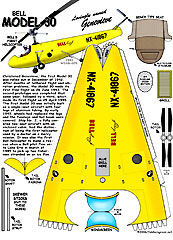
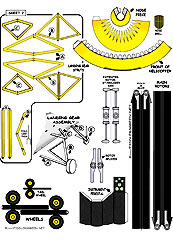
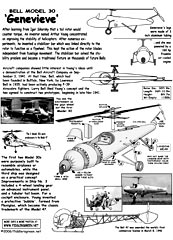
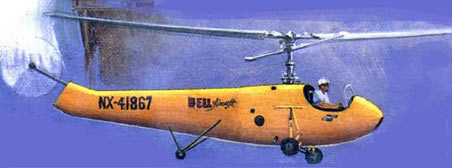
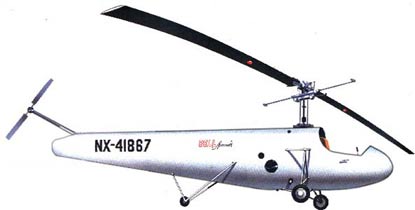
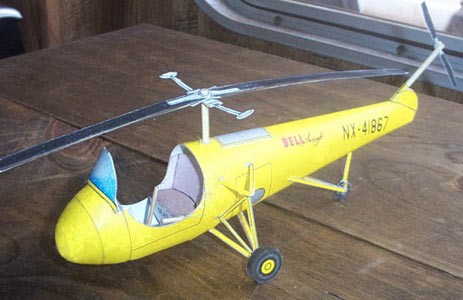
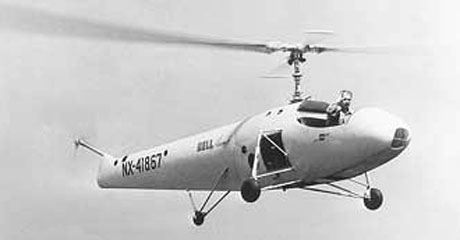
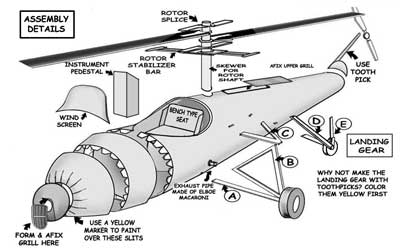
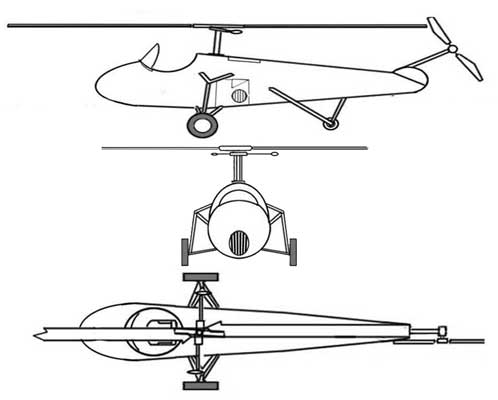
A bright yellow and cheerful model of the Bell model 30 which was the FIRST Bell helicopter flown in 1943. For most of these primitive helicopters, there seem to be no three views available but we do our best to make our own. Another addition for the Pioneer Helicopter Collection.

Bell's First Helicopter "Model 30"
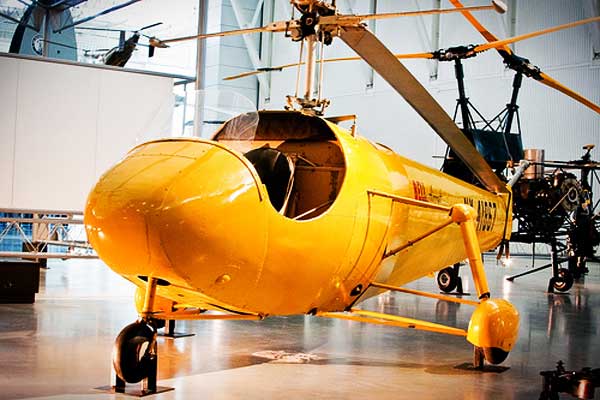

Bell became involved in helicopter design immediately after the United States entered the Second World War, and after two years of tests and trials brought a private venture of its own to fruition without any government support: its Model 30 experimental helicopter flew in 1943, One of the main achievements of this program was that Bell had perfected the rotor system, later used to such good effect in one of the company's most successful helicopters, the Model 47.
Bell Model 30
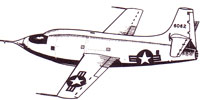 One of Bell's most exciting and impressive post-war achievements
was the construction of the first supersonic aircraft
as part of a joint program sponsored by the USAF and NACA (later
to become NASA). This was a piloted, rocket-motor propelled experimental
aircraft with thin-section straight wings. The X-1 started tests
in 1946 and became the first airplane to exceed the speed of sound
in October 1947. During their experimental flights subsequent
models in the X-1 series reached a maximum speed of mach 2.44
and an altitude of over 88,590 ft.
One of Bell's most exciting and impressive post-war achievements
was the construction of the first supersonic aircraft
as part of a joint program sponsored by the USAF and NACA (later
to become NASA). This was a piloted, rocket-motor propelled experimental
aircraft with thin-section straight wings. The X-1 started tests
in 1946 and became the first airplane to exceed the speed of sound
in October 1947. During their experimental flights subsequent
models in the X-1 series reached a maximum speed of mach 2.44
and an altitude of over 88,590 ft.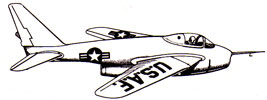
As the 1950s progressed Bell constructed several other experimental aircraft, among them the X-5 variable geometry wing plane and a vertical take-off aircraft, the X-14. The company also continued to work with NASA on investigating the problems of supersonic flight.
In March 1952 Bell's helicopter activities were moved into a separate division from Bell Aircraft and a completely new factory complex and offices were built at Fort Worth, Texas. This was known as the Bell Helicopter Division and, from 1957 onwards, as the Bell Helicopter Corporation. During the fifties the company entered into cooperation agreements with Kawasaki in Japan, Westland in Great Britain, and Agusta in Italy for the construction under license of its helicopters. Fixed wing activities remained concentrated at Niagara Frontier, which specialized in aircraft production, avionics and meeting military hardware requirements.
. 
The events that led to the monumental achievements of the Bell
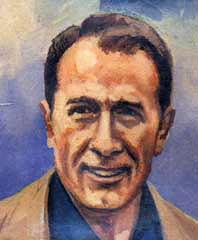
Model 47 began during 1930, when an inventor named Arthur Young
began private helicopter research. During the fifteen years he
devoted to creating the Bell Model 47, Young experimented with
a variety of scale flying models. After learning from Igor Sikorsky
that a tail rotor would counter torque, Young concentrated on
improving stability. This led him to invent a stabilizer bar which
was linked directly to the rotor to function as a flywheel. This
kept the action of the rotor blades independent from fuselage
movement. The stabilizer bar solved the stability problem and
became a traditional (and patented!) fixture on thousands of future
Bell helicopters.
Aircraft companies showed little interest in Young's ideas until a demonstration at the Bell Aircraft Company on 3 September 1941. At that time, Bell, which had been founded in Buffalo, New York by Lawrence Bell in 1935, had been actively producing P-39 Airacobra fighters. Larry Bell liked Young's concept and the two agreed to construct two prototypes, beginning in late November of 1941. Labeled Experimental Model 30s, they were proof-of-concept predecessors to the Model 47. A small group of engineers broke away from the main plant in June 1942 and converted an old garage in Gardenville, New York into Bell's first helicopter plant.
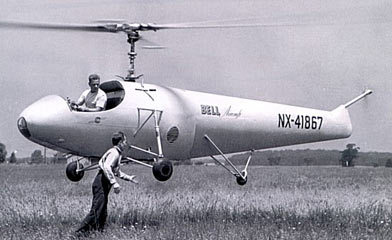
Christened Genevieve, the first Model 30 was rolled
out in December of 1942. After months of tethered flight and
vibration 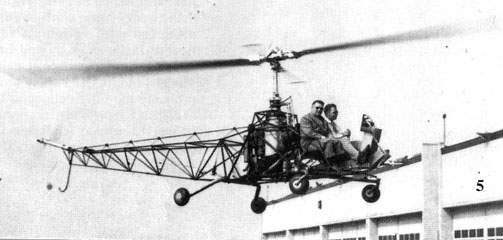 problems,
the Model 30 made its first free flight on 26 June 1943. The
second prototype was completed that same year, followed by a
third, which made its first flight on 25 April 1945.
problems,
the Model 30 made its first free flight on 26 June 1943. The
second prototype was completed that same year, followed by a
third, which made its first flight on 25 April 1945.
The first Model 30 was initially built as a single-seat aircraft with four legs of aluminum tubing. By early 1943, wheels had replaced the legs and the fuselage and tail boom were covered. Ship No. 2, a fully covered two-seat aircraft with an enclosed cabin, had the distinction of being the first helicopter used by a doctor on a mercy mission. It was also the first Bell helicopter to make a rescue when a Bell pilot flew onto Lake Erie in March of 1945 to pick up two fishermen stranded on an ice flow.
The first two Model 30s were purposely built to resemble airplanes or automobiles, while the third ship was designed as a practical concept. Improvements in Ship No. 3 included a four-wheel landing gear, an advanced instrument panel, and a tubular tail boom. For a cockpit enclosure, Young invented a protective 'bubble', formed from Plexiglas, which became the classic trademark of the Model 47.During the final months of the Second World War, when fighter aircraft production diminished, Larry Bell turned his attention to the helicopter as the company's future.
In June of 1945, Bell began work on the first Model 47, which was rolled out and flown six months later, on 8 December. It was followed by ten aircraft built for testing, training, and demonstration. Those prototypes evolved directly from Model 30 No. 3 with an open lattice-work tail boom and one-piece cockpit enclosures. Later models had covered tail booms and open or two-piece cockpit enclosures. As the series progressed, Bell reverted to the open tail boom and one-piece cockpit bubble.
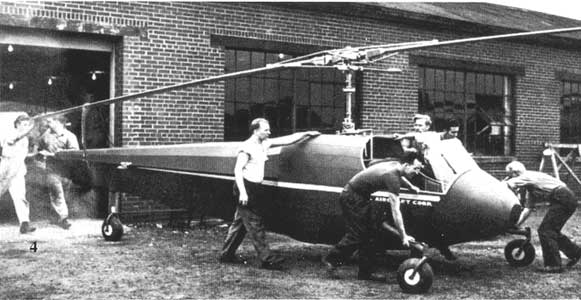
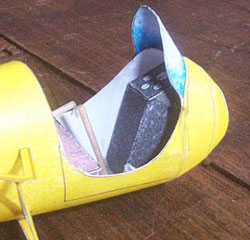
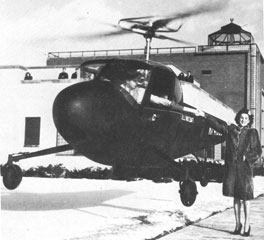
We're guessing that that dark circle on the nose is a landing
light..Any ideas?
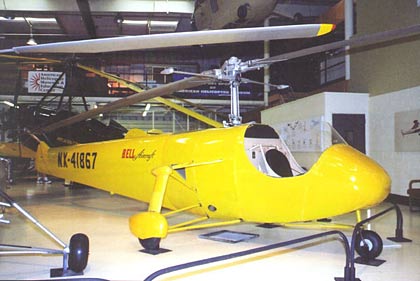
All cleaned up and on exhibit at the Helicopter
Museum
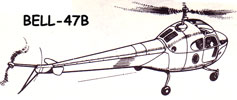 The basic Model 47 arrangement was a two or three-place side-by-side
aircraft powered by a six cylinder, opposed, air-cooled engine.
The engine was mounted vertically behind the cabin and drove
a main and tail rotor by means of a two-stage, planetary, reduction
geared transmission, which was bolted to the engine, making
the complete assembly one rigid unit. Bell's patented stabilizer
bar was located below and at right angles to the two blade main
rotor. All models through the 470/H- 130 had laminated wooden
rotor blades with a steel leading edge. The H-13H and all subsequent
models were equipped with bonded metal blades (most earlier
types were retrofitted with the metal blades). The center section,
to the rear of the cabin, was of welded tubular steel construction
and supported the engine and tail boom. The tail boom was of
similar construction, and supported the tail rotor drive shaft,
variable-pitch tail rotor,
The basic Model 47 arrangement was a two or three-place side-by-side
aircraft powered by a six cylinder, opposed, air-cooled engine.
The engine was mounted vertically behind the cabin and drove
a main and tail rotor by means of a two-stage, planetary, reduction
geared transmission, which was bolted to the engine, making
the complete assembly one rigid unit. Bell's patented stabilizer
bar was located below and at right angles to the two blade main
rotor. All models through the 470/H- 130 had laminated wooden
rotor blades with a steel leading edge. The H-13H and all subsequent
models were equipped with bonded metal blades (most earlier
types were retrofitted with the metal blades). The center section,
to the rear of the cabin, was of welded tubular steel construction
and supported the engine and tail boom. The tail boom was of
similar construction, and supported the tail rotor drive shaft,
variable-pitch tail rotor,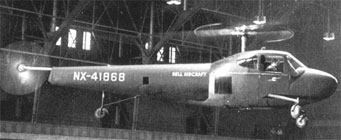 ventral fin and elevator. A tail skid later gave way to a tail
rotor guard which prevented damage during tail low landings.
ventral fin and elevator. A tail skid later gave way to a tail
rotor guard which prevented damage during tail low landings.
It was possible to equip the helicopter with a variety of landing gear including, skids, floats, or quadracycle wheel landing gear. Bell pioneered skid landing gear for helicopters which were comprised of tubular skids attached to legs and straight (later arched) cross tubes, which, in turn, attached to the fuselage. When the CAA granted Bell the first NC license for float-equipped helicopters on 5 October 1946, it was expected that the Model 47 would be used in Canadian bush country for geophysical survey work. Float landing gear added about sixty pounds.
In July 1960 Bell, by this time renamed the Bell Aerospace Corporation, became part of the Textron Inc. industrial conglomerate. It was then reorganized into three divisions: Bell Aerosystem Company (which corresponded to the Niagara Frontier Division), Bell Helicopter Company, and the Hydraulic Research and Manufacturing Company (Burbank, California). Bell Aerosystem's remained responsible for fixed-wing aircraft construction, power plant, electronics and defense systems (among other contracts the company carried out experimental vertical flights with the tilting-duct VTOL X-22 it had built), while ali work on rotor craft continued to be carried out by Bell Helicopter at Fort Worth. Over a period of 30 years a total of more than 14,000 civil and military helicopters have left the assembly lines of the enormous Texas plant. The factory at Fort Worth also has an experimental unit based at the Arlington municipal airport and a logistical center at Hurst Airport.
Click HERE to download an experienced test pilot for your model (100K) |
 |

Hey guys, look at this pretty
lady's hair and coat and how un-rotor-washed they are..and
all the snow that's NOT blowing around. Then look at that
long thin shadow in the snow ..in front of the lady's wider
shadow..hmmm about the thickness of a support pole, right? |
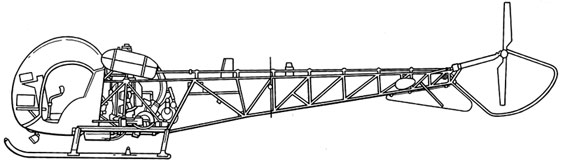
The next model Bell designed: the very popular H-13 Sioux
 |
 |
 |
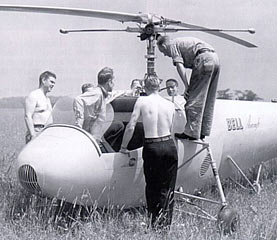
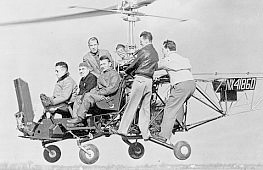 A few more photos of this marvelous machine |
Specifications for the Bell Model 30
 |
Crew: 2 |