

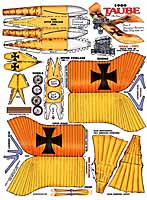
Taube - $$4.95
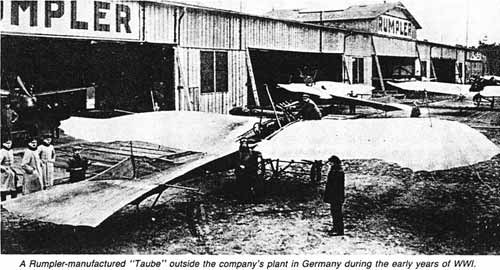
The Rumpler Taube (German, dove) is a pre-World War I monoplane aircraft, and the first mass produced military plane in Germany. Being the Germans' first practical military plane, it was used for all common military aircraft applications, including as a fighter, bomber, surveillance plane and trainer from its first flight in 1910 until the beginning of World War I.

WWI German Stealth Observation airplane: 1909 WWI Etrich Taube
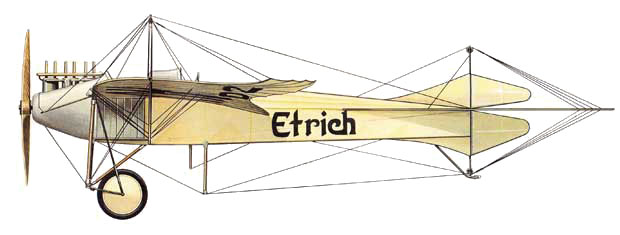
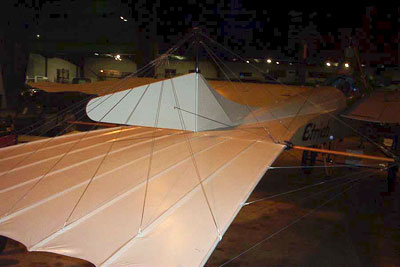
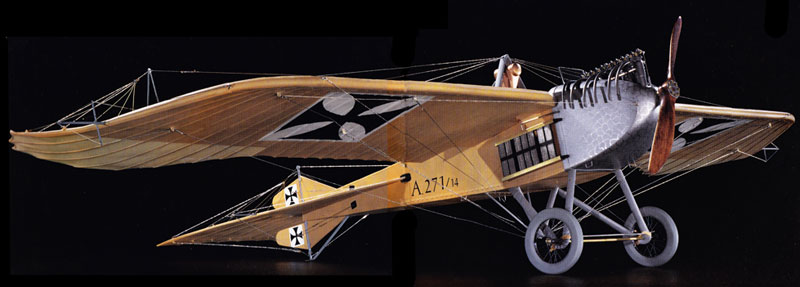
 This early observation aircraft was called by the French, "the Invisible Aircraft". Because of the translucence of the clear doped linen covering the Taube was almost invisible when above 1200 feet. The world's very first "stealth plane"! It was one of the last WWI Scouts to use the wing warping method of control.
In early history of aviation, the Taube ('dove' in German), designed by Igo Etrich in Austria, occupies a very important place. Together with a few others, notably the first Bleriot, it represents the transition between the first experimental heavier-than-air machines and the nimble fighters of WWI.
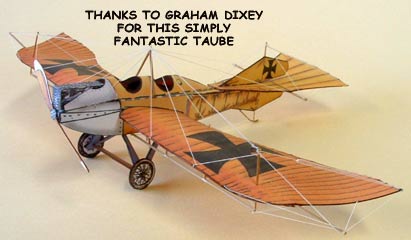
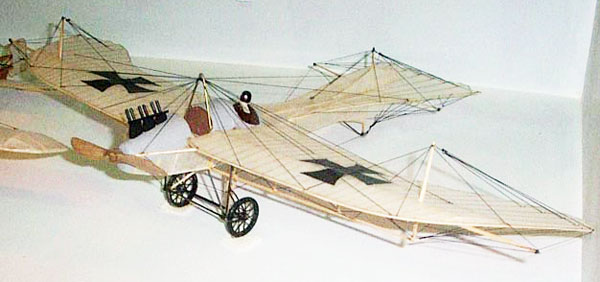
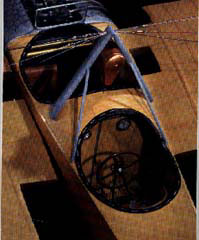
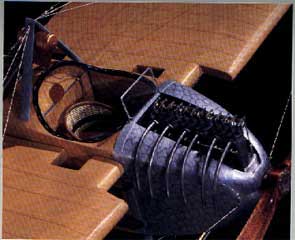
Just a few pics so you can see what I've done with your Rumpler Taube. I really enjoyed this one, especially all that rigging! The additional spars, etc, are all made from bamboo cane, split down to very fine slivers of wood. It's the only wood I know that has the right strength and spring in small cross-sections for this type of job. And you can buy a bundle of it for pennies at the local garden center! Graham Dixey (01/03)
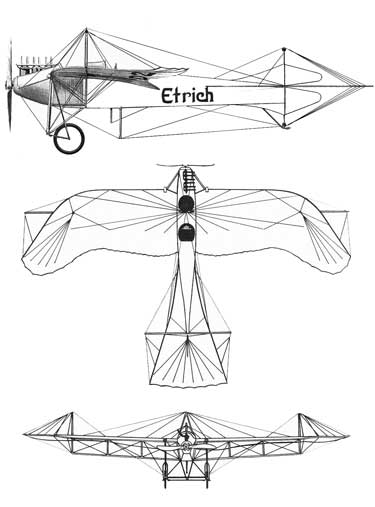
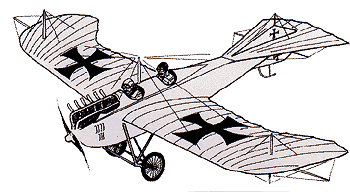
The Austrian engineer Igo Etrich designed and flew his first tractor
monoplane on 20 July 1909, and the first Taube prototype in July
1910. In late 1910 Etrich negotiated a manufacturing licence with
Lohner in Austria and Rumpler in Germany, and the latter company
produced most of the Tauben built from then until the outbreak
of World War 1. Those built from 1911 onward reflected a host
of dimensional and other variations, but the 2-seat military version
produced by Rumpler in 1912 was the most widespread and may be
taken as typical. At the outbreak of war in Europe on 4 August
1914 Tauben were already in service with the air forces of Italy,
Germany and Austro-Hungary as observation and training aircraft,
and many later-famous German pilots learned to fly on aircraft
of this type.
Privately owned Tauben were impressed for 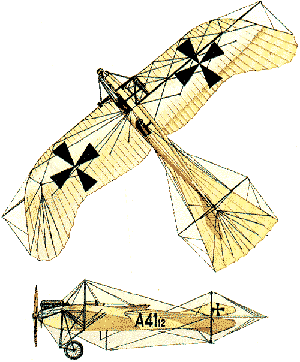 military service, and
a large-scale production program was put in hand. By this time
Dr. Etrich had relinquished his copyright in the design, following
a dispute with Rumpler, and this left the way clear for Tauben
for various types to be built in Germany by the Albatros, DFW,
Gotha, Halberstadt, Jeannin, Kondor, Krieger, LVG, LilbeckTravemuinde
and Rumpler factories. Etrich, meanwhile, joined forces with industrialist
Gottfried KrUger in early 1914 to form the Braxidenburgische (later
Hansa-und-Branden burgische) Flugxeugwerke GmbH. About five hundred
Tauben were built in Germany, those by DFW and Jeannin being known
as Stahltauben because of their steel-framed fuselages.
military service, and
a large-scale production program was put in hand. By this time
Dr. Etrich had relinquished his copyright in the design, following
a dispute with Rumpler, and this left the way clear for Tauben
for various types to be built in Germany by the Albatros, DFW,
Gotha, Halberstadt, Jeannin, Kondor, Krieger, LVG, LilbeckTravemuinde
and Rumpler factories. Etrich, meanwhile, joined forces with industrialist
Gottfried KrUger in early 1914 to form the Braxidenburgische (later
Hansa-und-Branden burgische) Flugxeugwerke GmbH. About five hundred
Tauben were built in Germany, those by DFW and Jeannin being known
as Stahltauben because of their steel-framed fuselages.
A wide variety of engines, with output ranging from 70 to 120hp, were fitted to German-built machines, the most popular units being the Mercedes or Argus mimes of 100 or l2Ohp. The two versions in Austro-Hungarian service were the Lohner-built A. 1 (with 8Shp Austro-Daimler and overhead radiators) and the A. II (l20~hp Austro-Daimler with frontal radiator), built by Lohner and (as the Series 71 and 72) by the KuK. Flieger Arsenal at Fischamend. In August 1914 the Taube quickly proved its worth as a reconnaissance aircraft when it gave the Germans warning of a Russian advance during the Battle of Tannenburg.
Later that month it was used for bombing when Lt. von Hiddesen dropped a small load of tiny bombs on Paris. The Taube was a stable aircraft with pleasant flying characteristics, and considering that it was already four years old when war broke out, its performance for 1914-15 was not at all bad. However, it was not highly manoeuvrable, and since it carried no armament other than crew members' revolvers or rifles), it was of little front-line value by the spring of 1915. It remained in use for a year or more thereafter as a very useful training type.
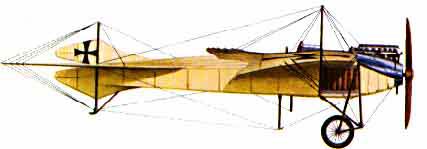
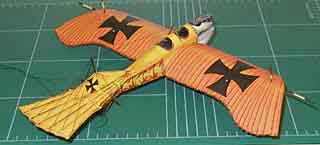 Wayne White displays his Taube in the 'rigging 'stage..Thanks for the photo Wayne. |
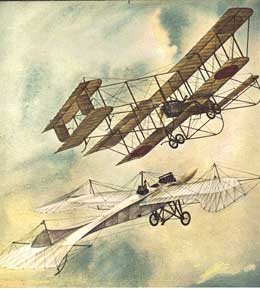 |
Ironically, one of the first planes to make war history was named the "Dove." The plane, designed by Igo Etrich, embodied suggestions from the naturalist Friedrich Ahlborn. The "Dove" held an altitude record of 21,522 ft., but its 120 h.p. Austor-Diamler in-line engine made it slow. Nevertheless, it achieved military fame by once being instrumental in deciding the fate of a battle.
On August 30, 1914, near Tannenberg, Flight Officer Ernst Canter of the Tactical Flying Squadron Section attached to the von Francois No. 1 Headquarters Staff climbed into the "Dove" with his observer and flew on a reconnaissance flight in the direction of the enemy. Circling over the Russian lines and harassed by rifle fire, Canter observed that about five miles to the rear the enemy was assembling fresh divisions for an attack. Immediately he turned back through the enemy fire and landed the "Dove" near the German lines to report the situation. Then he took off again and flew to General van Francois' headquarters. The second-in-command, realizing that with out reinforcements he would be in a far from happy situation, urged Canter to request more men from van Hindenburg. The flight officer and his observer climbed back into the cockpit and took off, once again exposed to enemy fire. Instinctively, Canter now used knolls and groups of trees for cover.
Hindenburg had no idea how close to defeat he was, but after issuing the necessary orders for reinforcements, the day was saved for Germany. "No flier, no Tannenberg!" the Field Marshal later remarked. But soon the machine became outdated as more powerful and faster aircraft equipped with armor were produced.
Specifications Engine:One-100 hp water cooled Argus in-line |
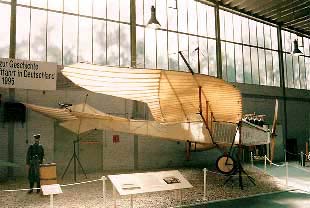 |
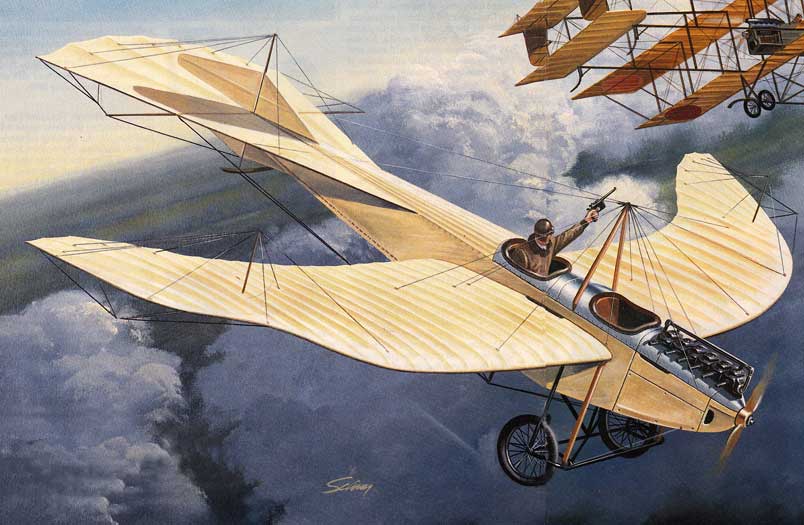
Like the Wright brothers and a large number of other contemporary aviation enthusiasts, the Austrian, Igo Etrich, took his lead from Otto Lilienhal, and made his first experiments with gliding wings. Then a Hamburg professor, Friedrich Ahlborn, drew his attention to the flight properties and shape of the Zanonia palm seed. In 1909 Etrich added altitude and lateral controls and, in 1913, the two-seater "Dove" was in reconnaissance service for the German army. It was considered by many to be the most stylish design of its day compared with the lattice-work tail structure of French, English and American planes. In 1910, the manufacturing rights were acquired by Edmund Rumpler, who dispensed with the name of Etrich. Hellmuth Hirth and Gunther Pluschow ("The Tsind-tau Fliers") first made there names as pilots with a "Dove."
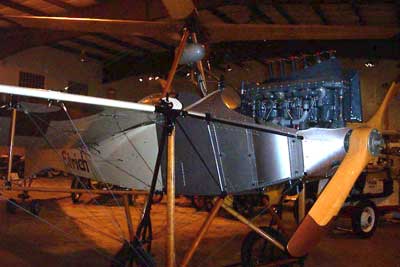
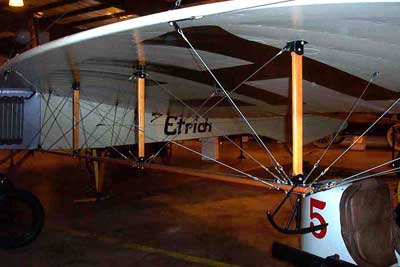
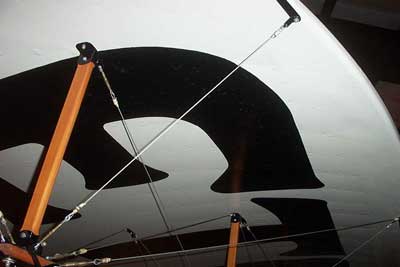
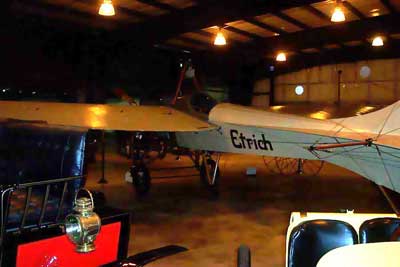
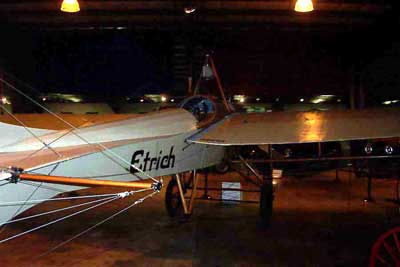
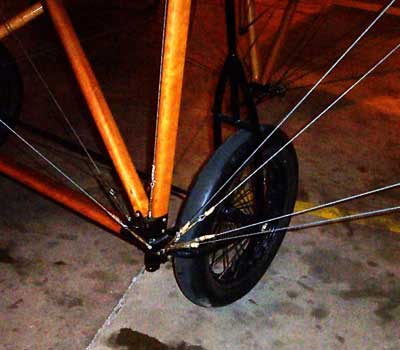
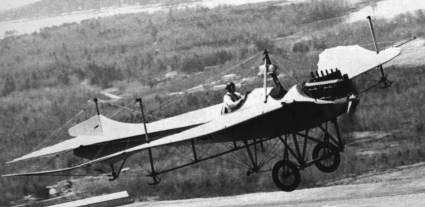
These images of the Etrich Taube were taken at the Owl's Head Museum in Maine. |
|
 |
 |
 |
 |
 |
 |
 |
Wonderful sceenic view from the Owl's Head Museum. |

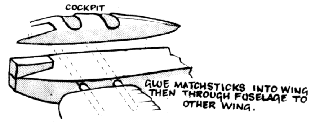
BEGINNERS GUIDE - HOW TO BUILD FIDDLERS GREEN MODEL ETRICH TAUBE
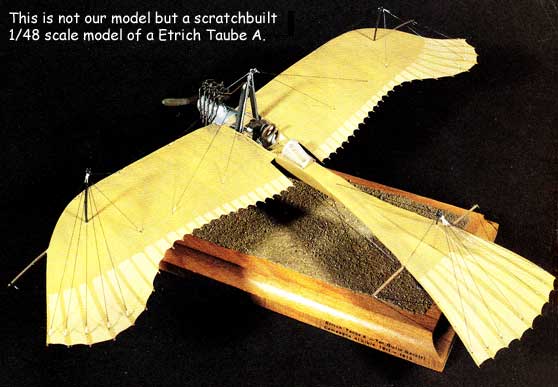
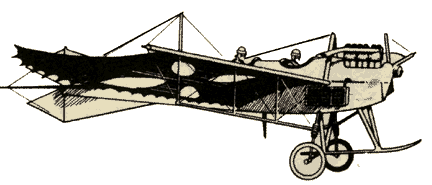

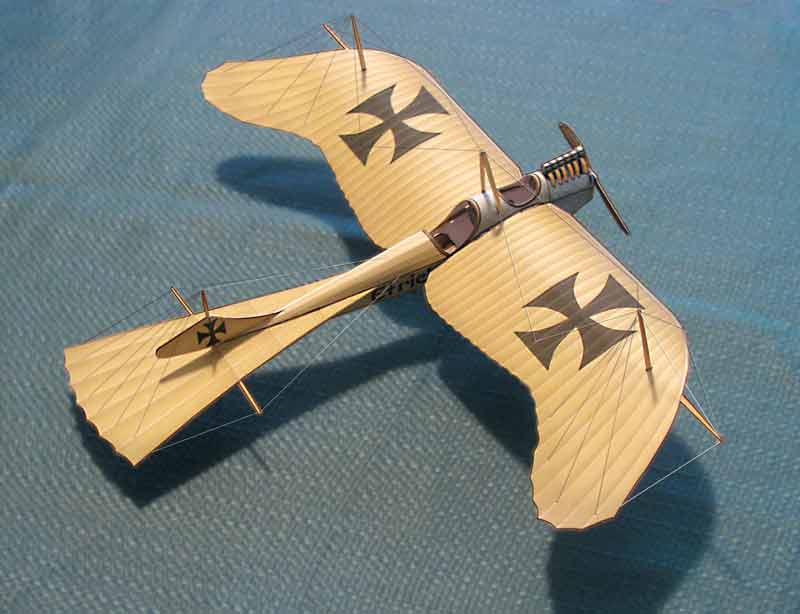
Here are some pictures of Richard's new design available and added to the Etrich Taube folder in January 2013.