

Messerschmitt Me-321 Gigant - $$34.95
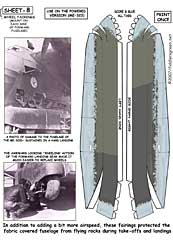
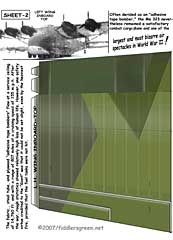
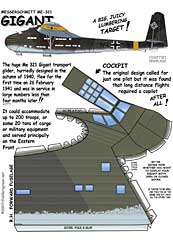
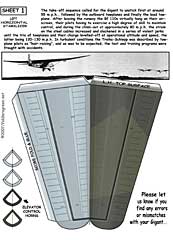
Me-321 Gigant WWII Cargo Glider. Kit includes 1 Panzer Tank, 1 Opel Blitz truck and even the powered Me-323 version. Arguably, the largest AC card model ever with a wingspan of over 4 feet!! NOT difficult to build but figure on a week to finish

Messerschmitt Me-321/323 Gigant WWII Cargo Glider
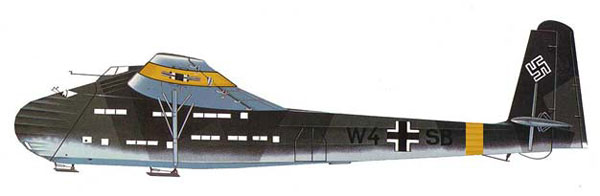
The Me-321 'Gigant' WWII Troop Carrying Glider
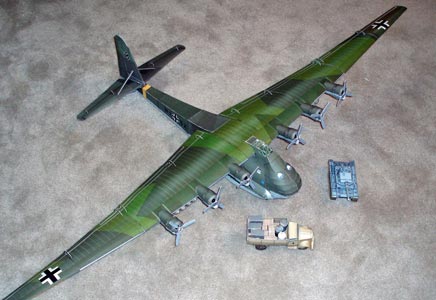
Drawn up in only 14 days, the massive Messerschmitt Gigant was designed as an assault glider for the invasion of Russia. The original Me 321 version needed rocket boost and three Me 110 tow planes to get airborne and dropped its take-off dolly to save weight and drag. This complicated arrangement led to many accidents, including one where all four crew and 120 troops were killed. To simplify, things, a powered version, the Me 323 was developed using the cheapest and puniest engines available and adding an eight-wheeled undercarriage. This reduced the carrying capacity greatly but improved practicality.
Used on several fronts, the Me 323 Gigant (Giant) proved vulnerable to attack from fighters and even medium bombers, and several massacres occurred with whole fleets of the lumbering transports shot down with heavy loss of life. The biggest of these occurred on 22 April 1943, when 16 Me 323s of Transportgeschwader 5 , fully laden with supplies of fuel for the Afrika Korps, were caught off Cape Bon, Tunisia, by two squadrons of RAF Spitfires and four squadrons of South African Air Force Kittyhawks. Fourteen Me 323s were shot down and destroyed, along with 240 tons of fuel, and of the 140 aircrew of TG5, only 19 survived.
Wow!!
Oh My God.. This is 'way cool. Can't wait till it's released!! Jimmy
Wow. That Gigant is a monster. Let's see, if I blow that up to four sheets from each one....I'll need a construction permit to build it in the backyard!! En cred eee bla! ..Dave C
First impressions:
1) Wow, this will be fun.
2) It's big, but it doesn't appear to be any more difficult than the bombers are.
Simpler than the B-17 or Ju-52. (by the way, tip of the cap to Mr. Dell on that one)
3) Where am I going to put it? Tim Allen
Wow...that was a thing of beauty! And I'm not even that fond of planes! Hans (regarding the Utube film)
I am awaiting the Gigants with wantful anticipation and growing fear. I have laid in a stock of several quarts of white glue. I am thinking about getting a bigger disk drive to hold them. Also bought several reams of card stock and a few crates of inkjet cartridges. Please consider breaking the models down into several smaller zip files, so it will be easier for those of us with slow internet connections to download them. For example Lt wing, Rt wing, fuselage, fiddley bits, ect. Just a thought. Dave Blocker
Howzit, I see the Me-321/Me-323 has been released, you guys did an amazing job with it, well done to John Dell on the colors, amazing. From the initial beta to the final model, awesome!! I haven't had much time lately to build models (new job eats up my time) but Xmas season is fast approaching and the Staggerwing amongst others is calling. Keep it up! Your modelin' pal Niki
The me-321 model is truly amazing. All you left out was where to mount the rubber bands to make it fly ! thanks Ed
"thou shalt maintaineth thy airspeed lest the ground reach up and smite thee."
I was just reading through your (excellent) Me-321 write up and noticed one small error. The page mentions the , but such a thing never existed, as production began before Messerschmitt's acquisition of Bayerische Flugzeugwerke, and it kept the original designation of Bf-110. Just a little thing. :) Elliot Alder 1/2012
Messerschmitt Me-321
On October 12, 1940, Unternehmen Seelöwe, or "Operation Sealion", as the projected invasion of the British Isles was known, was officially postponed by order of the Führer. Priority in objectives had been changed, and Unternehmen Barbarossa, the assault on the Soviet Union, now took precedence over Seelöwe. Adolf Hitler insisted that a final solution in the east must precede the subjugation of Britain, but the latter remained a primary objective, and plans for the mounting of Seelöwe at some indefinite date were still considered of the highest importance.
 The Führer believed that the Soviet Union would be crushed
in one short campaign, and that the launching of See/Owe might
be delayed no more than a year or 18 months, but the outcome of
the "Battle of Britain" had rendered obvious the fact
that the original plans, based on the assumption that there would
be virtually no opposition from the R.A.F. to an invasion, demanded
drastic revision.
The Führer believed that the Soviet Union would be crushed
in one short campaign, and that the launching of See/Owe might
be delayed no more than a year or 18 months, but the outcome of
the "Battle of Britain" had rendered obvious the fact
that the original plans, based on the assumption that there would
be virtually no opposition from the R.A.F. to an invasion, demanded
drastic revision.
The conclusion that a means of landing heavy equipment with the first airborne assault had become a prerequisite for any successful invasion of the British Isles had resulted in a highly novel concept, the Grossraumlastensegler glider infinitely larger than any previously envisaged, and capable of accommodating a PzKW IV tank, a self-propelled assault gun complete with crew, fuel and ammunition, or an 88-mm. antiaircraft gun with towing vehicle.
Within less than a week of the postponement of Seelöwe, the Technical Office of the RLM had prepared a broad specification or a Grossraumlastensegler, applied the code-name Unternehmen Warschau (Operation Warsaw) to the program, and had instructed Messerschmitt and Junkers that design studies should be submitted within 14 days-by November 1, 1940-and that the acquisition of materials for an initial quantity of 100 gliders from each manufacturer should commence immediately. Such was the fantastic sense of urgency imparted by the RLM that both manufacturers had to establish special design bureaus solely for the development of their respective gliders, the Messerschmitt bureau under the leadership of Oberingenieur Josef Frohlich being established at Leipheim and dubbed Warschau-Sud, and the Junkers bureau being formed at Merseburg as Warschau-Ost.
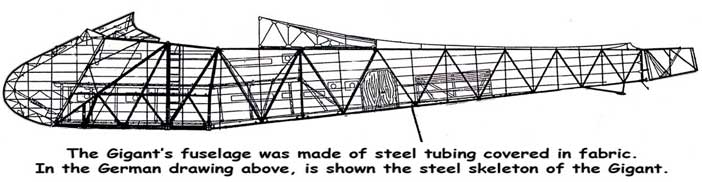
Despite the immensity of the task, both teams submitted detailed design studies on schedule and, on November 6, 1940, were instructed to initiate production immediately, and increase the initial quantity of each glider to 200 machines. At the same time the Messerschmitt and Junkers proposals were assigned the designations Me 263 and Ju 322. Whereas the Junkers team had been instructed to use wood for the construction of its glider, the Messerschmitt team was to employ a welded steel-tube structure. Work on the first airframes began in parallel with the preparation of detail drawings.
The urgency attached to Unternehmen Warschau necessitated both engineering offices and construction shops working literally around the clock, but whereas the Messerschmitt Warschau-Sud program ran surprisingly smoothly, the Junkers Warschau program was beset by difficulties virtually from the outset. Prodigious efforts were made at Leipheim, and while the first airframes were under assembly, the Mannesmann-Werke at Komotau was manufacturing the complete steel-tube fuselage skeletons and the steel-tube wing spars, and the May furniture factory in Stuttgart was producing the wooden wing former ribs, wooden tail assembly components, and secondary wood fuselage fairing structures. In February 1941, almost exactly 14 weeks from the receipt of instructions to proceed with construction, the first example of Messerschmitt's, dubbed Gigant, rolled out of the factory.
Initial Trials:
For initial trials a Ju 90 was allocated to Warschau-SW to serve
as the tow plane, and carrying four tons of bricks as ballast,
the Me 321 V1 was towed into the air for the first time on February
25, 1941. Although control forces were rather heavy, the general
handling characteristics of the Gigant were pronounced surprisingly
good, and only minor modifications were called for. However, it
was suggested that on long-distance flights some strain would
be imposed on the pilot, and that provision for a co-pilot with
full dual control was desirable, the decision being taken to introduce
this feature with the 101st example of the Gigant.

BIG Towing Problems:
A major problem was provided by the lack of a suitable tow plane.
The Ju-90 possessed barely sufficient power to tow the glider
off the ground with minimum ballast, and although work had commenced
on the Heinkel-Zwilling intended specifically to act as an Me
321 tug, it was obvious that some considerable time must elapse
before this unique aircraft could be made available to the Schleppstaffeln.
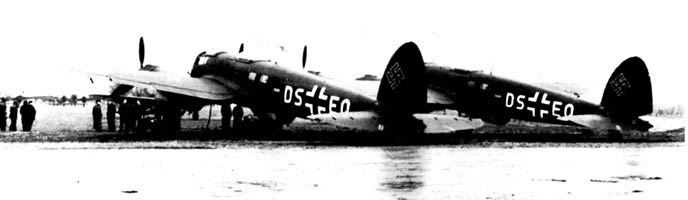
An interim solution was the so-called Troika-Schlepp or triple-tow
arrangement of three Bf 110C fighters evolved after a great deal
of experimentation. The Troika-Schlepp demanded a very high degree
of proficiency, on the part of the tow plane pilots, and in theory
the three Bf 110 fighters took off in close-vee formation towing
the Gigant by means of 10-mm. steel cables, that of the lead aircraft
being 328 ft. in length and those of the port and starboard aircraft
being 262 ft. long.
Apart from the ever-present danger of collision during the take-off,
the Troika-Schlepp method had the disadvantage of necessitating
a concrete runway at least 3,950 ft. in length, and the preliminary
preparations for take-off were so complicated
that it was utterly impossible to send up several gliders simultaneously.
The take-off sequence called for the Gigant to un stick first
at around 55 m.p.h., followed by the outboard tow planes and finally
the lead tow plane. After leaving the runway the Bf 110s virtually
hung on their airscrew's, their pilots having to exercise a high
degree of skill to maintain control, and during the climb-out
at 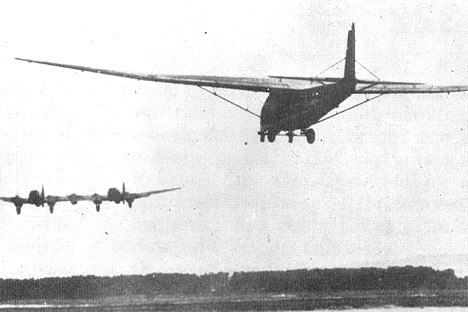 approximately 80 m.p.h. the strain on the steel cables increased
and slackened in a series of violent jerks until the trio of tow planes
and their charge leveled-off at operational altitude and speed,
the latter being 120-130 m.p.h. In turbulent conditions the Troika-Schlepp
was described by tow plane pilots as "hair-raising",
and as was to be expected, the test and training programs were
fraught with accidents.
approximately 80 m.p.h. the strain on the steel cables increased
and slackened in a series of violent jerks until the trio of tow planes
and their charge leveled-off at operational altitude and speed,
the latter being 120-130 m.p.h. In turbulent conditions the Troika-Schlepp
was described by tow plane pilots as "hair-raising",
and as was to be expected, the test and training programs were
fraught with accidents.
Trials with the Troika-Schlepp had been initiated before the completion of the first Gigant, a JU 52/3m standing in for the glider. As a safety precaution the transport was usually towed off the ground with its outboard engines idling, and during one of the earliest tests the "train" had just left the ground when the left-hand Bf-110 tug suddenly broke violently to port. The pilot of the Ju 52/3m immediately pulled the cable-jettisoning lever and gave his idling engines full throttle, but the port cable failed to part company with the transport, and as the pilot of the Ju 52/3m struggled to gain altitude, the trailing cable cut a farm cart in two, demolished farm buildings, uprooted trees, and finally became entangled with a telegraph line. The aircraft was virtually jerked to a standstill in mid air, but the sturdy trimotor remained airborne complete with trailing cable to which was now attached a full-size telegraph pole! Despite this baggage the pilot succeeded in landing the aircraft at Merseburg.
Part of the training program for the Troika-Schlepp included formation
take-offs by trios of Bf 110s trailing cables but without gliders
in tow. One of the first of these formation takeoffs ended in
disaster. At Merseburg when the starboard aircraft veered to port,
became entangled with the cable trailed by the center aircraft,
and both aircraft crashed. Shortly
afterwards, during the first Troika-Schlepp trials in which a
Gigant was actually used, the tow planes and their charge had just
climbed out of the airfield at Obertraubling, near Regensburg,
when the towline snapped.
With remarkable presence of mind, the pilot of the Gigant, Alfred Röhm, ignited his unused take-off rockets, pulled the giant glider around in a steep turn, his port wingtip virtually brushing the ground, streamed his braking chute and effected a perfect landing.
On another occasion at Merseburg, the pilot of a Gigant pulled his cable-release at an altitude of 1,300 ft. and promptly banked to starboard to make his landing approach. Unfortunately for the port tow plane his cable had not disengaged, and the Bf 110 was wrenched violently sideways, its rear fuselage breaking off.
Despite the hazardous triple-tow methods necessitated by the lack of a sufficiently powerful tow plane, the test program of the Gigant itself progressed relatively smoothly, although on one occasion during operational trials with a Gigant carrying 120 troops, the take-off rockets under one wing failed to ignite, the glider veered to starboard, its three Bf 110 tow planes colliding, and the entire "train" crashing to its destruction in a forest near the airfield boundary, 129 lives being lost. Another casualty was Otto Bräutigam whose Gigant crashed when water ballast shifted during the first overload trials.
The Leipheim plant had been joined in the Gigant assembly program by Messerschmitt's Obertraubling factory, and by the late summer of 1941 had completed deliveries of the first 100 Me 321A-1 gliders and had commenced deliveries of the Me 321B-1, the two sub-types differing in that, whereas the initial version had provision for a single pilot only, the later sub-type featured a wider flight deck with accommodation for pilot and co-pilot.

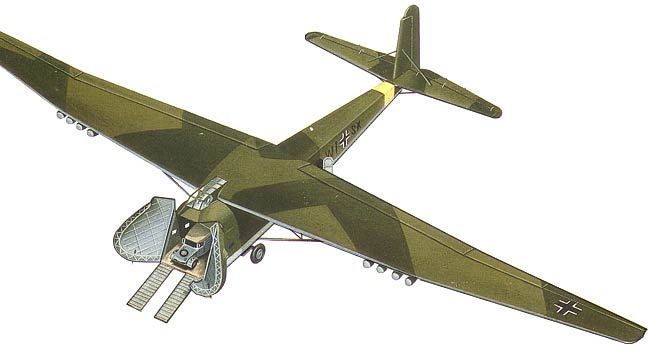
In December 1940, the RLM had decided to change the designation of the Messerschmitt glider from Me 263 to Me 321, and thus it was as the Me 321 V1 that the first Gigant began its test program at Leipheim. Featuring a rectangular framework of welded steel tubing covered with fabric over a secondary wood fairing structure, the Me 321 had an immense cargo hold measuring 36 ft. 1 in. in length by 10 ft. 4 in. in width by 10 ft. 10 in. in height, and affording a cubic capacity of 3,814 cu. ft. The cargo hold floor was supported by substantial cross girders and stressed to take distributed loads of up to 44,090 lb., or almost twice the empty weight of the aircraft, and a novel form of direct access was provided, the nose of the fuselage being split vertically to form two outward-hinging doors the full height of the cargo hold. Provision was made for the insertion of an auxiliary deck with which, it was estimated, up to 200 troops could be accommodated. The pilot was seated above the main fuselage structure in front of the leading edge of the wing.
The wing itself comprised a single rectangular girder spar built up of four steel-tube members connected by N-braces and wooden former ribs. The leading edges were plywood covered and the remainder was fabric covered, and the entire trailing edge was hinged, the outer portions acting as ailerons and the inner sections as flaps, the movable surfaces being carried by steel-tube outriggers projecting from the main spar. The center section was braced by a single strut on each side and tapered in chord and thickness, and the outer cantilever sections continued the taper but were set at a dihedral angle.
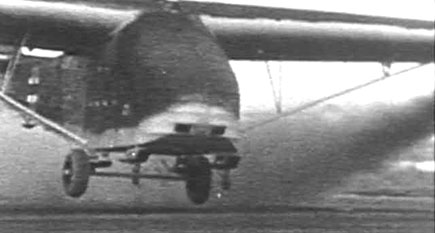
The entire wooden tail unit and the portion of the fuselage to which it was attached was hinged to give a tail incidence change of minus 5 deg. to plus 2.5 deg. Four sprung skids were provided beneath the forward fuselage, and for take-off a dolly was fitted comprising two Ju 90 main wheels with a cross-axle attached to the aft skids, and two Bf 109 main wheels attached by special swiveling supports to the forward skids, the dolly being jettisonable and weighing 3,748 lb.The Me 321A-1 and B-1 were usually fitted with a defensive armament consisting of two 7.9-mm. MG 15 machine guns fired from positions in the upper portions of each nose door, and when troops were carried, this armament could be supplemented by several 7.9-mm. MG 34 infantry machine guns fired from windows in the hold.
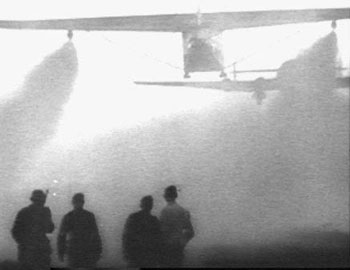 During the development program the number of hydrogen-peroxide
take-off rockets that could be attached beneath each wing had
been progressively increased, and for maximum-load take-offs up
to six 1,102 lb., four 1,653 lb., or three 2,205 lb. rockets could
be fitted on each side. The crew of the Me 321B-1 was increased
from five to six members by the addition of a co-pilot, the other
personnel comprising a radio operator, a loading officer and two
gunners.
During the development program the number of hydrogen-peroxide
take-off rockets that could be attached beneath each wing had
been progressively increased, and for maximum-load take-offs up
to six 1,102 lb., four 1,653 lb., or three 2,205 lb. rockets could
be fitted on each side. The crew of the Me 321B-1 was increased
from five to six members by the addition of a co-pilot, the other
personnel comprising a radio operator, a loading officer and two
gunners.
While the Gigant and the Troika-Schlepp may have been a viable
proposition for an operation such as Seelöwe for which they
were conceived, it was soon to become patently obvious that they
were of limited usefulness on the Eastern Front.
Elaborate preparations had to be made for the transfer of the Me 321 Staffeln as the range of the Bf 110 when used in the Troika-Schlepp role was barely 250 miles, and thus airfields along the transfer route that were to be used by the Me 321s had to be provided with special trucks and ground equipment, loading ramps, aircraft anchoring cables, and tank wagons with siphoning apparatus, as well as the special company which, attached to the Gruppe, was responsible for refueling and servicing the temperamental take-off rockets.
Take-off rockets were powered with hydrogen-peroxide with 1,102 lb thrust each! with a burn time of just 30 seconds. They demanded protective clothing for the workers.
Many of these problems would have been overcome had the Heinkel-Zwilling been available, but when the Me 321 was first consigned to the Eastern Front only the first prototypes of this tow plane had flown.
|
The Leipheim and Obertraubling factories had delivered 186 Gigant gliders by the end of 1941, and the remainder of the original order for 200 Gigant's were completed during the first months of 1942, some additional component manufacture being undertaken to keep the lines occupied pending the outcome of trials with the powered derivative, the Me 323.
Apart from some isolated transport duties in rear areas, the Gigant was to see little further service. Most remaining gliders of this type were transferred to Istres in France during the summer of 1943, and in July the Me 321s were assigned the task of ferrying two paratroop divisions to Sicily. The distance involved proved, in the event, to be too great for the He 111z towing a fully-laden Me 321, and as no suitable intermediate landing fields were available the operation had to be cancelled.
Messerschmitt's design bureau, working at Leipheim (code-named "Warschau-Sud"), had been allowed to employ a mixed structure of welded steel tube and wood for the airframe of its glider. The Messerschmitt design team, under Josef Frolich, also took a comparatively conventional approach in the layout of its design. The result, designated the Me-263, was a high-wing monoplane with a span of 180 feet 5 1/2 inches and a length of 92 feet 4 1/4 inches. A novel means of access to the cargo hold for that time was provided through a pair of enormous clamshell doors in the fuselage nose. If only personnel were to be carried, an auxiliary second deck could be inserted inside the 3,814-cubic-foot cargo hold to accommodate an estimated 200 soldiers.
The Me-263 was approved for construction on November 6, 1940. From then on, Messerschmitt personnel worked around the clock to complete the prototype, which was redesignated as the Me-321 in December. When completed in February 1941-after a remarkably short construction period of 14 weeks-the Me-321V-1 was the second largest flying machine built up to that time, after the Soviet Tupolev ANT-20bis. Its normal payload of 48,944 pounds nearly doubled its empty weight of 26,896 pounds.
During its test program at Leipheim, the glider, now called the Gigant ("giant"), displayed surprisingly good flight characteristics. Its greatest limitation lay in the "Schlepp", or towing system. The Ju-90 was just barely able to lug the monster into the air, even with eight hydrogen peroxide rockets mounted under the Me-321's wing to provide 30 seconds of supplemental thrust during takeoff. One frightening solution involved the "Troika-Schlepp", a trio of Messerschmitt C twin-engine fighters linked together in a V-formation.
Such formation flying, with the fighters tethered by cables to a gigantic glider along a 3,950-foot concrete runway and subsequently towing it for an extended length of time at up to 132 mph, was aptly described by one of the Troika pilots as "hair-raising." Accidents were inevitable, and on one trial flight an Me-321 with 120 troops aboard veered to the right when the takeoff rockets under its right wing failed to ignite. All four aircraft crashed, killing all 129 passengers and crew members. The Luftwaffe came up with another bizarre solution in the form of the Heinkel He-111Z Zwilling ("twin"), a pair of He-111H twin-engine bombers joined together by a common wing center section incorporating a fifth engine.
Satisfied with the Gigant, the Luftwaffe ordered 100 single-seat Me-321A-ls, which were delivered by late summer of 1941. Messerschmitt also produced the Me-321B-1, which featured a wider cockpit for a co-pilot. By September 1941, the first Sonderstaffel (GS), composed of five Me-321s and 15 s, was operational on the Russian front. Operating from Riga, Staffel (GS) 1 participated in the seizure of the Baltic islands of Muhu, Saaremaa and Hiumaa, but during subsequent operations muddy conditions and the 250-mile range of the limited the big gliders' practicality in Russia. By the time the 200th and last Me-321 was completed early in 1942, the gliders were being withdrawn from Russia for use in Operation Hercules-an airborne invasion of Malta, using He-111Zs to tow the Gigants, that never materialized. Subsequent transport glider operations to Stalingrad in January 1943 and to Sicily in July 1943 also had to be canceled.
Epilogue:
After World War II the military transport glider fell rapidly
out of favor. The Gigant was, and is likely to remain, the largest
non-powered aircraft ever built. Some achievements are simply
not worth surpassing.
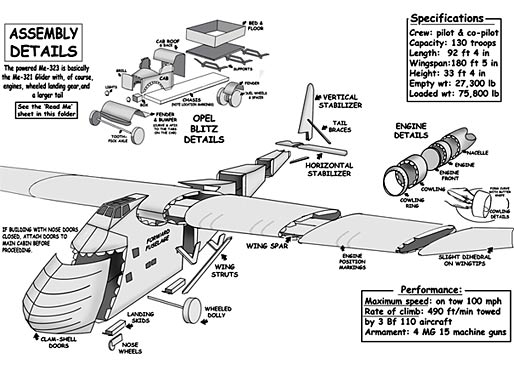
Specifications
 |
Crew: two, pilot and co-pilot Capacity: 130 troops Length: 92 ft 4 in Wingspan: 180 ft 5 in Height: 33 ft 4 in Empty weight: 27,300 lb Loaded weight: 75,800 lb Performance Maximum speed: 100 mph on tow Rate of climb: 490 ft/min towed by three Bf 110 aircraft Armament 4 × 7.92 mm (.312 in) MG 15 machine guns |
 |
 |
|
|
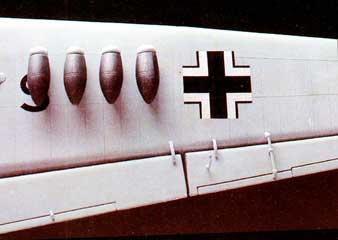
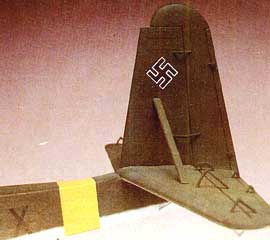
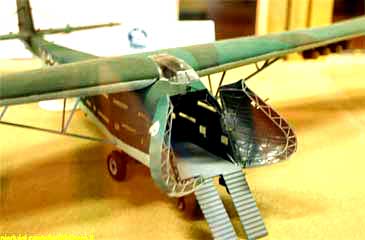
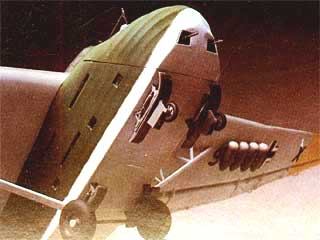
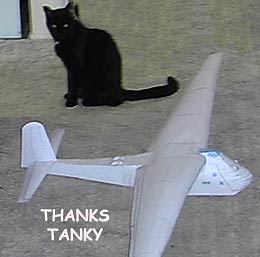
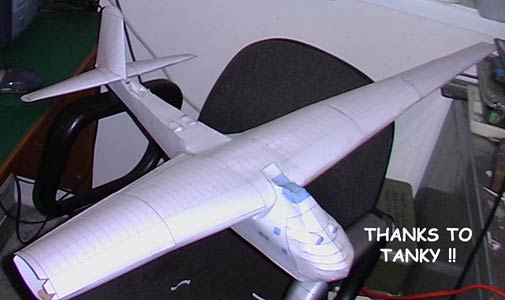
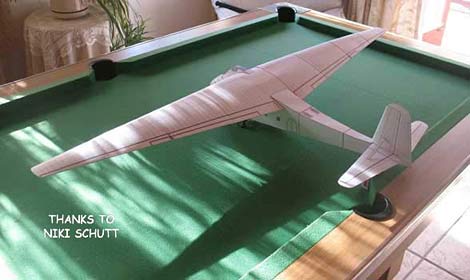
Here are a few photos sent in by our best beta
builders (bbb) with hopes it'll make your modeln' more fun.
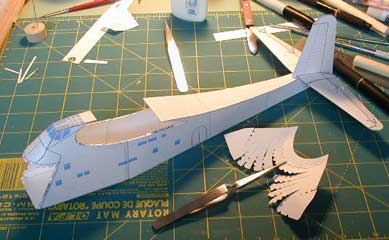 These two TOP photos thanks to Wayne White |
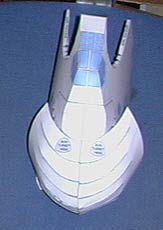
 The nose design came directly from the FG S-55 Helicopter. 'Wonder if there's a potential patent issue here.. hmmm |
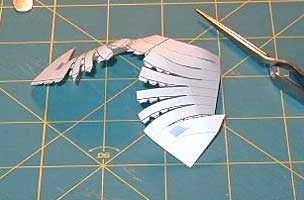
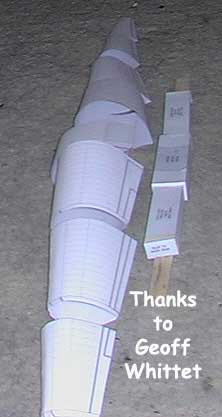
 Note how the paper, without before being actually formed is already trying to take the airfoil shape |
|
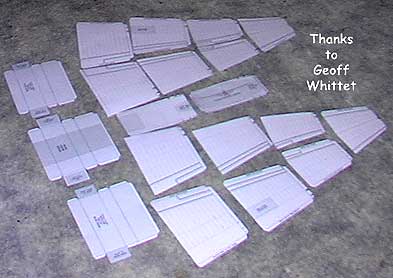
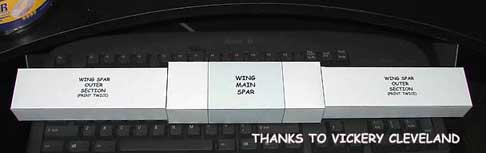 I have attached more photos of the ME 321 Beta Build. I noticed that it might be a good idea to reinforce the fuselage sections where the wing goes with an extra sheet of 110 lb card stock. The wings are also easier to work with if they are made of two sheets of stock. Overall this thing is awesome to build. My cats were a little disappointed that the wings were too large for them run off with. They enjoyed the landing gear wheels though. One came up missing and I found it in my shoe the next day. Vickery |
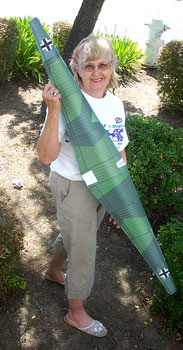 Annie displaying the finished wing. |
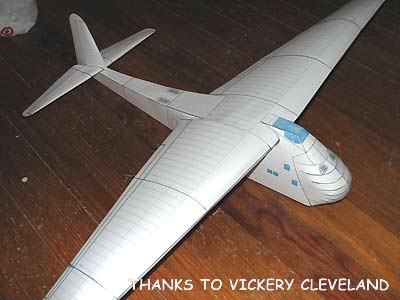 |
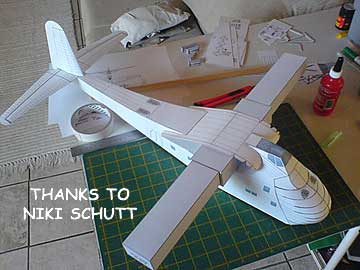 Now we're starting to see the Gigant take shape!! Take your time and be organized and you'll SAVE time in the end. But you already knew that, right? |
 |
|
 |
|
  |
|
 |
|
 |
|
Me-323
Motorized 321 Gigant Glider
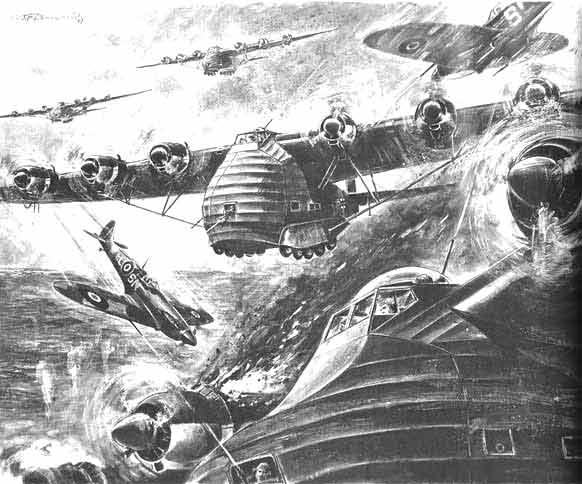
April 22, 1943 was a black day for the TG S's. Four days previously the Luftwaffe had lost 24 Ju 52's over the Mediterranean, and 35 other "Aunties" were so severely damaged that they broke up after emergency landings. Then the last sixteen aircraft of No. 5 Transport Squadron took off from Trapani for Tunis, with crews totaling 140 men. The "Giants" were carrying fuel for Rommel's Africa Corps.
The North African coast came into view. The planes were due
to fly over Cape Bon, and it was there that British fighters
attacked the formation. The more maneuverable "Spitfires"
and "Marauders" massacred the Germans, and only two
"Giants" escaped. The fourteen remaining aircraft
either crashed in coastal waters or were destroyed after emergency
landings. Two days later, the fifteenth "Giant" was
destroyed on the Tunis airport during an air raid. Only nineteen
out of 140 pilots, radio operators, air gunners and flight mechanics
were rescued; the others were killed or drowned. In one fateful
month a great idea which had been turned into reality was irrevocably
destroyed.
A single Me 323 returned to its base at Trapani, filled with wounded from Rommel's Africa Corps.
For months the TG 5
Me 323 E aircraft had flown between Trapani and Palermo
in Sicily and the Africa Corps airfields in Tunis and
Bizerta, carrying reinforcements to Africa and wounded
from there to Italy. Meanwhile orders had been issued
to discontinue dangerous individual flights and, instead,
to fly in close formation. Since the "Giants"
carried five to nine machine guns (13 mm. MG 131) and
were thus better armed than the Ju 52's, a large formation
seemed advisable. |
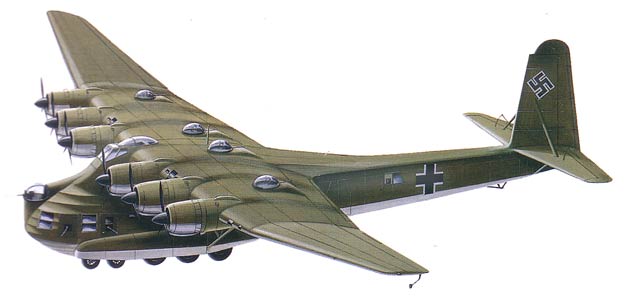
Conceived as a silent glider, and famed as a six-engine monster, Messerschmitt's "Gigant" Me 323 distinguished itself as a cargo plane during World War II, and with its immense size it lived up to its name. Its armament consisted of nine machine guns to which six more could be added in the sides of the fuselage.
In 1942, the reestablished Zeppelin aircraft makers had the engineers of Leipheim continue the development of the "Giant" after serial production had begun at Messerschmitt. As earlier, the Zeppelin enthusiasts wanted to make the giant even bigger, and under the designation ZLSO 523, they began work on the design of a larger aircraft, based on the essential features of its Me 323 predecessor. The Allied drive into France-where the project was being carried out in cooperation with the French SNCA.SO company -stopped further work on the super "Giant."
Often derided as an "adhesive tape bomber," the Me 323 nevertheless remained a satisfactory combat cargo plane and one of the largest and most bizarre air spectacles in World War II..
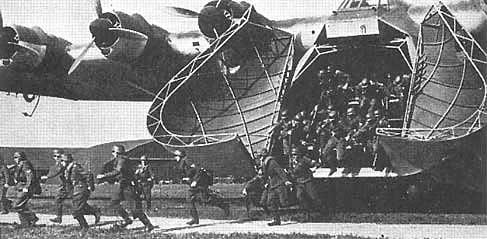
The Messerschmitt "Giants" were viewed with much suspicion by the German soldiers, even before hair-raising stories began to be circulated about the young pilots who took off with a full weight of 99,225 lb. and whose lives, along with those of their fellow passengers, often depended upon the copilots' skill at trimming. While the copilot was trimming the control surfaces, the pilot, with help from the servomechanisms, struggled with the extremely high control forces. These forces first became apparent in the Me 321 glider version, and were never effectively reduced.
The bow could be separated into two compartments accommodating 120 fully equipped infantrymen. De-plaining ramps were included in its equipment. As soon as a "Giant," swinging on its rear wheels, was brought into horizontal position, the cargo shifted to the exact center of gravity and could be secured promptly.
Some of the stories bandied around about the "Giant's" pilots sounded like sheer fantasy. One of these, which was quite typical, told of an entire crew that took off with their pilots on a "special flight" to loop the loop over Mount Etna in their six-engine aircraft.
The furious commander of the transport squadron allegedly radioed the Me 323 in person and called it back to base. The crew only just escaped court' martial, and were lucky enough to get off with a lenient eight-day house arrest.
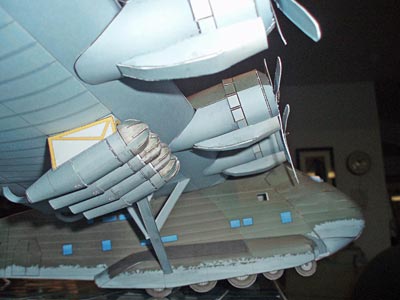 |
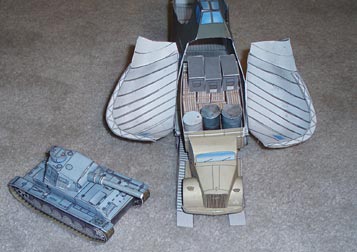 |
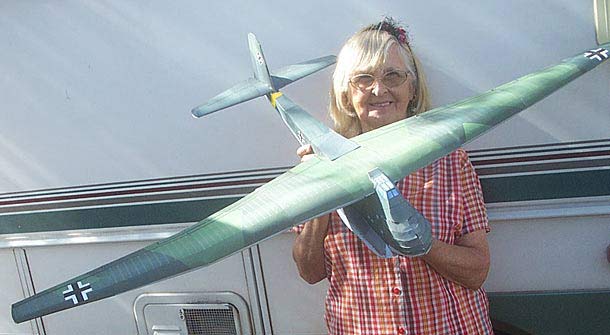
The above model of the Messerschmitt Me-323 and accessories are compliments of Dave Finkelman |
|
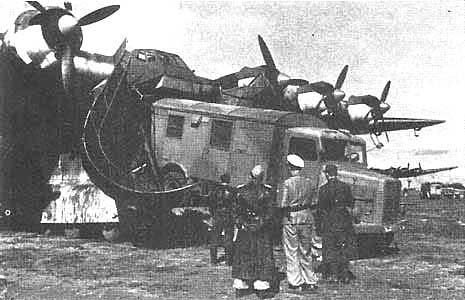
During the Africa campaign, infantry and wounded, who along with many other loads were often carried in "Giants," shuddered at such stories. "Fly in a thing like that?" one infantryman remarked. "You must be mad!" "The copilot failed to turn up," one survivor explained, "and because the flight was urgent, the flight captain was assigned an He III man. So we took off, with a fully-loaded weight of about 99,225 lb.; the entire freight space was taken up with vats of fuel for the Me 109's in Budapest.
The
flight captain couldn't get the plane off the ground, not by an
inch. 'Trim her, trim her, she's nose heavy, you idiot! ' he shouted.
So the man from the He 111 kept on trimming as if she were tail
heavy, and by the time the penny had dropped, the 2,625 ft. runway
and a bit more was behind us. Ahead lay a wood. To make it worse,
the Me 323's lateral controls were combined with trimming flaps
driven by an electric servomotor in each wing.
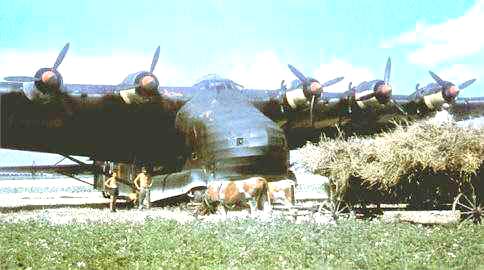 |
The Me-321
Gigant was so huge that when needed to land in a field or
pasture, it would be a major job to set up a strip hard and
long enough to allow takeoff. |
For months the TG 5 Me 323 E aircraft had flown between Trapani and Palermo in Sicily and the Africa Corps airfields in Tunis and Bizerta, carrying reinforcements to Africa and wounded from there to Italy. Meanwhile orders had been issued to discontinue dangerous individual flights and, instead, to fly in close formation. Since the "Giants" carried five to nine machine guns (13 mm. MG 131) and were thus better armed than the Ju 52's, a large formation seemed advisable.
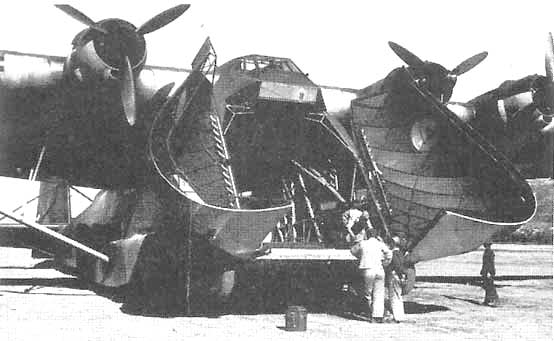
One of the puzzles of aviation history is why Messerschmitt's Gigant (giant) family set such new standards in air transport capability. These machines were physically vast, but in terms of weight (under 99,208 lb and power 6,600 hp they were not particularly impressive. Moreover, they had an old-fashioned fabric-skinned structure, low flight performance and big doors only at the front.
The real
breakthrough came after World War II with the Lockheed C-130,
which had far better payload provisions, a rear door which could
be opened in flight, and high performance. It all makes one wonder
why nobody built a stressed-skin air lifter of Gigant proportions,
powered by four R-2800 D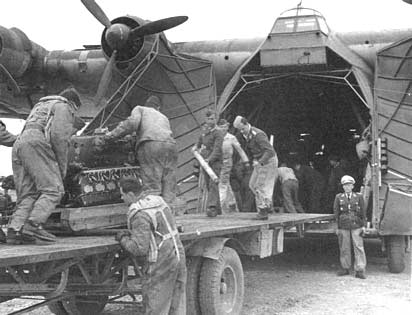 ouble Wasps.
Instead, the standard transports of World War II were the Junkers Ju 52 on the one hand and the Douglas DC-3 family on the other. Both had narrow, cramped fuselages which sloped steeply on the ground, with a side door. Troops, infantry weapons, spare parts, ammunition and, with difficulty, 55-Imp gal fuel drums or a motorcycle were possible loads. Anything really heavy or bulky had to go by surface means. The Soviets had airlifted trucks and even light tanks, although only by hanging them out in the slipstream underneath heavy bombers.
This dismal state of affairs probably reflected an almost total disinterest on the part of the customers. Except on rare occasions, such as the hurried evacuation of Kabul in Afghanistan during the winter of 1928-29, there was little demand for air transport, and it was meekly accepted that transports, or 'bomber transports', were unable to carry anything heavy or bulky.
Even Hitler's Luftwaffe failed to order any really capable transport, but nonetheless achieved fantastic success on 10 May 1940 in the invasion of Western Europe using Ju 52/3ms and even smaller gliders. When it came to the planned invasion of the UK, such airlift forces appeared inadequate. The initial plan for Operation Sealion envisaged that, with the RAF defeated, paratroops and glider borne infantry could hold bridgeheads, while Ju-87 Stuka's would demolish any opposing strong points.
This plan
was disrupted by the Luftwaffe's failure to eliminate the RAF.
Hitler postponed Sealion, and planned the assault on the Soviet
Union instead, which was expected to be over by the autumn of
1941. With a 'final solution' achieved in the East, Hitler then
planned to occupy the UK.
More careful planning showed that it would be prudent to be able
to bring in heavy armour, flak and other massive items with the
very first airborne assault. With extraordinary suddenness, it
was realized that there was an urgent need for transport aircraft
with capability far greater than anything previously envisaged.
Should they be powered machines or gliders? The instant choice
fell upon gliders., even though these would be unlikely to make
more than one mission each. The need was for large numbers of
heavy assault gliders; a single one-way flight by the whole fleet
ought to be enough.
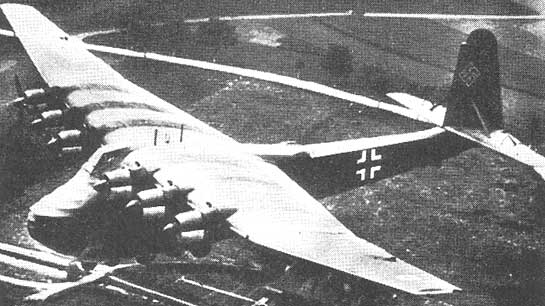
The Me 323 gave the Luftwaffe a tremendous airlift capability possessed by no other air force. Contrary to the insistent Africa Korps rumor, the 'Elastoplast bomber' was neither fragile nor highly inflammable, but a tough giant capable of absorbing tremendous punishment.
There are several RAF squadron combat reports which
tell of a Gigant lumbering on its way after the British aircraft
had expended all its ammunition.
Heavy losses: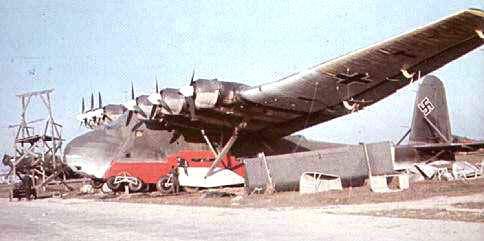
There were occasions, however, when Me 323Ds
of various varieties were shot down in droves. The worst time
was April 1943 when it lost 43 aircraft, a single example surviving
the final defeat in Tunisia in mid-May. Of these losses, at least
29 were shot down, the remainder being shot up on airfields. This
drastically reduced the total number of Me 323s available, despite
the fact that output at this time reached almost one per day,
a level never again even approached. (see top of this page)
Operational experience led to numerous internal improvements, more secure payload positioning which facilitated attainment of the correct center of gravity position, and the addition of a retractable rear-fuselage support leg and a massive spade anchor under the tail to dig in after landing and shorten the run.
Electric servo-motors were added to help operate the flaps, and later provision was made for up to eight auxiliary take-off rockets and a 66-ft braking parachute for landing. Take-offs remained a problem.
There was no aircraft of sufficient power available in numbers, and following rather discouraging model tests the triple tow was devised with three Messerschmitt Bf -100s all pulling one Me 321, the center tug having a towline 66 ft longer than those of the others.
The rest of 1941 was punctuated by fantastic accidents, near-accidents and amazing escapes, on one occasion with the glider doing a tight turn away from the snapped-cable tugs, with rockets firing and one wingtip almost touching the ground. Another scheme was to fix the three twin-engine fighters to the glider itself, one above the fuselage and the others under the wings, disconnecting only near the destination.
In the event, Heinkel produced the five-engine He 111Z twin-fuselage tug, and Messerschmitt's Leipheim and Obertraubling factories delivered 50 Me 321As and 100 dual Me 321Bs. These saw much action (but never invaded Malta or many other planned targets, and were also too late to help at Stalingrad).
 The decision had been taken years earlier, in
March 1941, to build a Gigant with engines. Inevitably this would
carry much less, because its empty weight would be some 2.5 times
greater. In many ways the glider was superior, but while it would
have been ideal (with adequate tugs) for a one-time assault on
the UK, it was less than satisfactory for the ongoing war in which
it found itself, where trucking had to be done on a sustained
basis from Marseilles to the Volga.
The decision had been taken years earlier, in
March 1941, to build a Gigant with engines. Inevitably this would
carry much less, because its empty weight would be some 2.5 times
greater. In many ways the glider was superior, but while it would
have been ideal (with adequate tugs) for a one-time assault on
the UK, it was less than satisfactory for the ongoing war in which
it found itself, where trucking had to be done on a sustained
basis from Marseilles to the Volga.
There was no way an Me 321 could 'go round again' when approaching an overcrowded airfield, once at rest it was almost impossible to move, and staging points had to have special crews with masses of concentrated hydrogen peroxide for the rockets, drag chutes, tow cables and many other special items.
Settling on the 14-cylinder Le Rhone 14N 48/49 engine with a takeoff rating of 1,140 hp, Messerschmitt had built 198 examples of the Me-323, as the powered version was known, by April 1944. The powered Gigant performed its transport function fairly well, but in spite of defensive weaponry as powerful as two 20mm MG151 cannons in wing turrets and eight 13mm MG151 machine guns on the Me-323E-2, the floundering behemoth proved to be highly vulnerable to attack by Allied fighters-and on some occasions, even twin-engine bombers.
The powered Me 323 was studied with many types of engine, and
the choice fell on the least powerful, the French Gnome-Rhone
14N. This was because the engine installation and propeller of
the Bloch 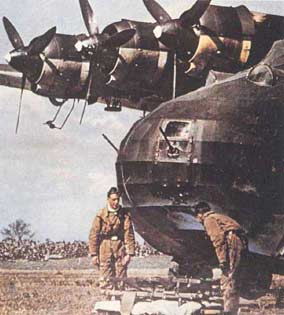 175 bomber was readily available and in production already,
and could just be bolted to a strengthened Gigant wing. Six engines
were needed, the left trio being GR14N 48s and the right trio
GR14N 49s rotating in the opposite direction. A flight engineer
cabin was added
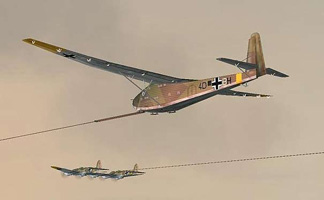
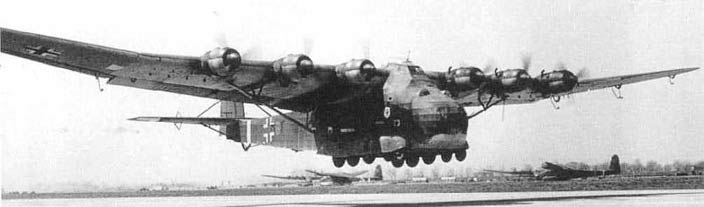
An Me 321A-1 glider is towed into the air at Leipheim by a Troika-Schlepp
of Bf 110C tugs. The Gigant's landing gear, jettisoned after take-off,
and the booster rockets under wing in each leading edge between
the inner and middle engines, and a completely new multi-wheel
permanent landing gear was added. This, like the aircraft itself,
showed the way to the 'high flotation' gears of today.
175 bomber was readily available and in production already,
and could just be bolted to a strengthened Gigant wing. Six engines
were needed, the left trio being GR14N 48s and the right trio
GR14N 49s rotating in the opposite direction. A flight engineer
cabin was added
An Me 321A-1 glider is towed into the air at Leipheim by a Troika-Schlepp
of Bf 110C tugs. The Gigant's landing gear, jettisoned after take-off,
and the booster rockets under wing in each leading edge between
the inner and middle engines, and a completely new multi-wheel
permanent landing gear was added. This, like the aircraft itself,
showed the way to the 'high flotation' gears of today.
The tailskid was then off the ground,
and with correct center of gravity position a man could reach
up and pull the tailskid down to the ground. Pictures show that
often the center of gravity was too far aft, the skid then being
firmly on the ground. This excellent gear rode over atrocious
front-line 'airfields', and pneumatic brakes could pull up a full-load
landing in under 656 ft.
The Me 323 first prototype had only four engines, and was the
prototype of a proposed Me 323C which needed the Troika-Schlepp
at take-off with full load, but which could then fly back empty
unaided. This remained a one-off, and the Me 323 V2 with six engines
proved the prototype of the Me 323D production version. Although
the Me 323D was not easy to fly, its production was not delayed,
and both Leipheim and Obertraubling were delivering by September
1942, just in time for the Tunisian campaign.
Two Jo 52 Gruppen were converted into KGzbV 323, which at first led a charmed life despite having to shuttle between Sicily and North Africa in daylight. The only defensive armament in the Me 323D comprised two 7.92-mm MG 15 machine-guns in cockpits on each side behind the wing, although troops could fire six MG 34 or MG 42 army weapons from the side windows.
Once the aircraft reached the Mediterranean a lot more firepower was needed. The nose-door guns were changed for 13-mm MG 131s and a second pair was added lower down in each door, and new aircraft received a forward dorsal cockpit with machine guns firing to front and rear.
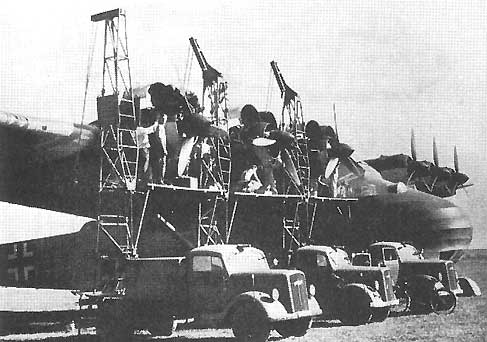
With the German defeat in North Africa, nearly all Messerschmitt Me 323s were assigned to the Eastern Front, where they were heavily committed over a vast area. Much ingenuity was shown in creating servicing and engine-change platforms, one scheme having three truck-mounted rigs joined together under each wing. Production, however, faded from mid-1943 and, although Leipheim restarted building aircraft in early 1944, only 198 Me 323s of all types were built, the last appearing in April 1944. At this time, the whole program had been transferred to the Zeppelin Glutei at Frederic, where the last variant to fly, the Me 323 Vi6, took to the air on about 11 December 1943. Powered by six Jumo 211 Rs, it was intended to lead to the production Me 323F.
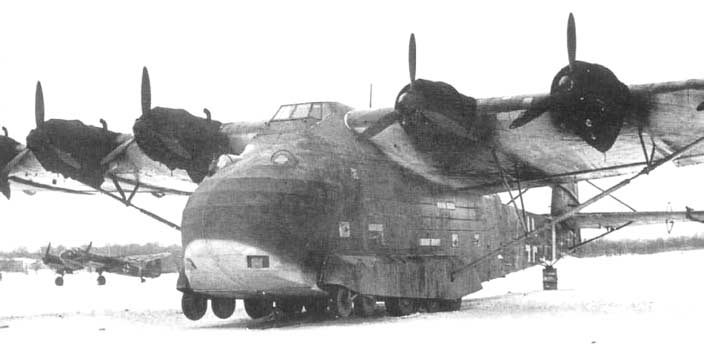
The planned Me 323G, with six 1.320-hp GR14R engines, was halted when the Me 323 V17 prototype was incomplete. There were many planned developments, including an extraordinary proposal for a twinned Me 323 joined by a new center section and with nine BMW 801 engines. Unconnected with development of the aircraft itself was the brief project at Karlshagen armament establishment, which had a bomb weighing 39,022 lb. The Me 323 appeared to be the only aircraft able to carry it, and a single test flight was made in July 1944. How the bomb was carried is not recorded, but the Gigant (which is thought to have been damaged in a strafing attack beforehand) broke up in the air.
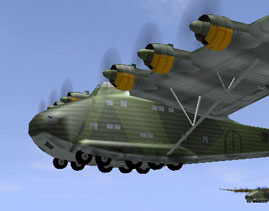
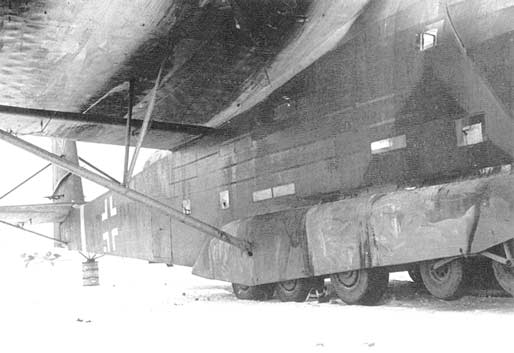 This is a great view of the Gigant main landing gear, cover and the wing strut. Along each side were a tandem-wheel front truck and a main gear with three larger wheels. All wheels were sprung by massive levers and coil springs to hold the Me 323 level no matter what the load was on board. When empty, however, that oil drum (shown above and included with model) was needed to support the tail |
|
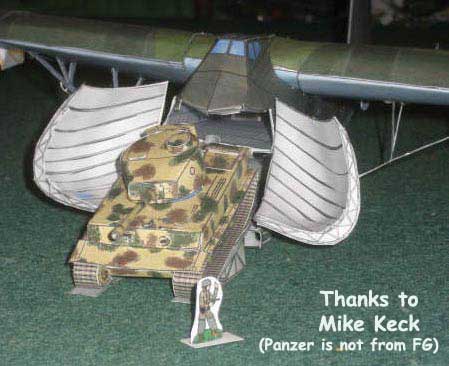
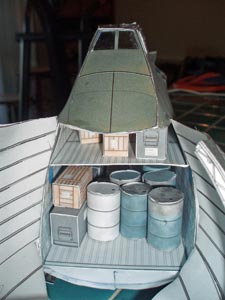
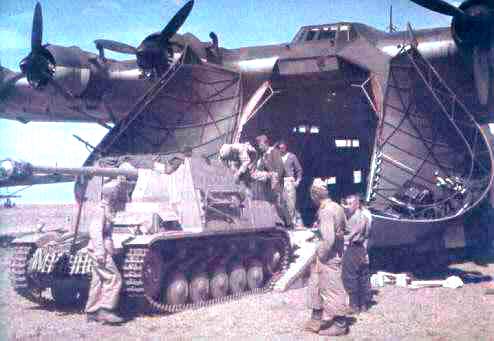 Haul a Panzer? No problem for the Me-323. Look at the expression in its' 'eyes' (canopy) |
|
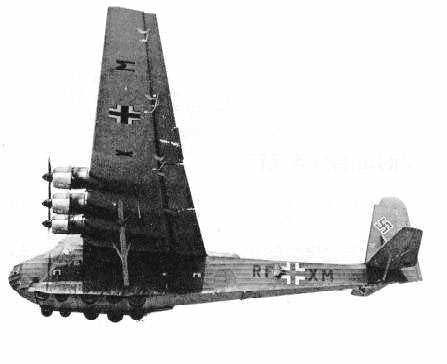
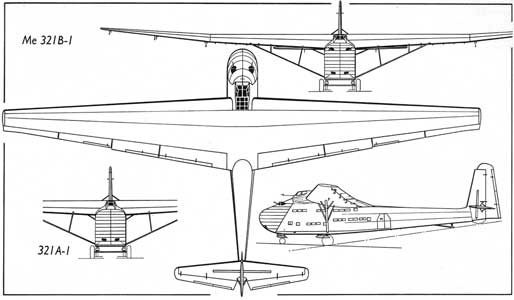
Specifications for the Messerschmitt Me-321/323
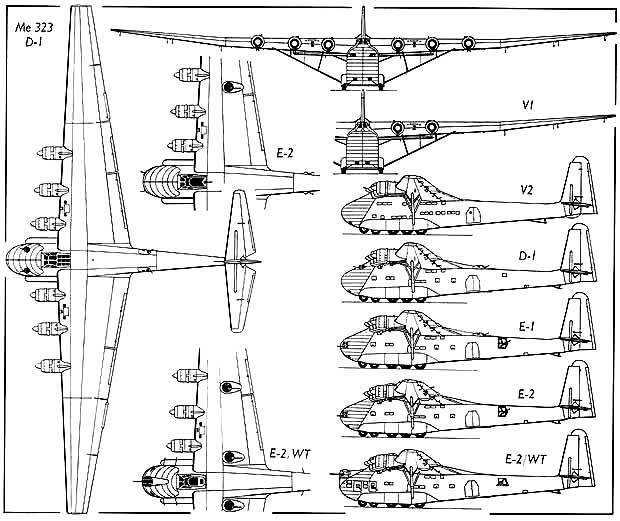
Use these views if you're planning on bashing your Fiddlers Green Me-323. You can see a few thousand German engineers were kept busy trying to perfect the Me-323 |
Crew: 5 Capacity: 130 troops or 10–12 tonnes of equipment Length: 92 ft 4 in Wingspan: 181 ft Height: 33 ft 3.5 in Empty weight: 60,260 lb Loaded weight: 65,000 lb Max takeoff weight: 94,815 lb Powerplant: 6× Gnome-Rhône 950 hp each Performance Maximum speed: 170 mph Range: 500 mi Ferry range: 684 mi Service ceiling: 13,123 ft Rate of climb: 710 ft/min Armament Guns: 18 × 7.92 mm (.312 in) MG 81 machine guns |
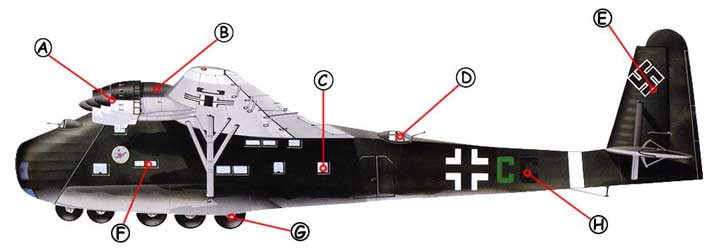 |
|||
| A: Even the six-engined Me 323 needed rocket assistance to get airborne with a full load. | B: The powered Me 323 was basically the Me 321 Gigant with 6 mighty Gnome-Rhône engines |
C: In some ways the Gigant was very advanced, with ideas such as the capacious fuselage and nose doors. | D: Due to its low speed and vulnerability to attack, up to six machine guns were carried in various mounts and turrets. |
| E: The wood & fabric tail fin of the Gigant towered over the ground at 31 feet 6 in. | F: The cabin could take loads as heavy as a Panzer IV tank or 120 soldiers or 60 stretcher patients. | G: The undercarriage was sprung to keep the floor level even on the roughest unprepared airstrips. | H: Construction was mainly fabric-covered steel tubing. Damage could easily be patched up, leading to the nickname 'Elastoplast bomber' |