

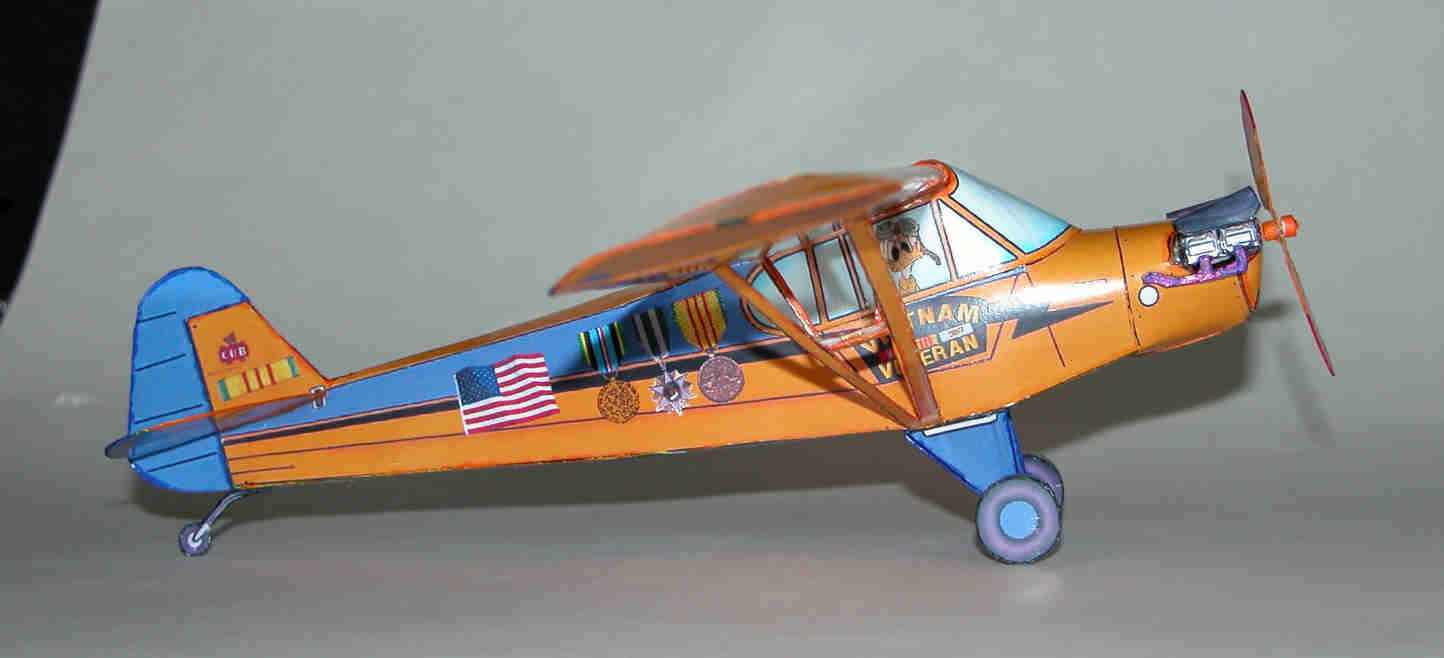
Piper Cub J-3 - $$3.00
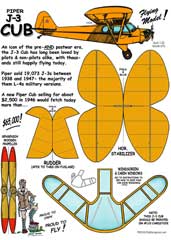
The Piper J-3 Cub is a small, simple, light aircraft that was built between 1937 and 1947 by Piper Aircraft. With tandem (fore and aft) seating, it was intended for flight training and became one of the most popular and best-known light aircraft of all time. About 10 versions (including floats and skiis!!) included in folder.


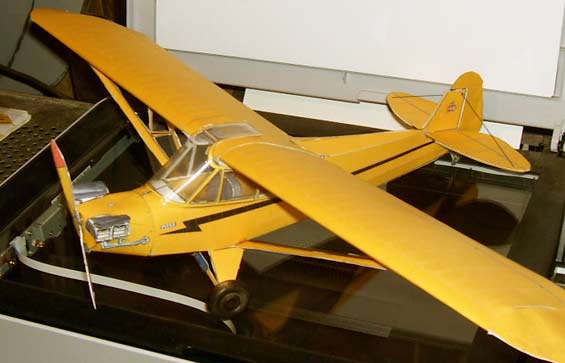
This little Piper Cub is an aviation legend. In 'Piper Cub Yellow', this little model demonstrates that some airplanes can be just slow and nice to look at. It's one of the easiest to make and has always been our most popular model.
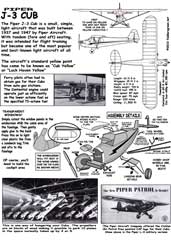
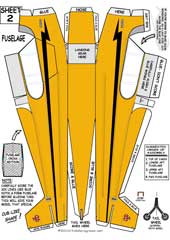
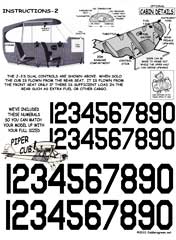
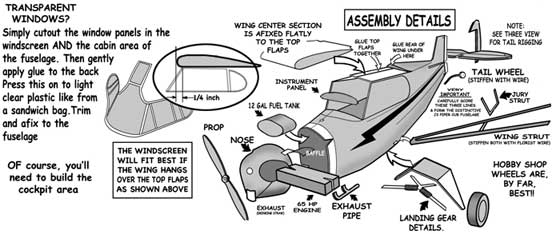
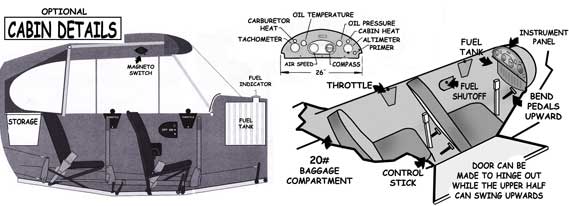
You'll be getting in your folder BOTH the regular and the large size as well a black and white version so you can create your own personal J-3 Cub markings. The 2 sheet instructions explain how to make the optional cabin as well as the clear plastic windows.
Floats and skis are finished and have been added to your MyModel folder. The wheels shown are wooden sprayed black costing 20¢ each at the local hobby shop. Wheels are included in the kit however.
The Piper Cub Story
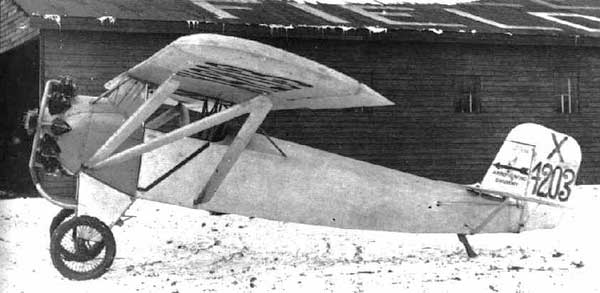
C. G. Taylor's "Chummy"
The brothers C. G. and Gordon Taylor began the small-scale design and manufacture of lightplanes in Rochester, New
York, in the mid-1920's. The first airplane produced by the
fledgling Taylor Brothers Aircraft corporation was the two-
seat "Chummy" made in 1926 and 1927. The Chummy was a
side-by-side, two-seater parasol monoplane powered by a 90
h.p. radial engine. While the Chummy was eminently unsuccessful as a commercial venture, it was indeed the great-granddaddy of the later Taylor and Piper Cubs.
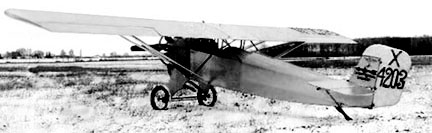 |
The stock-market crash of 1929 ended forever the chances
of marketing the Chummy since it had been designed to sell
for around $4,000. |
C. G. Taylor, a self-taught aeronautical engineer, handled the design work for the company, and his brother Gordon was responsible for demonstrations and sales of the newairplane. Gordon Taylor died in 1928 and in 1929 C. G. Taylor moved the operations of Taylor Brothers Aircraft Corporation to Bradford, Pennsylvania. It was here in that year that C. G. Taylor and William T. Piper became associated.
Piper who was 48 at the time of his meeting with Taylor was a successful Bradford businessman, having been in the oil business in Bradford since 1914 developing local oil field. holdings. When the Taylor Brothers Aircraft Corporation opened shop in Bradford, W. T. Piper and his partner Ralph Lloyd invested $800 of their oil partnership funds in the new company and Piper became a director of the firm.
Taylor and piper envisioned a new, more economical and more salable lightplane as an alternative to the chummy design. Manufacture of the new plane with which the company hoped to beat the depression was completed and the plane test-flown within a 30-day period in August and September, 1930. Engineering stress analyses were prepared in order to obtain CAA approval of the design.
The First Cub
The first successful plane Taylor and Piper produced was the
Model E-2. The engine installed in this airplane was the
Brownbach "Kitten" which had been manufactured in Pottstown, Pennsylvania. While the Kitten proved unsatisfactory in
the E-2, its name provided the inspiration for naming the E-2
Taylor "Cub". A Salmson, 9-cylinder, 45 h.p. engine turned out
to be too expensive to import for the Cub and the model using
this powerplant was never licensed.
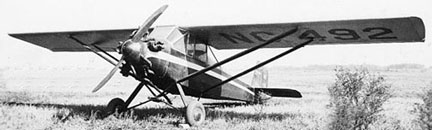 Taylor and piper envisioned a new, more economical and more salable lightplane as an alternative to the chummy design. Manufacture of the new plane with which the company hoped to beat the depression was completed and the plane test-flown within a 30-day period in August and September, 1930. |
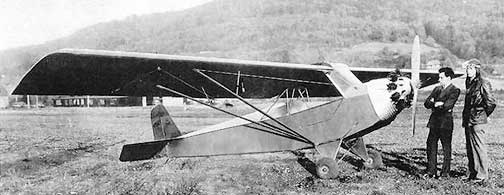 Engineering stress analyses were prepared in order to obtain CAA approval of the design |
Of all the design work that went into the E-2 Cub, there is perhaps no greater evidence of C. G. Taylor's engineering skill than the fact that the original USA-35B airfoil he selected for the E-2 was still in use when the last Cub was made.
Due to the effects of the stock-market crash, Taylor Brothers Aircraft Corporation was bankrupt early in 1931. After bankruptcy proceedings W. T. Piper purchased the assets of the company including the E-2 for around $600. Piper and C. G. Taylor reorganized the company under the name Taylor Aircraft Company with Taylor as president and Piper as treasurer. Both partners were sure that their Cub would one vday be a success with a more reliable powerplant and a reasonable price tag.
Early in its first year the newly formed Taylor Aircraft Company received a new model A-40, 37 h.p. opposed, air-cooled engine from Continental Motors Company in Detroit, and by June the Taylor Cub with the 37 h.p. Continental engine had been CAA approved, licensed, and was being, offered for sale. During 1931 the Taylor Company completed about 24 of the 37 h.p. Cubs.
From 1931 to 1936, the company showed only small profits. The number of Cubs produced in the first years were correspondingly small-22 airplanes in 1932, 16 in 1933, and 70 in 1934. It was in this year that W. T. Piper purchased C. G. Taylor's share in the company and became president and chairman of the board. The firm name remained the same. In 1936, C. G. Taylor formed the Taylorcraft Aviation company at Alliance, ohio, and continued in the design and manufacture of successful lightplanes.
In 1935 the Cub was produced in three models-the E-2 with the improved Continental A-40-2, 37 h.p. engine, the F-2 with the Aeromarine AR3-40, 40 h.p. engine, and the H-2 with the Szekely 40 h.p. engine. specifications and performance figures for all of these models were very nearly the same and the company made 210 Cubs during this year.
The J-2 Cub
 |
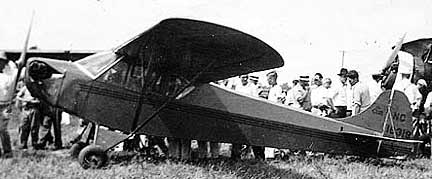 |
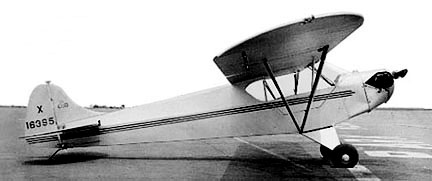
In 1935, the Cub cockpit was enclosed and the little ship
began to look more like it does today.In 1936 the completely redesigned J-2 cub was offered with
a greatly improved continental engine. The development of a
truly successful lightplane had been held back up to this time
by the lack of a reliable and economical powerplant. |
|
The Szekely and Aeromarine engines being used were extremely rough in operation and their excessive vibration made them impractical in a light airframe like that of the cub. Although it had been steadily improved since 1931, the continental A-40 was expensive and during the first few years of its use in the Cub it had presented a series of exasperating difficulties and "bugs."
Piper Aircraft and the J-3 Cub
The year 1937 was a year: of great change for W.T. Piper and
the Taylor Aircraft Company. In this year the Lycoming Company, the Franklin Air-cooled Engine Company, and the Continental Motor Company all produced the first reliable 40 and
50 h.p. airplane engines. Also it was in this year that the Bradford plant was destroyed by fire and the company reorganized
under the name Piper Aircraft Corporation. All manufacturing
equipment and 200 employees were moved to new quarters in
an empty silk mill in Lock Haven, Pennsylvania-the site of the
present Piper plant. In spite of the damage from the fire, Piper
production in 1937 was 687 airplanes and the work force was
doubled.
In 1938 Piper introduced a further improved version of the Cub, the Model J-3 using the Continental, Lycoming, and Franklin 40 h.p. engines which were soon further developed to 50 h.p. In 1938 the Cub sold for $1,300 and production was 736 airplanes.
Further improvement from 1938 to 1940 boosted the horse-power in all three Cub engines from 40 to 50, 55, 60, and finally to 65 h.p. All three engines (Continental, Lycoming, and Franklin) were used in about equal numbers until 1941. The J-3 Cub was CAA approved for use with the 65 h.p. engines in 1940.
Sparked by the newly inaugurated Civilian Pilot Training Program (C.P.T.P.) Piper sales in 1939 were 1,806 airplanes, and increased in 1940 to 3,017 and in 1941 to 3,197 airplanes. When the Army requested lightplanes for maneuvers in 1941, Continental-powered planes were used since the A-65-8 engine developed slightly more power than either the Lycoming or Franklin engines. Military use of the Continental engines throughout the war resulted in their easy availability after the war was over and all of the postwar Cubs (and most other lightplanes manufactured) were powered by the tried and true Continental.
The Cub Goes to War With The Piper L-4
Although over 75 percent of the lightplanes used in the Civilian Pilot Training Program were Piper Cubs, military acceptance of the Piper Cub L-4 for other than civilian training was slow to
develop. In June, 1941, the Air corps was requested to send
observation planes for use in the Second Army maneuvers,
which were to be held at camp Forrest,
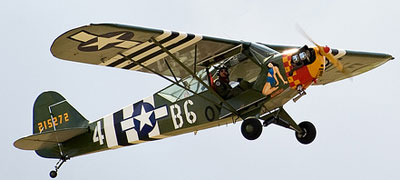 The Piper L-4 Grasshopper sporting invasion stripes |
Tennessee. The Air Corps was unable to come up with the planes, so Aeronca, Taylorcraft, and Piper supplied the 12 L-4 planes which were needed along with pilots, mechanics, and technicians free of charge to the Army. The lightplanes proved so useful at Camp Forrest that the Army requested them for the Third Army maneuvers, which were to be held at Fort Bliss in El Paso, Texas shortly after the conclusion of the Second Army maneuvers. It was during these Fort Bliss operations that the lightplanes earned their nickname "Grasshoppers". Further use of this civilian-operated and financed fleet of lightplanes convinced the military of the value of the modern lightplane in military operations.
Shortly after Pearl Harbor-December 7, 1941-the piper Aircraft corporation received the first Army order for 40 Cubs, which was soon followed by a second order for 750. During World War II the government purchased a total of about 6,000 airplanes from Piper. Surprisingly, the bulk of Piper's wartime production was not airplanes at all, but steel radar masts! The Piper cub was used in almost every theater of the war by both the Army and, the Navy and by governments for a vast variety of jobs. Cubs were used for artillery fire direction, liaison, as transports, for reconnaissance, aerial photography, and as ambulances. In some invasion operations, Piper Cubs were launched from special decks constructed on LST's and during the Normandy invasion over 1,000 "Grasshoppers" were flown from England directly to fields in France. Many Cubs were shipped into the combat zones in cargo planes and assembled at the scene of operations.
What People Say
Thanks for the mini-cub . . . gave me a nice relaxing afternoon (and I needed one!). Jim
My first try at the Cub was a bit sloppy as I learned the tricks, but the second almost seemed to assemble itself. The optional floats really call to mind the Alaskan bush pilot, and add a neat feature not often found for plastic models. I have already printed a few more of the free downloads, and am debating whether to simply order more model downloads individually, or to buck up and get the whole CD. Hmmm, decisions, decisions! Russ
My goodness! The Cub brings back memories of N7360H, a 1947 J-3 that my father and I owned. It was a lovely ship and quite a change from the Cessnas I usually flew. And, sadly, it was destroyed in a hanger fire set by a couple of kids out for "fun". Keep up the wonderful work. Michael - (May 21, 2001)
Saw your web site in Air & Space, and had to check it out. Very kewl! Downloaded the J-3 Cub and printed it on 22" x 28" poster board on an Encad Novajet 50. Turned out a 26" wingspan! Thanks! Tim Webb
Well, I finally got her put together. Started out with Duro Gel super glue, then finally figured out that hot glue works better on poster board. Anyway, yes, that is a string on the left wing, and yes, she has flown, in circles. My friend John, who is a microlight modeler, suggested that a balsa stick inside the fuselage might work for rubber band powered flight, but we decided that the prop would have to be bigger than the ground clearance, and that the plane would be too heavy made out of posterboard to fly that way. Not to mention better landing gear. I found that about 4 oz of lead rigger's seals in the nose puts the CG just right. A few tips for those wanting to "scale up" your models: 1. print in high res. 2. tolerances are quite loose. I had to make a lot up as I went along, especially when it came to the wing struts vs dihedral. I actually gave this one a bit more dihedral than it was designed for, so it would fly better. 3. Cheerios don't work for wheels on this scale! I used the wheel strips. Tim Web
... got everthing up and running according to your instructions. which by the way are excellent. Made my first printout of the large J-3 cub. Just teriffic!!! Looks just like the one I used to have! I'm like a kid in a penny candy store!!! My spouse will have to pry my hand from this mouse with a crowbar. Glad I found this website.Yours for great modeling. John Gabriel (gabby)
I wanted to add that the suggestion to use a colored paper to enhance the colors is right on. I have printed and am building the Piper Cub on a manila file folder, heavily coated with a clear licquer and it is stunning. Manila folders prove to be a good choice. Thanks again. John D
Still More About the History of The Piper J-3 Cub
 She was conceived in bankruptcy, a true child of the Depression, but she grew up to be a star
and to make a fortune for her backer, if not her designer. When war came the
soldiers loved her, too. She initiated more gauche young men into the joys of
flight than any other airplane ever; and now, as a sprightly old lady, she is
still much loved. With more power to her elbow, and a fashionable "Super"
to her name, she still seems young and fascinating to her swains.
She was conceived in bankruptcy, a true child of the Depression, but she grew up to be a star
and to make a fortune for her backer, if not her designer. When war came the
soldiers loved her, too. She initiated more gauche young men into the joys of
flight than any other airplane ever; and now, as a sprightly old lady, she is
still much loved. With more power to her elbow, and a fashionable "Super"
to her name, she still seems young and fascinating to her swains.
The Cub was sired by the brothers Taylor-C. G. and Gordon-as the Roaring Twenties drew to a close. These brothers had begun fabricating airplanes in upstate New York several years earlier with a design called the Chummy. With a name like that it was, of course, a two-seater. It also had a 90-hp radial engine and was offered to the public at $4,000, which was rather too much for the aviating public then. The Chummy became an early victim of the Depression.
In 1928 brother Gordon died. The two Taylor brothers had been very close: They'd always worked on their airplanes together, and together they'd gone out barnstorming whenever they had no customers for a Chummy, which was very often. C. G. Taylor felt he couldn't stand to live in Rochester after his brother's death, so he began casting around for somewhere else to build airplanes. He chose Bradford, Pennsylvania, an oil city with money to spend on new industries. The good citizens of Bradford put up $50,000 to persuade Taylor to set up shop there. Of that sum $800 came out of the pocket of one William T. Piper, a highly successful oil man of forty-eight years, a man who had never had aught to do with aviation before, but who found himself suddenly the holder of a seat on the board of the Taylor Aircraft Corporation.
But Piper, if a novice in aviation, was no beginner in business. He could see at once that what aviation lacked was a cheap little airplane, cheap both to buy and to operate. He persuaded Taylor to design such a machine, a kind of scaled-down Chummy. It was named the E-2, and the first one was put together within a month, in late 1930.
The first E-2 was powered by an engine with the lovely name of Brownbach Kitten. It wasn't much of an engine, but it did serve to inspire the name of Cub for the E-2. Various other engines were tried. "The first engines were so bad we always had to travel double-with an automobile to bring the pilot home!" said Mr. Piper, who until his death in 1970 kept up with the affairs of his corporation. Eventually they settled on Continental Motors' A-40 with 37 horsepower.
They also went bankrupt. After bankruptcy proceedings, Piper bought the entire assets of the company for around $600. No doubt it hardly looked a bargain at the time. The new Taylor Aircraft Corporation had C. Q. Taylor as president and Piper as treasurer. But on June 15, 1931, a date Mr. Piper remembered proudly and with clarity, they got the Cub licensed. They sold twenty-two that year, at a price of $1,325 each.
Business was hardly brisk. Sales dropped to seventeen aircraft in 1933, then climbed to seventy-one the next year, two hundred in 1935, and five hundred in 1936. This was the improved J-2 model, with, for the first time, an enclosed cockpit. In the spring of 1936 Piper bought Taylor out. "Just like anybody else, we got thinking along different lines," Mr. Piper told me on one occasion. "He wanted to do one thing, I wanted to do another. I had all the money in the thing; he had all the know how. He couldn't get anybody to buy me out, so I bought him out."
 Then came a holocaust: The entire works burned to the ground.
Piper was in Hollywood on a selling trip; he was told by telephone
that his new business was a smoking heap of ashes. "We began
looking around for someplace to go," he told me, not adding
that only five percent of the company's value was covered by insurance.
And so Piper came to Lock Haven, Pennsylvania. "Here was
a town that was financially sick," he said. "Here was
an old silk mill that could be bought for a fraction of what it
cost. And an airport right next door. It was a very good move
for us."
Then came a holocaust: The entire works burned to the ground.
Piper was in Hollywood on a selling trip; he was told by telephone
that his new business was a smoking heap of ashes. "We began
looking around for someplace to go," he told me, not adding
that only five percent of the company's value was covered by insurance.
And so Piper came to Lock Haven, Pennsylvania. "Here was
a town that was financially sick," he said. "Here was
an old silk mill that could be bought for a fraction of what it
cost. And an airport right next door. It was a very good move
for us."
It was an even better move for Lock Haven, an old lumber town
that had settled into decline. That silk mill was a little large
for Piper at first, so the second floor was rented out. But not
for long. Sales mounted to 687 in 1937, and in 1938 the new, improved
J-3 was introduced. This offered the choice of Franklin and Lycoming
engines, as well as the Continental-all of them 40 hp, all to
be developed over the years till they gave 65 hp. Then, with the
Civilian Pilot Training Program, the Cub really started to go:
1,806 were sold in 1939; 3,017 in 1940, and 3,197 in 1941.
The scene now changes to Tennessee, midsummer 1941. The U.
S. Army is on maneuvers and it has asked the Air Corps for some
planes for observation purposes. The Air Corps is sorry, it can't
help. It has nothing suitable. So Piper, along with Aeronca and
Taylorcraft (Taylor had started up again by himself), supply a
dozen light planes and their crews.
In the collapse of the postwar flying boom, Piper Aircraft failed once again, and then was refinanced and reopened with 250 people instead of the 2,700 employed before the shutdown. But the Cub went on-now in a variety of models, such as the PA- Cub Special with 90 hp, the Vagabond, the Family Cruiser and the Clipper, the Pacer and the Tn-Pacer, and the Colt. They were getting further and further away from the basic Cub, but still were recognizably its children.
The J-3 Piper Cub-some interesting points: It started life as a simple design for a tandem-seat two-place light plane for the private owner. After a series of ups and downs for the airplane and its producers, including a disastrous factory fire, the design evolved into the J-3 version. It featured such refinements as a tail wheel and brakes, a starter made of rubberized shock chord, wound around a drum that could be engaged to the engine drive shaft. Most of the time the starter worked. Metal wing spars replaced the wooden ones of the earlier J-2, and the yellow paint job- to become known a 'Cub Yellow' was adopted . By December 1941, one third of all the airplanes in America, and nearly two-thirds of all the light planes, were Piper Cubs. World War II brought new orders for the J-3. painted in olive drab and redesigned the L-4, for the army artillery spotting and liaison. Besides that workhorse task, the L-4s served as transports for Generals Eisenhower, Patton, Bradley, Clark and others. They landed on beachheads and back roads, in pastures and plowed fields, and gave the ground forces a degree of communication they never had before then. Cubs were armed with rockets and one was used to capture two enemy soldiers by landing next to them. One even was credited with downing a Messerschmitt Bf-109 that was chasing the Cub which could turn on a dime and the German couldn't. In spite of wartime heroics, the 'Cub' will always be remembered as the airplane that gave wings to thousands of pilots all over the world |
Piper Introduces the Super Cub
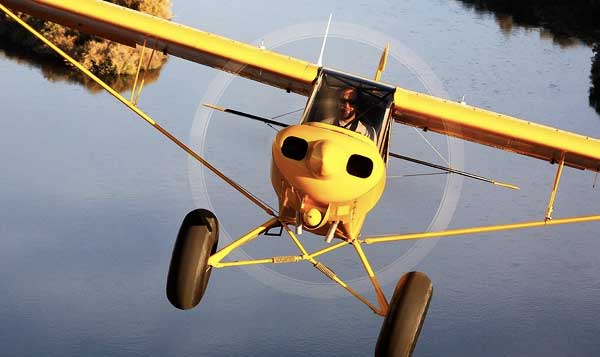 But the Super Cub, introduced in 1949, is a real Cub, even though you can now
get it with all of 150 hp. It's still being manufactured in dribs and drabs,
as orders trickle in from prospectors in Alaska and wild lifers in Kenya and
anybody else who needs an airplane but has only the boondocks for an airport.
But the Super Cub, introduced in 1949, is a real Cub, even though you can now
get it with all of 150 hp. It's still being manufactured in dribs and drabs,
as orders trickle in from prospectors in Alaska and wild lifers in Kenya and
anybody else who needs an airplane but has only the boondocks for an airport.
Is there a pilot in America who has not flown a Cub? It's a strangely modern-looking airplane when you remember that its genesis was back in the days when the biplane was still king and the last words in modernity were such period pieces as the Ford Tn-Motor and the Lockheed Vega.
The shape is instantly familiar to every fledgling aviator, however, because it's also the shape of everybody's first model airplane: high wing for stability, slab-sided fuselage for ease of construction, gear well forward to bounce her back into the air again.
Getting into it is everyone's biggest problem with the Cub. Each evolves his own technique, but they all are variations on the basic necessity to bend yourself double and twist through 180 degrees at the same time. If you have lumbago, better fly something else. Once in, things get easier. The engine fires at once. Taxiing is easy enough, but it takes a bit of practice before your heels stop slipping off the little brake pedals that rise, mushroom-like, from the cockpit floor. You must swing from side to side to see around the engine. Check the switches and carb heat, and, if you're solo, reach a long, long way forward from the back seat to reset the altimeter. Taxiing in a circle is the only way to ensure there is nobody about to land.
The takeoff is the first surprise. You leave the ground almost before you've got the throttle fully open. After that you creep upward at barely 400 fpm, with 55 mph and 2,150 rpm on the dials. Several of those sixty five horses seem to be expended in sheer noise. From the rear seat the visibility is not of the best. I guess the sky wasn't so crowded back in 1930. Watch the oil temperature; on a hot day it may be nudging the limit by the time you reach circuit height. Full bore gives about 87 mph and a hot cooking smell from the engine. A realistic cruise is 75 mph at 2,150 rpm. With any sort of breeze on your nose the cars on the thruway will leave you behind.
The aileron drag is remarkable. It's a blessing that a rudder is good and powerful. It's when you try slow flight that the Cub begins really to impress you. Power off, the stall comes up at about 35 mph, gentle, with a slight left wing drop if you keep the stick hard back.
The nose falls away before the wing, so that you tend to be picking up speed again before the wing really has much chance to go down. The center-of-pressure travel must be considerable. Fierce and prolonged back pressure on the stick is required to reach the stall, and if you release the stick at the moment of stall, the ship will pitch sixty degrees nose down. The Cub (Mach 0.17) preceded the F86 Sabre by about eighteen years with the variable incidence tail, though it's a slow and finger aching game trimming the thing.
Stalls with power on in turns are even more impressive. Try a climbing turn, with full power, top rudder, and the airspeed dropping. First a good warning buffet-and just about nothing else happens. The airspeed disappears into that region of uncertainty at the bottom of the dial, but she will not snap on you. If you really force it and go on forcing it, she may very gently shudder into level flight.
What a marvelously safe airplane for military observation purposes the Cub
must have been! Its stalling characteristics must be as safe as any airplane
ever made. The approach in a Cub is best done at higher-than-necessary speed.
There is no aerodynamic reason for th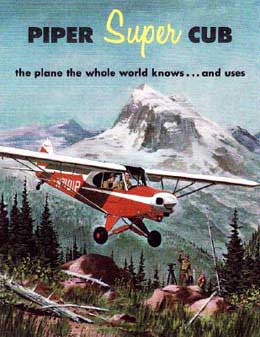 is, just the fact that if you try gliding
in at the Cub's natural speed you are likely to have other airplanes weaving
and dodging and backing up and overshooting behind you.
is, just the fact that if you try gliding
in at the Cub's natural speed you are likely to have other airplanes weaving
and dodging and backing up and overshooting behind you.
You can't see very much straight ahead if you're in the back seat. A crosswind helps. You can then peer around the side of the nose. If you are going to side-slip in, close the window first, or you will arrive in a billowing cloud of cockpit dust and papers. And you know what they say: If you can land a Cub smoothly, you can land anything.
You can aerobat the Cub. The Cub I flew was an old one with wooden spars, and I was asked not to do more than spins and wing overs in case the wood had become a little creaky with age.
That big door makes the Cub series probably the best-ever light plane for air-to air photography. That huge window-door gives you a magnificent field of view, with only the wing strut to get in the way, and more often than not, it is the wing strut that makes the picture.
What does it cost to operate a J-3? One owner told me it costs him no more than $3.78 an hour! Here is how that figure is made up, based on 200 hours' flying a year: fuel, 900 gallons, $396; oil, 36 quarts, $18; engine maintenance, $40 (own labor); airframe maintenance, $125 (own labor); tie down, $180 ($15 a month). That's a total of $759, over 200 hours, or $3.78 an hour.
Notice that no depreciation is included. The airplane is simply no longer depreciating. It may even be appreciating. Another Cub owner gives these figures for operating his J-3 for 250 hours in a year: initial purchase price, $1,100; fuel, $495; oil, $50; charts, computers, landing fees, and the like, $35; tie down and hangar, $180; liability insurance, $150; maintenance, $75; annual inspection, $100; and initial registration fee, $4. So his costs were $1,100 down and $1,089 for the year, which works out to $4.34 an hour (excluding purchase price). In the second year he flew 300 hours for $3 an hour, and in the third year about the same. He then sold the plane for only $100 less than he had paid for it, so his flying over those three years averaged $3.60 an hour.
"An airfoil that is very reluctant to stall," he said. "It has a broad peak to the lift curve. Undoubtedly more people learned to fly in this airplane than any other single type. Flying schools found you couldn't break them. And repairs were easy to make. The airplane is a little tricky to land-it porpoises. It does put the student on his guard." It does, indeed.
The oddest thing about the Cub is how heavy the controls are. You might almost be flying a bomber instead of the lightest of light planes. "The principal reason is that it has a high degree of lateral stability. It just doesn't like being rolled." Its slow cruising speed? "It's terribly dirty. There's really been no effort made to fair the intersections of any of the various parts. It's not the wing. A great many of us in this company have a great love and respect for that wing. It put us in business. And it's still used on the Aztec. I think that airfoil was a happy choice.
And the future of the Super Cub? "When it becomes our last fabric-covered airplane"-the other is the Pawnee-"I don't think there'll be any qualms about cutting it off unceremoniously."
Piper was still at the height of its success with the 65-horse J-3 Cub when it began developing bigger and better things out of the basic Cub airframe. First came the J-4, the side-by-side Cub-a smooth airplane, if you can find one. Not many more than a hundred are still flying. Then the J-5 Cruiser, a fat Cub with seats for three, cruising 85 mph on 75 hp, which is not half bad.
Those were the days just before Pearl Harbor, and by peacetime the Cruiser had become the J-5C Super Cruiser, with 100 hp, an electrical system, and redesigned landing gear. About this time, Piper abandoned the J nomenclature and started the PA series; the Super Cruiser is also known as the PA-12.
The last of the Cruisers was the PA-14 Family Cruiser, with seats for four, 115 hp, and a devastating 110-mph cruise. The Super Cruiser is far more abundant than its two brothers, for upward of a thousand Supers are still active, while less than a hundred PA-14's and maybe two hundred 75-horse J-5's are still about. They were all, in their day, extraordinary value; you could get a J-5 new for $1,995 in 1940 and a PA-12 for $2,995 in 1945.
The Cruiser made its tiny mark on history, too, for in 1947 two PA-12's flew around the world, their two pilots spending four months battling headwinds, ice, desert heat, and every possible kind of foul-up. But they proved the superior dependability of the Piper airframes. The worst mechanical problem in five hundred hours of flying thirty percent over gross was a cracked tail wheel.
If you think the Cub is a real fun airplane, you should try the Super Cub, while you've still got a chance. For a start, you fly it solo from the front rather than the rear seat, which is a big improvement. You run it up to full power against the brakes, lift the tail on the slipstream, let go of the brakes, lurch forward a few yards, lower full flap, and haul back viciously on the stick. Surprise! You get airborne.
You can climb a Super Cub at 1,000 f pm. You can climb at an angle of forty five degrees to the horizontal. In a wind you can fly slowly backward relative to the ground. You can reach well over 20,000 feet quite quickly, and with the arctic heater Piper installs, you can gently roast yourself at the same time. You can land in almost as short a distance as needed for takeoff, but not quite, so that you can be sure of getting out of any field you've gotten into. The technique is to approach with full flaps, a little power, and the airspeed way off the bottom of the dial. At the moment of touchdown, cut the power, raise the flaps, and stand on the brakes. With practice you can achieve a most impressively sudden arrival.
We once paced out what a real expert could achieve in the way of a short landing run. Against a reasonable breeze it was thirty-seven yards. But have a care, for the Super Cub is heavier than the old J-3, and it can stall on you.
The load you could carry for the horsepower has always been one of the Cub's notable qualities. The early ones with only 37 hp would take 400 pounds disposable
load; with 50 hp, 500 pounds; with 65 hp, 540 pounds. The big 150 Super Cub
will carry 820 pounds. Nor is it very critical, for you can get away with fair
overloads, and the allowable center of gravity range is generous. In consequence,
all the Cub series have always been favorites for any kind of flying job,
be it at work, air shows, endurance flights, or mountain 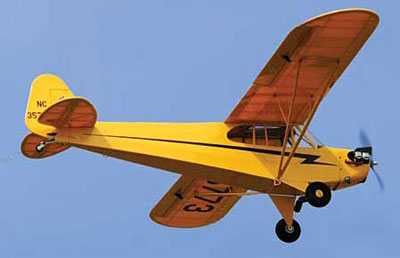 landings. Truly, a
universal airplane.
landings. Truly, a
universal airplane.
Let the late Mr. Piper have the last word in this story, about his old partner C. G. Taylor. "Taylor designed a good airplane," he said. "Have to give the devil his due." And what did old devil Taylor do? He went away and designed the Taylorcraft. It wasn't really anything like the Cub: It had side by-side seats and a very different airfoil. C. G. Taylor moved to Alliance, Ohio, and set up the Taylorcraft Aviation Corporation to build his new bird. At first it had a 40-hp Continental, and a cruising speed of less than 90 mph, but soon the Taylorcraft moved up to 65 hp-Lycoming, Franklin, or Continental, according to the customer's choice, though by far the largest number chose the Continental.
The owner of one Taylorcraft acquired his bird, a 1940 B-12 Continental-powered model, as a wreck from someone's chicken coop. He then rebuilt it himself. Introducing us to his machine, he said, "I think it's an excellent airplane. It's efficient. You can cruise nicely at 2,050 rpm, where the engine's real smooth, and you're making 90 to 95 mph."
He went on: "I paid $200 for it as a bag of bones. I guess i've put about $1,600 into it since, rebuilding. And we've flown some five hundred hours in it. It's a little faster, perhaps a little more maneuverable than a J-3. It's a nice cross-country airplane. I've only got one wing tank in mine, but I've heard they used to have four, as well as a fuselage tank.
"In turbulence she does have a tendency to bounce around a lot, but she's a gentle and forgiving old machine-though if you stall with a bit of rudder you'll go right into a spin."
We climbed aboard and it's cozy inside. Don't take anyone with sharp elbows into a T'craft. The airplane has enormous round control wheels, like something out of a 1930's cloth bomber. How cockpit styles have changed! The airplane's owner has painted a yellow mark on his wheels to show where top dead center lies. And he shows us the trim lever, under his seat, and makes us open the door to peer back and see the trim tab, a separate vane mounted underneath the stabilizer.
Fired up, we bounce and hop across the stones to the takeoff
point, which at Old Rhinebeck in this wind is at one side of a
big pit. You hurtle down one side of the pit, and stagger up the
other, waiting for the right combination of bump and gust to get
airborne. In the T'craft this moment seems to come very smartly,
for the takeoff is quite short. We climb out indicating 1,100
fpm, which means the VSI is lying in its teeth, bu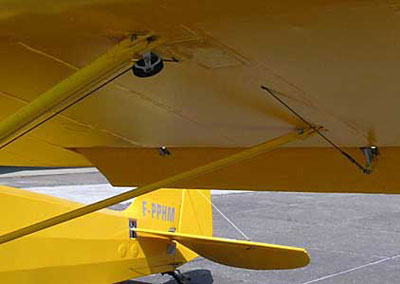 t even so, the
climb-out is right smart.
t even so, the
climb-out is right smart.
At 2,000 feet we level off. It's a real wintry day, and while the cabin heat is good around the feet there's a Force Eight gale coming in the door onto your face. Visibility is better than expected, except in a turn. Stability in pitch is good, but the T'craft lacks positive stability in yaw. Sideslip and let go, and she stays side slipping, with only a slow return to straight flight. You must keep on the rudder all the time, or the ball in the slip indicator will be all over the place. The ailerons on this airplane are very big and sensitive, and quite uncompensated, which doesn't help.
Before starting the approach, we are told that the airplane tends to float, due to the curved undersurface of its wing. The best glide is 60 to 65; the sink rate goes up at lower speeds, and if you slow it up too soon you can find yourself sinking onto the ground with rather an untidy thump. We find we need to keep pushing on the rudder to keep things straight on final. But there's perfectly adequate control on the roll-out.
Taylorcraft went on building the 65-hp Model B for many years. During World War II it produced a tandem trainer that looked very much like the old Cub, and also considerable numbers of the L-2B-called Grasshopper, as was the military Cub-in which an observer sat behind the pilot.
Taylor designed a four-seater Model 15 with a 150-hp Franklin, but what with a fire in the plant and overproduction of the 65-hp model, Taylorcraft was soon bankrupt again. The corporation was revived in 1947 and lingered on into the mid fifties, experimenting with molded fiberglass coverings and models with up to 225 hp. C. U. Taylor, though he designed splendid airplanes, was never the world's best businessman, whereas perhaps his old partner W. T. Piper was.
About Floats
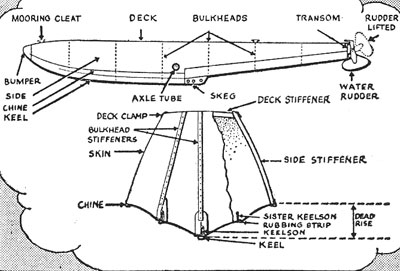
Float Terminology
 |
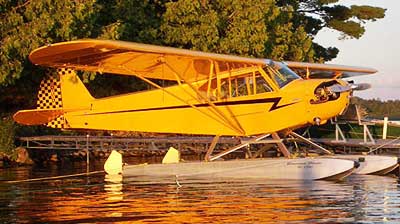 |
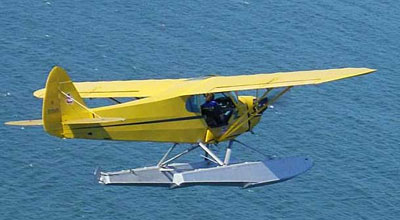
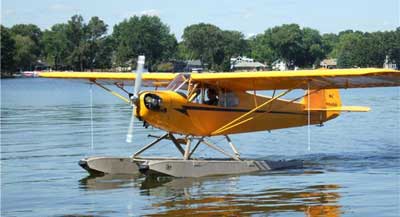
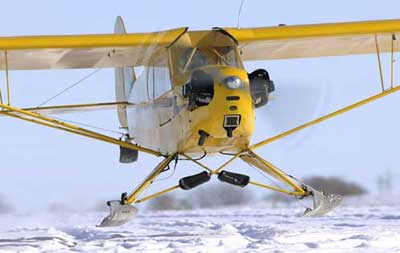
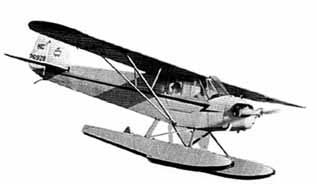
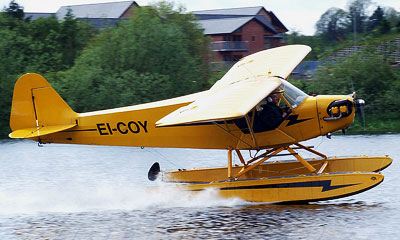
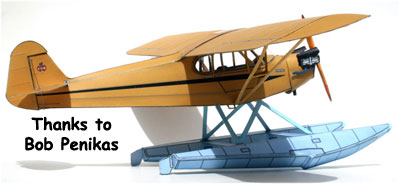
Adding Floats to the Piper J-3 Cub made it very versatile, so it could take off and land on just about any open body of water, and with Skis any snow covered field. |
 |
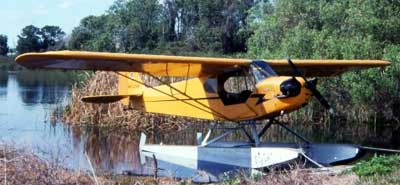 Approximately 900 J-3 Cubs were produced in 1945, 1,320 in 1946, and 720 in 1947 |
|
 |
 |
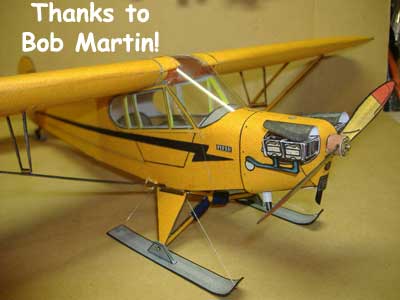 |
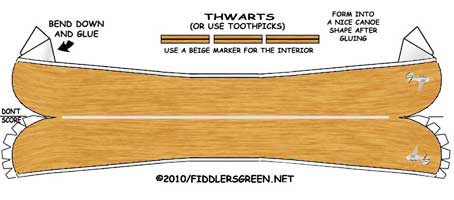
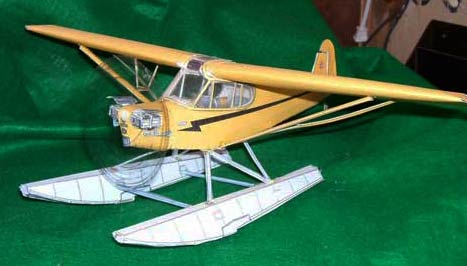 There are Floats and Skis for the new Piper J-3 Cub cardmodel. Even a strap-on canoe all included in the folder. Image thanks to Count Mudget |
 |
 |
About the Piper Cub....
The model that's still considered the generic general aviation airplane by
many non-pilots still has an enormous attraction to pilots, as well. In fact,
it's so popular, it has taken on classic status and assumed a price tag out
of all proportion to its talents. Created in the early '30s, the Cub evolved
to the 65 hp J-3 that would carry two at 65 knots cruise. The Super Cub came
along in the '50s, with engines that eventually stabilized at 150 hp and performance
that stabilized just this side of unbelievable. The Super Cub became the standard
bush plane/tow plane/utility hauler of the world, with the ability to leap out
of 500 foot strips with payloads inside or strapped outside that often boggled
the imagination.
CUB CONSTRUCTION
The J-3 fuselage framework was built of welded chrome molly
steel tubing lightly faked to shape and covered
with Grade A cotton fabric, testing 80 psi, warp and fill, minimum.
Flightex was the most widely used brand name. The finish on the
original Cubs was cellulose nitrate dope. Postwar Cubs were finished
with cellulose butyrate dope. The last Super Cubs were covered
with Ceconite Dacron cloth.
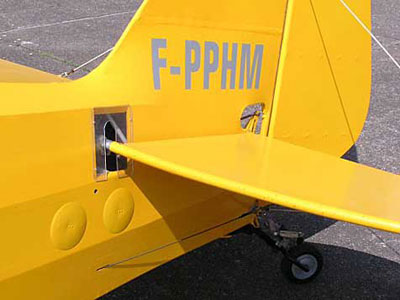
Seats of 26-inch width were mounted in tandem, and a large split-type door opened most of the right side; the airplane could be (and often was) flown with the right side open. Windshield and windows were of Pyralin, and the left-side window was slideable for controlled ventilation. The sparse upholstery was whipcord; a small baggage shelf behind the rear seat had a 20-pound capacity. The nine-gallon (or optional 12-gallon) fuel tank was mounted just behind the firewall and utilized a simple, bobber-type fuel gauge that projected through the filler cap. The wing was framed with solid spruce spars (early models) or dural spars (late models) and stamped aluminum ribs. The leading edges, back to the front spar, were covered with dural metal sheet, and the completed framework was fabric-covered.
A simple tripod landing gear of 72-inch tread was snubbed with Rusco rubber shock rings, and the 7.00 x 4 wheels were shod with low-pressure tires. There were no wheel brakes on the early Cubs, except as extra-cost items. The fabric covered tail group was framed of welded steel tube, and the horizontal stabilizer was adjusted in flight, controlled by a jack screw. The rudder was aerodynamically balanced, and all controls were operated by twisted steel cable.
The standard J-3 finish was "Cub Yellow" (Randolph M-9521-D Sport Yellow) with black trim. A Sensenich wooden propeller, wiring for position lights, dual controls, safety belts, and a first aid kit were standard equipment. Optional equipment included battery, position lights, carburetor heater, cabin heater, steerable tail wheel, Goodyear air wheels with brakes, 12-gallon fuel tank, wheel pants, prop spinner, Edo 1070 floats, and skis. The Goodyear tire size was 8.00. x 4.
Aviation history buffs know that the birthplace of the Cub wasn't Lock Haven, Pennsylvania, home of the Piper factory during its glory years, but Bradford, Pennsylvania, where in 1930 C.G. Taylor set up shop at Harri Emery Airport. When the Great Depression arrived and Taylor went under, William T. Piper stepped in and bought the company out of bankruptcy. The Taylor name was retained and a new design, the Cub, was launched. It was a huge success. Over the course of just a few years, hundreds of Taylor Cubs were manufactured right there in Bradford. Then, in March of 1937, a fire destroyed the factory. Piper relocated the plant to Lock Haven, changed the name to Piper Aircraft, and the rest is history. The Cub would go on to become the most Popular and widely recognized light airplane in the world. The Bradford connection was largely forgotten.
USAir pilot George Welsch has always had a sentimental attachment to
the Cub. George's father soled in one
in 1940 and in 1964 he soloed George
in a J-3. When Welsch learned that the
historical significance of the Taylor factory site was lost on most Bradford residents and that no marker was in pla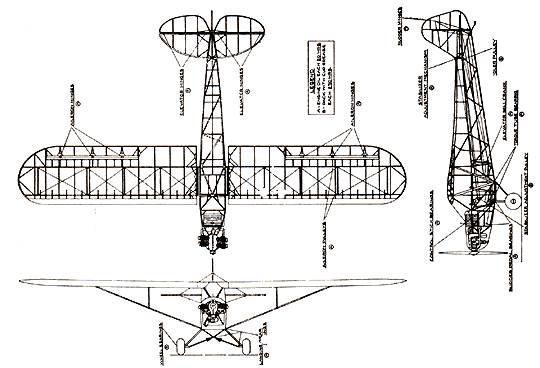 ce
to signify the spot, he decided to do
something about it. Welsch contacted
the president of the University of Pittsburgh at Bradford, which is located on
the site of Harri Emery Airport (it
turned out the school had a collection
of rare Piper memorabilia) with a plan
to build a monument. With help from
the school Welsch has set up a foundation to raise the estimated $25,000
needed for the project.
ce
to signify the spot, he decided to do
something about it. Welsch contacted
the president of the University of Pittsburgh at Bradford, which is located on
the site of Harri Emery Airport (it
turned out the school had a collection
of rare Piper memorabilia) with a plan
to build a monument. With help from
the school Welsch has set up a foundation to raise the estimated $25,000
needed for the project.
A man by the name of Gil Taylor, and his brother, established the Taylor Brothers Aviation Corporation in 1929. One-of their most famous designs was known as the Taylor Cub and it first flew in 1930. The company had a difficult time during the Great Depression and, in 1937, an oilman by the name of William T. Piper took over the ownership and formed the Piper Aircraft Corporation. When first produced by Piper, the Cub was powered by a 40 horsepower Continental A40-4 engine. A very successful version, especially popular during World War II, was Powered by a 65 h.p. engine. This had the designation of J-3C- 65,but was more commonly known as the J-3 Cub.
Just before entry into World War II, the United States government implemented what was known as the Civilian Pilot Training Program. The aircraft of choice for the "CPT" was the Piper Cub. In 1940, 3,016 Cubs were built and at the wartime peak, a new one left the factory every 20 minutes. It was recorded that over 50,000 pilots began their flight training in Piper Cubs during WWII.
In 1947, the U.S. Army selected the Cub for artillery spotting. It was soon learned that this versatile airplane had capabilities far beyond the Army's initial expectations. The Army's version, modified for various tasks, was known as the L-4 and designated the "Grasshopper." The U'S. Navy had a number of these airplanes designated the NE-1.
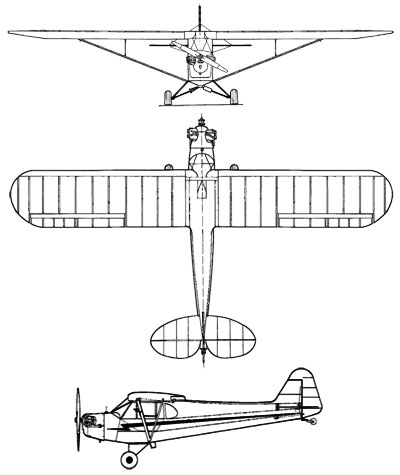
Specifications for the 65 h.p. version gave it a maximum speed of 85 mph, and a service ceiling of 12,000 feet. The range was just under 200 miles and the gross weight was 7220 pounds. The airplane had a 35'2" wingspan and a length of 22' 3".
Civil Air Patrol has a history with this airplane that dates back to WWII. During this time, civilian pilots flew their private aircraft, many of which were Piper Cubs, in patrol along the Atlantic Coast. They conducted exhaustive searches for German submarines, known as U-boats. When a U-boat was sighted, CAP pilots would call in air strikes. German U-boat commanders quickly realized the threat of these tiny aircraft.
Many U-boats would crash-dive upon sighting a CAP
aircraft. Some of the submarine crews would try to shoot
them down and, as a result, the Army Air Corps began
arming the CAP airplanes with bombs. Duri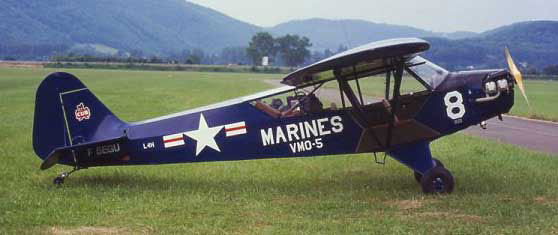 ng the war
two German U-boats were sunk by CAP air crews. If a
CAP airplane was shot down, and several were, there was
little chance for survival in the cold Atlantic. As a result of
this threat, CAP developed a program of search and rescue
which remains one of its three main missions to this day.
ng the war
two German U-boats were sunk by CAP air crews. If a
CAP airplane was shot down, and several were, there was
little chance for survival in the cold Atlantic. As a result of
this threat, CAP developed a program of search and rescue
which remains one of its three main missions to this day.
Because of the nature of the mission of the early CAP air crews, they became known as the "Flying Minutemen!" They would leave their homes in the morning, go fight in a war during the day, and return for dinner in the evening. This is how the "minutemen" fought during the Revolutionary War.
"After the German surrender in 1945, one of Hitler's high-ranking naval officers was asked why the Nazi U- boats had been withdrawn from the U.S. coastal waters early in 1943. The answer: 'it was because of those damned little red and yellow airplanes!" (quoted from Robert E. Neprud's publication, Flying Minutmen).
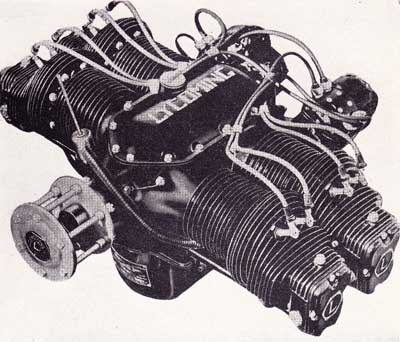 Lycoming O-145 Engine |
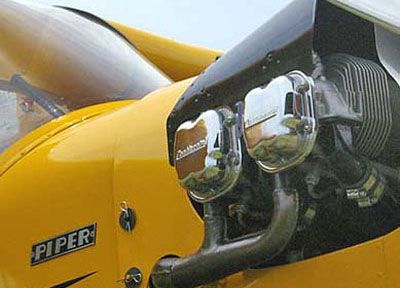
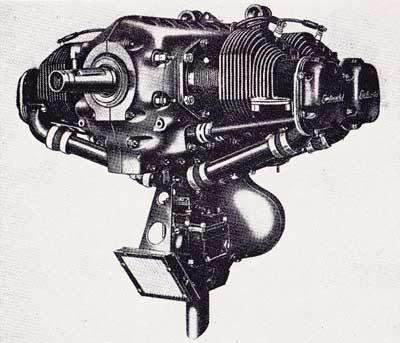 The Continental A65, was the most widely used engine in the J3 Cub |
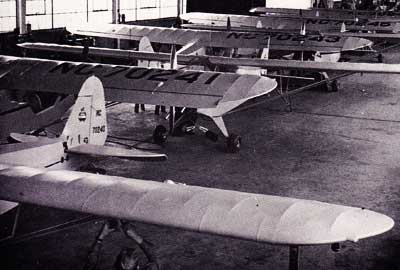 The Piper J-3 Cub assembly line at the Lock Haven, plant in 1946. |
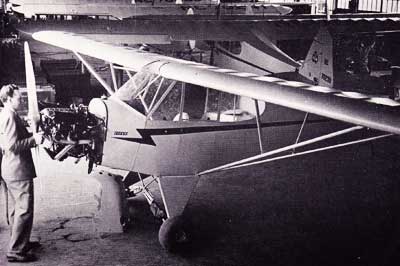 Piper J-3 Cub gets its powerplant and prop at the end of the assembly line. |
 |
 |
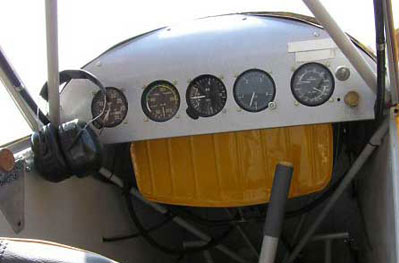
The Cockpit is very basic making it easy for beginner flyers. |
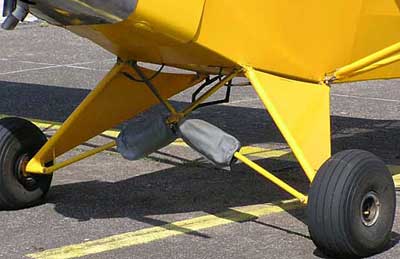
With fixed landing gear there are no worries of forgetting to lower the landing gear. |
 |
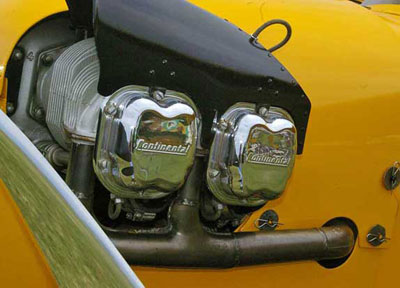 |
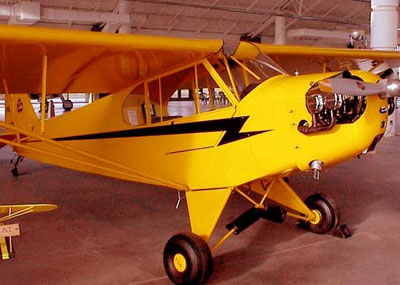
The J-3 is distinguished from its successors by the exposed cylinder heads. There are very few other examples |
|
 |
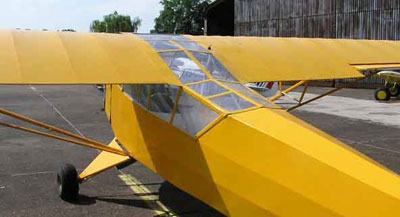 |
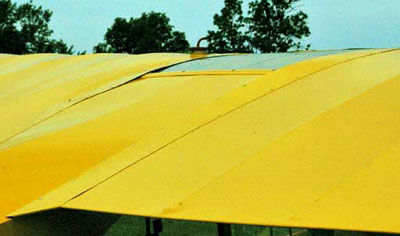
Here you can see the difference between the standard J-3 Cub and the L-4 "Grasshopper" it was basically the extra windows on the top and sides. |
|
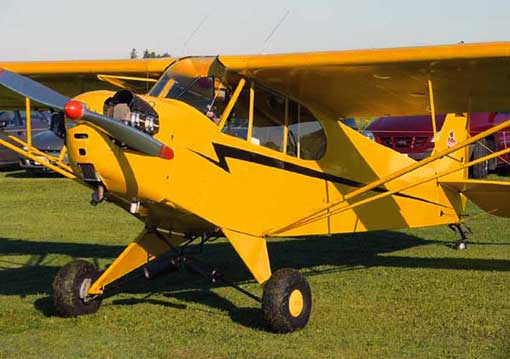 The Piper J3 Cub airplane has been a sight to behold for decades and usually attracts an audience when parked |
|
Piper J3 Cub Specifications
 |
Crew: one pilot
|
|
This repaint was designed and built by Gary Dare whose efforts as "Director of Repaints and New Model Development" are always appreciated. It will be made available for Memorial Day. |
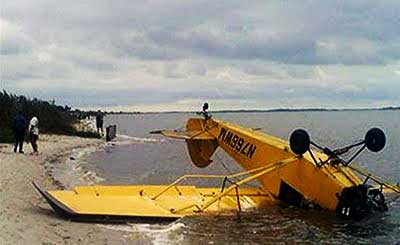 Whoops..... |
On Sunday, September 13, 2009 Thomas J. Henry, 45, of Ellicott City, MD., was flying this single-engine Piper Cub when the engine shut down. While on its way to land the plane's propeller got caught in the sand and the plane flipped over into the water. |