

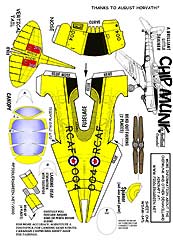
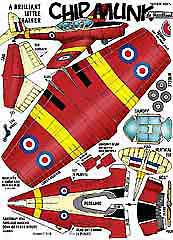
DeHavilland Chipmunk - $$5.50
The de Havilland Canada DHC-1 Chipmunk is a tandem, two-seat, single-engined primary trainer aircraft which was the standard primary trainer for the Royal Canadian Air Force, Royal Air Force and several other air forces through much of the post-Second World War years.

de Havilland DHC-1 Chipmunk
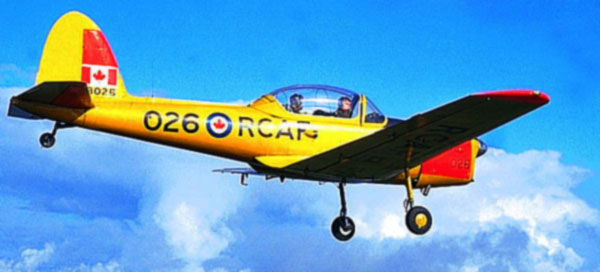
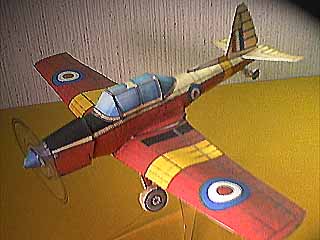
This de Havilland all metal military trainer followed the classic de Havilland Tiger Moth as a basic trainer in Canada and Great Britain. Lucky you, we just happen to have the Tiger Moth model as well.
The Cessna Model 170/172 and its immediate successors of the same family have
the double distinction of being the best-selling series of light planes of
all time, and also the most widely produced aircraft series yet developed,
well over 30,000 examples having come off the production lines by the 1980s.
The origins of the series stretch back to 1948, when Cessna introduced the
Model 170, itself little more than a four-Model 170 were improved radically,
and all subsequent Cessna aircraft of the type have been designed round similar
flaps.
In 1955 the company developed the Model 172, which was essentially a Model
172B with detail improvements and the tail wheel landing gear replaced by
a spatted tricycle unit. The improved ground safety of the new variant proved
immediately attractive, and in 1956 some 1,170 Model 172s were sold, compared
with a mere 174 of the Model 170B, whose production was terminated.
What People Say...
 |
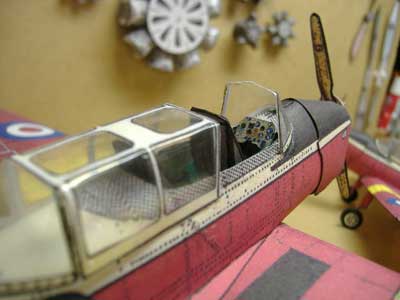 |
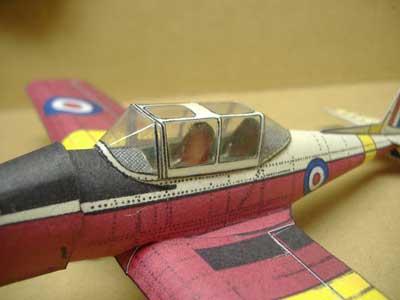
"Clear Cabin" de Havilland Chipmunk submitted by Bob Martin. Thanks Bob! |
|
This model now comes in Two Versions! Thanks to August Horvath!
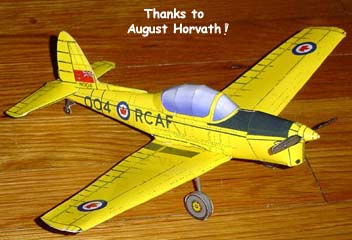
de Havilland DHC-1 Chipmunk
|
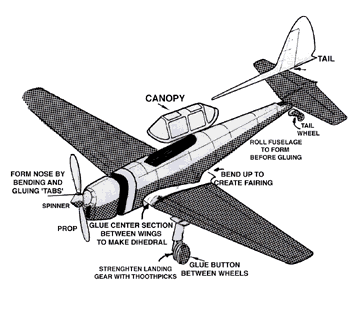
Form the fuselage around a pencil or the handle of your Exacto knife before gluing together. We've found that it's easier to glue thee cockpit to the fuselage BEFORE gluing the wings in. You can get your fingers up in to cockpit area to help it set. Be sure to place it squarely on the top of the fuselage. The wing fillets need a little attention to get them to curve outward. Do this before gluing the wings in. Glue and align the tail surfaces with the same care. The landing gear will need a toothpick to stiffen them and make a strong glue connection with the lower surface of the wing. |
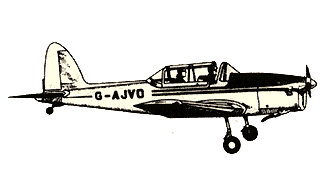
The de Havilland Canada DHC-1 Chipmunk was designed to succeed de havilland's Classic Tiger Moth biplane trainer. Flying for the first time at Downsview, Toronto on 22 May 1946, the tandem-seat stressed-skin monoplane was the first indigenous design of de Havilland Aircraft of Canada Ltd. The prototype, put through its paces by Pat Fillingham from the parent company at Hatfield, was powered by a 108-kW (145hpl de Havilland Gipsy Major 1C.
Chipmunks built to the prototype's specification were designated DHC-1B-1, while those with a Gipsy Major 10-3 were designated DHC-1B-2. Most Canadian-built Chipmunks had a bubble canopy.
Downsview built 218 Chipmunks, the last in 1951. Two were evaluated by the Aeroplane and Armament Experimental Establishment at Boscombe Down. As a result, the fully-aerobatic Chipmunk was ordered from Hatfield and Chester to Specification 8/48 as an sb initial trainer for the RAF.
The RAE received 735 Chipmunks manufactured in the UK. The first to wear RAF roundels were flown by the Oxford University Air Squadron from February 1950; thereafter, the type replaced the Tiger Moth with all 17 university air squadrons, as well as equipping many RAF Volunteer Reserve flyer, schools in the early 1950's. National service pilots underwent their initial training on the Chip, which served intermittently at the RAE College, Cranwell.
A few Chipmunks of No, 114 Squadron were pressed into service in Cyprus on internal security flights during the troubles of 1958.
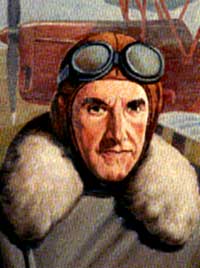 |
Geoffrey de Havilland (July 27, 1882 - May 21, 1966) Founder and Chief designer for de Havilland Aircraft Company. |
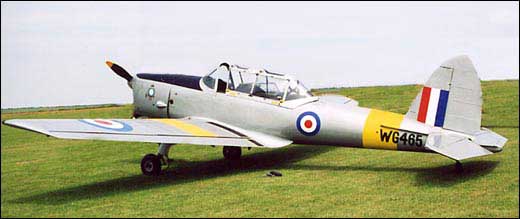
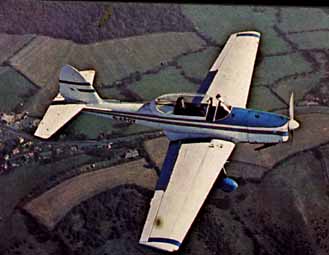
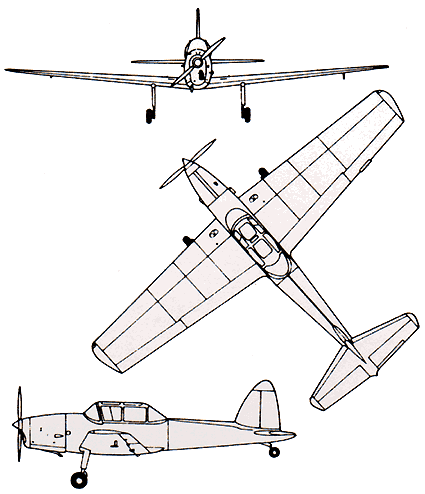
Specifications for the de Havilland DHC-1 Chipmunk
 |
Crew: 2, student & instructor
|
 |
||
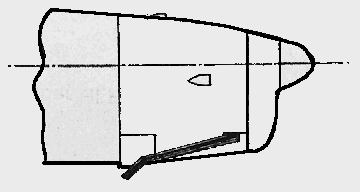
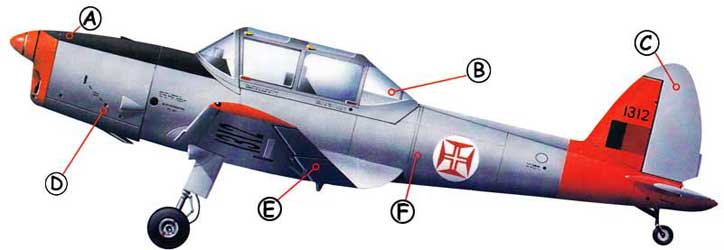
| A: The top surface of the nose was painted matt black on the Portuguese air force Chipmunks to prevent glare from the sun blinding the pilot. | B: Most Canadian Chipmunks featured a clear view blown canopy in place of the greenhouse structure of the British and Portuguese built versions | C: Following on from earlier de Havilland designs, the Chipmunk featured a classic curved tailfin and rudder. |
| D: Standard versions of the Chipmunk were powered by the de Havilland Gipsy Major engine. | E: The Chipmunk's Tapered wings were mounted at the base of the fuselage and held one 9-gallon fuel tank in each side. | F: The fuselage was of all metal stressed-skin construction. The markings on this aircraft are of the Portuguese air force. |
de Havilland DHC-1 Chipmunk
The de Havilland Canada DHC-1 Chipmunk, affectionately nicknamed "Chippie," was the first postwar aircraft designed by the Canadian subsidiary of de Havilland, first flying on May 22, 1946, as a tandem two-seat primary trainer to replace the Tiger Moth, with over 1,283 units produced until 1959 across Canada, the UK, and Portugal. Powered by a 145-hp de Havilland Gipsy Major 8 inline engine (or variants like the 145-hp Gipsy Major 10), it featured a low-wing all-metal construction, fixed tailwheel landing gear, wingspan of 10.36 meters, length of 7.75 meters, and maximum speed of 225 km/h (140 mph), with a range of 418 km and service ceiling of 15,800 feet. Adopted by the Royal Canadian Air Force (RCAF) in 1948 and the Royal Air Force (RAF) as the Chipmunk T.10 for ab initio training, it excelled in aerobatics with +6/-3 g limits and trained thousands of pilots, including Prince Philip. Variants included the civilian Mk 21, military Mk 22, and single-seat aerobatic conversions like Art Scholl's Super Chipmunk; many remain airworthy today in private hands, valued for their forgiving handling and role in aviation education. The Chipmunk's enduring legacy lies in its reliability and contribution to postwar pilot training worldwide.
de Havilland DHC-1 Chipmunk Aerobatics
Photo: Department of Civil Aviation, Australia