

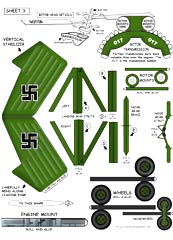
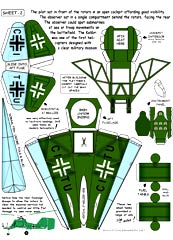
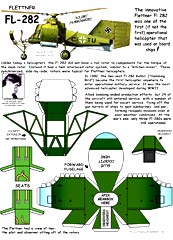
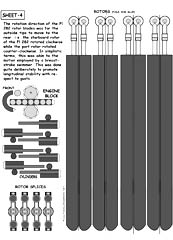
Flettner-282 - $$5.95
In Germany, Anton Flettner developed a series of helicopters using counter-rotating intermeshing rotors. In 1942, the two seat Fl 282 Kolibri ("Humming Bird") became the first helicopter anywhere to enter operational military service. It was the most advanced helicopter developed during WWII. Thanks to Aaron for distilling this pretty complex piece of machinery into a relatively easy cardmodel.

Flettner Fl-282 'Kolibri' WWII Helicopter

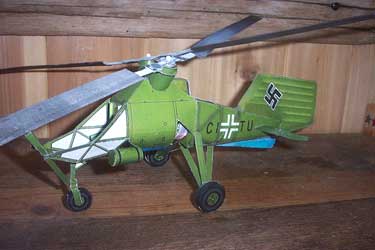
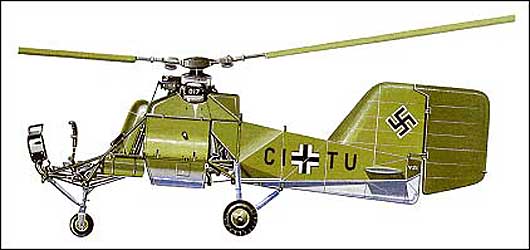 Side view of the Fletner 282 Helicopter |
The pioneer work of Anton Flettner is often overshadowed by the more publicized activities of his contemporaries Focke and Sikorsky; yet Flettner's first fully practical helicopter, the Fl 265, was far superior to the Fw 61 and made a successful free flight several months before the VS-300 began tethered flights. Look and compare the Flettner 282 to Igor Sikorsky's R-4.
Enough with the helicopters. Please have some planes for a change. Brian
Thank you again. Fiddlers Green sure makes Fridays extra special. Bob Penikas
Thanks for the Flettner, I love my magic keys, what a deal!!!! The last two friday models caught me by surprise - what another Friday already? The four month dry spell last year is already completely forgotten. This more than makes up for it!!! Keep up the fun work! Norm
A super big hats off to y'all...This is one cool series. Makes this old rotor head happy to see these birds...All significant in their
own unique way...My favorite is the Flettner nearly tied with the Hiller 44...A darned fine set...Large thanks...Wayne
Flettner FL-282 Kolibri
One of the major forces of the evolution of autogyros into
modern helicopters was Germany's Anton Flettner, whose first rotary
wing aircraft flew in 1932. Through various stages, Flettner developed
a machine which, in 1939, caught the interest of the German Navy,
who planned to use it for antisubmarine patrol. Accordingly, 30
prototypes of the new two-seat Fl 282 Kolibri were ordered immediately,
plus 15 assessment craft.
| Flettner's first rotor craft, flown in 1932, had a 2-blade rotor 100ft in diameter, with a 30hp Anzani engine mounted part of the way along each blade driving a propeller - a form of propulsion similar to that used by the Italian Vittorio Isacco on his so-called 'helicogyros' developed in the U.S.S.R. in the 1930s. The Flettner machine, unsurprisingly nicknamed 'Gigant', made a successful tethered take-off, but later overturned during a gale and was written off. | 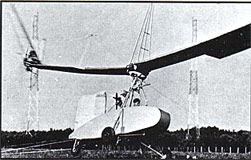 |
|
The next design was the Fl 185, whose prototype flew in 1936 and had a 3-blade main rotor. The centrally-mounted Sh.14A engine drove, in addition to the rotor, two small anti-torque propellers on outriggers each side of the cabin and a large cooling fan in the nose. |
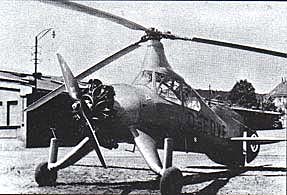
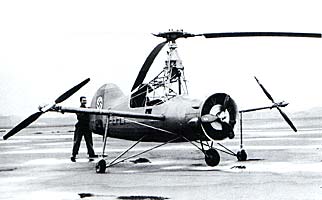
Eventually Flettner developed the idea of counter-rotating, intermeshing twin rotors. Many of his advisers thought that the airflow disturbed by the intermeshing blades would make this system less efficient than one using a single rotor; but Flettner believed that any problems thus encountered would be more than offset by the reduced drag resulting from having no external rotor-carrying structure. He proved his point by installing such a system in the Fl 265, whose prototype flew in May 1939. At this time encouragement for the development of small helicopters came mostly from the German Navy, on whose behalf six Fl 265's had been ordered in 1938 with a view to developing a machine suitable for shipboard reconnaissance |
and anti-submarine patrol. Service trials of the Fl 265 were more than satisfactory, and plans were made for series production; but by this time work was well advanced on a later model, the Fl 282, which could carry 2 men and was more versatile. This was to be the last and best version-but by now the Allied bombers were closing in on Regensburg and the factory desperately producing them.. |
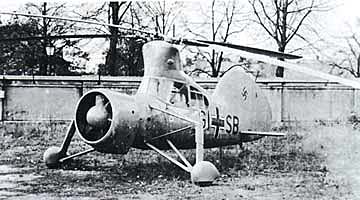
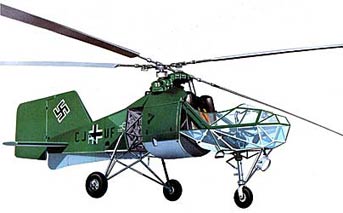
The RLM therefore agreed to wait for the Fl 282, to hasten whose development it ordered thirty prototypes and fifteen pre-production aircraft in spring 1940.The maiden flight was made in 1941. The first three prototypes were completed as single-seaters and had fully enclosed cabins made up of a series of optically flat Plexiglas panels, faired-in rotor pylons and well-contoured fuselages. The Fl 282V3 was fitted with end plate auxiliary fins and a long under-fin beneath the rear fuselage. Later machines had more utilitarian bodies and some had semi-enclosed cockpits; others had a completely open pilot's seat.
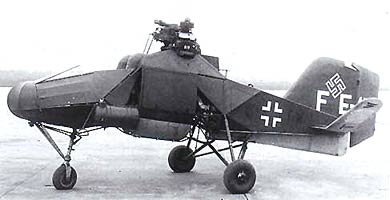 Two views of the Flettner 282 with a partially enclosed cockpit |
 |
Flettner demonstrated that the little craft could land on a ship, even in heavy seas. The German Navy (Kriegsmarine) was impressed with the Kolibri and wanted to evaluate its use for submarine spotting. Naval leaders ordered several dozen of the craft with the clear intention of mass-producing them.
The first Fl 282 flew towards the end of 1941. The Fl-282 was more highly developed and flew more hours than any other German helicopter, and very extensive tests and measurements were made of all flight aspects. Most of this test work was done by Flettner's chief pilot, Hans E. Fuisting, who also undertook blind flying and trained many of the 50 pilots who learned to fly the Fl-282.
The Fl 282 served in the Baltic, North Aegean, and Mediterranean Seas. Plans to build thousands of Kolibris were abandoned after the Flettner factories were bombed by the Allies. Only three of these helicopters survived the war; the rest were destroyed to prevent capture. Two of the survivors went to the United States and Britain, the third to the Soviet Union.
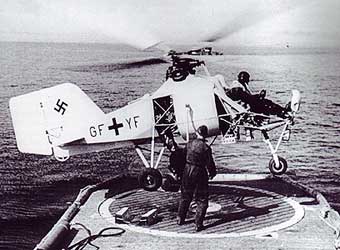 Extremely maneuverable and very stable, even in gusty conditions,
the machine could be flown hands-off in forward flight above 37
mph for indefinite periods. By 1942, the Kolibri was operational
on warships with suitable platforms, escorting convoys in the
Baltic, Mediterranean and Aegean Seas, and was thus effectively
the first military helicopter in the world.
Extremely maneuverable and very stable, even in gusty conditions,
the machine could be flown hands-off in forward flight above 37
mph for indefinite periods. By 1942, the Kolibri was operational
on warships with suitable platforms, escorting convoys in the
Baltic, Mediterranean and Aegean Seas, and was thus effectively
the first military helicopter in the world.
The helicopter was found to be especially valuable at dawn and dusk when pilots of fixed wing aircraft did not have good visual contact in the poor light. During the day observation was especially favorable in the Mediterranean where the clear water allowed the helicopter crews to 'see' submarines as deep as 130 feet.
The Fl 282 was designed so the rotor blades and landing gear could be removed and the helicopter stored in a compact area such as the pressure tank of a U-boat. There is no evidence that it was ever used this way. The helicopter pilot could match the speed and course of the submarine and radio the position to the convoy. He could also mark the sub's position with a smoke bomb. But the helicopter was too small to carry weapons, although some tests were conducted with small anti-submarine bombs. There is no accurate information on the helicopter's actual use during the war.
However, critics argued that fighter planes would easily attack the slow-flying craft. In 1941, the Navy conducted an evaluation using two fighter planes to stage a mock attack on a Fl 282. The fighters could not hold the agile helicopter in their gun sights for very long.
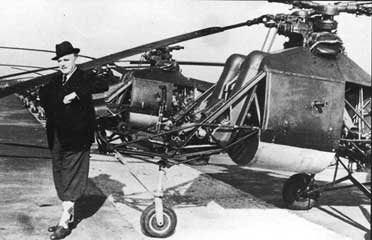 Herr Anton Flettner trying to look casual at a photo-op |
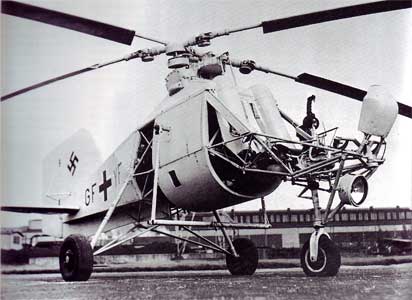 A basic gray Flettner Fl-282 parked |
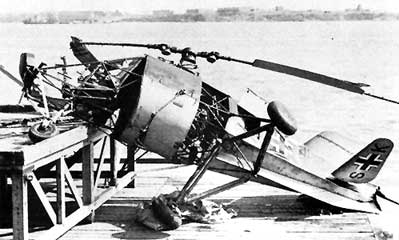
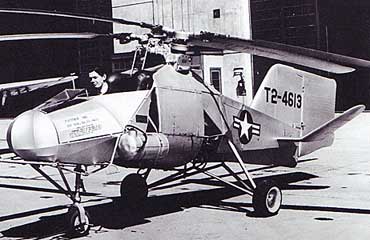 A captured Flettner 282 being used as a research test bed. |
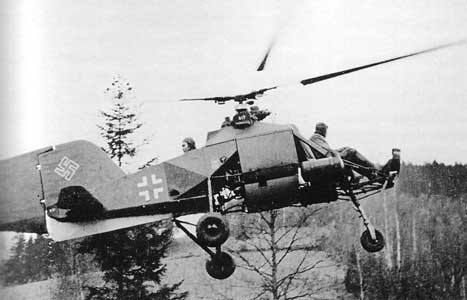
The Fl-282B had a maximum speed of 93 mph at sea level. The Fl-282B was used for such military tasks as directing artillery fire and guiding tanks over rough terrain. Beginning in 1944, the army began to implement a program to provide a helicopter to each independent artillery brigade. However, as the Allies advanced into Normandy in 1944, the Fl 282s were destroyed to prevent capture, but three were taken home as war booty by Russia and the United States.
Large Scale Flettner FL-282 model |
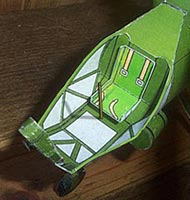 Framework can be cut out.All it takes is a little time and a steady hand |
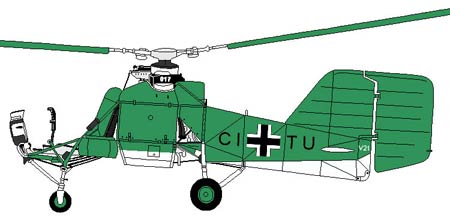
The Flettner 282 Kolibri was intended as an observation helicopter
for use on ships. To speed up development, 30 prototypes and
15 production models had been ordered almost immediately. This
dates back 1940.
The Flettner series were the first helicopters (1938) to use a system of two separate rotors counter rotating into each other. Year of design being 1938. However, there was a great difference in engine placement. The Fl 282 had a central mounted engine, a Bramo Sh 14A, with the cockpit in front of it. There were three types of cockpits: an open one, a half open one and a fully closed one (mixed usage and designated B-1 version). The observer was sitting behind the rotor, facing aft. Not every Kolibri was built as a dual seater.
In 1942, the German Kriegsmarine started testing the Kolibri
on ships. Special platforms were built on the aft sections of
either minelayers or cruisers. The Kolibries had to operate
from these platforms measuring 5 by 5 meters, while the ship
was moving. Soon it was concluded that the Kolibri was an agile
craft, also pretty stable under bad weather circumstances and
very reliable. 20 of the then built 24 prototypes were used
by the Kriegsmarine in the Mediterranean and adjacent seas,
mainly to protect convoys. The examples that had been ordered
were never built, following bombardments of the BMW and Flettner
factories. Only three prototypes remained at VE-day.
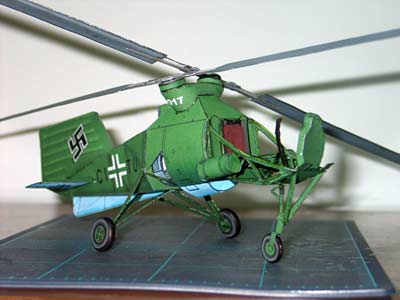 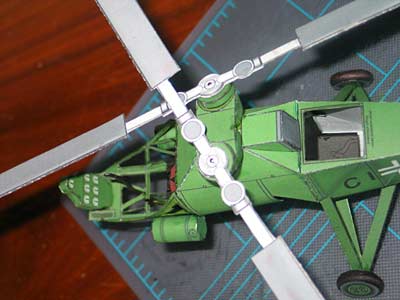 Here are some pix of the Flettner 282 Hummingbird I just finished. Just thought I would share; and say thanks. Tim Allen |
Specifications
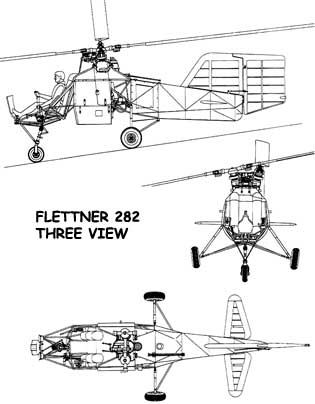 |
Payload: 840 lb |
 |
The Flettner Fl-282 was a tricky machine
to fly.. |