

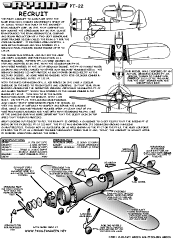
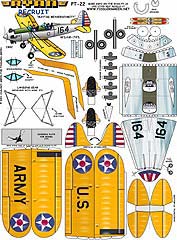
PT-22 Trainer - $$5.50
Trainers are on the Helicopter CDs. The Ryan PT-22 Recruit is a military trainer aircraft used by the United States Army Air Forces for primary pilot training. It was the first monoplane that the Army had used for primary pilot training, as all previous PT aircraft were biplanes.

Ryan PT-22 'Recruit' Trainer
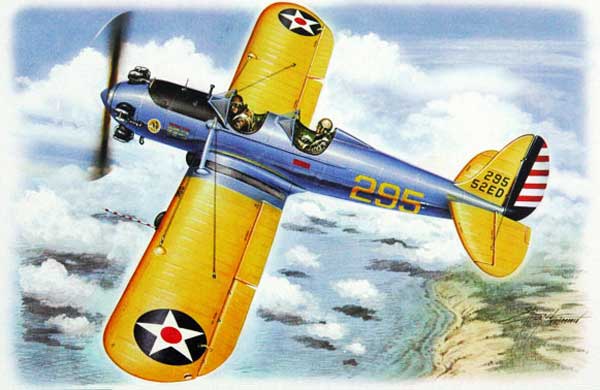
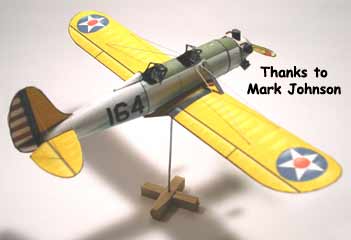
Primary trainers represented the first of three stages of military flight training--primary, basic, and advanced. Prior to 1939, the Air Corps relied entirely on biplanes as primary trainers, but in 1940 it ordered a small number of Ryan low-wing civilian trainers and designated them as PT-16s.
They were so successful that the Air Corps then ordered large numbers of improved versions, among them the PT-22. By the time production was completed in 1942, 1,023 PT-22s had been delivered.
Chauncy Green designed this model along with the P-16 ST-A version with the enclosed engine..His attention to even the smallest detail sure makes for a neat little model..I think it's his best yet... John
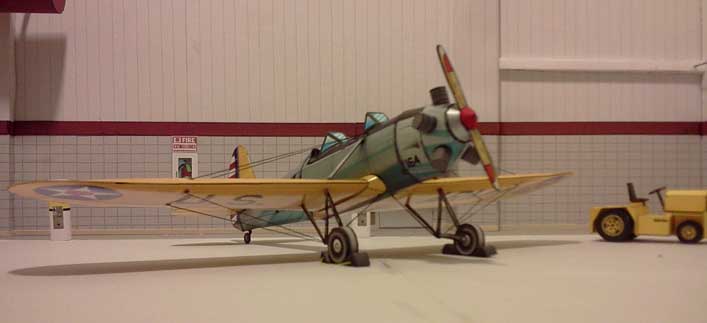
Hey there ol' buddy--I just finished the PT-22, using the Red River silver paper for the fuselage. Thanks to you and Chauncy for a fine little model! I am attaching some low res pics for your amusement. Her cousin the PT-16 is printed and ready to go.
I don't know if anybody bothers to write to you and sing praises a bit.If not, they should. You and your recently recruited help have been doing a heckuva job--and I don't mean that in the same sense as " you're doing a heckuva job, Brownie." This one's for real. The quality of your work has escalated at a furious pace--not that we can't still appreciate the artistic merits of the "old stuff." John Freeman (see below)
As the Ryan PT (primary trainer) 22 is quite a well
known aircraft I will not impose a lengthy history of it on you this
time. No promises for the future, however. The Ryan Aircraft company
was already well known because of designing and building the ship
that
Charles Lindbergh used for his famous crossing of the Atlantic. Even
though it was well known, old man Ryan decided to not concentrate
on building planes, but instead to grow his line of flying schools
and related services. However, he just couldn't stay away from the
design business, and designed the Ryan ST (sport trainer) which the
government eyed as a trainer as WWII approached. It evolved through
the PT-16 to the PT-22.
The 22 was powered by the powerful Kinner engine, whose five cylinders
protruded through the otherwise sleek cowling. Anyone who has ever
heard a plane with a Kinner engine will never forget, or ever mistake
the sound. Sounds like a kid dragging a stick along a picket fence--sort
of a pucketa-pucketa-pucketa noise.
I got my nerve up on this one and tried the Red River Metallic Silver
paper for the fuselage. I found it tough to work with for two
reasons--it is much more difficult to form than our regular stuff,
and it doesn't take as kindly to glue. With card stock I can fudge
a
bit of a compound curve here and there when necessary--not so with
this stuff. I did scrape the silver off the glue tabs, but I believe
the backing is not ordinary paper--it still didn't glue readily.
That said, it is beautiful stuff, and the flaws that I was so concerned
about sort of faded as the detail was added. I will use it again,
and no doubt get better at it with practice.
The model, of course, came from Fiddlers Green.. Thanks Chip and company
for a nice job! John Freeman
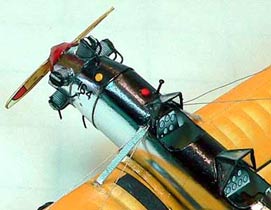 Thanks to John Freeman- this is as good as it gets! |
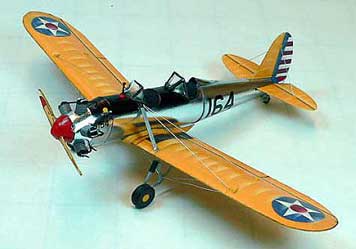 |
Ryan PT-22 Trainer
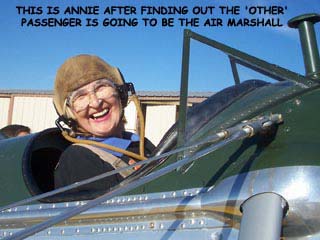 Danny Don and I made a deal.. We design a model of the PT-22 (HIS plane above), and he flies us around Chandler, AZ for a couple hours. |
Chauncy had already designed the PT-22 which is a close cousin of the PT-22 and with not much trouble we were able to come up with this great little model.. Thanks Chauncy. I owe ya one! |
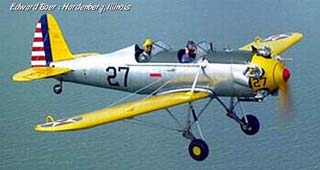 The S-T and S-T-As featured open cockpits, a slim metal fuselage
and an externally-braced wing, and were powered by a Menasco four-cylinder
inline engine of from 95 to 125 hp. The fixed landing gear was
of an
The S-T and S-T-As featured open cockpits, a slim metal fuselage
and an externally-braced wing, and were powered by a Menasco four-cylinder
inline engine of from 95 to 125 hp. The fixed landing gear was
of an 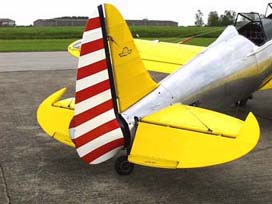 unusual "knuckled" design, which on most of the
civilian models was covered with a streamlined fairing. The design
was popular, and in 1939 the Army Air Corps acquired one S-T-A
for evaluation as a primary trainer, under the designation XPT-16.
By the late 1930s, the USAAF realized the need for monoplane primary trainers to supplement its current fleet of biplane training aircraft,
as the newer combat aircraft were all monoplanes. The XPT-16 was
in fact the first monoplane primary trainer purchased by the Air
Corps.
unusual "knuckled" design, which on most of the
civilian models was covered with a streamlined fairing. The design
was popular, and in 1939 the Army Air Corps acquired one S-T-A
for evaluation as a primary trainer, under the designation XPT-16.
By the late 1930s, the USAAF realized the need for monoplane primary trainers to supplement its current fleet of biplane training aircraft,
as the newer combat aircraft were all monoplanes. The XPT-16 was
in fact the first monoplane primary trainer purchased by the Air
Corps.
Fifteen YPT-16s were ordered in 1939 and another 30 in 1940, with the designation PT-20. Both were powered by the 125 hp Menasco engine, the PT-20 having wider cockpits and other changes to better suit military training needs. The Menasco engines did not provide as much power or reliability as the military desired, so some of the PT-20s were re-engine with five-cylinder Kinner R-440 radial engines, rated at 132 hp. The Kinner engine was also fitted to the 100 PT-21s ordered by the Air Corps in 1941 and the 100 similar NR-1 trainers for the U.S. Navy.
With the rapid expansion of U.S. air forces in 1941 came a similar increase in the need to train pilots and aircrews. In that year, Ryan received orders for the PT-22, officially named Recruit, which was powered by the larger Kinner R-540 engine of 160 hp. This was to be the major production model of the Recruit, with 1,023 built. On the PT-22, the landing gear fairing's, also called "spats" were removed from the design, as they had made it difficult to inspect and repair the landing gear. Since a military primary trainer spent at least half of its time practicing landings and take offs with beginning pilots, care of the landing gear was more important that the slight gain in top speed that the spats provided.
Ryan also built versions of the S-T series for export to other countries including China and the Netherlands. Some of the Dutch STM's were fitted with floats and saw service against the Japanese in Java and the Dutch East Indies in 1942.
 |
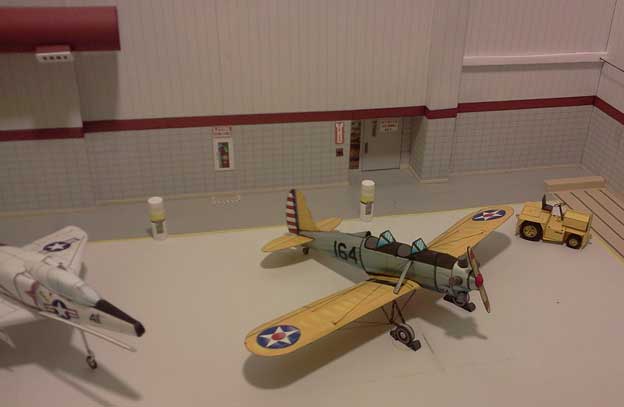 My project for now will be a series of card model photos called "AT THE HANGAR" . I planned on sharing the photos with ya , hope you don't mind. Here's the PT-22 i built this week. Carl Apr 9, 2012 |
Designer Claude Ryan became famous following the success of Charles Lindbergh's Trans-Atlantic flight. Yet, despite the fame and attention that the "Spirit of St. Louis" brought to the Ryan Aeronautical Company, Ryan decided to concentrate more on building his flight training schools rather than additional aircraft. By 1933 however, Ryan was once again designing aircraft and introduced a low-wing monoplane with fixed landing gear, the Sport-Trainer (more commonly referred to as the "Ryan ST"). The ST became a force in the home and export markets.
In 1940, with America's entrance into World War II only months away, the U.S. Army Air Corps. evaluated a ST (called the XPT 16 by the A.A.C.) and ordered 100 for use as primary trainers. Fitted with a powerful Kinner radial engine, the XPT 16 went through a number of different variants before the definitive PT 22 entered service. Considered similar in layout, the PT 22 differed from earlier versions in that it was not equipped with faired landing gear or wheel spats. A total of 1,043 PT22s were built for the A.A.C., with an additional 100 NR-1 aircraft purchased by the U.S. Navy.
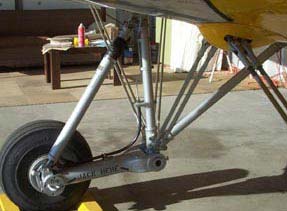 Close up of the landing gear that had to be extra rugged for the abuse form the budding pilots |
 These photos and the one of Annie above were taken the day our friend Danny took up in his P-22 |
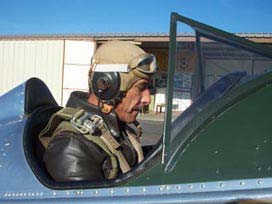 Danny Don getting ready to do a little aviation |
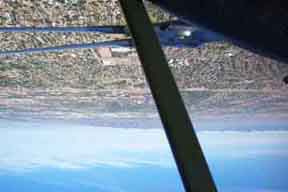 Guess what we were doing..Curiously, the gently swept wings were used to create a more unstable aircraft at landing-giving the student a taste of the larger fighter's "feel" |
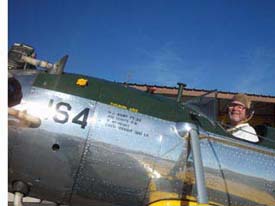 Yours truly in the 'passenger's cockpit.. |
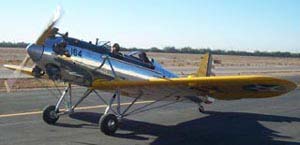 On our way back, Danny asked if I was up for an aileron roll and of course I answered Yes!! It meant going into a shallow dive but the darn thing did it..He said that it could also do a barrel roll but out of respect for the 60 year old airplane, he'd rather not.. And THIS 60+ year old would rather not too :-) |
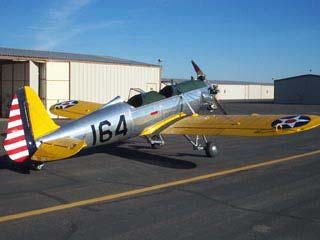
The P-22 #164 is hangered at Chandler Airport, Arizona but can
be seen at many air shows around the SW.
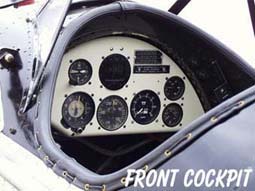 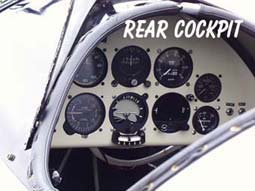 Cockpits of the Ryan PT-22 Recruit |
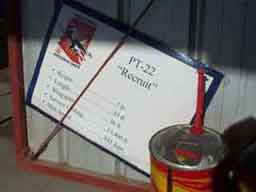
Specifications of the Ryan PT-22
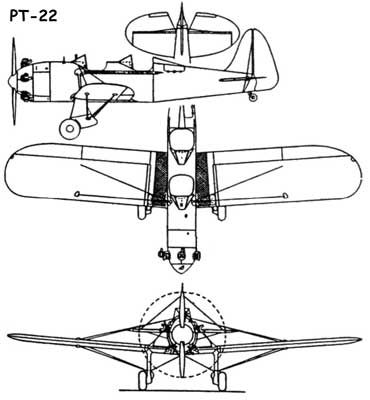 |
Crew: two (student and instructor) Length: 22 ft 7½ in Wingspan: 30 ft 1 in Height: 7 ft 2 in Max takeoff weight: 1,860 lb Powerplant: 1× Kinner R-540, 160 hp Performance Maximum speed: 125 mph Cruise speed: 100 mph Range: 205 miles Service ceiling: 15,400 ft |
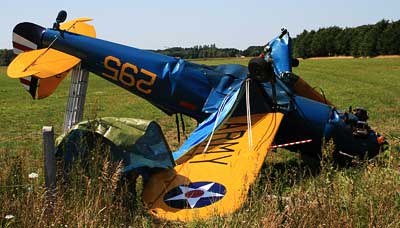 |
Ryan PT-22 Crash, both pilot and passenger were injured. |