

Mig-21 - $$5.95
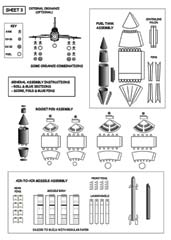
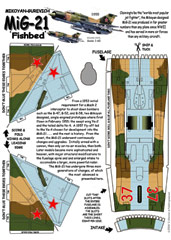
The Mikoyan-Gurevich MiG-21 is a supersonic jet fighter aircraft, designed and built by the Mikoyan-Gurevich Design Bureau in the Soviet Union. It was popularly nicknamed "balalaika", from the aircraft's planform-view resemblance to the famous Russian stringed musical instrument. Over 10,000 built !! BUT this offer is for ONE model in two scales plus ordnance and a cartooned Russian Soldier. The entire Collection of over 10 Mig-21s is available as well.

MIG-21 (Fishbed) Russian Supersonic Jet Fighter
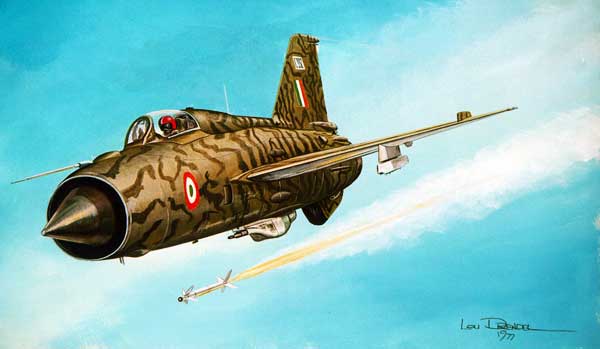
This webpage is for the single MiG-21, the MiG-21 Collection which has 14 different versions!
Click HERE to get to the MiG-21 Collection model offer.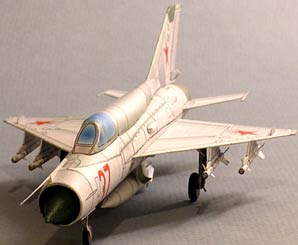
Following on from the MIG 19, the MiG-21 was Russia's first supersonic fighter. It was so successful that they eventually built more than 10,000 of them! On 16 June 1956, an attractive but unremarkable little delta-wing aircraft made its first flight. Few would have believed, that 50 years and far more than 10,000 aircraft later, the MiG-21 would still be flying..
What People Say...
Downloaded the new version of the MiG-21, very very nice, kudos to you and John Glessner. Niki Schutt
Nice job on the Mig 21 revamp, I especially like Ivan the Guard! I haven't done any building in a while, may have to change that and then put Ivan on duty in front of them.
Figured I'd just send a quick note to say good job. Stephen Gifford
|
 |
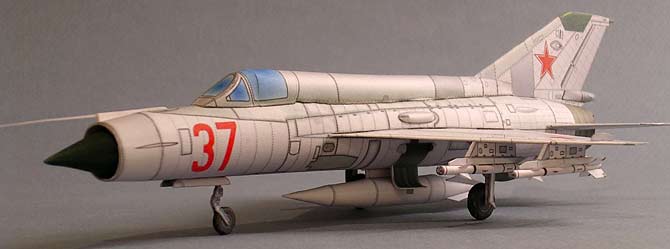 |
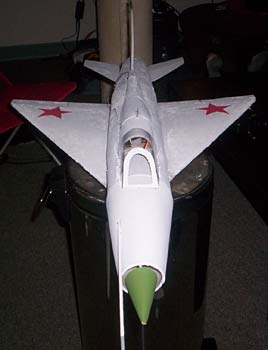
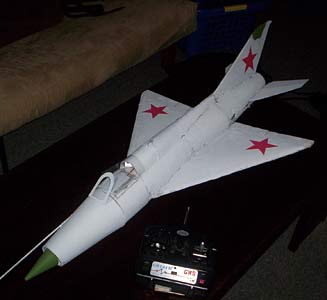
Well I finally finished the basic Mig 21 design. I am now working on camo versions (finished and included in folder). But I just had a look at your "Budding Designers" info (that is a great source of information - good for you to have it), I am somewhat of a perfectionist when it comes to card modeling. I also build a model now and then to keep my sanity during the design work.John Glessner. Nice Job John.. REAL nice!! I'd agree you're a perfectionist modeler as evidenced above! chip A couple years later, we have John's Russian Silver design as our first choice in the folder. It really should be printed out on silver cardstock available at RedRiverpaper.com. The paper is a bit pricey around a buck a sheet but well worth the extra trouble! Your Mig-21 comes either as one model or in a collection of more than 10 different versions. Included are sheets of ordnance plus a very special 'What If' fantasy Mig-21 twin fuselage design the designer, John Glessner sent along. Great conversation maker.. |
MiG-21
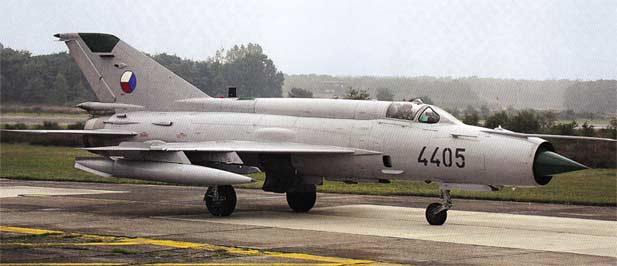
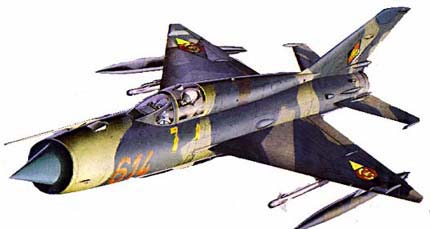 On 16 June 1956, an attractive but unremarkable little
delta-wing aircraft made its first flight. Few would have believed,
even the rapidly growing Mikoyan-Gurevich 0KB, is designers,
that 30 years and far more than 10,000 aircraft later, the MiG-21
would still be in production.
On 16 June 1956, an attractive but unremarkable little
delta-wing aircraft made its first flight. Few would have believed,
even the rapidly growing Mikoyan-Gurevich 0KB, is designers,
that 30 years and far more than 10,000 aircraft later, the MiG-21
would still be in production. Back in the mid '50s, Russian aviation technology was based firmly on their experience of the Korean War, The TsAGI, the Soviet aerodynamic research agency had formed the opinion that the best configuration for a lightweight fighter should be a delta wing with a conventional tailplane.
The Mig bureau were one of those charged with putting this theory into practice. Eventually the designers succeeded, probably beyond their wildest dreams. Yet the first aircraft, while they flew well and were relatively inexpensive to produce, were outclassed by the US fighters they were designed for combat. For a start they were under armed: the first had just two 30mm guns mounted in the wing roots, but to save weight this was changed to a single gun. Internal fuel load was a mere 2340 liters.
The first pre-production MiG-21s reached the VVS - the Soviet Air Force. In late 1958. By 1959 a K-I 3A ('AA-2 Atoll) air-to-air missile had been added to the MiG-21s extremely basic armament. This missile had a range of approximately 6.5km with a 6kg warhead, and an infra-red seeker head driving canard control fins, and was almost certainly based on the early American Sidewinder. But to carry this modest weapon the left-hand gun was usually removed to save weight.
None of this stopped other Warsaw Pact countries from ordering the MiG-21, once the Soviet Union gave them permission. Like the VVS, they were impressed with its maneuverability and its economics, and small numbers of MiG-21 Fs were made in Czechoslovakia. The same early version has been made in China as the J-7 (F-7 is the export version). The Indians, who were building up their own aircraft began to make the MiG-21themselves, in preference to any Western fighter. India traditionally would have chosen British, but Britain was insisting that fighters were obsolete and hardily trying to export any. This linked Hincustan Aeronautics with MiG fighters, and the Indian Air Force has followed with the MiG-27M and MiG-29.
One of the most marked changes in appearance came in 1960
when the addition of search radar in a much larger nosecone resulted
in the whole forward fuselage being enlarged in the MIG-21PF.
The fin was made wider (later it became 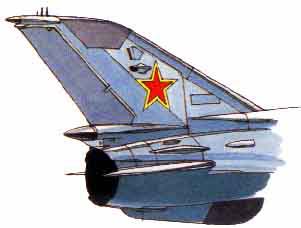 wider still). As Soviet avionics technology improved, it was fed into the
MiG-21. By 1967, the MiG-21MF, with the new R- 13 engine, was
a totally different aircraft from the one that had first flown
eleven years before. The blown flaps were perhaps Just as important
as the progressive power increases and the improved weapons. They
had a dramatic effect on reducing landing speed, and enabled the
MiG-21 to operate off much smaller airfields, The rival Mirage
Ill, could not have any flaps and landed at a much higher speed.
wider still). As Soviet avionics technology improved, it was fed into the
MiG-21. By 1967, the MiG-21MF, with the new R- 13 engine, was
a totally different aircraft from the one that had first flown
eleven years before. The blown flaps were perhaps Just as important
as the progressive power increases and the improved weapons. They
had a dramatic effect on reducing landing speed, and enabled the
MiG-21 to operate off much smaller airfields, The rival Mirage
Ill, could not have any flaps and landed at a much higher speed.
The non-stop development of the MiG-21 for 25 years rested on Tumanskiu's bureau producing a succession of new engines. The MiG-21F (F=boosted) had the R- 11F engine, and in 1961 the SPS (blown flaps) development replaced the track-mounted Fowler flaps by plain flaps blown with compressed air from the revised R- 11F25 engine.
Early MiG-21s had a unique canopy, without a separate windscreen, molded from a single giant sheet of plastic and hinged at the back When the pilot ejected, the canopy was pulled away to serve as a windshield in front of the pilot. But the MlG-2IPFMA of 1963 changed to a side-hinged canopy, separate fixed windscreen and a new ejection seat. Still more power was forthcoming from the R- 11 -300 engine. At this time an extra pair of wing pylons were added, a zero/zero seat (giving sea-level, zero-speed ejection capability) and the new GSh-23L twin-barrel guns mounted in a pack in the bottom of the fuselage.
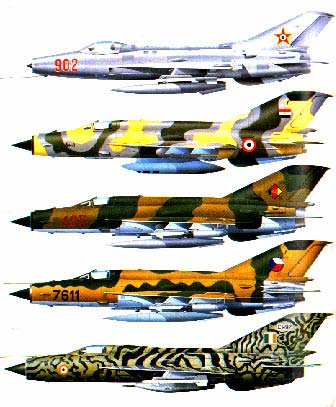
The MiG-21 designers decided they could extract still more from this already prolific airplane. They virtually started again and designed a wholly new fighter with the same shape out a new airframe with none of the compromises caused by 20 years of piecemeal changes, Called the MiG-21 bis, the latest version also has the R-25, a much more powerful yet lighter and more economical engine.
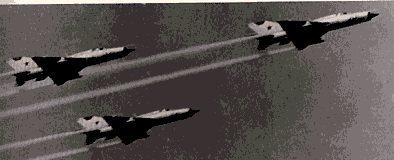 |
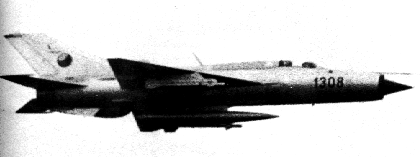 |
 |
 |
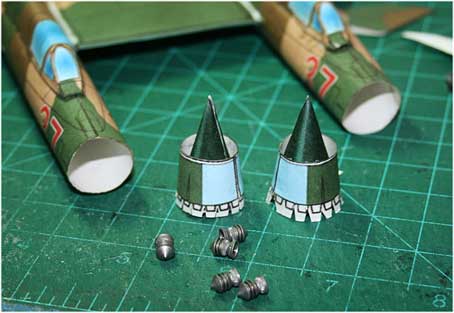
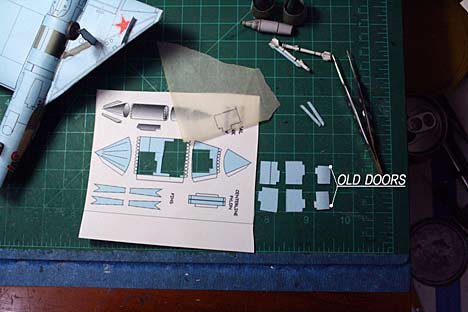 I traced the fuselage gear door openings, retraced that onto the centerline fuel tank parts page and cut out the new doors. I installed the two inner doors in a closed position, then installed the outer doors open just for more stuff to hang down. |
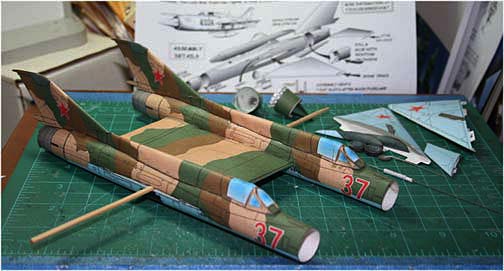 |
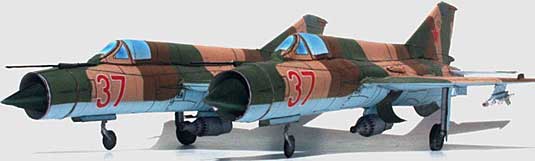
Wing span eight inches. Fuselages ten inches. Bob Penikas |
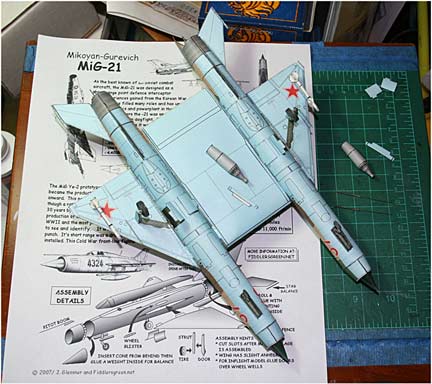 Note the doors have been fixed and are now the correct size |
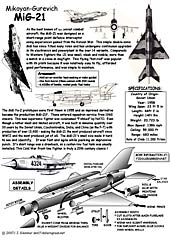
Specifications for the MiG-21F-13
|
Length: 51 ft 8.47 in (with pitot) Wingspan: 23 ft 5.66 in Height: 13 ft 5.41 in Wing area: 247.3 ft² Empty weight: 10,738 lb Gross weight: 15,650 lb Powerplant: 1 × Tumanskiy R11F-300, 8,380 lbf thrust dry, 12,650 lbf with afterburner each Performance Maximum speed: 1,385 mph Maximum speed: Mach 2.05 Range: 981 miles Service ceiling: 62,335 ft Armament 1x internal 30 mm NR-30 cannon, plus 2x K-13 or K-13A (R-3S) AAM or 2x 500 kg (1,102 lbs) of bombs |
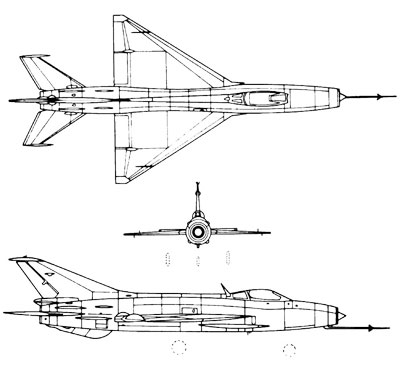
 |
|
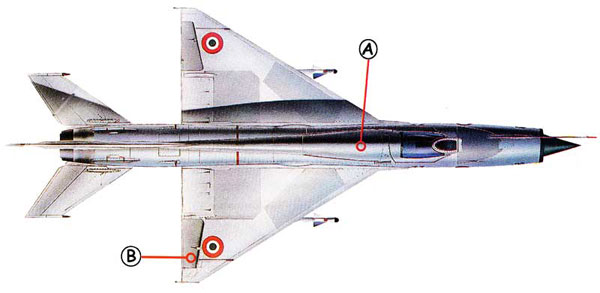
| A: The MiG-21 has been built in an amazing number of variants, including two-seaters for training. The later fighter aircraft have a large humped spine that carries extra fuel. | B: The MiG-21 was called a "tailed delta." T-configuration, combined with a powerful engine, made the fighter one of the nimblest of its era. lt was more than a match in a dogfight with the healy Phantom that opposed it in Vietnam and in the Middle East. |
 |
||
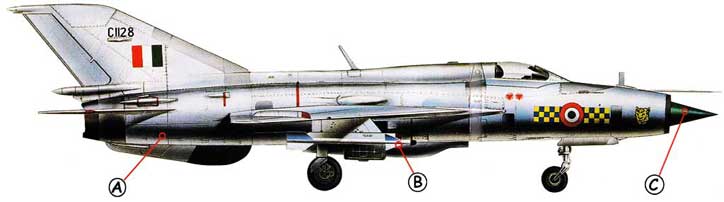
| A: Three different types of engines powered the MiG-21 through its production life, all made by MNPK Soyuz (Tumansky). | B: This version of the "Fishbed," the MiG 21FL, did not have internal guns but carried a GPI cannon pack under the fuse age with a 23-mm weapon. | C: An inlet spike on the nose augmented engine performance, especially al supersonic speeds. |
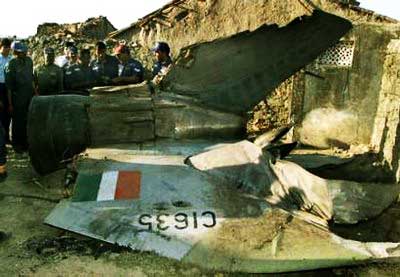 |
IAF MiG-21 crashes near Jodhpur, the pilot ejected safely, and no damage on the ground. |