

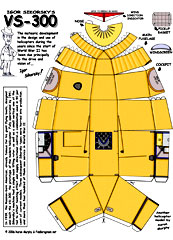
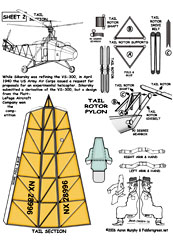
Sikorsky VS-300 - $$4.95
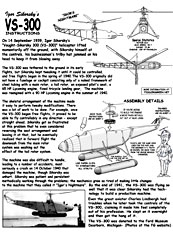
The Vought-Sikorsky VS-300 was a helicopter designed by Igor Sikorsky. Its first free (untethered) flight was on 13 May 1940. While not the first successful helicopter to fly, it was the first of the configuration that would later become the most popular.

Vought-Sikorsky VS-300 Early Helicopter
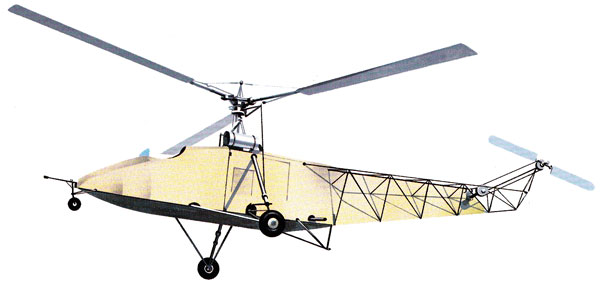
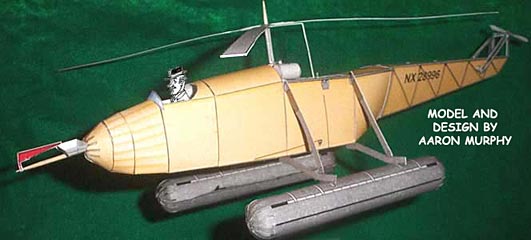
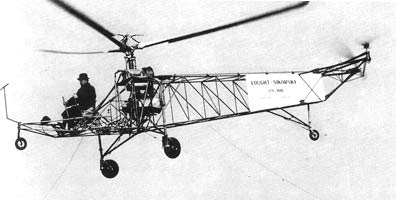
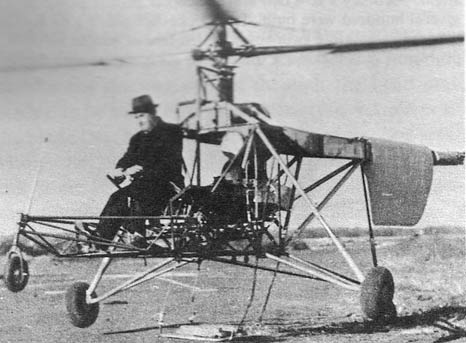
The first, tentative and tethered hover of the 1940 prototype Sikorsky VS-300 which, in May 1940, progressed to free flight. Igor Sikorsky himself, though aged fifty-nine at the time and casually attired, did all the early test flying. The skeletal VS-300 went through many forms and was not as advanced as some of the best contemporary German machines but it possessed two very large advantages: it was American and it introduced a most elegant solution to the problem of overcoming rotor torque with the now classic tail rotor.
Igor Sikorsky, who emigrated to the United States in 1919, was in the 1930s engaged in the design of the only possible form of long-distance airliners then feasihie, the Clipper flying boats. The company for whom he worked was United Aircraft Corporation (UAC). In about 1931 an early interest in helicopters returned and Sikorsky began to experiment in that little-known field. By 1938, possibly as a result of news of the flights of the Focke-Achgelis Fw 61, the UAC board appointed him to the post of engineering manager of the Vought-Sikorsky Division with a remit to develop a practical helicopter. The result, after a great deal of hard, mainly empirical, development work, was the open-framed VS-300, which first flew in free flight in May 1940 with Sikorsky himself at the controls, famously clad in an overcoat and trilby hat. The VS-300 lacked the elegant engineering of the German Flettner or Focke-Achgelis designs but it flew - just.
It is often pointed out that Sikorsky invented nothing new with the VS-300; this may be true, but he assembled the best-known techniques to produce his first practical helicopter. The main difference between the VS-300 and the German machines was Sikorsky's use of a single, three-bladed rotor with a collective pitch head and the small anti-torque propeller set at 90 degrees at the rear of the fuselage, a configuration that was to become universal. In May 1941, after no fewer than seventeen major modifications, the VS-300 was demonstrated to the US Army and Navy. An army captain, Franklin Gregory, an experienced autogyro pilot, flew the VS- 300. He found it very hard to control, describing the machine as a 'bucking bronco and difficult but possible to master, given new piloting techniques and intensive development of the helicopter's control systems.
've posted a photo and build review of that nifty Vought-Sikorsky VS-300 Helicopter at: http://www.tinpaper.net/tinpaper_sikorsky.html. Joe Golden (8/06)
Sir:
Outstanding model. I am going to build the larger version. Two points...
1. The VS300 was only silver. Though the model's color is inconsequential because printing in B&W gives a nice gray/silver appearance.
2. The VS300 had a Franklin 100 hp. This was a horizontal engine like the current Lycoming types. The R4 was the first to have a radial engine. The VS300 had a V-belt drive to the main rotor.
I am really impressed with the detail in the model.
Thomas P. Anderson
DCMA Sikorsky - ANOC
Igor Sikorsky's VS-300
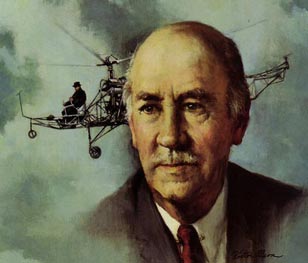 Igor
Sikorsky established a new life for himself in the U.S.A. and
founded a company which became part of United Technologies then
United Aircraft Corporation. Sikorsky had never lost interest
in the helicopter and had, in 1931, taken out a patent to cover
a helicopter with major innovations.
Igor
Sikorsky established a new life for himself in the U.S.A. and
founded a company which became part of United Technologies then
United Aircraft Corporation. Sikorsky had never lost interest
in the helicopter and had, in 1931, taken out a patent to cover
a helicopter with major innovations.
Perhaps the most important of these innovations was the selection of a single main rotor and a small vertical anti-torque rotor, though this idea was not entirely new: Achenbach, in 1874, conceived a design using an anti-torque rotor and much later, in the 1920s, the Dutchman, von Baumhauer also hit upon the concept of a single main rotor and an anti-torque secondary rotor.
As the Engineering Manager of UAC's Sikorsky Aircraft division, Igor Sikorsky approached the management in the latter part of 1938 with the recommendation that design and development should begin of a direct-lift machine. With his early helicopter experiments behind him and nearly three decades of experience in the design of aeroplanes, it could not have been too much of a surprise to the Russian emigrant when approval was given for the project.
In April 1939 Sikorsky Aircraft merged with Chance Vought to become
Vought-Sikorsky, still a division of UAC. Thus it was that Vought-Sikorsky
began a courtship with helicopters that would eventually lead
to the separation of Vought and Sikorsky and the emergence of
one of the world's greatest helicopter producers.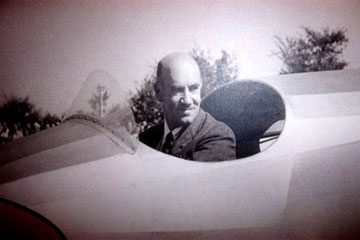
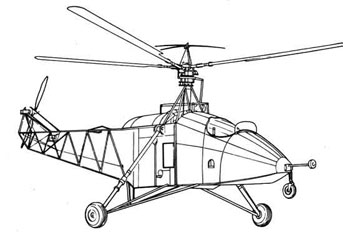
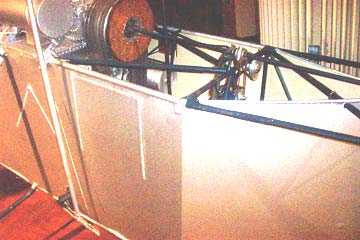
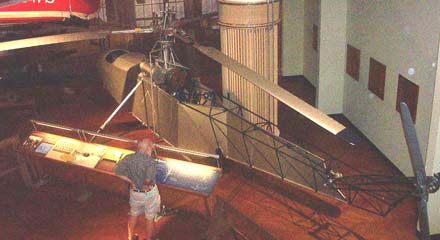
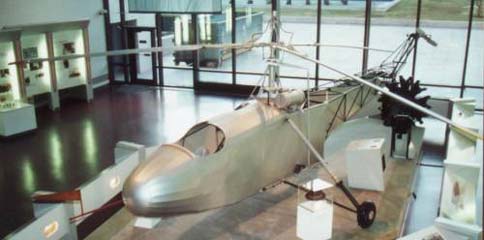
The Vought-Sikorsky VS-300 appeared in 1939 and was very different from any helicopter to be seen in Europe. The fuselage comprised an open structure of steel tubes forward and a boom aft carrying both a ventral fin and the tail rotor. On the forward structure sat the pilot, with a 75-hp Lycoming four-cylinder engine to his rear under the main rotor pylon.
The 28-foot diameter three-blade main rotor had cyclic pitch control. Sikorsky himself piloted the VS-300 on its first tethered lift-off, on 14 September 1939, and other brief tethered lifts followed in November with weights suspended from the airframe to assist stability. The lack of adequate control over flight was put down to the cyclic control system and so the VS-300 was taken away for modification.
In its revised form the VS-300 used its main rotor for lift only. The rear boom gave way to a new welded structure of steel tubes, the extreme tail of which supported a small vertical anti-torque rotor. However, slightly further forward on the open fuselage structure were attached outriggers on which two small horizontally mounted rotors provided longitudinal control (pitch in same direction) and lateral control (pitch in opposite direction).
Flying resumed and on 13 May 1940 it made its first untethered free flight to become the most successful helicopter outside Germany. In the following year the Lycoming gave way to a 90-hp Franklin engine.
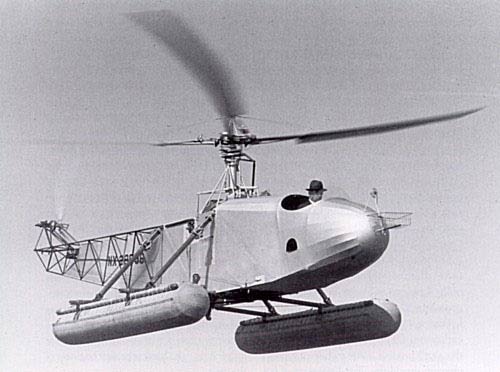
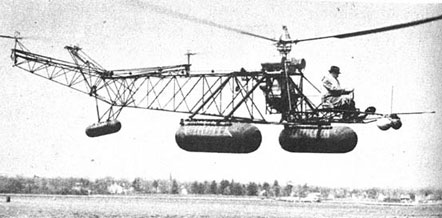
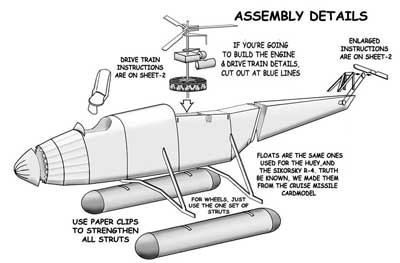
In April the VS300 donned two large rubber flotation
bags to allow a trial ascent from water. Though not the first
waterborne helicopter (Papin and Rouilly of 1915), in this form
it became the first helicopter to achieve a successful take-off
from water. On 6 May Igor Sikorsky flew the helicopter to a new
world endurance record of a little over 1 hour 32 minutes, thereby
eclipsing the German Fw 61's record.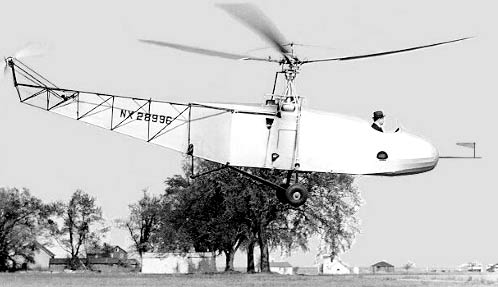
From June 1941 the VS-300 underwent important modifications: the outriggers were removed, cyclic pitch for lateral control was adopted and a horizontal tail rotor was used for longitudinal control. In December of that year a new 30.7 foot diameter rotor with full cyclic pitch control was fitted, the horizontal tail rotor removed and a vertical anti-torque rotor substituted.
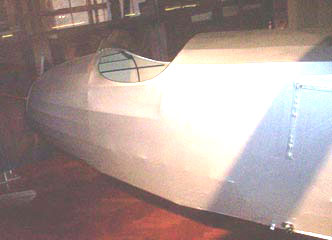
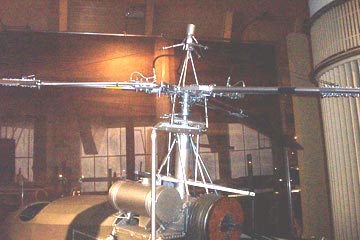
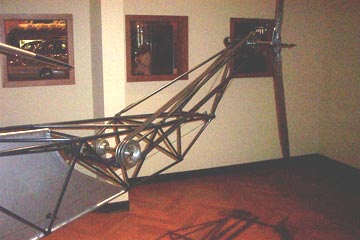
Thus the classic helicopter configuration had come into existence. Further changes to the VS-300 involved the substitution of a 150-hp Franklin engine and the use of fabric to cover part of the airframe. The VS-300 continued to fly in 1942 and in the following year was eventually retired to the Henry Ford Museum, Dearborn, MI..
Its maximum, speed and range were probably 50 mph and 75 miles respectively.
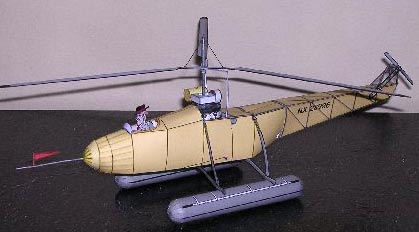
Belt
interior cut out and colored |
 |
|
I formed the rotors and added the upper suspension to hold them up. but lower not added Dennis |
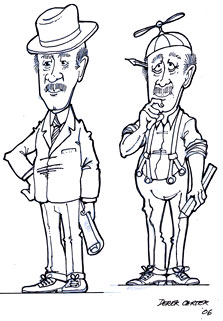
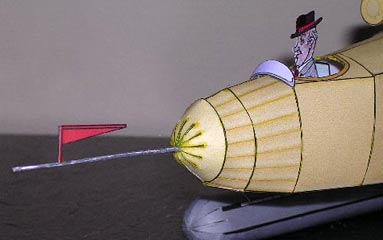 Instrument tube added ..Mr. Sikorsky and his Fedora Wooden skewer colored with silver Sharpie works well. I could not tell if the control rods went inside or outside the fuselage so opted for the cleaner look. |
|
By the way, the metal framework V-300 is the background for my Rescue Award from Sikorsky. In the early 1980's, they changed from separate certificates for each recognized rescue in a Sikorsky aircraft to one large form to which you added gold foil Sikorsky stamps. I rescued twelve people with my crews and a lot more medivac's and such. The Bell
H-13 was followed by the Schweitzer 300 as the primary trainer
for helicopters. Hughes was the last to build the 300, that
I know of. There are a lot of them in the Davis-Monthan bone
yard, others went to government agencies when it was discontinued. |
||
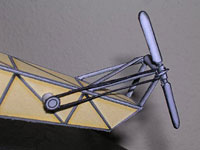
A neat article about a 1:20 scale plastic model of the VS300.
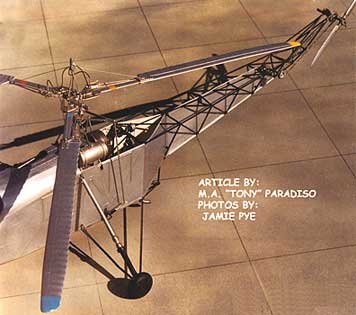 |
The pioneering VS-300A was covered with
silver doped fabric, replicated on the model with thin sheet
styrene. |
WHEN IGOR SIKORSKY'S VS-300A on flew Sept. 14, 1930,
it became the world's first helicopter. It flew for
four years, developing test data for bigger and better helicopters.
The VS-300A was retired to the Henry Ford Museum in Dearborn,
Michigan on Oct. 7, 1943. More than 500 hours were devoted to its construction, and it
was built following drawings and photos of the full-size aircraft-
everything on the model is an exacting miniature of the original. |
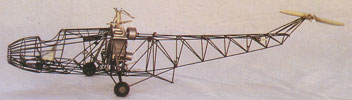 |
The builders credit their accomplishment to reference materials. Without the original plans and photos, the model would not be nearly as accurate.
|
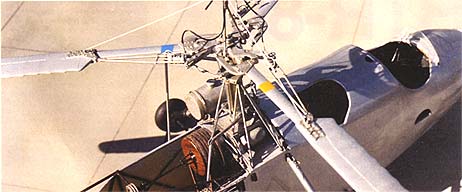 |
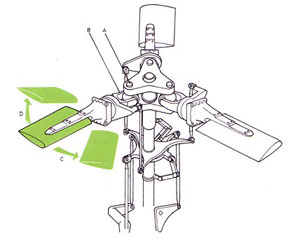
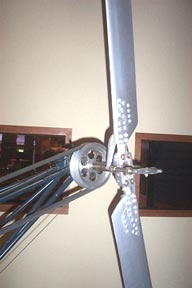
The complex rotor-head assembly and power
plant were built from styrene, with a few small pulleys obtained
from the spare parts box. |
A
short history about helicopters:
 The first studies on helicopters were well in advance
of the first airplanes. Leonardo da Vinci is credited with having
first thought of a machine for vertical flight, the "airscrew,"
the design for which, dated 1493, was only discovered in the 19th
century. It consisted of a platform surmounted by a helical screw
driven by a somewhat rudimentary system, not unlike that of rubber-powered
model aircraft.
The first studies on helicopters were well in advance
of the first airplanes. Leonardo da Vinci is credited with having
first thought of a machine for vertical flight, the "airscrew,"
the design for which, dated 1493, was only discovered in the 19th
century. It consisted of a platform surmounted by a helical screw
driven by a somewhat rudimentary system, not unlike that of rubber-powered
model aircraft.
The great Tuscan genius wrote that if this instrument in the form of a screw were well made of linen, the pores of which had been stopped with starch, it should, upon being turned sharply, rise into the air in a spiral. However his design was never put to any practical use.
The first firm historical evidence of such a machine being built
dates from 1784, when two French artisans, Launoy and Bienvenu,
devised an ingenious toy consisting of two propellers made of
birds' feathers fixed to the tips of a shaft, around which two
strings were twisted, tensioning a spring in a crossbow arrangement.
As it straightened out, the spring caused the propellers to rotate
for a few seconds, sufficient to send the toy spinning a few meters.
 The question of vertical flight was confined to drawings and more-or-less
working models for another century, but a number of people were
passionately interested in the subject. In 1842 W.H. Phillips
built a scale jet-propelled helicopter in Great Britain, and a
year later Sir George Cayley, the father of British aviation,
invented his "Aerial
Carriage" which had four "rotors"
arranged coaxially in pairs. This strange vehicle was an improvement
on other contemporary projects, but Sir George did not succeed
in finding a suitable engine, so the machine remained on the drawing
board.
The question of vertical flight was confined to drawings and more-or-less
working models for another century, but a number of people were
passionately interested in the subject. In 1842 W.H. Phillips
built a scale jet-propelled helicopter in Great Britain, and a
year later Sir George Cayley, the father of British aviation,
invented his "Aerial
Carriage" which had four "rotors"
arranged coaxially in pairs. This strange vehicle was an improvement
on other contemporary projects, but Sir George did not succeed
in finding a suitable engine, so the machine remained on the drawing
board.
Finding a satisfactory powerplant was long a fundamental problem with helicopters. At the beginning, steam engines had already been invented, but only with limited capacity and their weight:power ratio was prohibitive. Thanks, however, to the efforts of a few "aeronautical" pioneers, some designs really did fly, such as the spring-operated models by Bright (1861) and Castel (1878), and the steam-driven ones by the Frenchman Ponton d'Amcourt (1863) and the German Achenbach (1874), while Alphonse Pdnaud (1870) tested a series of models of various shapes and with various propulsion systems.
One of the most ingenious solutions was that adopted by Enrico Forlanini, who flew a model helicopter in 1877 with a pair of two-bladed, coaxial, contra-rotating rotors, using a steam engine fed by a small boiler heated by a stove which also served as a stand for the model when at rest.
The helicopter as such was still to come.
More About Igor Sikorsky:
Following his frustrated experiments in helicopters before the
First World War, Sikorsky turned his attention to fixed-wing aircraft.
He built the first multi-engine aircraft, the Sikorsky GRAND,
and then went on to the ILYA MORONETS, a great four-engine luxury
passenger airliner that looked like something out of a Jules Verne
novel; it was likely no coincidence that Sikorsky was a big fan
of Verne's writings. The name was that of a tenth-century folk
hero. When the war broke out, Sikorsky built about 79 of these
huge aircraft for the Tsarist government.
 When the Bolsheviks seized power in 1917, Sikorsky decided he
was on the wrong side of the class struggle and fled to France
in 1918. Failing to find steady work there, he went to the United
States in 1919, inspired by the work of Edison and Ford to seek
his fortune in a land where a person with "ideas of value"
might have a good chance to succeed. After a few lean years, in
1923 he and a few associates founded the Sikorsky Aero Engineering
Corporation on Long Island, New York. He finally achieved success
in 1928 with his "S-38" amphibian aircraft, which established
the Sikorsky name and associated with amphibians and flying boats
that would evolve into the great and elegant ocean-spanning Sikorsky
Clippers.
When the Bolsheviks seized power in 1917, Sikorsky decided he
was on the wrong side of the class struggle and fled to France
in 1918. Failing to find steady work there, he went to the United
States in 1919, inspired by the work of Edison and Ford to seek
his fortune in a land where a person with "ideas of value"
might have a good chance to succeed. After a few lean years, in
1923 he and a few associates founded the Sikorsky Aero Engineering
Corporation on Long Island, New York. He finally achieved success
in 1928 with his "S-38" amphibian aircraft, which established
the Sikorsky name and associated with amphibians and flying boats
that would evolve into the great and elegant ocean-spanning Sikorsky
Clippers.
In 1929, Sikorsky moved the Sikorsky Aviation Corporation to Stratford, Connecticut, where the company was soon brought under the umbrella of the giant United Aircraft holding company. Although he spent most of his time working on his seaplanes, he still tinkered with helicopter concepts in his spare time. He patented one of his designs in 1931, and by 1935, his son Sergei was building flying models of his father's helicopters, which Igor would demonstrate to his engineers or the board of United Aircraft, which by that time had become a true corporate conglomerate.
In 1938, United Aircraft, suffering under the prolonged Depression, had to shut down production at its Sikorsky division. However, in an amazingly far-sighted and generous action, the company allowed Igor Sikorsky to retain a small development team and work on a helicopter project on a low-budget basis. Sikorsky was now effectively out of the fixed-wing aircraft business and into the helicopter business
full-time; he said later: "It was a wonderful chance to relive one's life all over again." He claimed the machine would cost $30,000 USD to build. It would cost much more than that, but it would still pay off handsomely and UA management would consider it a bargain.
 |
 |
 |
 |
|
 |
Specifications for the VS-300
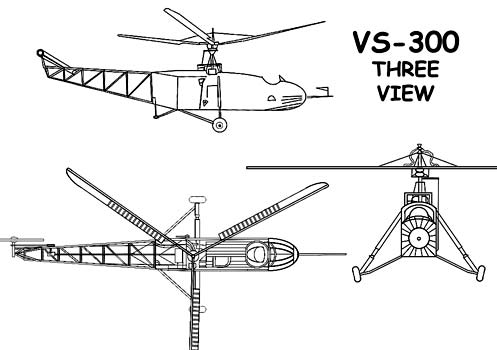 |
Length: 28 ft Rotor diameter: 30 ft Height: 10 ft Loaded weight: 1,150 lb Powerplant: 1× Franklin reciprocating piston engine, 90 hp |