

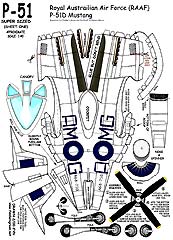

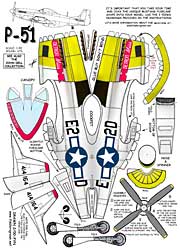

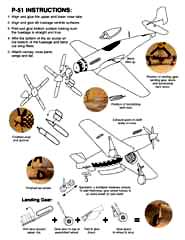
North American P-51 - $$6.50
The P-51 flew most of its wartime missions as a bomber escort in raids over Germany, helping ensure Allied air superiority from early 1944.After World War II and the Korean conflict, many Mustangs were converted for civilian use, especially air racing.

The North American P-51 Mustang
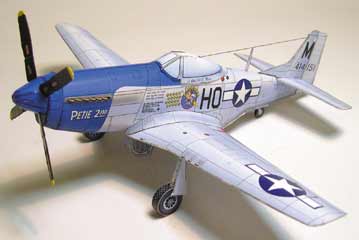
The North American P-51 Mustang was the best fighter America produced and what a fighter it was! When Reichsmarschall saw them flying over Berlin he was reported to have said that the war was over.
This webpage is for the single FG North American P-51, the North American P-51 John Dell Collection which has 15 different versions as of March, 2010.
Click HERE to get to the North American P-51 John Dell Collection model offer
(the pages will be similar)
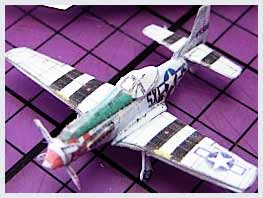
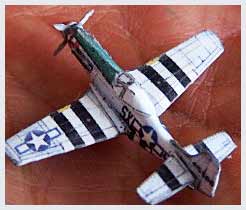
This is the North American P51 model that won the FG Modeling Madness (FGMM) 2010 best in class prize. |
|
 |
 |
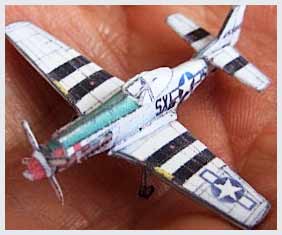 |
The P-51 is a good choice for downscaling. The model is simple enough not to lose any detail and it goes together quickly. -Chris |
 |
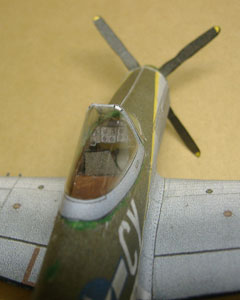 |
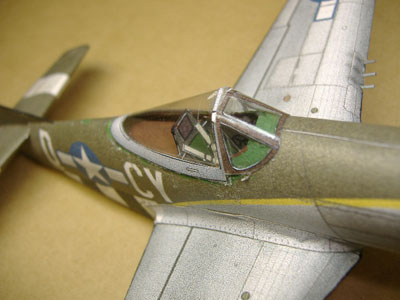
Clear Cabin North American P-51 Mustang submitted by Bob Martin. |
|
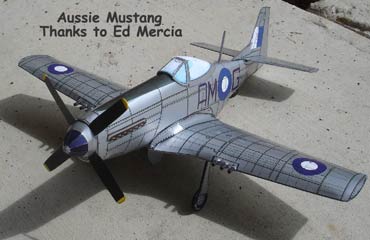 The birth could not have been more timely. Allied bombers raiding
targets deep inside Germany in daylight were having to go it alone,
and the cost in lost aircraft was cause for grave concern. When
the first of the P-51 Bs arrived in England at the end of 1943,
they were welcomed with profound relief.
The birth could not have been more timely. Allied bombers raiding
targets deep inside Germany in daylight were having to go it alone,
and the cost in lost aircraft was cause for grave concern. When
the first of the P-51 Bs arrived in England at the end of 1943,
they were welcomed with profound relief.
To facilitate long-range escort duty, this revolutionary Mustang was fitted with an extra rear-fuselage tank and with drop tanks, first of 75 US gallons and later of 108 US gallons capacity under each wing, permitting a round-trip range of about 1700 miles. This was sufficient to accompany the heavy bombers on their longest raids. Once the tanks were dropped, the P-51 Bs could deal on pretty even terms with any Bf 109 or Fw 190 or indeed any other piston-engine German fighter.
First arrivals in England of the P-51 D were met with great excitement, though careful check flights demonstrated that this new Mustang was, in fact, not quite such a good performer as the P-51 Bs already in service. It was fractionally slower to climb, about 3mph slower in level flight and directional control was not so good due to the reduced side area of the rear fuselage. A few experienced pilots preferred to stick with the previous model, but the P-51 D was fitted with an added dorsal fin which restored the aiming accuracy. Six Bazooka-type rockets, three slung under each wing, were fitted to a few P-51 s used for attack missions.
A very much more striking type was built towards the end of the war, the P-82 Twin Mustang. This extraordinary aircraft was basically two lengthened Mustangs joined together by new center wing and tail surfaces, with new landing gears. The Twin went on to become one of the standard long-range night and escort fighters of the Korean war, where three of them became the first North Korean Air Force victories. Conversely, Mustang Twins of the USAF inflicted the first losses to the other side, when several Soviet-built Yak-9s were shot down during the first two days of the conflict.
 |
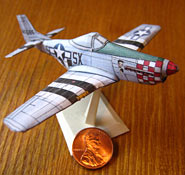 Here are the mustangs I got this weekend. The "Miss Marilyn II" is scaled as you sent it. The silver D-Day Mustang was reduced to a 1 3/4" span. FUN, FUN, FUN ! Thanks, Mike McNally |
Other types of this versatile aeroplane continued in service long after World War II was over. The USAAF and Air National Guard picked the Mustang as standard post-war piston-engine fighter-bomber. though it was not the P-51H that was selected but the mass-produced P-51 D. Called F-51 D from 1947, they saw intensive use in Korea, formed the backbone of the infant Israeli Air force and served with many other countries. Even today the USAF has supported the manufacture of new piston and turboprop Mustang versions by the Cavalier company, and the Piper Enforcer is currently flying with the USAF as an economical attack aircraft derived from the Cavalier Turbo Mustang.
Today, more than 40 years after its creation, the Mustang is one of the aircraft most avidly sought after by civilian flying buffs, and it is confidently expected that the legendary P-51 will be ranging the skies well into the next century.
P-51 Mustang
Email Letter to cardmodelling group from Wayne (Mar 00)
Have started Chip's P-51 using the "Legacy (tm)" silver metalized paper and here's a few of my up-to-this-point-in-construction observations:
As far as those rare, stray surface ( ;>) glue marks, the stuff DOES like glue and won't give it up for love or money . Gluing time seems significantly shorter than with un-coated/unprepared card-stock ("Elmer's" (tm) white glue)...Might just be my imagination...
I really like the way this paper takes a "natural" curve. The flying surfaces took an airfoil shape with little or no effort. I scored the fold lines and brought the edges together; no rolling necessary. Owing to the paper's propensity to very easily wrinkle, additional kindness is a necessity when bringing these mating edges together. Looked very realistic as far as a symmetrical airfoil is concerned. The fuselage took to the curve just as well.
This paper will take a "roll" very easily, so much so that I really didn't need to roll the paper on my foam pad (I've an old, dense-foam mouse pad that works super) While pressing the glue tabs to the back of the silvered paper by (eventually) gently rolling the tab with a dowel on my cutting pad created a slight curve. More firm pressure while rolling the back-side of the paper on my cutting mat produced a very nice, gentle curve.
Another caution when putting ANY pressure on this paper.. Make
darned sure the surface upon which you're working is SPOTLESS.
The slightest stray speck or cut mark will leave a permanent
indentation (see above...SOFT!)...I haven't tried painting this
stuff but I suspect "hiding" these imperfections
could be difficult (unless one's tempted to super-detail bullet
holes,
maintenance scratches, etc.; hmmm, rivets?)...
All in all, I really like this paper. I just need to remember to keep the rough-housing to a minimum.
Construction Tips!
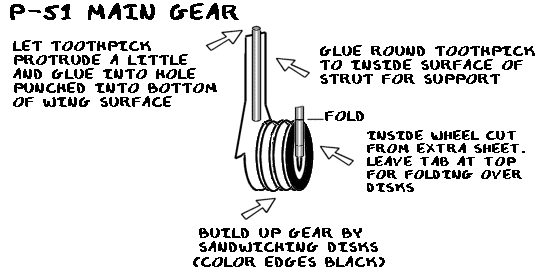
You'll find that the Mustang fuselage comes together like magic. The wing fairing's, like several others in this series, needs to be well formed before the wing is attached.
One of the neat things about Fiddlers Green Airplane models is that, basically, the assembly process is just about the same for all. Wings are best scored and folded along the leading edge and glued along the trailing edge. The mustang wings, however, are different from most of our planes because of that little forward flair at the wing root. (see below) . The procedure is just the opposite.
First, roll the upper leading edges of both wings over a round pencil or dowel to get a nice airfoil shape. THEN, GLUE ONLY THE ROOTS OF THE WINGS and let dry. You can then glue the rest of the leading edge together. Slide a ruler over the TRAILING edge to sharpen. With just a little care, the wing will take shape nicely.
The prop works well when attached with a straight pin but the clear plastic prop disk provided in the kit of 10 models is more effective. If you have bought the model singly, you can make a prop disk out of just about any 'blister' type packaging. Trace anything that 's about 13/4 inches in diameter and cut out with a scissor.
When North American Aviation offered to design a new fighter for Britain they could hardly have imagined just how successful the resulting fighter would become. It took only 17 weeks to design to produce the first prototype. It entered RAF service in April 1942 powered by the Packard built Allison engine. It wasn't until the new Merlin engine was installed that the Mustang became, arguably, the best fighter in WWII.
With 108 gallon drop tanks under the wings, the P-51 was just what Allied bombers needed for protection during daylight raids deep inside Germany. The rate of bomber losses fell sharply as more and more P-51s were delivered into service. In fact, Reichsmarschall Goering, head of the German Luftwaffe, said that when he saw these fighters over Berlin, he knew the war was lost. Total production topped 15,586!
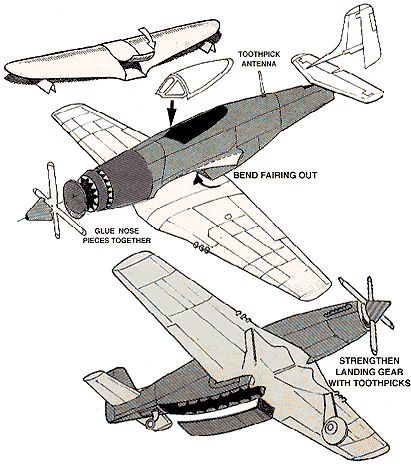
Thanks to Joe Cangero for the landing gear graphics. This is for the advanced P-51 modelers, like Joe, who want to give this classic model all the time it deserves.
Some aviation historians, and certainly those pilots who flew them, subscribe most strongly to the proposition that the North American P-51 Mustang was the greatest piston-engine fighter of World War II. Be that as it may, few, if any, aircraft had a more intriguing history.
In 1939, the British, badly in need of more combat aircraft, asked the North American Aviation company to build for them, under licence, the Curtiss Hawk 87. The Americans were willing to comply, but said they could build a new and better machine, They not only could.. they did, and they carried Out the assignment with astonishing speed. They designed, built and test-flew a prototype within 7 weeks! Considering NAA had never built a fighter before, this was an incredible feat.
When this, the first of all Mustangs (known then as the NA73X), took to the air on 26 October 1940, it was new from nose to tail. It was about the size of the Spitfire and had about the same power, yet it had heavier armament (four .50 in and four 0.30 in guns or four 20mm cannon), three times the fuel capacity and higher speed1 It had only one real drawback: the Allison engine delivered only moderate power at anything over medium altitudes. Most of the first Mustangs and USAAF P-51s and F-6s with the Allison engine were therefore used as low-level fighter, attack and reconnaissance aircraft.
In 1942 it was suggested that the altitude-limitation problem might be overcome by fitting a Rolls-Royce Merlin engine. NAA not only agreed, they did a huge amount of redesigning, and the end result exceeded all expectations. This revitalized Mustang was designated the P-51B.
The rate of bomber losses fell sharply as more and more Mustangs were delivered into service, Reichsmarschall Goering, head of the German Luftwaffe, said that when he saw these fighters over Berlin, he knew the war was lost. But still further design improvements were yet to come. The P-51s flush hinged canopy offered limited rear vision, and it was decided that a sliding bulged design of the type made by the Malcolm company in Britain would be much better. The conversion proved to be an easy one, and modifications were carried Out in the field. By spring 1944, even this had been replaced by one of the first teardrop or blister canopies.
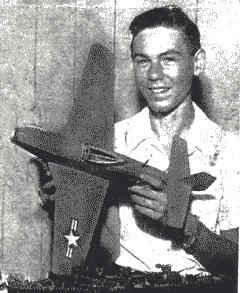
This is chip, age 15 from a newspaper
article clipping about the annual town crafts show. True to life, the star on the wing was backwards but was digitally corrected some 45 years later. Some models are NEVER finished!
The early Allison-engine version had a more restricted performance and gave of its best at altitudes below 15,000 ft. Pilots of the Royal Air Force-the service for which the aircraft was originally built-found the Allison engine dependable and smooth-running at normal speeds. This model was chiefly used for ground attack and tactical reconnaissance, the RAF still having many of the original Mustangs it had received in 1942 on operations at the end of hostilities three years later.
Wing Commander Tom Fazan, having previously flown the slow Westland Lysander spotter aircraft, anticipated that his transition to the Allison-engine Mustang might be difficult, when he took command of one of the first squadrons equipped with the type early in 1942. He later recalled that the Mustang was surprisingly docile and he always felt the aircraft was flying him and not he it. It was very stable and he particularly liked the wide track undercarriage which was a boon on the small bumpy grass aerodromes from which they generally operated. The Mustang was also a very solid aircraft; one felt the construction was good and that it would stand up to the rough and tumble of operational use very well-and it did.
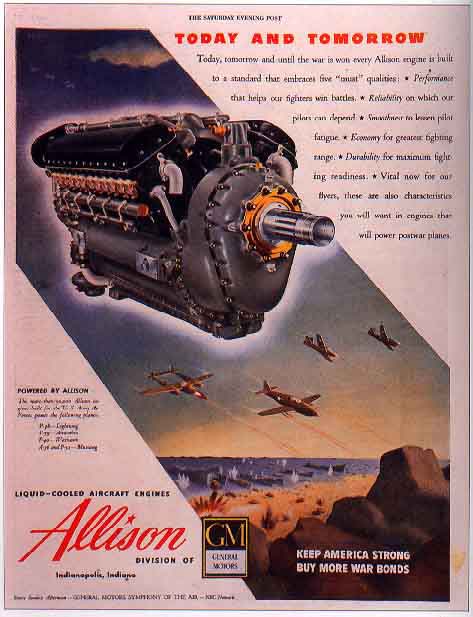
The Mustang's airframe was considerably heavier than that of most of its European contemporaries and thus it took the Packard Merlin with its two-speed, two-stage supercharger to provide the power match required. Mass-produced at two large plants, the Merlin-engine Mustang became the main USAAF fighter during the final year of World War II. While it is not surprising that such a powerful aircraft should be adapted in postwar years for racing and sport, what does say much for the inherent good design and construction of the aircraft is that, more than three decades after the last example left the production lines, nearly 60 civilian operated Mustangs are still flying in the United States alone.
The reputation of the Mustang as being 'a hot ship' led to occupancy of its cockpit becoming one of the most sought-after assignments by USAAF pilots. The cockpit was of a comfortable size, much roomier than the glove-like positions in the Spitfire or Messerschmitt Bf 109. The original 'coffin hood' type canopy restricted vision, but no more than in similar-styled contemporaries. The introduction of the so-called bubble canopy on the P-51D giving all-round visibility was a vast improvement, although its predecessors were said to be faster.
The flight controls in a Mustang were the conventional stick
and rudder pedals arrangement. All control surfaces had fibre
trim tabs adjustable by three knobs on a control pedestal installed
on the left side of the cockpit. This control pedestal also sported
the operating levers and switches for propeller pitch, fuel mixture,
throttle, landing gear and flap control. Switches on the right
side of the cockpit were for electrics, radio and oxygen supply.
There were normally 14 gauges and dials on the instrument panel,
below which were switches to operate weapons release and fuel
supply. As the two-speed, two-stage supercharger cut in automatically
with changes in altitude, operation of the Mustang was considerably
easier for the pilot than either the Republic P-47 Thunderbolt
or Lockheed P-38 with their sensitive turbo-superchargers.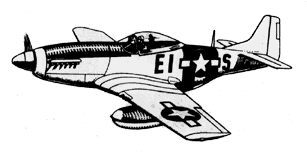
The pilot's seat was designed to accommodate either a seat or back type parachute, but the bucket had no fore or aft movement and adjustments had to be made on the rudder pedals to accommodate the very large man more comfortably. The seat could, however, be raised and this was an advantage when taxing. The back of the seat was armored and the pilot was afforded additional protection by a steel panel aft of the engine and a bullet-proof windshield in front of him.
The Mustang was such a clean design that it would quickly pick up speed in a dive and if you weren't careful you could get into compressibility. The airspeed indicator was red-lined at 500 mph but, of course, at high altitude you could be hitting the 500 figure when the dial only showed 300 mph. A lot of men got killed because they didn't compensate for altitude, got into a high speed dive at 30,000 ft or more and suddenly found the aircraft in compressibility when the pointer was still way below the red line. The Mustang was tough, but if you got into man uncontrollable dive it only took a heavy hand on the stick to shed wings and tailplane.
How a Mustang behaved in a stall depended very much on its loading. Clean and with no fuel in the rear tank the stall was fairly gentle and recovery quite comfortable. Spins in a '51 were to be avoided. Even a power-off spin was nasty, the nose snapping up and down all the time. I never got into a power spin, but understand you were lucky if you came out alive.
Chip and company,
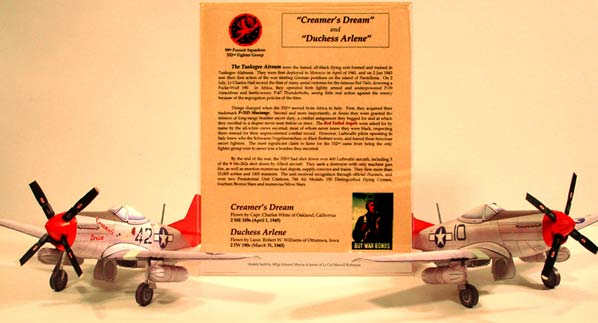
The Tuskegee Airmen were the famed, all-black flying unit formed and trained in Tuskegee Alabama. They were first deployed to Morocco in April of 1941, and on 2 June 1943 saw their first action of the war strafing German positions on the island of Pantelleria. On 2 July, Lt Charles Hall scored the first of many aerial victories for the famous Red Tails, downing a Focke-Wulf 190. In Africa, they operated both lightly armed and underpowered P-39 Airacobras and battle-weary P-47 Thunderbolts, seeing little real action against the enemy because of the segregation policies of the time.
|
Many top E.T.O. aces flew the Mustang, including
Colonel Donald Blakeslee (15 victories) and C.O. of the famous 4th Fighter Group (which destroyed over
1,000 German aircraft, more than any other American fighter group in WW II), Captain Don Gentile
(35 victories), Captain John Godfrey (31 victories), and Chuck Yeager (who later broke the sound barrier in the Bell X-1, and ended his military career as a Brigadier General). Also Colonel
Eagleston (23 victories), commander of the 354th Fighter Group of the Ninth Tactical Air Force, and top
ace of the 9th. Also in the 9th was
Major James Howard, the only American ace in both theaters of
the war (6 victories in China flying P-40's, and 6 victories in Europe flying P-51's).
This glorious airplane came about when the British contacted North American Aviation in 1940, with a request to build fighters for the RAF. North American was willing, but the Spitfire was not well suited to NAA production techniques, so they offered to design and build a new fighter that would meet British requirements, and be easier to mass produce. The British accepted and the rest, as they say, is history. In only 100 days NAA rolled out the first prototype Mustang. By November 1941, the first of over 600 aircraft produced under British contract were delivered to the RAF.
The streamlined new fighter incorporated some
advanced ideas, in particular a laminar flow wing of thin cross section, which allowed the Mustang to avoid most of
the "compressibility" dive problems that plagued many other high performance fighters of the time.
Two of the first ten Mustangs built
were taken to Wright Field, at Dayton Ohio, for testing by the
AAF, which designated them XP-51.
It was hoped to use the Rolls Royce Merlin engine
in the new fighter, but British engine production was not adequate, so the inferior 1,150 hp. Allison F-series V-12
was substituted in the early Mustang models. This resulted in poor high altitude performance, so the
RAF used their Mustang I (P-51) and II
(P-51A) models for low altitude ground attack and reconnaissance
duties. These they performed very well.
The Mustang I had a top speed of 370 m.p.h. at
15,000 ft. Best climb at 11,300 ft. was 1,980 ft/min. An assortment of .30 and .50 caliber machine guns were carried,
but the Mustang IA was armed with 4-20mm cannon. Handling and maneuverability were good. Like the
FW 190, the P-51 was a pilot's
airplane.
P-51A (Mustang II) production was divided between
America and Britain. This model standardized armament as 4-.50 cal MG. (two per wing). There were ground attack
versions of the P 51A in U.S. service, designated A-36A, which served the AAF in the North African
campaign. There were also
specialized photo reconnaissance versions of all major Mustang
models, the F-6 series.
The decision was made to mass produce the outstanding
Merlin engine under license in the United States. The P-51B and C models (Mustang III in British service),
which entered service in December of 1943, were powered by the new Packard-built version of the
Merlin V-12, driving a four bladed
propeller. At the same time, the airframe was strengthened, the
radiator was re-designed, the ailerons were improved, and racks for long range drop tanks or bombs were
added under the wings.
This new engine completely changed the character
of the Mustang, and resulted in what was probably the best all around piston-engine fighter of WW II. It came at
a crucial moment for the AAF daylight bombing campaign. Luftwaffe fighters had taken such a toll of
un-escorted heavy bombers that the
losses were becoming un-supportable. The great range of the P-51B-7
(which also carried drop tanks), allowed it to escort the heavy bombers all the way to their targets
deep inside Germany. In March of 1944, Mustangs went all the way to Berlin. Eighth Air Force bomber
losses plummeted, while
Luftwaffe fighter losses skyrocketed.
The 1,450 hp. Packard/Merlin engine (1,595 hp.
war emergency rating) gave the P-51B-7 a top speed of 445 m.p.h. Best climb was 3,320 ft/min at 10,000 ft. The new
Mustang carried 4-.50 caliber MG (two per wing), and up to 1,000 lb.. of external stores. Its range
was an astounding 2,200 miles with
two 150 gal. drop tanks. Endurance with drop tanks was 8.7 hours.
As 1944 progressed, things continued to get worse
for the Germans. The improved Republic P-47D model arrived with greatly increased range (2,100 miles with drop
tanks), and so did the definitive Lockheed P-38L model, with even greater maximum range than the
single engine fighters. Now the
Luftwaffe was often outnumbered over its own homeland. For the
German fighter force, the end was at hand.
Later in 1944, the P-51D model arrived. This became the most famous Mustang of them all. It sported a "tear drop" canopy for better all around vision, and a more powerful 1,790 hp. version of the Packard/Merlin engine, along with many detail improvements. Maximum speed was still about 445 m.p.h., and the armament was increased to 6-.50 caliber wing MG. All manner of external stores could be carried. Reconnaissance versions were also produced. Recognition of the D model is easy, because of its teardrop canopy and the large fillet fin added in front of the vertical stabilizer.
The final major production version of the Mustang was the P-51H. This re-designed model incorporated major improvements, as extensive in scope as those incorporated into the FW 190D or Spitfire Mk. 22. It was based on the experimental lightweight F and G versions. These were attempts to build extremely long range Mustangs for escort work in the Pacific War.
In the H model, the structure was increased in strength by 10%, to allow higher "g" loads in combat maneuvers. No structural part was left in common with earlier models. The Mustang, already more maneuverable than most of the enemy fighters it faced, could now pull even tighter turns. Also, the canopy was raised for better visibility, the ailerons were altered to improve the roll rate, the wing was re-designed for greater lift and less drag, radiator fairing contours were improved, and the tail was re-designed for greater strength and more surface area.
This last change is easily visible, as the size of the vertical stabilizers fin fillet was greatly reduced. Streamlining was improved to increase speed, and stability was improved. A new version of the Packard/Merlin, incorporating water injection, delivered over 2000 hp. All of these changes resulted in the finest American fighter of the war. The H model saw combat in the Pacific in 1945, toward the end of the war. Speed was 486 m.p.h. at 30,000 ft. best climb rate was 5,350 ft/min. at 5,000 ft. Service ceiling was 41,600 ft.
Unlike most other American piston engine fighters, which were withdrawn from service soon after the end of WW II, the Mustang fought on, doing valuable ground support work in the Korean War. It was adopted by many other nations, too numerous to list here, and remained in service in some countries into the 1960's. The following specifications are for the famous D model of 1944.
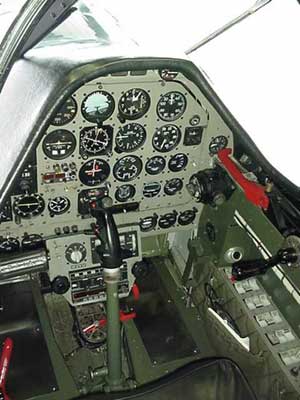 |
North American P-51 Mustang Cockpit. |
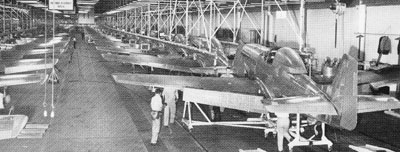 |
North American P-51 Mustang Factory. |
Specifications for the North American P-51
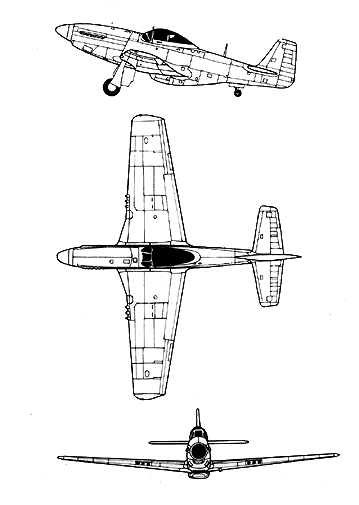 |
Length: 32 ft 3 in Wingspan: 37 ft Height: 13 ft 8 in Wing area: 235 ft² Empty weight: 7,635 lb Loaded weight: 9,200 lb Max takeoff weight: 12,100 lb Powerplant: 1× Packard V-1650-7 liquid-cooled supercharged V-12, 1,490 hp at 3,000 rpm; 1,720 hp at WEP Zero-lift drag coefficient: 0.0163 Drag area: 3.80 ft² Aspect ratio: 5.83 Performance Maximum speed: 437 mph at 25,000 ft Cruise speed: 362 mph Stall speed: 100 mph Range: 1,650 mi with external tanks Service ceiling: 41,900 ft Rate of climb: 3,200 ft/min Wing loading: 39 lb/ft² Power/mass: 0.18 hp/lb Lift-to-drag ratio: 14.6 Recommended Mach limit 0.8 Armament 6 × 0.50 in (12.7 mm) machine guns; 400 rounds per inboard gun; 270 per outboard gun 2 × hardpoints for up to 2,000 lb of bombs 10 × 5 in rockets |
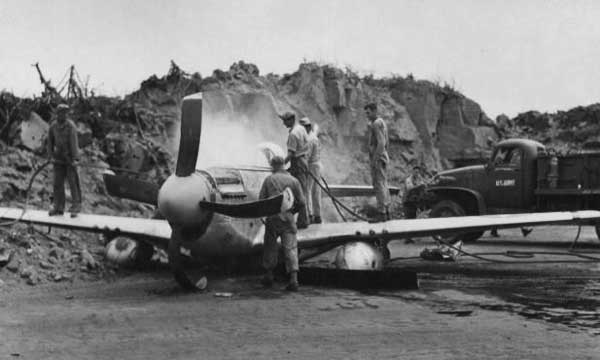 |
As the North American P-51 "Little Angel" was taking off from Central Airfield #2 for a fighter escort mission over Tokyo, Japan, the engine "conked out";
when the plane hit the ground, the pilot pulled up the landing gear to prevent overshooting the runway. Firefighters from the 363rd Air Service Group,
12 April 1945, Iwo Jima, Bonin Islands. |
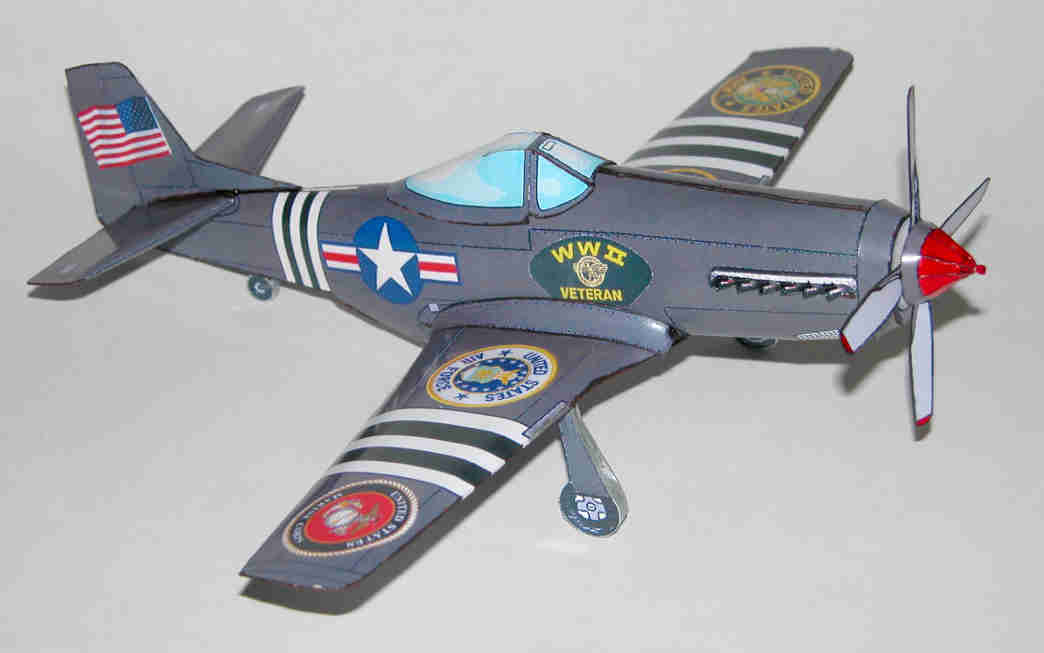 |
This repaint was designed and built by Gary Dare whose efforts as "Director of Repaints and New Model Development" are always appreciated. It will be made available for Memorial Day. |